FSMA PSR Qualified Exempt? Keep Up with Your Paperwork!

If your farm is considered qualified exempt from the FSMA Produce Safety Rule you have probably needed to provide paperwork to the NJDA at least once.  Farms should be reviewing and updating their documentation that proves qualified exemption status annually and be prepared to show this again to the NJDA when required. Guidance and template forms are available online. Need a refresher on what a qualified exemption is? See below!

Under the FDA Food Safety Modernization Act (FSMA) Produce Safety Rule, farms are eligible for a qualified exemption and associated modified requirements if they meet certain criteria:

The farm’s food sales averaged less than $610,182 (adjusted for inflation) per year during 2020-2022; and
The average value of the farm’s sales to qualified end-users exceeded the average value of the farm’s sales to all others during the previous three years. A qualified end-user is either (a) the consumer of the food or (b) a restaurant or retail food establishment that is located in the same state or the same Indian reservation as the farm or not more than 275 miles away.
Because of COVID-19, state and local governments across the United States had instituted public health orders that resulted in many restaurants and retail food establishments either closing or significantly limiting their operations, leaving many farmers without their usual buyers during the 2020-2022 period. The guidance intends to allow affected farmers to shift their sales away from qualified end-users while still being considered eligible for the qualified exemption. Specifically, under the temporary policy announced in the guidance, farms that are currently eligible for the qualified exemption and associated modified requirements will still be considered eligible, even if they shift sales away from qualified end-users, so long as they continue to meet the requirement that their average food sales during the previous three years total less than $610,182 (adjusted for inflation). This temporary policy is intended to remain in effect only for the duration of the public health emergency, after which the FDA intends to issue additional guidance.

Qualified exempt farms must comply with modified requirements under the Produce Safety Rule, which include establishing and keeping certain records and prominently displaying their name and business address on food packaging or at the point of sale. Farms are responsible for ensuring that the food they produce is not adulterated under the Federal Food, Drug, and Cosmetic Act (FD&C Act) and they should use good agricultural practices to ensure the safety of their produce.

Produce Safety Planning Workshops for Beginning Farmers

This fall the Rutgers On-Farm Food Safety Team is rolling out two brand new classes as part of our From the Ground Up initiative to support new farmers and all small-medium size farms. Our goal in creating these two complementary programs is to give farmers the power to achieve success in food safety and business.

On Wednesday September 27, 2023, we will be debuting the new class called “From the Ground Up: Produce Safety Planning for Beginning Farmers” held at the Rutgers Specialty Crop Research and Extension Center in Cream Ridge, NJ from 10:00am to 2:00pm. We designed this class to allow farmers to set themselves up for success in on-farm produce safety from the beginning, instead of having to go back later to correct infrastructure, systems, or training. A farm that has a well-established food safety culture is better able to meet market demands and consider production changes when planning for the future. Plan for your worker training needs, learn how to identify and reduce risk, and make a portable handwashing station to take home with you. Registration is $30.00 and includes lunch. Everyone who registers will get a voucher to attend our online “Food Safety Plan Writing Workshop” in October 2023 for free.

On Wednesday October 18th 2023, we will be holding our first Online Food Safety Plan Workshop from 6:00pm – 8:00pm Eastern Time via Zoom. The two-hour writing workshop will guide farmers through the step-by-step process of writing the plan best suited for their operation. All attendees will receive a customizable template to work with. A food safety plan can be used to standardize and streamline the training of new employees. This saves time in training and guarantees all members of a farm’s team take the same actions under the same circumstances. Having an on-farm food safety plan can guide farmers’ actions around food safety, forecast risk, serve as a worker training tool, and aid with overall organization.
Registration is $15.00 and free for everyone who attended our September 2023 program in Cream Ridge, NJ.

Follow these links to register and learn more about each class:
“From the Ground Up: Produce Safety Planning for Beginning Farmers”, Wednesday September 27, 2023, Cream Ridge, NJ, 10:00am – 2:00pm Eastern Time
“Online Food Safety Plan Workshop”, via Zoom, Wednesday October 18th 2023, 6:00pm – 8:00pm Eastern Time

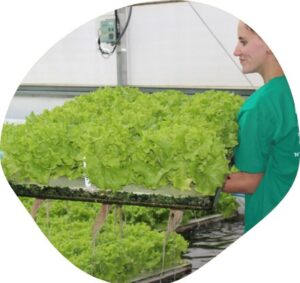
Webinar: Managing Food Safety Risks in Hydroponic Operations

Incorporate food safety into your hydroponics setup and worker training.

August, 17, 2023 12:00 – 1:00 p.m. Free!
Register online
You will get the link to sign on or call in a few days before the event.

Hydroponic growers use a variety of methods to grow, harvest, and pack produce. This webinar will focus on general best practices in the hydroponic growing environment to reduce the risk of human pathogen growth and spread.
This webinar will focus on risk assessment and management through:
1. Appropriate worker training
2. Evaluation of growing and harvest processes
3. Identification of food contact surfaces
4. Development of a cleaning and sanitation process

United States Department of Agriculture (USDA) Changes to Audit Costs

USDA has just announced that proposed audit fees for the Harmonized and GAP/GHP audits will increase to $155 per hour. The average Harmonized Audit runs anywhere from 12 to 15 hours, GAP/GHP audits average 5 to 10 hours. The current fee is $132 per hour. For anyone who needs an audit try to schedule before October 1, 2023 when the new rates take effect.  For further information or discuss the proposed increases contact:  Melissa Bailey, Associate Administrator, AMS, USDA, Room 2036–S, 1400 Independence Ave. SW, Washington, DC 20250; telephone (202) 205–9356, or email melissa.bailey@usda.gov.

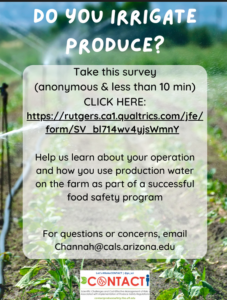
Your Input Needed on Preharvest Water use in Produce

Do you irrigate produce?Survey link
Have questions about Subpart E or agricultural water?

The On-Farm Food Safety Team is involved in a national survey to find out:

  • Does the produce industry understand the rule?
  • What areas of the rule are still unclear to the industry.
  • How preharvest water is used and treated on farms across the U.S.

This survey will help us get a better understanding of what you know and how extension educators can assist the industry. Please take a few minutes and fill out the survey by clicking on the image to the right.

Organic Grower Advisory 3/7 Registration Open

The Rutgers Organic Grower Advisory meeting will be held on March 7th. This meeting has served to increase communication between commercial farms using organic practices and Rutgers Cooperative Extension agricultural agents and specialists. This year the meeting will be held both in-person and online. We have a AV system that will allow for better sound quality for all participants. Please see details below, and use the Qualtrics link to register if you plan to attend.

March 7th 10:00 – 2:00
Rutgers Cooperative Extension of Mercer County
1440 Parkside Avenue, Ewing NJ 08638
OR Online via Zoom

In-person attendees will have a pizza lunch option at a cost of $5.00 per person, payable at the door.

Registration deadline is March 3rd, register here!

Examples of hot topics for discussion from the 2021 Organic Grower Advisory meeting are:
• Weed control updates
• Organic animal feed
• Allium leaf miner
• Spotted lanternfly
• Organic sweet corn
• Disease control
• Organic certifications