Preparing Orchards Against the Frost – Low Tech Strategies

Frost is common in the northeastern US. However, frost events during bloom, specifically in orchard crops, can be economically devastating. Often, the cause is a few hours below the injury threshold temperature for the developing buds, as cooler nights result in the rapid loss of thermal energy. Several passive or low-tech strategies can help maintain a slightly higher orchard floor temperature and potentially prevent substantial crop loss.

Site selection is the most effective frost protection method. When planning a new orchard, selecting a site with proper cold air drainage is the most valuable decision a grower can make and enjoy the rewards for many years. Cold air drainage is essential, so avoid buying a site or planting trees on the site that accumulate cold air. Also, identify areas where the cold air moves in and out. When possible, plant early blooming varieties in the least frost-prone areas and plant delayed and or extended bloom varieties in frost-prone areas.

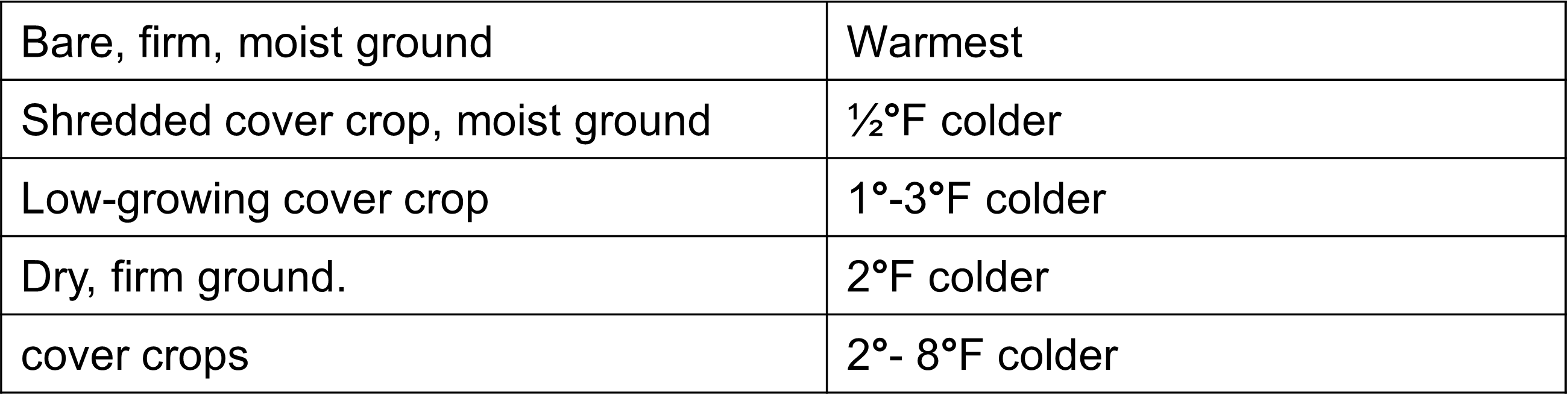
Table 1. Relative temperature differences are influenced by orchard floor conditions (Courtesy, Robert Crassweller, PSU).

Do not invite the frost with excess vegetation and ground cover. The management of weeds along the row and sod between the rows will influence orchard temperatures. The bare ground will absorb more heat during the day and release more heat at night than soil covered in vegetation (Table 1). During the day, 45-50% of solar radiation gets reflected or absorbed by the atmosphere, and the earth absorbs the remaining 50-55%. Vegetation reduces this heat transfer to the soil because it reflects light before it can reach the soil surface. Removing tall weeds and windbreaks along the edges of orchards will also help improve airflow and limit the accumulation of cold air pockets in some areas of the orchard. This can be particularly important during spring bloom when just a few more degrees can make the difference between killing the flowers or not!

Extremely low grass cutting: Maintaining sod between the rows at a minimum height by frequently mowing will help with frost protection. Similarly, keeping the rows weed-free by using postemergence herbicides to kill emerged weeds and removing weed residues from the previous season will maximize the warming of the soil by solar energy during the day. Maintaining weed-free rows should also be considered by applying residual herbicides in the fall. Depending on herbicides applied in the fall, this will prevent or reduce weed emergence in early spring and give you more flexibility for applying your residual and postemergence herbicides in spring. 

The cold air drain machine has a fan that pulls cold air from the surrounding ground and pushes it into the sky. This is effective in a lower section of the orchard or the end of the vineyard where the cold air drains due to a slight slope. Placing the machine in the middle of the orchard may prove ineffective as the pulled cold air could settle back into the orchard unless there is a low inversion layer to mix with warmer air. Using the cold air drain machine can enhance the effectiveness of low grass cutting. The machine costs around $15,000, and its operating cost is much less than other active frost protection methods.

Wet soil slows the release of thermal energy on frost night. However, the soil profile must be thoroughly wet. This can be achieved by irrigating the soil to field capacity (maximum water holding capacity of that soil). Also, the temperature must be warmer during the preceding days to pack sufficient heat into the soil. Sandy soils store less energy than loamy soils because there is more air space between soil particles than loamy soils. Heavier soils may require more than 8–10 hours of irrigation to reach field capacity.

Delayed pruning delays bud development, which helps avoid damage from early spring frosts. Years of observation in commercial orchards in the northeast indicate that more buds survive after a frost event, specifically in peaches, if the pruning is delayed. Often, large farm operations begin pruning early in the dormant season due to labor availability and time constraints. In such cases, avoid pruning upper branches until the risk of a late freeze has passed. Also, avoid hard blossom thinning on peaches on lower branches or blossom thinning altogether. Instead, focus only on fruit thinning, which can serve as insurance against crop loss. Remember that any available crop will likely command a good price in frost years.

Combining the above methods can have a cumulative effect on overall frost protection in the orchard. Keeping trees healthy with proper nutrient and pest management is also important. Healthy trees may still lose a crop but are more likely to survive the next season than poor vigor and diseased trees. The success of Frost Protection will also depend on understanding each method’s working principles and the combination of environmental factors necessitating its use. The bulletin https://njaes.rutgers.edu/e363/ explains what to monitor before a frost event and active frost protection methods such as irrigation, heat application, and air mixing.

Potential Winter Injuries in the New Jersey Vineyards

Winter injury is a crucial limiting factor to wine grape production in New Jersey (NJ). The lowest recorded temperatures during Jan 21-23, 2025, and Dec 23, 2024, were 0˚F and below at several northern, central, and southern NJ locations (Table 1). These temperatures are below the threshold of causing winter injury to grapevine buds, canes, and even trunks in some cold-tender wine grape varieties.

This event brought the memory of the 2014 extreme cold when the large mass of arctic cold engulfed most of NJ over many hours with temperatures near and below 0˚F. These low temperatures suddenly dropped from very high temperatures on previous days. Significant damage in multiple wine grape varieties was reported in the survey conducted following that event: https://njvines.rutgers.edu/assessing-winter-cold-injury-in-nj-vineyards/.

Figure 1. Using freezing tolerance model to anticipate potential bud damage in Chardonnay at Central NJ vineyard location.

On a positive note, (1) the lowest temperatures on Dec 23 and Jan 22-23 were not preceded by very high temperatures, and (2) the lows occurred during the maximum cold hardiness of grapevines (mid-Dec to early-Feb). Rapid temperature fluctuations can be very damaging, while gradual temperature decline during the fall and winter helps achieve ideal cold acclimation and maximum cold hardiness. There are newer and better models that predict freezing temperature, e.g., a threshold temperature that can kill 50% of grape bud on the vine.

Figure 1 is an example of using the Cornell Grapevine Freezing Tolerance Program and Prediction Application to determine freezing tolerance at a specific central New Jersey location. This user-friendly interactive application allows one to select the weather station location, select a specific variety to create the chart with max temp (red), min temp (blue), and freezing tolerance model (black) lines. For the selected central NJ location, it is evident that when the lowest temperature reached below 0˚F, the vines’ freezing tolerance temperature also decreased. In general, if the minimum temperature gets within 3-4˚F of the model line, slight damage (5-10%) may have occurred; if it hits the line, expect 30-50% damage; if it goes through the line, expect more than 50%+ damage. In the example below, no or slight bud damage is expected in Chardonnay. However, such models are designed for a mature, healthy grapevine planted at sites with proper cold air drainage. Young or too weak, or too vigorous vines, or at lower spots, may see more damage than predicted by the model. (link https://cornell-tree-fruit-physiology.shinyapps.io/North_America_Grape_Freezing_Tolerance/)

What happens when the  grapevine is cold-damaged?

  • Death of the fruitful buds: Grapevine compound bud consists of the primary, secondary, and  tertiary buds  (Figure 2).

    Figure 2. Cross section of grapevine compound buds with primary (P), secondary (S), and tertiary (T) buds. A – all three buds are alive; B – P is dead, but S and T are alive; C- all three buds are dead. Photos by Lynn Mills, WSU.

    In general, primary buds develop into a new fruitful branch. The secondary buds will break if the primary bud is dead. The clusters from the secondary buds are smaller than the primary buds and can produce 50-80% of the primary bud crop. The tertiary buds are generally non-fruitful and will sprout if the primary and secondary buds are damaged. However, vegetative growth becomes very useful for grapevine health and recovery.

  • Development of Crown gall: After the harsh winter, gall development on graft unions, canes, and trunks can be the first visible sign of winter damage. Galls, caused by Agrobacterium around the trunk and graft, damage the vascular system, restricting the movement of water and nutrients in the grapevine. However, waiting for the symptoms to appear may prove counter-productive. Determining that the winter injury has occurred and which part was affected is half of the process of dealing with winter injury.

Assessment of bud damage in the vineyard.

  • Vines should be assessed for cold injuries following sub-zero temperatures. Allow at least a day or two before you sample any buds for cross-section. Randomly sample 100 bud-containing nodes throughout the block of a variety and different blocks of the same variety separately. If there is a high variation in the bud damage, sample 100 more buds or reassess how you define sampling block. The bottom 5-6 buds should be inspected for damage, starting from the basal buds. Make the horizontal cuts deep enough so that all three buds are visible. Figure 2 shows green indicates the alive buds, whereas brown indicates the dead buds. If part of the primary bud is green and part brown, consider it a dead bud. Take necessary precautions while using razor-sharp blades for dissection.
  • Adjusting the number of retained buds based on primary bud damage is the most effective strategy to achieve a full crop. Prune normally if only 25% or less of primary buds are damaged. Increase the retained buds by 50% if the primary bud mortality is 25- 50%. Increase the retained buds by 50% so the total number of viable buds remains normal. In case of more than 50% of buds are damaged, avoid pruning or hedge up to 6 or more buds, and also bring up multiple suckers to establish future cordon.

Other pruning strategies for avoiding or reducing winter injuries.

  • The best time for pruning is after the highest risk of winter damage has passed, typically from the end of Feb to March. This is specifically useful if the cold event occurs towards the end of winter. Unpruned vines can still be assessed for bud injuries, and adjusted for the pruning severity.
  • Delayed pruning also delays the bud burst and is a frost avoidance technique. It may not be practical to prune the larger vineyard just before the green tip stage. In that case, an option is double pruning, where a rough pruning atop 6-8 buds during the winter and then fine pruning at around bud swell is performed. However, start pruning the hardest cultivar first and finish with the least hardy.
  • Balanced vines, neither vigorous nor weak, will have less winter damage than un-balanced vines. Canopy management can achieve balanced vines, starting from the winter pruning.
  • Choosing the right location for planting grapevines is the most effective strategy. Avoid cold pockets or low spots where cold air will likely drain and accumulate. Weed-free stripes and low mowing between isles, which facilitate cold air drainage, are helpful tools.
  • Selecting cold, hardy varieties or planting cold-tender varieties at the higher elevation and cold-resistant or hybrid varieties at the low spots avoids the problem.
  • Retaining two or more trunks for cold-tender or young vines should be standard practice.
  • Hilling up the graft union works as an insulation that protects the graft union from cold damage. Factsheet FS1264 https://njaes.rutgers.edu/fs1264/details the essential aspects of hilling-up. The grapevines with multiple trunks and hilled-up are even less likely to suffer winter injuries than just retaining more trunks or just hilling-up.

References

  • Centinari M. 2016. What is going on in your vineyard right now? PSU Extension Wine and Grape U.
  • Fiola J. 2021. Assessing Grapevine Bud Damage. Timely Viticulture. https://extension.umd.edu/resource/assessing-grapevine-bud-damage/Timely Viticulture.
  • Ker K and Brewster R. 2011. Strategies to recover from Winter Damage. KCMS Applied Research and Consulting.
  • Moyer M, Mills L, and Keller M. 2011. Assessing and Managing Cold Damage in Washington Vineyards. Washington State University Publication EM042E.
  • Zabadal TJ, Dami IE, Goiffnet MC, Martinson TE, and Chien MC. 2007. Winter Injuries to Grapevines and Methods of Protection. Extension Bulletin E2930. Michigan State University Extension.

New Peach Varieties – ‘Felicia’, ‘Evelynn’ and ‘Anna Rose’

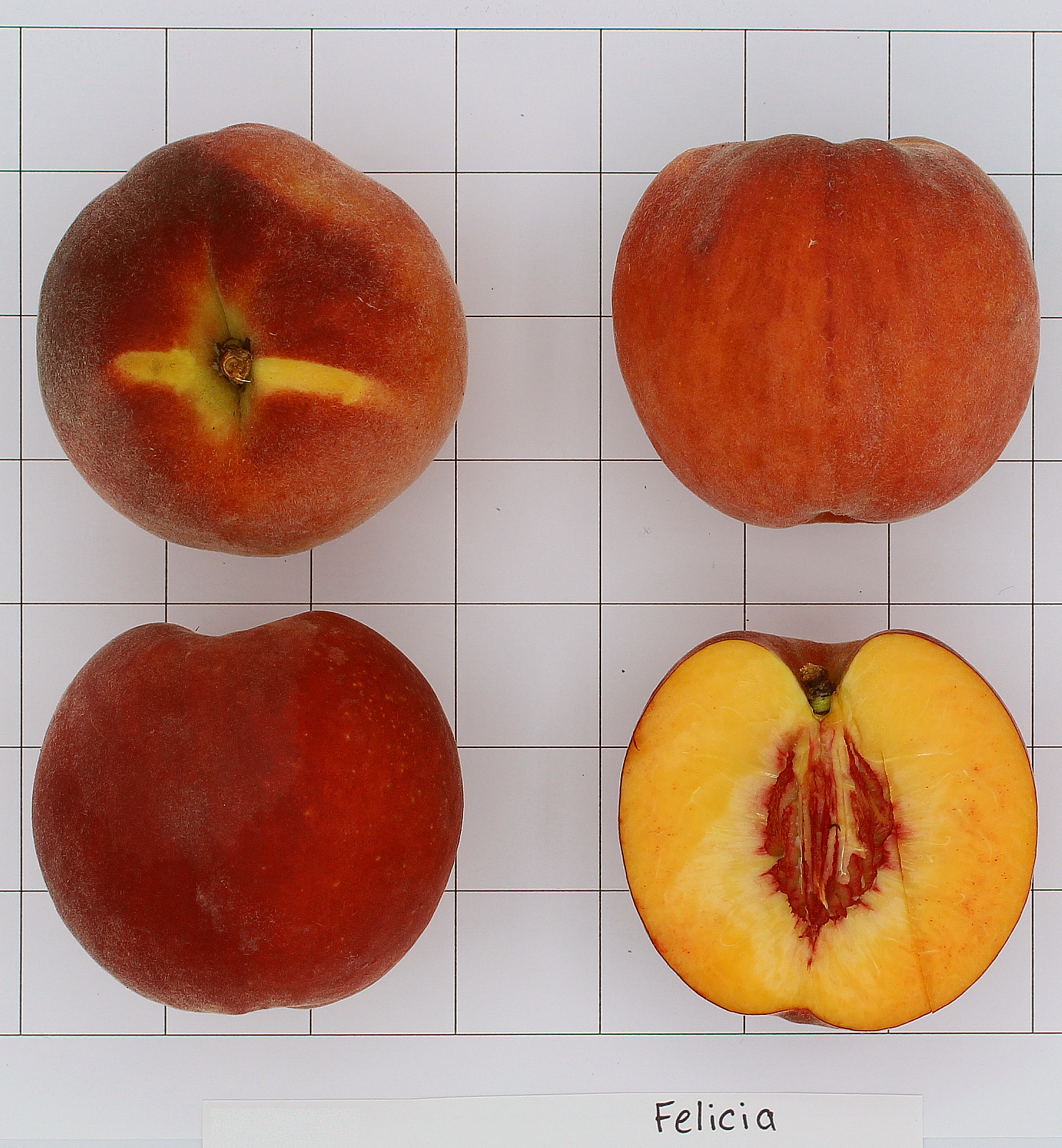
Felicia peach The Rutgers/NJAES stone fruit breeding program, led by Joe Goffreda, continues to create, and release exciting new peach varieties. We, in collaboration with growers, also continue to develop the varieties by evaluating their performance in plantings in commercial orchards and at Rutgers Agricultural Research and Extension Center. During this key time of the season, historically Redhaven season, it is important for our area to capture a substantial market share with premium fresh peaches. We are glad to feature some new and improved peach options for this season.

Felicia is a recent release from Rutgers University. It is a very attractive freestone yellow-fleshed peach variety. It has attractive red to dark red skin, little pubescence, with traces of red in the flesh. It ripens a few days before Redhaven; however, unlike Redhaven, it retains firmness for longer while maintaining the balance of sweetness and acidity (Table 1). Fruit is large and firm-fleshed, which is essential for post-harvest handling. It has low susceptibility to bacterial spot.

Though Redhaven is still the standard, yellow-fleshed, traditional peach in this season, it has a few challenges. For example, fruit can ripen faster than it changes skin color. That means it requires experience to start picking. Felicia is a good choice if one is planning a replacement for Redhaven. [Read more…]

Hill-Up your Grapevines to Prevent Winter Injury

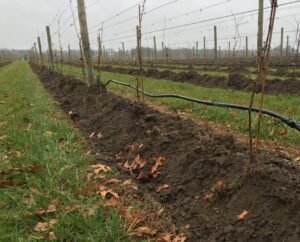
Freeze injury on grape flower buds and canes can cause crop loss and increased disease problems, but freeze damage at the graft union can kill the entire vine! The most effective technique for limiting freeze injury to the graft union is hilling up soil around the vines high enough to cover the graft union with 3 to 4 inches of soil. This practice is especially important for vines less than 5 years old. Now, before temperatures drop and the ground freezes is the time to get out there and hill up your vines. Factsheet 1264 https://njaes.rutgers.edu/fs1264/ details the following important aspects of hilling-up to protect the graft union from cold damage.

  • Dead grapevinesThe principle of Hilling-up – How the soil works, both as a thermal mass that holds the heat and an insulator that slows heat loss.

  • How to perform effective hilling-up using available and specialized implements.
  • Cost benefits of using the implements.
  • Challenges such as timing, preventing damage to the drip lines and trunks during hilling-up; and how to address those challenges.
  • The process of hilling down in the spring to prevent root formation above the graft union and proper weed management.

Vineyard Nutrition Monitoring

from NJ Center for Wine Research & Education

Bloom is here and it is a great time to get an accurate assessment of the nutritional status of your grapevines.

Monitoring Grapevine Nutritional Status

Grape Leaf PetioleWhat to sample? Soil or leaf petioles.
Soil sampling should be performed before planting and every 3 years, primarily to track the pH. Sample each block as you would for other crops.

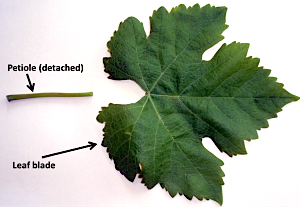
The more direct method for determining the nutrient status of the vine is tissue sampling, specifically petiole sampling (Figure 1. Grape leaf blade and detached petiole). Petiole sampling should be performed every 2-3 years in established plantings. You may need to sample annually when establishing the vineyard.
[Read more…]

Red Blotch Virus Alert Meeting

South Jersey vineyard and winery managers are invited to an Alert Meeting at Auburn Road Vineyard and Winery, 117 Sharptown-Pilesgrove Road, Woodstown, NJ on Monday September 29th at 4:30 PM to 6:30 PM.

Red Blotch

Do you have plants that look like this?
It may be a virus symptom.

We often see red leaves in vineyards at this time of the season, which can result from many causes including viruses, mineral deficiencies, trunk injury, and crown gall. In a season like 2014, following a damaging winter, the most common causes include the aftereffects of cold injury to the woody parts of the vines and the subsequent crown gall infections.

There are several well-documented types of viruses known to have serious deleterious effects on the performance of grape vines with names like Grape Leaf Roll and Grape Fan Leaf. A newly identified virus, generally called Red Blotch, is present in New Jersey vineyards. Red Blotch biology and potential impact on vineyard performance is yet to be worked out.

[Read more…]