Basil downy mildew has been confirmed in greenhouse grown sweet basil in central New Jersey. This is the first confirmed report of BDM in the state and region this growing season. All basil growers are encouraged to scout their fields or greenhouses on a daily basis. [Read more…]
May 27, 2025 Andy Wyenandt
Controlling Rhizoctonia root rot
Rhizoctonia root rot has been reported over the past week. Rhizoctonia root rot, caused by Rhizoctonia solani, is an important soil-borne fungal pathogen with a very large host range. The pathogen can survive saprophytically on living or dead plant material (organic matter) or as sclerotia in the soil (for more than 3 years). Disease development is favored by warm temperatures, dry (or very well drained) soils and stressed plants. Symptoms of Rhizoctonia root rot may begin as stunted plant growth (with poor root systems) with the appearance of brown lesions at the base of the stem causing wilting with lesions eventually girdling the stem and killing the infected plant. Rhizoctonia root rot infections only extend about an inch above the soil surface (Figure 1), unlike Phytophthora blight infection which can extend much farther up the stem. [Read more…]
January 22, 2025 Andy Wyenandt
Greenhouse Sanitation Important for Disease Management in Transplant Production
Proper greenhouse sanitation is important for healthy, disease-free vegetable transplant production.
Efforts need to be made to keep transplant production greenhouses free of unnecessary plant debris and weeds which may harbor insect pests and disease. Efforts need to be taken throughout the transplant production season to minimize potential problems.
- All equipment, benches, flats, plug trays and floors should be properly cleaned and then disinfested prior to use.
- Any weeds in or around the greenhouse structure should be removed prior to any production.
- Any transplant brought into the greenhouse from an outside source needs to be certified ‘clean’, as well as, visually inspected for potential insects and diseases once it reaches your location.
Remember, disinfestants, such as Clorox, Green-Shield, or hydrogen dioxide products (Zerotol – for commercial greenhouses, garden centers and Oxidate – commercial greenhouse and field), kill only what they come into direct contact with so thorough coverage and/or soaking is necessary. The labels do not specify time intervals for specific uses, only to state that surfaces be ‘thoroughly wetted’. Therefore, labels need to be followed precisely for different use patterns (i.e., disinfesting flats vs. floors or benches) to ensure proper dilution ratios. Hydrogen dioxide products work best when diluted with water containing little or no organic matter and in water with a neutral pH.
Draft Rules For Dual-Use Solar Energy Pilot Program & Public Information Session
On December 2, 2024, the NJ Board of Public Utilities posted draft rules for the Dual-Use Solar Energy (agrivoltaics) Pilot Program that was enacted by the NJ State Legislature. The purpose of the posting is to elicit public input by the January 31, 2025 deadline. The draft rules in the NJ Register are available to review here: https://go.rutgers.edu/Dual-Use-Solar-Rules
There will be a public information session (presentation and Q&A) about the draft rules on the morning of December 17. More details about this session are available here: https://www.nj.gov/bpu/newsroom/public/
November 14, 2024 Andy Wyenandt
The Rutgers Agrivoltaics Program wraps up its first year of crops research in New Jersey
The Rutgers Agrivoltaics Program is a multidisciplinary group of Rutgers faculty and staff committed to designing and conducting applied agrivoltaics research and outreach for stakeholders in New Jersey and throughout the region.
The Rutgers Agrivoltaics Program (RAP) was initiated over 3 years ago with the signing and passage of the Dual Use Solar Act by the New Jersey legislature. In 2023, agrivoltaics (AV) research installations were established at three Rutgers-New Jersey Agricultural Experiment Stations (NJAES). One at the Clifford E. and Melda C. Snyder Research and Extension Farm in Pittstown, NJ; one at the Animal Farm on the Rutgers New Brunswick (SEBS) Campus, and one at the Rutgers Agricultural Research and Extension Center (RAREC) near Bridgeton, NJ. Members of the Rutgers RAP Team in collaboration the New Jersey Board of Public Utilities, NJ Department of Agriculture, and NJ-DEP are now in the process of implementing the Dual-Use Solar Energy Pilot Program.

Specialty crops being grown in a double panel AV plot at the Rutgers Agricultural Research and Extension Center near Bridgeton, New Jersey.
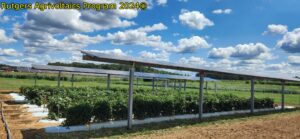
An image of specialty crops being grown in a single AV panel plot at the Rutgers Agricultural Research and Extension Center near Bridgeton, New Jersey.
The agrivoltaics research at the Rutgers Agricultural Research and Extension Center (RAREC) near Bridgeton, New Jersey was designed to study the effects of agrivoltaics systems on the production of specialty and agronomic crops. This year eggplant, bell pepper, fresh-market tomato, and soybeans were grown under three different treatments: single-axis tracking array with one row of panels, single-axis tracking array with two rows of panels, and no panels (conventional production as a control) to determine the effects of the panels on crop yield and quality.
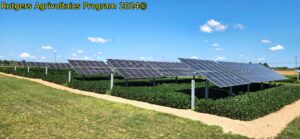
Soybeans were grown in two whole blocks at the Rutgers Agricultural Research and Extension Center near Bridgeton, NJ in 2024.
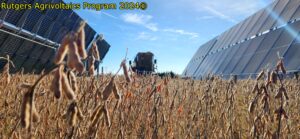
Soybeans being harvested between double AV panel arrays at the Rutgers Agricultural Research and Extension Center near Bridgton, New Jersey.
At the Clifford E. and Melda C. Snyder Research and Extension Farm in Pittstown, NJ the effects of single-axis tracking arrays with one row of panels on forage growth was studied to measure potential impacts on hay yield and quality. There were three cuts of the hay this season along with sampling for forage quality.

Hay being cut in mid-May at the Snyder Research and Extension Farm in northern New Jersey.
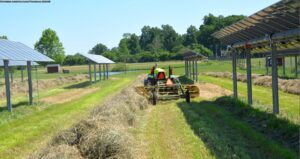
Cut hay being wind-rowed at the Snyder Research and Extension Farm in northern New Jersey.
At the Rutgers SEBS Cook Campus Animal Farm in New Brunswick, New Jersey, which hosts equine and livestock facilities, research was done to study pasture forage production and animal grazing patterns in combination with vertical bifacial solar panels. In early fall, four gestational cows (led by Buttercup) were introduced to the AV array research pasture for the first time. The research pasture also includes shelter and drinking water for the animals.
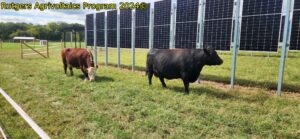
Buttercup (on the right) leading the small herd into the field of vertical bifacial panels at the Cook Campus Animal Farm on the campus of Rutgers University in New Brunswick, NJ.
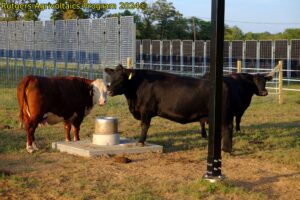
Buttercup and friends at the watering hole.

The ribbon cutting ceremony held on 30 Sep 2024 at the Cook Campus Animal Farm on the SEBS campus of Rutgers University celebrating the accomplishments Rutgers Agrivoltaics Program.
On 30 Sep., over 80 people attended the Rutgers Agrivoltaics Program ribbon cutting ceremony at the Rutgers Animal Farm in New Brunswick, NJ where State officials, University leaders, and invited guests applauded the research and outreach efforts of the Rutgers Agrivoltaics Program and discussed the potential impacts of agrivoltaics for both the agricultural and solar industries in New Jersey.
Results from all three Rutgers Agrivoltaics Program research sites will be presented at upcoming Extension meetings this winter and spring across New Jersey and the region.
UPCOMING PPRESENTATIONS
Dan Ward will be presenting at the New England Fruit and Vegetable Conference on 18 December 2024 in Manchester, New Hampshire.
Multiple RAP Team members will be presenting in the morning Agrivoltaics Session at the 2025 New Jersey Agricultural Convention and Trade Show in Atlantic City on 5 February at Harrah’s Resort.
More to be announced!
For more information on the Rutgers Agrivoltaics Program and more AV resources please visit the new RAP website by clicking here. Stakeholders interested in keeping up the what’s going on can now subscribe to the new website and have information send directly to their email account. Just go to our contact page and follow the instructions to subscribe!
Articles and images can be used by Permission from the Rutgers RAP Team only – For Permission contact RAP at shawn.sorrels@rutgers.edu.
September 26, 2024 Andy Wyenandt
Recommendations for Neopestalotiopsis control in fall planted strawberries
A new article by Dr. Phil Brennan (University of Georgia) from the Strawberry News website (UGA) has been published with information compiled by Dr. Guido Schnabel (Clemson University) and Dr. Bill Cline (North Carolina State) on managing fall-planted strawberries with the known presence of Neopestalotiopsis. New Jersey growers who may have purchased strawberry plants this fall from sources with known Neopestalotiopsis issues need to be proactive in mitigating it as best they can this fall and develop a plan for the upcoming spring. For more information please click here.
For more information on diagnosing Neopestalotiopsis in strawberry please click here.
