Cucurbit downy mildew was confirmed on cucumber in Caroline County, Maryland on the Eastern Shore on 6/27. This is the first report of cucurbit downy mildew in the mid-Atlantic region this growing season. All cucurbit growers should scout their fields on a regular basis and initiate a protectant fungicide program. Cucumber growers should include downy mildew-specific fungicide(s) in their weekly applications. For more control information on the control of cucurbit downy mildew please see the 2016 Mid-Atlantic Commercial Vegetable Production Recommendations Guide.
June 28, 2016 Andy Wyenandt
Dickeya dianthicola affecting potato growers throughout Mid-Atlantic region – Updated 7/5/16
In addition to Dickeya dianthicola being found in ‘Reba’, ‘Snowden’, and ‘Norwis’ on 3 farms in New Jersey this year, the pathogen has also been detected in fields with seed originating from Maine on 5 farms on Long Island in ‘Reba’, ‘Vivialdi’, ‘Superior’, ‘Norwis’, and ‘Waneta’ and three fields of ‘Vivaldi’ in DE. The pathogen has been detected in PA, MD, VA, NC, WV, and FL this summer on seed from Maine and New Brunswick, Canada (NJ and VA). Maine potatoes are currently shipped to over 20 states across the country (CA, CT, FL, ID, IN, KY, MD, MA, MS, NH, NJ, NY, NC, OH, PA, RI, TN, VT, VA, WA, WV, and WI). Potato growers, crop consultants, and Extension personnel in states which grow Maine potatoes should remain vigilant by scouting their fields for Dickeya symptoms on a regular basis and by submitting any suspect samples for diagnostic testing. Dickeya dianthicola has been detected in the US in the past, and because of this, APHIS just recently announced that the pathogen has been designated as a non-reportable/non-actionable pathogen despite its potential to cause 100% crop loss. A link to the USDA/APHIS website for information on Dickeya dianthicola detection and control can be found here.
For more information on Dickeya please see the following articles posted online – source(s) of information:
Update on Dickeya detections in potato – University of Delaware
Dickeya Blackleg: New potato disease causing major impact. – Cornell University
Watch for Dickeya – a new potato disease – The Ohio State University
High security Aroostook farm advances tater technology. – Maine Potato Board
Slowing Dickeya, other pathogens in Canada. – North Dakota State University
Dickeya: A new threat to potato production in North America. – SPUDsmart
Dickeya is coming. – University of Wisconsin/North Dakota State University
Maine ‘Ground Zero’ for new potato disease. – Maine Department of Ag.
Maine seed potato growers looking to protect brand against disease. Maine Department of Ag./Maine Potato Board
June 27, 2016 Andy Wyenandt
Dickeya discussion at National Plant Board meeting in Wilmington, DE
The National Plant Board will be holding their annual meeting in Wilmington, DE on July 31 to August 4th. The National Plant Board plays a significant leadership role in regulation and policy rules in agricultural production with each state having a representative member. One of the topics of discussion will be Dickeya dianthicola which has caused significant problems in potato production in NJ other states in the mid-Atlantic region. There will be presentations on Dickeya and seed potato production on the morning of Wednesday August 3rd starting at 8:15 AM. More information on the meeting and the schedule can be found here.
June 24, 2016 Andy Wyenandt
Dickeya dianthicola affecting potato in New Jersey
Dickeya dianthicola, an aggressive form of blackleg, has been found on potato in New Jersey for a second year in a row. The pathogen has also been found in potato crops in other states in the mid-Atlantic region this summer. The pathogen can cause significant losses if brought into the field on infested seed. Symptoms of Dickeya include the rotting/melting of the infested seed piece without the smell of traditional soft rotting bacteria. The bacterium will spread to other tubers developing on plant and into the stems leading to blackleg symptoms on the foliage. Infected plants can collapse quickly under hot conditions. Surveying and testing for Dickeya is currently being done in all states in the region. All potato growers should scout on a daily basis and any suspect plants should be submitted for testing. In New Jersey, fields of ‘Reba’, ‘Snowden’, and ‘Norwis’ have tested positive for Dickeya dianthicola from seed originating from Maine and Canada.
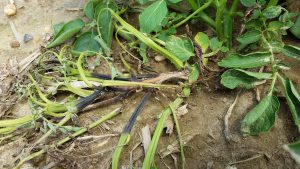
Symptoms of blackleg caused by Dickeya dianthicola on an infected potato plant.
June 21, 2016 Andy Wyenandt
Vegetable Disease Briefs – 6/21/16
- Cucurbit downy mildew has been reported on cucumber as far north as northern North Carolina this past week. CDM was reported on acorn, yellow summer, and butternut squash in South Carolina and on watermelon and cucumber in North Carolina. All cucurbit growers should scout on a regular basis for downy mildew and powdery mildew.
- There have been no new reports on late light in the region. Late blight (US23) was reported on potato on the Eastern Shore a few weeks ago. All tomato and potato growers in the region should scout on a regular basis.
- Blackleg caused by Dickeya dianthicola has been reported in potato this past week. All potato growers should continue to scout for symptoms of Blackleg, especially as temperatures warm up, and report any suspect plants or fields for testing.
June 16, 2016 Andy Wyenandt
Vegetable Disease Briefs – 6/16/16
- There have been no new reports on late light in the region. Late blight (US23) was reported on potato on the Eastern Shore two weeks ago. All tomato and potato growers in the region should scout on a regular basis.
- Blackleg caused by Dickeya has been reported in potato this past week.
- Cucurbit downy mildew has been reported on cucumber as far north as central North Carolina this past week. CDM was reported on acorn, yellow summer, and butternut squash in South Carolina on 6/14. All cucurbit growers should scout on a regular basis for downy mildew and powdery mildew.