Archives for July 2025

Preparing for Pepper Anthracnose in 2025

Pepper Anthracnose

Pepper Anthracnose

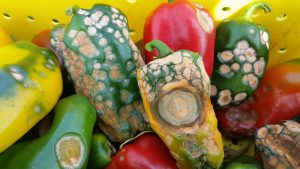
Pepper anthracnose caused by Colletotrichum spp. has become a significant problem on some farms in southern New Jersey.

Unlike in tomato, where symptoms are only present in mature (red) fruit, pepper anthracnose can infect pepper fruit at any growth stage. Currently, there are no commercially-available bell or non-bell peppers with known resistance to anthracnose. [Read more…]
Cucurbit powdery mildew control in 2025

Cucurbit powdery mildew (CPM), caused by Podosphaera xanthii, is one the most important diseases of cucurbit crops throughout the world. The pathogen is an obligate parasite, just like cucurbit downy mildew, meaning it needs a living host in order to survive. In northern regions that have a killing frost in the fall the pathogen will die out when the crop freezes. Not being able to overwinter, the pathogen must be re-introduced each spring or summer in the mid-Atlantic region. The pathogen accomplishes this by re-infecting cucurbit crops in the spring as they are planted up the east coast starting in Florida, then the Carolina’s, Virginia, and so forth. By late May, as soon as cucurbit crops begin to germinate in the mid-Atlantic region, the potential threat for potential powdery mildew infections begin. [Read more…]

Fruit IPM Report July 7, 2025

Peach:

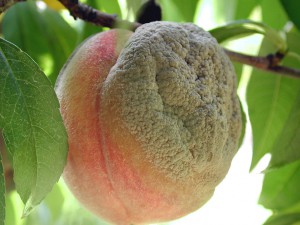
Figure 1. Brown rot on mature fruit. Entire surface of lesion is covered with spores.

Brown Rot:  Warm and wet weather this summer have been ideal conditions for brown rot to develop on fruit (Figure 1). Most growers should be relying on a captan based program for mid-season covers, followed by better materials during the last 3 weeks pre-harvest. For reference see Dr. Norm Lalancette’s post Improving Your Late Season Peach Brown Rot Control Program — Plant & Pest Advisory.

Tarnished Plant Bugs; and Other Cat-facing Insects: Cat-facing insect activity is increasing with the arrival of hot weather and is present at moderate to high levels in some orchards.

Oriental Fruit Moth: A biofix point for OFM was set on 4/2 for southern counties and 4/17 in northern counties. See below for timings for third generation.

OFM 3nd Generation Timing
Insecticide Type
County/Region Degree Days by  7/7 base 45 Conventional

2100-2200

2450-2500

Intrepid/Rimon

2000-2100

2350-2450

Diamides/Virus

2025-2150

2375-2450

Gloucester – Southern 1971 1st –7/11-7/14

2nd – 7/22-7/24

1st –7/8-7/11

2nd – 7/19-7/22

1st –7/9-7/12

2nd – 7/20-7/22

Middlesex – Northern 1790 1st – 7/17-7/20

2nd – too far off

1st – 7/14-7/17

2nd – too far off

1st – 7/15-7/18

2nd – too far off


Scale Insects: Second generation White Peach Scale crawlers should emerge sometime this week or next. Second generation San Jose Scale crawlers emerge about 7/17 +/- 8 days. Esteem is a good scale material that has a 14-day PHI for stone fruit. Centaur is also effective, has a 14-day PHI and can be used only once during the growing season. Venerate has shown efficacy as a pre-harvest treatment against scale and has a 0-day PHI. If using Venerate to control scale insects, make 2 applications 7 days apart starting a week after crawler emergence.

Japanese Beetles: Japanese beetle activity has been noticeable in many orchards. Products containing imidacloprid are standard insecticides for Japanese beetle control and have a short PHI. See the NJ Commercial Tree Fruit Production Guide for more information.

Apples and Pears:

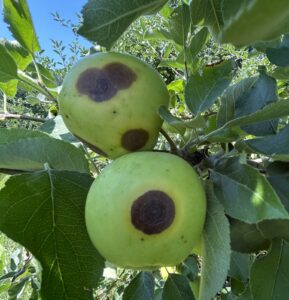
Figure 2. Bitter rot infection on apple.

Diseases: Now that primary scab has ended, the focus turns toward summer diseases such as fruit rots (esp. Bitter rot; Figure 2), and sooty blotch and fly speck. Bitter rot control has been difficult at best in recent years even where management programs have been rigorous. Research has suggested products such as Merivon, Luna Sensation, Inspire Super, Omega, and Aprovia may be effective, and longtime reliable broad-spectrum fungicides such as captan and ziram should provide control. Experience has suggested that the addition of phosphorous acid products such as Prophyt or Rampart to captan sprays may improve control. Observations are that these products improve control of other summer diseases such as sooty blotch and flyspeck, and may help suppress scab infections where present. Bitter rot symptoms have been observed in both southern and northern counties.

Brown Marmorated Stink Bugs: Brown Marmorated Stink bugs are present at low to moderate levels in orchards statewide. Eggs are hatching and nymphs are present. See the NJ Tree Fruit Production guide for effective materials.

Codling Moth (CM): Second generation timings are updated below. Trap counts and emergence are low. Therefore, if you have applied your 2nd generation insecticides and your trap counts are low (less than 5 moths per trap), additional treatments are not needed.

Codling Moth Degree Day Timing – Second Generation
Application and Insecticide Type
County Area Biofix Rimon:

75-100DD + 14-17 days later


Intrepid

1150 + 1450 DD

Diamides – Altacor, Voliam mixes: (150-200 DD)

Madex

1250 DD + every 7-9 days during brood hatch (later if first spray is an IGR)

Standard Insecticides –  Delegate, Avaunt, OP’s, carbamates, pyrethroids

1250 DD + 1550 DD


DD 1150 1450 1250 1250 1550
Southern April 28 N/A N/A past 7/10 past past 7/13
Northern  April 30 N/A N/A past 7/13 7/7 7/7 7/17


Scale Insects: Second generation San Jose Scale should emerge about mid-July. Options include Esteem (2 applications/year; 45-day PHI); Centaur (1 application/year; 14-day PHI); Diazinon 50W (2 applications/year; 21-day PHI); Venerate (0-day PHI; Make two applications 7 days apart starting a week after crawler emergence).

Phenology Table: Based on annual observations made in Gloucester County.

Pest Event or Growth Stage Approximate Date 2025 Observed Date
 Bud Swell (Redhaven/PF-17)  March 23 +/- 15 Days March 30
1/4″ Green Tip Red Delicious March 31 +/- 13 Days March 30
Pink Peach (Redhaven/PF-17) April 4 +/- 15 Days April 1
Tight Cluster Red Delicious April 9 +/- 13 Days April 5
Full Bloom Peach (Redhaven/PF-17) April 9 +/- 14 Days April 10
Pink Apple (Red Delicious) April 14 +/- 12 Days April 16
Full Bloom Apple (Red Delicious) April 22 +/- 11 Days April 25
Petal Fall (Redhaven) April 22 +/- 10 Days April 19
Petal Fall (Red Delicious) April 27 +/- 13 Days May 2
Shuck Split (Redhaven) April 30 +/- 11 Days April 26
Pit Hardening June 15 +/- 9 Days June 15


Tree Fruit Trap Captures – Southern Counties

Week Ending STLM TABM-A CM BMSB OFM-A DWB OFM-P TABM-P LPTB PTB
4/5/2025 0 0 0 0 0 0 0 0 0 0
4/12/2025 0 0 0 0 6 0 0 0 0 0
4/21/2025 0 0 0 0 36 0 1 0 0 0
4/27/2025 25 0 0 0 24 0 5 0 1 0
5/2/2025 517 0 4 0 12 0 6 0 13 0
5/9/2025 159 4 10 0 3 16 5 4 46 0
5/16/2025 91 11 6 0 1 36 2 14 69 0
5/23/2025 299 21 3 0 1 23 1 26 23 0
5/30/2025 399 14 2 0 0 41 1 11 10 3
6/6/2025 733 13 1 0 0 36 2 12 29 1
6/13/2025 684 19 2 1 0 81 2 17 22 8
6/20/2025 724 24 2 0.5 1 60 1 23 19 12
6/27/2025 932 5 1 0.8 1 40 0 5 24 14
7/4/2025 643 0 0 0.75 1 17 0 0 6 16


Tree Fruit Trap Captures – Northern Counties

Week Ending STLM TABM-A CM BMSB OFM-A DWB OFM-P TABM-P LPTB PTB AMBROSIA BEETLE
4/5/2025 387 0 0 0 0 0 0 0 0 0 0
4/21/2025 435 0 0 0 0 0 1.3 0 0 0 0
4/27/2025 26 0 0 0 0 0 25 0 0 0 72
5/2/2025 86 0 0.33 0 72.5 0 47.2 0 0 0 136
5/9/2025 56 0 5.3 0 58.8 0 22.9 0 0 0 145
5/16/2025 13.75 2.6 7.3 0 4 0 5 0 0 0 50.5
5/23/2025 4.8 10.3 10.5 0 0.6 31.25 4.2 0 14.6 1 22.2
5/30/2025 2.2 4.8 1.8 0 0 12.4 9.6 0 9.6 1.9 22.1
6/6/2025 3 4.83 2.8 0.25 0 20 4.1 0 21.2 1.8 40.3
6/13/2025 65 20 11.4 0.6 0 12.3 4 0 10.5 1.5 59.2
6/20/2025 26 26 8 0.75 1 13 4.5 0 11 0.75 52
6/27/2025 145 19 6 1.3 6 35 5.4 0 16 1.6 38
7/4/2025 212 6 3 6 12.5 40 2 0 8.4 1.1 27


Grape: The next timing for Grape Berry Moth will be on or about 7/24 for Intrepid or Diamides, or a few days later for other insecticides based on the biofix of May 24 in southern counties. Treatments for the third generation are at an accumulation of 1620 degree days (base 47.14).

Blueberry: Spotted-wing drosophila, Oriental beetle, and Sharp-nosed leafhopper have increased from the previous week. Blueberry maggot trap counts remain low. For weekly reports on blueberry pests and recommendations read the Rutgers Blueberry Bulletin.

Week Ending  SWD AC Traps SWD BC Traps OB AC Traps OB BC Traps
AVG HIGH AVG HIGH AVG HIGH AVG HIGH
6/6/25 8.5 29 3 9 7.8 29 0 0
6/13/25 21.51 45 32.6 86 240 1350 34 170
6/20/25 37.52 148 37.6 83 405 2025 555.4 4050
6/27/25 13.5 34 27.4 67 681 2025 134.9 450
7/4/25 21.2 73 41.1 64 541 2025 331.6 1575
SWD = Spotted-Wing Drosophila, OB = Oriental Beetle; AC = Atlantic County, BC = Burlington County


Week Ending BBM AC Traps BBM BC Traps SNLH AC Traps SNLH BC Traps
AVG HIGH AVG HIGH AVG HIGH AVG HIGH
6/6/25 0 0 0 0 1 6 0.85 3
6/13/25 0.29 7 0.16 4 1.26 8 3.27 17
6/20/25 0 0 0.04 1 1.28 8 4 16
6/27/25 0.05 4 0 0 0.25 1 0.28 2
7/4/25 0 0 0 0 0.81 13 1.17 4
BBM = Blueberry Maggot, SNLH = Sharp-nosed Leafhopper; AC = Atlantic County, BC = Burlington County

Tobacco Streak Virus (TSV) found on tomato in New Jersey

Tobacco Streak Virus (TSV) was found on fresh-market tomato this past week in southern New Jersey. TSV has a host range of close to 200 species, including cranberry, tobacco, tomato, pepper, asparagus, bean, soybean, mustard, radish, a number of ornamental hosts as well as weeds such as thistle, field bindweed, and jimson weed. Like Tomato Spotted Wilt Virus (TSWV), the Tobacco Streak Virus is also vectored by thrips. TSV can be seed-borne (reported in some hosts), spread via pollen, and mechanically transmitted. Symptoms can vary significantly depending on the host. Infected plants may have downward leaf curling, show black streaks on leaves and stems, chlorosis, stunted growth, deformed growing tips, ring spots, and flower drop. There is no genetic resistance to TSV in tomato and management should focus on keeping thrips populations as low as possible, scouting on a regular, removing infected plants, and knowing your weed population (as a potential source). The only method to correctly identify TSV is through serological tests such as ELISA.

For more information on Tomato Spotted Wilt Virus please click here.

Veg IPM update 7/4/25

Greetings from the Veg IPM team! We hope that you’re all enjoying the holiday and the nice weather for this weekend.

Sweet Corn

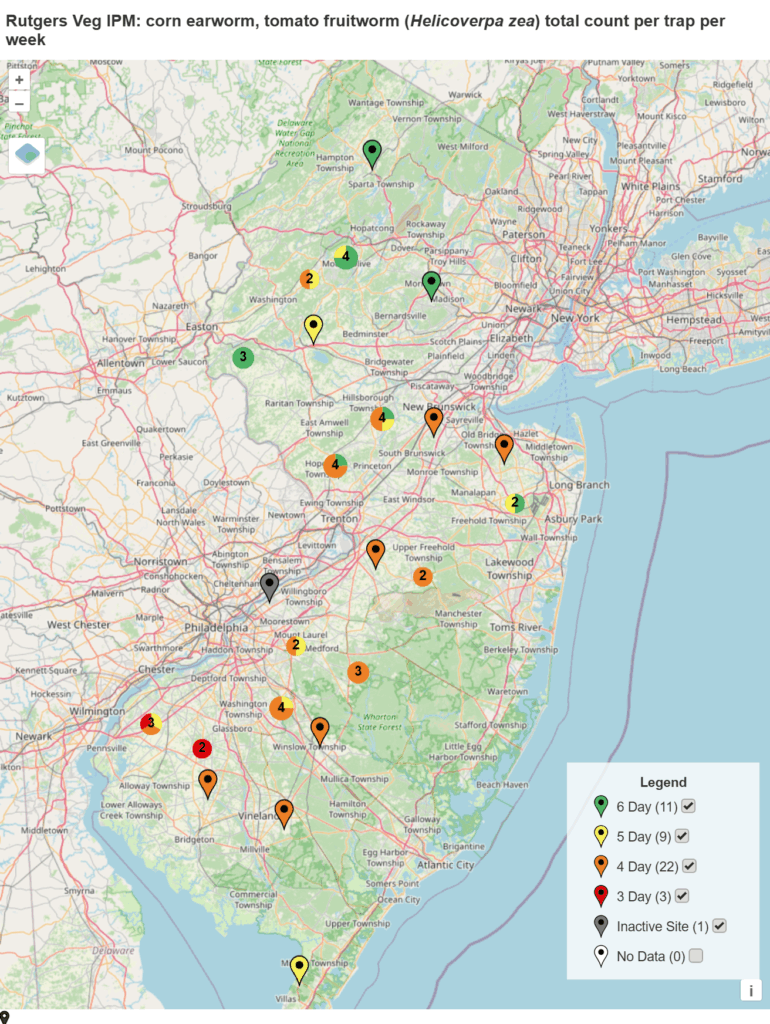
Moth captures in much of the state (see map) have decreased over the past week and a half, but a 4-day spray schedule is still necessary for most growers at this time. When temperatures are high (>85 degrees F), shorten the spray interval by one day. Rotation is important for avoiding resistance, and there are four IRAC groups that are registered in silking sweet corn: 1 (carbamates), 3 (pyrethroids), 5 (spinosyns), and 28 (diamides). Corn earworm is at least partly resistant to several pyrethroids, so a spray program should not rely solely on pyrethroids, although they can be useful in tank-mixes or as pre-mixed products, such as Besiege or Elevest (Group 28 + Group 3). For detailed information about resistance and potential spray programs, the University of Delaware has an excellent resource on corn earworm management. We’ve also seen some very minor instances of European corn borer, beet armyworm, and corn earworm feeding in pre-silking corn, as well as our first sighting of fall armyworm (found in Burlington County). In the pre-tassel stage, we use a treatment threshold of 12% infestation of these types of caterpillars, and sightings have been far below this so far.

Spray intervals based on nightly pheromone moth captures for the southern part of New Jersey. Note that not all locations in the IPM program are currently trapping. This map is based on the following thresholds: 0 moths = 6-7 day schedule, 1 moth = 5 day spray schedule, 2-20 moths = 4 day spray schedule, 20+ moths = 3 day spray schedule.

Tomatoes

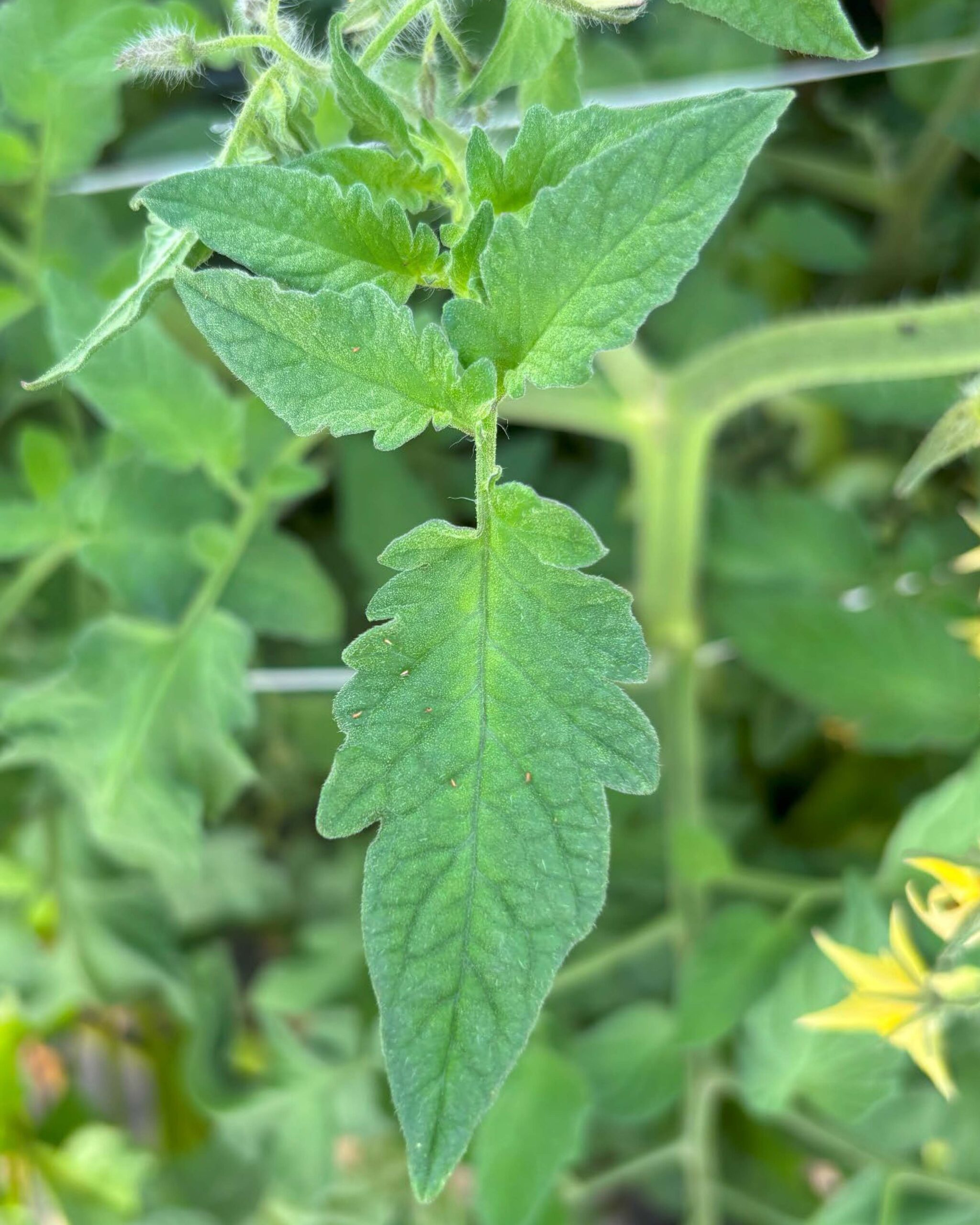
Throughout New Jersey we’re continuing to see high thrips counts both in tunnels and in the field, although numbers have been higher in tunnels. We consider more than 5 thrips on 10 leaves a high count. Other guides suggest 3-5 thrips per flower or the presence of stippling damage on fruit to be a treatment threshold. Thrips management is especially important because of their ability to vector tomato spotted wilt virus (TSWV), a growing concern in New Jersey where we have resistance-breaking strains. TSWV has already been seen on farms this season. Thrips management can be especially challenging in high tunnels due to a lack of products. Minecto Pro (IRAC 28 + 6) and Exirel (IRAC 28) can be used in tunnels, but only suppress thrips populations (this means they reduce numbers, but do not eradicate them). In the field, Entrust/Radiant (IRAC 5) can be used as well as Torac (IRAC 21A) and Harvanta (IRAC 28). We do not recommend pyrethroids or neonicotinoids for thrips due to resistance in different thrips species. Refer to the previous link for a complete list of best management practices for thrips and TSWV.

6 tiny light-colored thrips on a tomato leaf.

Thrips on a tomato leaf. Photo by Maria Cramer.

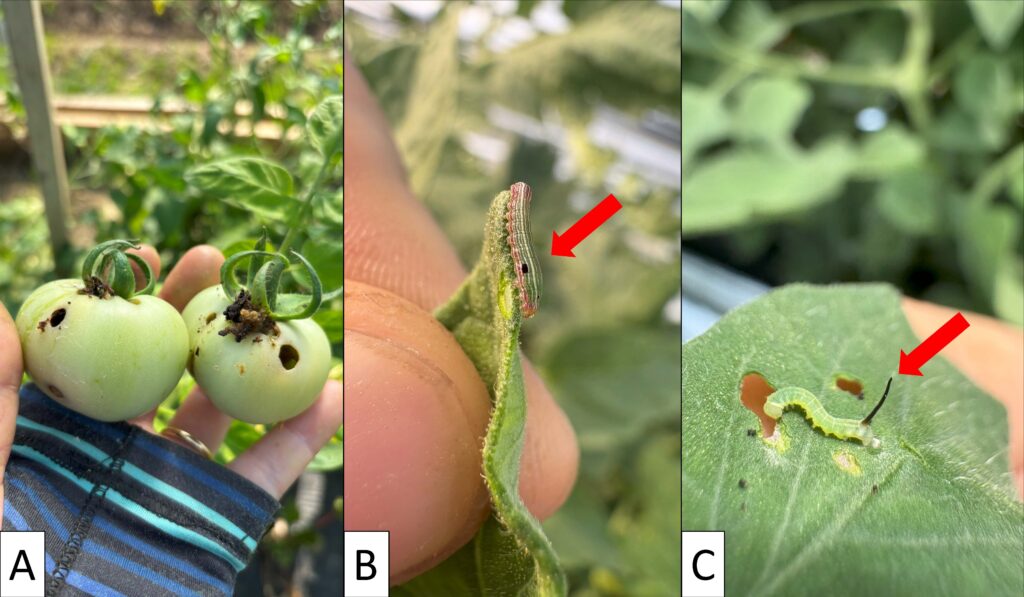
Caterpillar pests have begun showing up in southern NJ plantings in the last week. We’ve seen some fruit damage, and tomato fruitworm (AKA corn earworm), beet armyworm, and hornworms on plants and fruit. There are no reliable thresholds for determining when to spray for these caterpillar pests, however scouting and consulting the corn earworm pressure map for the state will help give a sense of risk to the crop. When corn earworm pressure indicates a 3 or 4 day spray interval in corn (2-20 moths per night) as is currently the case in much of the state, tomatoes should be scouted weekly for feeding damage. Pyrethroid resistance is widespread in tomato fruitworm/corn earworm and beet armyworm, so other classes of insecticides should be used if management is needed.

3 pictures: The picture on the left shows two green tomatoes with circular dark holes and frass. The center picture shows a small striped caterpillar with a black spot above its set of true legs on the edge of a tomato leaf. The picture on the right shows a small green caterpillar with a black spine on its posterior end feeding on a tomato leaf.

Caterpillars in tomatoes: A) Tomato fruitworm feeding holes (photo: Maria Cramer), B) A beet armyworm with red arrow indicating distinctive black dot on the side of the caterpillar above its front set of legs (photo: Kris Szymanski), and C) A very small tomato hornworm with red arrow indicating the horn (photo: Kris Szymanski).

We’re also seeing limited aphid and spider mite activity in tomatoes. If dealing with primarily aphids, products such as Beleaf (IRAC 29) are recommended, especially if plants have reached the flowering stage. However, natural enemies often control aphids, so if counts are low and natural enemies like lacewings, lady beetles, or parasitoid wasps are present, you may avoid sprays. For spider mites, Nealta (IRAC 25) is an effective material that is more friendly to beneficial insects, but Portal (IRAC 21A) and other materials can also be used to manage populations.

Peppers

In terms of most insect pests, peppers have been looking very good. We have seen aphids, spider mites, and thrips at low levels so far, however it’s important to keep in mind that thrips can transmit TSWV to peppers as well, and so monitoring and staying on top of thrips populations is crucial.

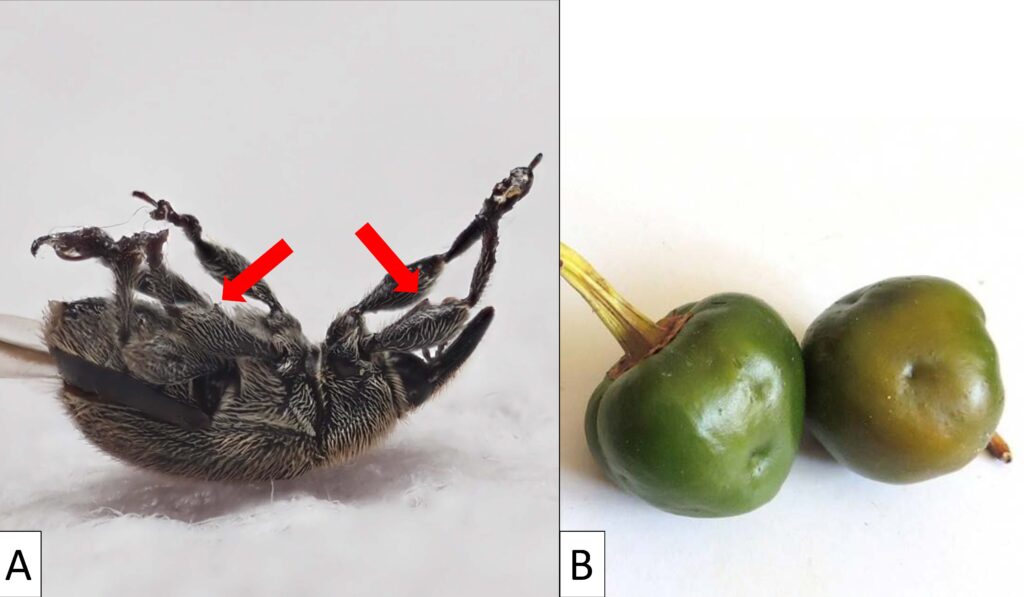
In southern New Jersey, pepper weevils are periodically introduced from other regions of the United States via the processing industry, so we have been using pheromone traps to monitor their populations. Single pepper weevils have been found on traps at locations in Cumberland and Salem counties. Because established pepper weevil populations are virtually impossible to eradicate and can lead to total losses, the presence of a single weevil triggers routine insecticide applications through the end of pepper harvest. Many populations of pepper weevils are resistant to pyrethroids, and insecticide classes should be rotated when managing them to prevent further resistance. Currently available chemistries suppress, but do not eradicate, pepper weevils. Read more about pepper weevil biology and management here. If you think you may have pepper weevil on your farm or are interested in monitoring, please contact Maria Cramer.

On the left, a pepper weevil lies on its back, with two red arrows indicating the spines on the undersides of its legs. On the right, two small green pepper fruit have dimples in the surface.

A) The first pepper weevil found in southern NJ in 2025. Red arrows indicate the characteristic spines found on the undersides of the legs which are key for identifying pepper weevil (photo: Maria Cramer). B) Dimpled pepper fruit indicate pepper weevil egg laying and can help confirm pepper weevil infestations (photo: Joe Ingerson-Mahar).

Cole Crops 

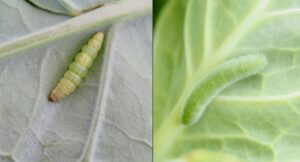
We are no longer seeing many flea beetles in cole crops, but we continue to see caterpillar activity. Treatment thresholds vary between crops and growth stage, but for heading cole crops between early vegetative and cupping, the treatment threshold is 30%. As heads form, the treatment threshold goes down to just 5% infestation. Sprayable Bt products (IRAC 11A) such as Dipel, Xentari, or Javelin can be effective on young imported cabbage worm caterpillars. Other materials approved for caterpillar control include Entrust/Radiant (IRAC 5), Proclaim (IRAC 6), Torac (IRAC 21A), and Exirel (IRAC 28). Diamondback moth (the primary caterpillar found in southern NJ) has resistance to many insecticide groups, and pyrethroids (IRAC 3A) are not effective for their management. For Bt products and contact insecticides, coverage on the undersides the leaves is essential.

Two caterpillars on brassica leaves. Diamondback moth caterpillar on the left is smooth and tapered at each end. Imported cabbageworm on the right is fuzzy.

Left: Diamondback moth caterpillar, showing characteristic tapering at each end. Right: Imported cabbageworm caterpillar showing characteristic fuzziness. Pictures by Maria Cramer.

Diseases

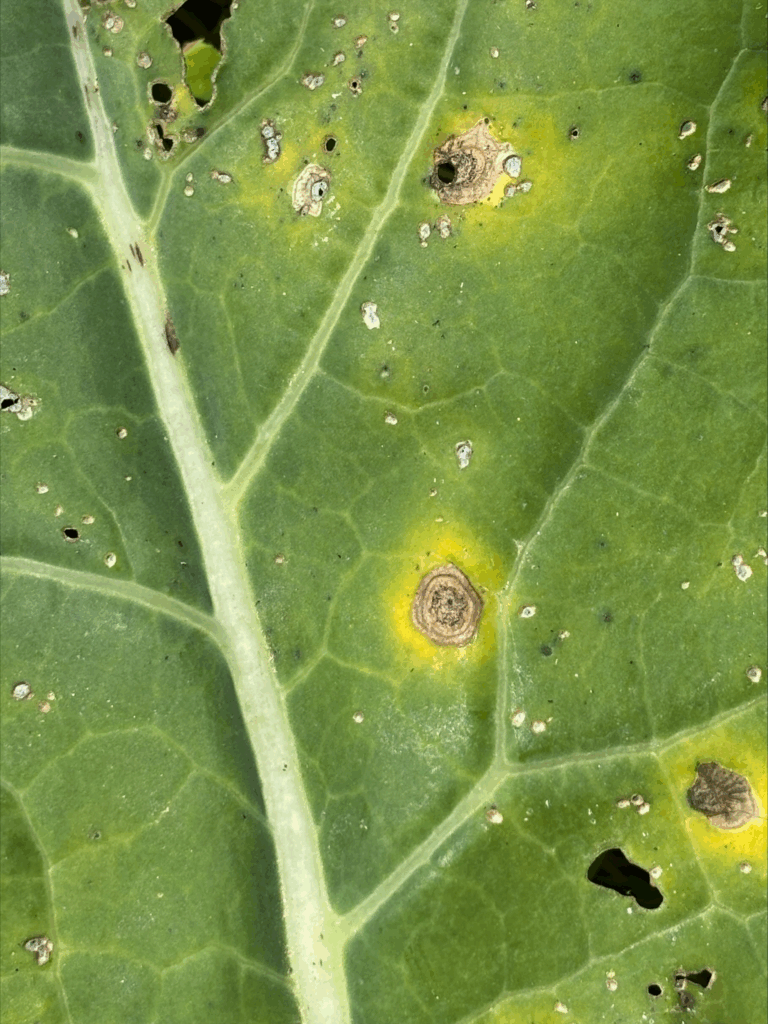
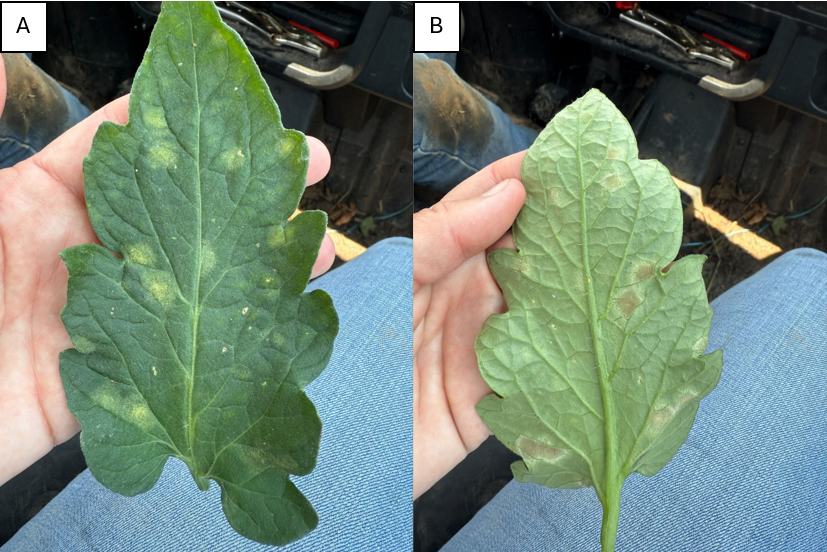
With the heavy rainfall over the last week, conditions have been favorable for diseases to spread. We’re still seeing bacterial and fungal issues in peppers and tomatoes, but we have also started to see issues like Alternaria in cole crops. To prevent the spread of disease, avoid working fields when foliage is wet and continue to use resistant varieties when possible. In tunnels, leaf mold is becoming a prevalent problem as well. Be sure to vent the structure regularly to reduce humidity. Mural (FRAC 7 + 11) is labeled for greenhouse use.

Alternaria on broccoli

Alternaria on broccoli. Photo by Amanda Quadrel


Photo showing leaf mold symptoms on the upper (A) and lower (B) surface of the leaves. Photo by Darcy Perehinys


As always, please consult the Mid-Atlantic Commercial Vegetable Production Guide for a comprehensive list of materials that are labeled for specific crops and pests. As always, be sure to follow label rates and application instructions.

The Vegetable IPM Program wishes to thank the following Field Technicians, without whom much of the information presented weekly here would not be available:

Southern team: Renee Carter, Kris Szymanski, and Nick Vergara

Northern team: Martina Lavender, Coco Lin, and Cassandra Dougherty

When Plants Get Sick, Pests Thrive: The Unseen Battle in Cranberry Bogs

Our research on how cranberries respond to phytoplasma infection—and its effects on above- and belowground herbivores—was recently featured on the Theobald Smith Society’s website in the article When Plants Get Sick, Pests Thrive: The Unseen Battle in Cranberry Bogs

Phytoplasma infection, which causes false blossom disease in cranberries, is transmitted by the blunt-nosed leafhopper (Limotettix vaccinii). Our findings show that infection increases cranberry susceptibility to herbivores both above and below ground by increasing plant nutrient levels and suppressing plant defenses. This work highlights the complex—and often harmful—interactions among plants, pathogens, and insect herbivores in agricultural ecosystems.