Archives for May 2025

Vegetable IPM Update 5/15/25

Greetings from the Veg IPM team! No major changes have taken place between last week and this week, and with the rainy weather, scouting has been limited.

Sweet Corn

We’ve put out corn earworm pheromone traps throughout the state. While silking corn is the main target of CEW activity, we set the traps early to detect overwintering moths, which have become more common with warmer winters. As a reminder, we’re no longer using blacklight traps as of this year, and we’ll be reporting pheromone trap counts in the Plant Pest Advisory as the season progresses. So far, we haven’t spotted any corn pests through visual inspection.

Cole Crops 
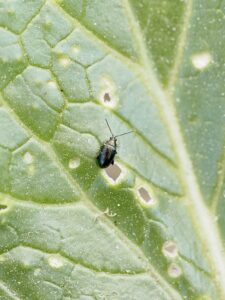
A shiny black beetle with straight antennae stands on a leaf surrounded by circular feeding holes.

Flea beetle surrounded by feeding damage. Picture by Maria Cramer.

Flea beetle are active in various cole crops. This year, they have been especially prevalent in Napa cabbage and bok choy. Young plants are especially vulnerable to attack from flea beetles. The treatment threshold for flea beetles in heading cole crops is 50% infestation.
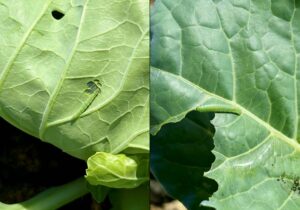
 

Two picture, the picture on the left shows a smooth caterpillar that tapers at both ends. The picture on the right shows a caterpillar that is fuzzy all over and does not taper at either end.

Left: Diamondback moth caterpillar, showing characteristic tapering at each end. Right: Imported cabbageworm caterpillar showing characteristic fuzziness. Pictures by Maria Cramer.

We’re seeing caterpillar activity (imported cabbageworm and diamondback moth) in cabbage and other cole crops. Treatment thresholds vary between crops and growth stage, but for heading cole crops between early vegetative and cupping, the treatment threshold is 30%. At this stage, sprayable Bt products (IRAC 11A) such as Dipel, Xentari, or Javelin can be effective on young caterpillars. Other materials approved for caterpillar control include Entrust/Radiant (IRAC 5), Proclaim (IRAC 6), Torac (IRAC 21A), and Exirel (IRAC 28). For Bt products and contact insecticides, coverage on the undersides the leaves is essential.


Tomatoes

In high tunnels and the first field plantings of tomatoes, we’re seeing limited aphid, thrips, and spider mite activity. If dealing with primarily aphids, products such as Beleaf (IRAC 29) are recommended, especially if plants have reached the flowering stage. For thrips, Entrust, Radiant (IRAC 5) and Torac (IRAC 21A) can be used. For spider mites, Nealta (IRAC 25) is an effective material that is more friendly to beneficial insects, but Portal (IRAC 21A) and other materials can be used to manage populations.


Please consult the Mid-Atlantic Commercial Vegetable Production Guide for a more comprehensive list of materials that are labeled for specific crops and pests. As always, be sure to follow label rates and application instructions.

Authors: Amanda Quadrel (Northern NJ Veg IPM coordinator) and Maria Cramer (Southern NJ Veg IPM coordinator)

 

Crown Gall in Grapevines – Early Symptoms and Management.

What is Crown Gall?

Figure 1. Early symptoms. Young soft galls developing on the graft union during early spring (L) and cracking of bark by growing crown galls (C and R).

Crown gall is a serious disease affecting grapevines, particularly in cool-climate viticulture. It is caused by the soil- and plant-borne bacterium Agrobacterium vitis (A. vitis). This pathogen induces tumor-like growths (galls) that disrupt the grapevine’s vascular system, reducing the flow of water and nutrients from roots to shoots. If left unmanaged, crown gall can stunt vine growth and eventually kill the plant.

Diseases Symptoms

The earliest and most distinctive symptoms are abnormal, soft, whitish swellings (see Figure 1, Left). As these galls grow, they cause the bark to crack and peel due to pressure from underneath (Figure 1, Center and Right). Galls can initially be mistaken for benign growth, and therefore, detection requires careful inspection.

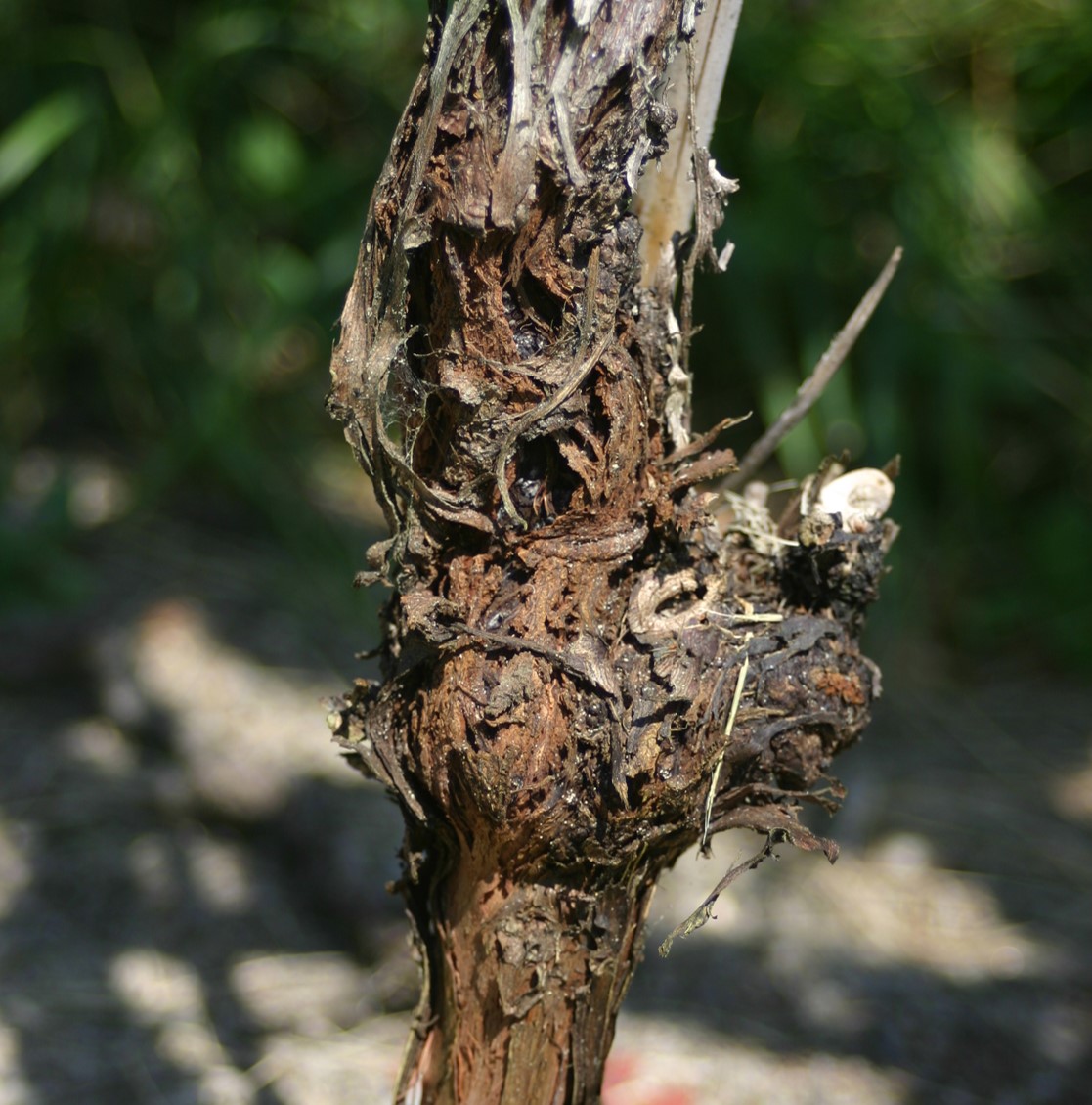
Figure 2. Crown gall on the graft union and trunk of the grapevine.

As the disease progresses, galls may become woody, rough, and brown, growing to several inches in diameter (Figure 2). They most often appear at the graft union or sites of mechanical injury on the lower trunk. The graft union is especially susceptible due to: (i) its irregular shape, which is prone to cracking, and (ii) potential contamination by A. vitis during the grafting process. Galls may also form on cordons and canes. Early scouting and removal of affected trunks can help limit the spread of infection. If the gall encircles the vine’s vascular system, the entire plant may collapse and especially in young vines, which have thinner trunks.

Another indicator of severe infection is the emergence of multiple new suckers from the vine base (Figure 1, Left). Additionally, leaves of affected vines may show green wilting and reddening due to restricted water and nutrient flow (Figure 3). However, similar symptoms can also result from viruses or nutrient deficiencies, making diagnosis challenging. In such cases, inspect the trunk visually for physical signs of gall formation or vascular disruption.


Why does wounding cause gall formation?

Figure 3. Leaf of crown gall-affected grapevine showing green wilting and reddening.

Wounding is a key point of infection in crown gall development. In early spring, grapevines attempt to heal sites of winter injury by producing callus tissue. These masses of undifferentiated cells with soft cell walls are particularly vulnerable to infection. A. vitis, which may already be present in the vine, exploits these wounds to inject its DNA into the callus cells. This bacterial DNA contains a tumor-inducing gene that integrates into the plant’s genome, leading to uncontrolled cell division, resulting in the characteristic gall.

Management of Crown Gall

An integrated pest management (IPM) approach is essential for effective crown gall control. Strategies include:

1, Avoidance
Site selection is the best decision to avoid cold injury. Avoid planting in low-lying areas where cold air settles. Gentle slopes are preferable for air drainage but beware that cold air may still collect at the lower end of a slope. Avoid planting in such spots unless you have excellent air drainage practices.

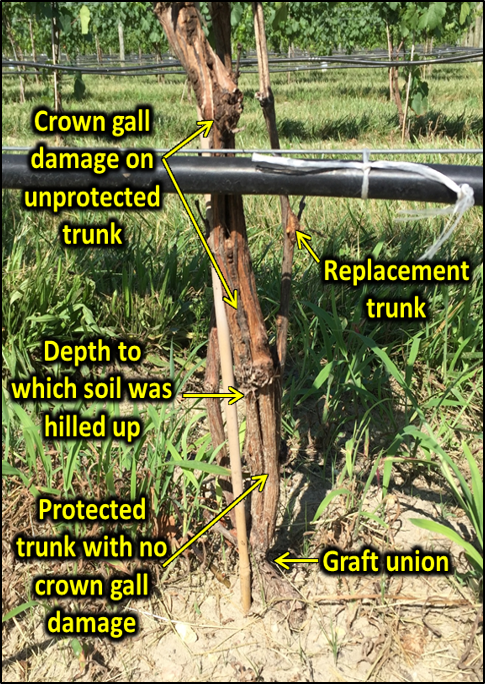
Figure 4. Grapevine in a year after hilling and damaging winter. Notice the graft union and trunk a few inches above it, unaffected by winter damage due to hilling-up, while the unprotected trunk shows crown gall.

2. Exclusion
Start with clean, certified planting material to reduce the chance of introducing A. vitis into your vineyard. Ideally, use 2010 Protocol-certified stock, which is propagated using advanced screening techniques to minimize bacterial contamination.

3. Resistance
Different grapevine species vary in susceptibility. Vitis vinifera cultivars are generally more susceptible. Hybrids and some vinifera varieties show moderate tolerance. Native species and certain hybrids tend to have better resistance. Consider planting more resistant varieties in areas prone to cold injury.

4. Protection
Hilling up soil around the base of vines during winter is highly effective. The soil acts as insulation, protecting the graft union and lower trunk. While this won’t shield unburied parts of the vine, it can preserve enough tissue to allow regrowth from protected suckers (Figure 4). Training these suckers as new trunks and using multiple trunks per vine can reduce the risk of total vine loss. For detailed guidance, refer to Rutgers NJAES Factsheet FS1264.

5. Eradication
Remove and destroy infected vine sections (Figure 5). This is the most effective post-infection strategy. Scout during early spring or winter pruning. Any removed vine parts should be taken out of the vineyard entirely. If removing an entire vine, extract it with the root system, as A. vitis can persist in root debris for years.

6. Chemical Control Options

Figure 5. New trunks and cordons were developed after removing the old, infected cordon.

A few commercial treatments are available, including:

  • Galltrol-A (AgBioChem, Inc., Provo, UT)
  • Gallex (AgBioChem, Inc., Provo, UT)
  • Copper-based compounds
  • Antibiotics

However, their effectiveness varies. Once the bacteria establish themselves systemically, eradication becomes extremely difficult. Always follow label instructions and integrate chemical treatments with cultural practices for best results.

References
Burr T. and Martinson T. 2015. Start Clean, Stay Clean Grape Crown Gall. National Clean Plant Network. Factsheet.

Moyer M. 2013. Grapevine Crown Gall. – Disease Management White Paper. Wine.wsu.edu/research-extension/

Gohil H., Nitzsche P., and Ward D. 2017. Hilling up to Prevent Winter Injuries in Vineyard. Rutgers NJAES Factsheet 1264. https://njaes.rutgers.edu/fs1264/

Todaro T. and Longstroth M. Managing Grapevine Crown Gall. Michigan State University Extension.

Tree Fruit IPM Report May 12, 2025

Peach:

Bacterial Spot: Copper formulations should be used starting at petal fall to suppress bacterial spot. Generally we recommend starting at 0.5 ozs metallic copper and gradually lowering the rate as the season progresses. The rate applied will depend on the formulation. Dr. Lalancette published a chart listing common copper formulations and rates for peach and nectarine applications. Avoid combining copper with captan especially if it has been overcast for several days. Also avoid acidic spray solutions when applying copper. Dr. Lalancette has published a handy guide for copper applications in early covers. Antibiotics containing oxytetracycline may also be used and may offer slightly more residual activity during long wetting periods. We have observed bacterial leaf spot symptoms in the field starting last week (Figure 1).

Figure 1. Bacterial leaf spot in peach. Photo by Dave Schmitt.

Oriental Fruit Moth: We have recorded high OFM trap captures this season throughout the state. A biofix point for OFM was set on 4/2 for southern counties and 4/17 in northern counties. The first of two insecticide timings for first generation Oriental Fruit Moth control fall at 170-200 degree days base 45 after biofix. This timing generally coincides with 100% petal fall in peaches. Timings are updated below: Do not apply insecticides until all bloom is off. No Insecticides for OFM are needed where Mating Disruption is implemented.

OFM 1st Generation Timing
Insecticide Type
County/Region Degree Days by 5/12 base 45 Conventional

170-200, 350-375

Diamide

100-150, 300-350

Gloucester – Southern 555 1st –past

2nd – past

1st –past

2nd –past

Middlesex – Northern 444 1st –past

2nd –past

 1st – past

2nd –past

Green Peach Aphid: GPA colonies begin forming sometime during bloom. Examine trees for the presence of colonies from pink to shuck split. Count the number of colonies on ten trees and use a treatment threshold of 2 colonies/tree at petal fall for peach, and 1 colony/tree for nectarine. The best way to scout for aphids during bloom is with a beating tray. This is particularly important for nectarine blocks. If more than 1 colony of aphids are found in nectarines, or 2-3 colonies are found in peaches, an insecticide for aphids will be needed when all petals are off. See the NJ Commercial Tree Fruit Production Guide for recommended materials and rates. Aphid colonies curling leaves was noted in southern counties starting the week of 4/28.

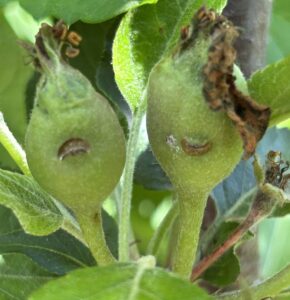
Plum Curculio; Tarnished Plant Bugs; and Other Catfacing Insects: Last week we observed on average 1% injury on developing fruit from PC (Figure 2), specifically apples, in southern counties. This is an increase from 0.3% injury observed from last week.

Figure 2. Injury to developing fruit from plum curculio oviposition in apple.

Plum Curculio start to move into orchards at about 88-100 degree days base 50 after January 1. Applications for PC should be initiated once all petals are off, with a second application made with ovicidal materials at 379-402 DD. Currently we have accumulated about 452 DD base 50 in southern counties, and 397 DD base 50 in northern counties. Growers can monitor degree day development at their site by finding the nearest weather station and using the degree day development tool at NEWA. Catfacing insects are active now and can cause injury. Greater than 1 to 2% fresh catfacing injury on the fruit means that adjustments have to be made in the spray program.

Scale Insects: White peach scale crawlers have not yet emerged but usually begin emergence about the third week of May and continue emergence until about the middle of June. San Jose scale crawlers typically begin emergence about late May or Early June and continue emergence for up to 6 weeks. Control options during crawler emergence include Neonicitiniods (suppression only), and the IGR’s Esteem and Centaur. See the NJ Commercial Tree Fruit Production Guide and the product labels for more information.

Lesser and Greater Peach Tree Borers: Growers using mating disruption for borer control can begin placing dispensers around the end of April and should have them in place by mid-May.

Apples and Pears:

Diseases: Now that primary scab is nearing the end, or has ended, the focus turns toward summer diseases such as fruit rots (esp. Bitter rot), and sooty blotch and fly speck. Bitter rot control has been difficult at best in recent years even where management programs have been rigorous. Studies have shown that fruitlets become susceptible to bitter rot infections 20 days post petal fall. Products such as Merivon, Luna Sensation, Inspire Super, and Aprovia may be effective, and longtime reliable broad spectrum fungicides such as Omega, captan and ziram should provide control. Experience has suggested that the addition of phosphorous acid products such as Prophyt or Rampart to captan sprays may improve control. Observations are that these products improve control of other summer diseases such as sooty blotch and flyspeck, and may help suppress scab infections where present.

Fire Blight: Infections can still occur post bloom so covers with antibiotics when infection events are forecast using the NEWA fire blight model may be beneficial. Remember to rotate streptomycin and oxytetracycline products. To reduce the risk of antibiotic resistance developing, apply in combination Actigard and Apogee to control fire blight. These products may be particularly useful in young trees where fire blight incidence and damage can be significant. This article from Michigan State provides more information on the use of these materials to target shoot blight. If symptoms appear, it is generally recommended to cut out infected limbs; however, this is a practical decision that must be made. This blog post from Michigan State may be helpful to decide whether it is worth cutting out infected tissue.

Codling Moth: A Codling Moth Biofix was set in Southern counties on 4/28 and in Northern counties on 4/30. See the NJ Commercial Tree Fruit Production Guide for recommended materials and rates. Where Mating Disruption has been employed, supplemental Madex applications should be made at the timings listed below.

Codling Moth Degree Day Timing
Application and Insecticide Type
County Area Biofix Rimon:

75-100DD + 14-17 days later


Intrepid

150 + 450 DD

Diamides – Altacor, Voliam mixes: (150-200 DD)

Madex

250 DD + every 7-9 days during brood hatch (later if first spray is an IGR)

Standard Insecticides –  Delegate, Avaunt, OP’s, carbamates, pyrethroids

250 DD + 550 DD


DD 75 100 150 450 250 250 550
Southern April 28 Past Past 5/7 Too far off 5/14 5/14 Too far off
Northern  April 30 Past Past 5/10 Too far off Too far off Too far off Too far off

Scale Insects: Dormant oil applications are standard recommendations for scale control but in some years when conditions are not optimal for oil application scale control may be less than desired. Where oil was not applied or in orchards where scale is a recurring problem, an application of Centaur at petal fall or Movento between petal fall and first cover should “clean up” problem blocks. Centaur is recommended at 34.5 ozs./ac and Movento should be applied at 6-9 ozs./ac. A penetrant must be included to Movento as per the product label. Movento will also control apple aphids, including Wooly Aphid, when used at this timing. In pears Movento may also control aphids and 2nd generation pear psylla (if eggs are present) when applied at first cover.

Rosy Apple Aphid:  If a pre-bloom application was not made, monitor for colonies during bloom and use a treatment threshold of 1 colony/tree at petal fall. Rosy aphid colonies have been observed in orchards starting the week of 4/28.

Wooly Apple Aphid (WAA); Green Apple (Spirea) Aphids (GAA): GAA colonies are being observed in some apple blocks. GAA is generally a pest that can be tolerated since they do little direct damage. Treatment thresholds for GAA are if 50% of the shoots are infested with no beneficial insects present. WAA aerial colonies are also being observed about a month earlier than usual. In most years these are controlled by beneficials however in some years like 2022, serious outbreaks can occur. The best control for WAA is Movento applied before or when the first colonies appear. Diazinon is also effective at knocking down infestations. Movento will also control GAA and should control san jose scale when applied in mid-May, and suppress scale when applied in late May or early June.  Do not combine Diazinon with Captan.

Ambrosia Beetle : Trap captures continue at previous week’s levels. Infested trees should be showing signs of stress or will be soon. Once these beetles bore into the trunk, they will form a gallery in the heartwood of the tree to lay their eggs and farm the ambrosia fungus to feed themselves and their larvae. Once the female lays her eggs, it will take about 30 days for them to become adults and emerge from their host tree to begin the second flight. If you have had a history of this pest in your orchard, you should begin scouting for damage and remove any trees that have been attacked. It may be beneficial to leave attacked trees in the orchard for a few weeks before removal so they can act as trap trees to reduce populations. Beetles generally do not leave the host tree once they’ve attacked it. They will attract other beetles to the stressed tree and adjacent trees so they tend to stay in one area rather than spread throughout the orchard.

Pear Psylla:  Second generation pear psylla have not appeared yet, but usually begin hatching mid-late May. Options for control include spinosyn products such as Delegate and Entrust, and the neonicotinoids (IRAC group 4A). The addition of 0.25-1 gal of summer oil may improve control. Other options include Movento, and products containing abamectin. Be sure to read and follow the label instructions regarding the addition of penetrants for these products.

Grapes

We are prebloom in vineyards in southern counties. The most important diseases to manage at this time are Phomopsis and Powdery Mildew. Starting at 3″ growth start managing for Black Rot. More information about early season disease control can be found in this blogpost from Virginia Tech. SLF nymphs are emerging in southern counties and will continue to hatch over the next few weeks.

Figure 3. SLF Nymphs on Grape.

We are beginning to catch grape berry moth in pheromone traps in vineyards; however, a biofix will not be set until early native varieties are at trace bloom. Research has shown that insecticide timing for the first generation provides little, if any, control of grape berry moth in vineyards.


Phenology Table: Based on annual observations made in Gloucester County.

Pest Event or Growth Stage Approximate Date 2025 Observed Date
 Bud Swell (Redhaven/PF-17)  March 23 +/- 15 Days March 30
1/4″ Green Tip Red Delicious March 31 +/- 13 Days March 30
Pink Peach (Redhaven/PF-17) April 4 +/- 15 Days April 1
Tight Cluster Red Delicious April 9 +/- 13 Days April 5
Full Bloom Peach (Redhaven/PF-17) April 9 +/- 14 Days April 10
Pink Apple (Red Delicious) April 14 +/- 12 Days April 16
Full Bloom Apple (Red Delicious) April 22 +/- 11 Days April 25
Petal Fall (Redhaven) April 22 +/- 10 Days April 19
Petal Fall (Red Delicious) April 27 +/- 13 Days May 2
Shuck Split (Redhaven) April 30 +/- 11 Days April 26
Pit Hardening June 15 +/- 9 Days

Tree Fruit Trap Captures – Southern Counties

Week Ending STLM TABM-A CM BMSB OFM-A DWB OFM-P TABM-P LPTB PTB
4/5/2025 0 0 0 0 0 0 0 0 0 0
4/12/2025 0 0 0 0 6 0 0 0 0 0
4/21/2025 0 0 0 0 36 0 1 0 0 0
4/27/2025 25 0 0 0 24 0 5 0 1 0
5/2/2025 517 0 4 0 12 0 6 0 13 0
5/9/2025 159 4 10 0 3 16 5 4 46 0

Tree Fruit Trap Captures – Northern Counties

Week Ending STLM TABM-A CM BMSB OFM-A DWB OFM-P TABM-P LPTB PTB AMBROSIA BEETLE
4/5/2025 387 0 0 0 0 0 0 0 0 0 0
4/21/2025 435 0 0 0 0 0 1.3 0 0 0 0
4/27/2025 26 0 0 0 0 0 25 0 0 0 72
5/2/2025 86 0 0.33 0 72.5 0 47.2 0 0 0 136
5/9/2025 56 0 5.3 0 58.8 0 22.9 0 0 0 145


Ornamental IPM – Blight and pest alerts – next IPM Session 5/13/25

  1. Serious potential for Boxwood Blight
  2. Bronze Birch Borer (BBB) approaching adult emergence
  3. Clearwing Borer adult flight – time to monitor
  4. Red-headed flea beetle (RHFB) egg hatch – adult emergence soon
  5. Oomycete material considerations
  6. (click the ‘Read More’ below for complete dates in S-C-Northern NJ per pest)

Still time to Sign up for the 2025 – Rutgers Ornamental IPM Program

(Join us for the next Session Tuesday 5/13/25)

Note we have Clearwing borer lures and wing or delta traps, scale crawler tape, and yellow sticky cards available to commercial grower program members at our Cumberland (twaller@njaes.rutgers.edu) and Monmouth (william.errickson@njaes.rutgers.edu) RCE offices.

[Read more…]

South Jersey Wine Grape Twilight

When: May 20 (Tue) 5:00 PM
Where: Autumn Lake Winery: 870 W Malaga Rd, Williamstown, NJ 08094

Pesticide Credits: CORE; PP2; 1A; 10

PROGRAM

Welcome and Updates
Hemant Gohil, Gloucester County Extension Agent, Rutgers NJAES
Mark Hernandez, Owner, Autumn Lake Winery

Field Observations from the Wine Grape IPM Pilot Program
Janine Spies, Statewide Fruit IPM Program Leader, Rutgers NJAES.

2025 Recommendations for Disease Management
Peter Oudemans, Extension Specialist, Small Fruit Pathology, Rutgers NJAES.

Record Keeping Update for 2025
George Hamilton, Extension Specialist in Pest Management, Rutgers NJAES.

Grape Berry Moth in the Vineyard
Anne Nielsen, Extension Specialist in Fruit Entomology, Rutgers NJAES.

Crown Gall – Early Symptoms and Management
Hemant Gohil, Extension Agent, RCE of Gloucester County.

Grape Nutrition Update. 
Gary Pavlis, Extension Agent, RCE of Atlantic County.

Pesticide recertification credits and adjourn.

Light fare will be provided. If you plan to attend, please email Joan Medany at jmedany@co.gloucester.nj.us or call 856-224-8030. For additional assistance, please get in touch with Hemant Gohil at 856-224-8029 before the meeting.

Vegetable IPM Update 5/08/25

Sweet Corn

We’ve put out corn earworm pheromone traps throughout the state. While silking corn is the main target of CEW activity, we set the traps early to detect overwintering moths, which have become more common with warmer winters. As a reminder, we’re no longer using blacklight traps as of this year, and we’ll be reporting pheromone trap counts in the Plant Pest Advisory as the season progresses.

Cole Crops 

A shiny black beetle with straight antennae stands on a leaf surrounded by circular feeding holes.

Flea beetle surrounded by feeding damage. Picture by Maria Cramer.

Flea beetle are active in various cole crops. This year, they have been especially prevalent in Napa cabbage and bok choy. Young plants are especially vulnerable to attack from flea beetles. The treatment threshold for flea beetles in heading cole crops is 50% infestation.


Two picture, the picture on the left shows a smooth caterpillar that tapers at both ends. The picture on the right shows a caterpillar that is fuzzy all over and does not taper at either end.

Left: Diamondback moth caterpillar, showing characteristic tapering at each end. Right: Imported cabbageworm caterpillar showing characteristic fuzziness. Pictures by Maria Cramer.

We’re seeing caterpillar activity (imported cabbageworm and diamondback moth) in cabbage and other cole crops. Treatment thresholds vary between crops and growth stage, but for heading cole crops between early vegetative and cupping, the treatment threshold is 30%. At this stage, sprayable Bt products (IRAC 11A) such as Dipel, Xentari, or Javelin can be effective on young caterpillars. Other materials approved for caterpillar control include Entrust/Radiant (IRAC 5), Proclaim (IRAC 6), Torac (IRAC 21A), and Exirel (IRAC 28). For Bt products and contact insecticides, coverage on the undersides the leaves is essential.


Tomatoes

In high tunnel tomatoes, we’re seeing limited aphid, thrips, and spider mite activity. If dealing with primarily aphids, products such as Beleaf (IRAC 29) are recommended, especially if plants have reached the flowering stage. For thrips, Entrust, Radiant (IRAC 5) and Torac (IRAC 21A) can be used. For spider mites, Nealta (IRAC 25) is an effective material that is more friendly to beneficial insects, but Portal (IRAC 21A) and other materials can be used to manage populations.


Please consult the Mid-Atlantic Commercial Vegetable Production Guide for a more comprehensive list of materials that are labeled for specific crops and pests. As always, be sure to follow label rates and application instructions.

Authors: Amanda Quadrel (Northern NJ Veg IPM coordinator) and Maria Cramer (Southern NJ Veg IPM coordinator)