Archives for May 2021

Updated COVID Farm Guidance for the 2021 Season

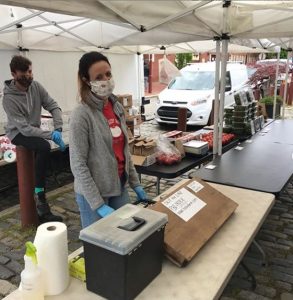
Volunteer workerWe have been watching as the state executive orders continue to roll out and how this impacts the agricultural community.  The two key take-aways for farms this season are:

  1. Ensure that your customer capacity limits allow for 6′ of social distancing
  2. Communicate to customers that masks will be required when indoors and when social distancing isn’t possible out of doors

Guidance documents have been updated on the following topics 
U-Pick Operation Guidelines under COVID-19
RCE Wholesale Grower Questions
Best Practices for Direct Market Sales
Complying with NJ Executive Orders – Pick Your Own

The Rutgers On-Farm Food Safety Team now has a COVID-19 Information For the Agricultural Industry webpage where these updated documents are housed, along with other COVID resources and vaccine information including printable posters in multiple languages.
Manage Stress with 10 Self-Care Tips

Mental health is something few people feel comfortable talking about. However, we all know stress can lead to many health issues both mental and physical. Here are a few self-care practices to help eliminate stress and strengthen your mental well-being:

Adopt better sleep habits: Prepare yourself for a restful night’s sleep by securing a comfortable environment. Turn off electronics, lights, and other distractions that may stimulate the brain.

Begin an exercise regimen: Start with small changes by opting to take the stairs, if able, instead of the elevator. Take stretch breaks during the day. Go on a walk or a bike ride.

Find a hobby: Don’t be afraid to try something new or do something you enjoy.

Take a social media break: Put down the tablet, smartphone, step away from the computer for a block of time.

Utilize stress management techniques: Try yoga, meditation, or breathing exercises.

Get organized: Use a planner to set goals for yourself. You will feel a sense of accomplishment crossing things off your list!

Keep a journal: Instead of dwelling over negative thoughts, put them down on paper. Then “close the book on them” and enjoy your day.

Volunteer: It feels good to help a friend or give back to your community, as well as a great way to connect and cultivate relationships.

Strengthen your communication skills: Make connections by reaching out and talking to someone, as well as be a good listener.

Treat yourself, as well as others, with respect: Remember, we are all human, we make mistakes, and we miss goals, but maintaining a positive outlook is key.

Information shared from: Jana L. Davidson, Progressive Agriculture Foundation. More information from the article in the May 5th edition of the Morning Ag Clips.

Gypsy Moth Seen in Cranberry Beds

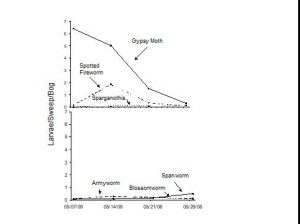
We are observing high populations of gypsy moth larvae in cranberry beds near wooded areas. The last time we saw these numbers was over a decade ago in 2007-2008. I am showing a graph (Figure 1) that illustrates the number of lepidopteran pests (gypsy moth, spotted fireworm, Sparganothis fruitworm, armyworms, cranberry blossomworm, and spanworms) observed in 2008 in various cranberry beds (from bud break to bloom). The graph shows the timing when gypsy moth larvae were found in beds in comparison with other common leps. Based on these data, number of gypsy moth larvae peaked at this time of the year and then decline in the following two weeks. It also shows an overlap of gypsy moth numbers with the numbers of spotted fireworm and Sparganothis fruitworm in beds. This indicates that treatment for gypsy moth should also control these other pests if the residue lasts for 10-14 days.

Lepidopteran Larvae in 2008 Sweep net Samples

Figure 1. Number of Lepidopteran Larvae in 2008 Sweep net Samples

Biology. Gypsy moth has one generation a year. It overwinters as eggs. Eggs hatch at this time of the year (we should have already passed peak egg hatch). First instars “balloon” on silken threads from infested trees onto nearby cranberry beds. Thus, gypsy moths tend to be one of the earliest caterpillars to show up in cranberry beds, usually during the first week of May. Observed larvae are mostly 2nd instars and will feed on the terminal buds. Although less common, it is also possible that eggs overwintered on the bog floor and that older larvae will crawl later in the season onto beds from surrounding trees.

Scouting and Control – Gypsy moth larvae are quite easy to detect by means of sweep net sampling and are easy to control with most of the insecticides at our disposal. The action threshold for gypsy moth is an average of 4.5 larvae in sets of 25 sweeps. We recommend the use of Intrepid, Delegate, Altacor, Exirel, or Verdepryn, if populations exceed action thresholds. These are reduced-risk insecticides that are very effective against lepidopteran pests.

Nursery and Conifer Pest Scouting Guide: 250-600 GDD & Boxwood Blight Information & Request for Collaborators

Please print or download these resources (click on them)

General Nursery Scouting (contains conifer information within range

Conifer / Christmas Tree Specific Pest Scouting Guides

To determine your local growing degree-days, please review this postObtaining your local growing degree-day information”

Projected GDD50 accumulation as of 5/5/2021
Region Location 5-May 1-Jun 1-Jul 1-Aug 1-Sep
Southern Upper Deerfield (NJ50) 308 665 1342 2184 2970
Central Howell / Freehold (NJ10) 208 511 1132 1926 2660
Northern High Point (NJ59) 127 315 767 1373 1928
Forecast: NOAA NCEP Coupled Forecast System model version 2 (CFSv2) forecast system (3.5 months) (USPEST.ORG)


Pest Scouting – Growing Degree-day Ranges (240-600 GDD50)
CROP TYPE Common Name Scientific Name GDD Min (50F) GDD Max (95F) Reference Developmental / Target Stage
Many Redheaded flea beetle Systena frontalis 242 600 Unv. Del First control target – egg hatch / larval activity
Conifer Arborvitae leafminer Argyresthia thuiella 245 360 RU Larvae Treatments (1st generation)
Prunus American plum borer Euzophera semifuneralis 245 440 5 Adult flight, egg laying
Boxwood Boxwood mites Eurytetranychus buxi 245 600 RU All Stages
Lilac Lilac leafminer Caloptilia syringella 246 363 5 Larvae Treatments
Holly Holly leafminer Phytomyza ilicis 246 448 RU Larvae Treatment
Yew Taxus mealybug Dysmicoccus wistariae 246 618 RU Adults/Crawlers
Conifer Pine sawflies (Red-headed) Neodiprion lecontei 246 1388 RU Larvae (1st generation)
Boxwood Boxwood leafminer Monarthropalpusi flavus 249 6 Adult emergence
Conifer Eastern spruce gall adelgid Adelges abietis 250 310 5 Egg hatch, galls begin forming (not a control target)
Birch Birch Leafminer Fenusa pusilla 275 375 4 Adults laying eggs
Boxwood Boxwood Psyllid Cacopsylla busi 290 440 RU Nymphs
Conifer Pine Needle Scale Chionaspis pinifoliae 298 448 RU Crawlers (1st generation) – control target
Locust Locust leafminer Odontota dorsalis 298 533 5 Typical treatment window
Conifer Pine eriophyid mites Eriophyidae 298 533 5 Typical treatment window
Malus Redbanded leafroller Argyrotaenia velutinana 298 618 5 Typical treatment window
Privet Privet Rust Mites Aculus ligustri 298 802 RU All stages
Oaks Kermes oak scale Allokermes spp. 298 912 5 Typical treatment window
Conifer Pine root collar weevil Hylobius radicis 300 350 4 1st adults active
Conifer Turpentine beetle Dendroctonus terebrans 300 350 4 Parent beetles colonizing brood material
Spirea Spirea aphid Aphis spiraecola 326 6 Adults/nymphs
Conifer Hemlock Woolly Adelgid Adelges tsugae 350 350 RU Eggs and 50% hatch
Malus, Prunus, many Lesser peach tree borer Synanthedon pictipes 350 375 4 Adult flight, egg laying
Rhododendron Azalea Lacebug Stephanitis pyrioides 350 646 RU Adults (1st generation)
Dogwood, apple, pecan, elm, hickory, willow Dogwood borer Synanthedon scitula 350 850 4 adults, eggs, caterpillars
Conifer Elongate Hemlock Scale Fiorinia externa 360 700 RU Crawlers (1st generation)
Elm Elm Leaf Beetle Xanthogaleruca luteola 363 530 RU Larvae treatment (1st generation)
Conifer Larch casebearer Coleophora laricella 363 618 2,4 Nymphs active – typical treatment window
Many Oystershell Scale Lepidosaphes ulmi 363 707 RU Crawlers
Walnut Walnut blister mite Eriophyes erinea 363 707 5 Typical treatment window
Beech Woolly beech aphids Grylloprociphilus imbricator & Phyllaphis fagi 363 7070 5 Typical treatment window
Conifer Striped pine scale Toumeyella sp. 400 500 3 Crawlers (1st generation)
Conifer Pine needle midge  Thecodiplosis brachynteroides 400 500 7 Adults (1st generation)
Conifer Pine tortoise scale Toumeyella parvicornis 400 1000 4 Crawlers
Yews, Rhododendrons, many Black Vine Weevil Otiorhynchus sulcatus 400 2800 RU Adults treatment
Basswood Basswood lacebug Gargaphia tiliae 415 6 Adults/nymphs
MANY Fourlined plant bug Poecilocapsus lineatus 435 6 Egg hatch / early instars
Many Two-Spotted Mite Tetranychus urticae 437 997 RU Adults (build-up activity)
Birch Bronze Birch Borer Agrilus anxius 440 880 RU Adults (egg laying)
Boxwood Boxwood Leafminer Monarthropalpusi flavus 448 700 RU Larvae treatment
Rhododendron Azalea whitefly Pealius azaleae 448 700 5 Adults/nymphs
Oak Oak skeletonizer Bucculatrix ainsliella 448 707 5 Typical treatment window
Conifer Hemlock looper Lambdina fiscellaria 448 707 5 Typical treatment window
Conifer Pine shoot beetle Tomicus piniperda 450 500 4 Adults emerge; begin shoot feeding – control target
Conifer Pine Chafer (Anomela Beetle) Anomala oblivia 450 600 7 Adults (1st generation)
Many Gypsy moth Lymanttria dispar 450 900 4 Caterpillar to pupation – control target missed
Juniper Maskell scale Lepidosaphes pallida 470 6 Crawlers (1st generation)
Conifer European pine shoot moth Rhyacionia buoliana 480 710 5 Larvae Treatment
Malus, Prunus, many Peach Tree Borer Synanthedon sp. 500 600 RU Adults – emerge (1st treatment both types)
Rhododendron Rhododendron Borer Synanthedon rhododendri 509 696 RU Adults emerge
Many White prunicola scale Psedaulacaspis prunicola 513 6 Crawlers (1st generation)
Many Redheaded flea beetle Systena frontalis 517 1028 Unv. Del Adults – feeding / laying eggs
Many Cottony camellia / taxus scale Pulvinaria floccifera 520 6 Crawlers (1st generation)
Birch Birch Leafminer Fenusa pusilla 530 700 RU Larvae (2nd generation)
Conifer Arborvitae Leafminer Argyresthia thuiella 533 700 RU Adults (egg laying) – larvae treatments
Euonymus Euonymus Scale Unaspis euonymil 533 820 RU Crawlers (1st generation)
Oak Oak blotch leafminers Cameraria spp. ; Tisheria spp. 533 912 5 Typical treatment window
Maple Greenstriped mapleworm Dryocampa rubicunda 533 1645 5 Control target
Conifer Balsam gall midge Paradiplosis tumifex 550 700 4 Galls apparent
Conifer Juniper scale Carulaspis juniperi 550 700 7 Egg hatch
Malus, Prunus, many Greater peach tree borer Synanthedon exitiosa 575 710 4 Adult emergence
Conifer Cryptomeria scale Aspidiotus cryptomeriae 600 800 3 First crawler emergence
Conifer Bagworm Thyridopteryx ephemeraeformis 600 900 RU Larvae (early instars) – ONLY CONTROL WINDOW
Conifer Cooley spruce gall adelgid Adelges cooleyi 600 1000 7 Nymphs active – Douglas fir (control target)
RU Rutgers Cooperative Extension – Landscape IPM Notes
2 http://ccetompkins.org/resources/using-growing-degree-days-for-insect-management
3 https://extension.psu.edu/ipm-basics-for-christmas-trees#section-2
4 https://www.canr.msu.edu/ipm/agriculture/christmas_trees/gdd_of_conifer_insects
5 https://www.agriculture.nh.gov/publications-forms/documents/landscape-pests.pdf
6 https://extension.umd.edu/ipm/pest-predictive-calendar-landscapenursery
7 https://www.canr.msu.edu/ipm/agriculture/christmas_trees/gdd_of_landscape_insects
Unv. Del. Coorespondance with Dr. Kunkel (University of Delaware)


Boxwood Blight risk-model information, considerations, and links:

Boxwood Blight Risk Assessment as of 5/5/2021
Region Location CODE 4-May 5-May 6-May 7-May 8-May 9-May
Southern Upper Deerfield NJ50 Infection Risk Infection Risk Very Low  Very Low  Very Low  Very Low 
Central Howell / Freehold NJ10 Low  Low  Very Low  Very Low  Very Low  Very Low 
Northern High Point NJ59 Very Low  Very Low  Very Low  Very Low  Very Low  Very Low 
Please check your local boxwood blight risk here (click here and type in your area code – select closest station)


Wednesday 5/4/21 -PPA Post regarding boxwood blight activity (click here)

  • These advisories are general in nature and change rapidly so someone from your business should be using this risk model (CLICK HERE) daily if boxwood is important to your financial stability – In 30 seconds you can have a better idea of boxwood blight (and other pathogen) activity in your immediate area!
    • (click on the link – input area code – select closest weather station – check 7-14 prediction – click on graph / table) 


Phytophthora sampling and Redheaded Flea Beetle survey requests (5-minutes to take both)

Please answer a few questions if you would like to be included in a statewide Phytophthora in Conifer Nurseries sampling project 

Please fill out this brief survey if you are experiencing damages due to Redheaded flea beetle (RHFB)

Contact – Timothy J. Waller – twaller@njaes.rutgers.edu for more information

Secretary Fisher Gives Mask Guidance for Farmers Markets

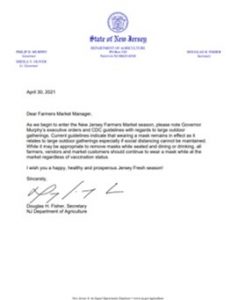
Secretary Fisher issued guidance on 4/30/21 for farmers markets regarding mask wearing, stating “While it may be appropriate to remove masks while seated and dining or drinking, all farmers, vendors and market customers should continue to wear a mask while at the market regardless of vaccination status.”  To see the full letter from Secretary Fisher visit Farm Market Mask Guidance.pdf (nj.gov)

Farm Market Mask Guidance


Vaccine Information Resources for Farmers

Anyone who lives or works in NJ is now eligible for a COVID vaccine at any of the vaccine megasites. No appointment needed, see walk-in hours here:
https://covid19.nj.gov/pages/vaccine

Information resources for farmers and farm workers continue to be developed by the CDC and the state of NJ. These resources are easily accessed on the Rutgers On-Farm Food Safety COVID website.  This website will be updated as more resources are developed.  Available now on the website:

  • Documentation from NJDOH stating all are eligible for free COVID vaccinations regardless of immigration status
  • Megasite locations and times for walk-in COVID vaccines for anyone 16 years or older
  • COVID vaccine educational posters in English, Spanish, Haitian Creole, Korean, simplified Chinese, and traditional Chinese
  • CentraState (Freehold) walk-in vaccine clinic information – May 11th and 15th

Farmers or farm workers with questions about locating a vaccine or other vaccine information may use the email address njfarmvax@njaes.rutgers.edu for assistance.
