Safely Using Herbicides in Re-Used Plastic Mulch

Crops covered with plastic protection

Plastic mulch and trickle irrigation are expensive. Re-using the mulch for a second crop after the first can be an effective way to spread the cost.

Plastic mulch and trickle irrigation are expensive. Re-using the mulch for a second crop after the first can be an effective way to spread the cost. When the cost of supplies and labor are evaluated, re-using a field with trickle irrigation and black plastic mulch is an attractive idea, but weed control can be a problem.

The herbicides used under the plastic and between the rows of mulch for the first crop must be safe and labeled for use in the second crop. Prefar applied at 6 quarts per acre in a band when the mulch is laid is a good choice for under the plastic. Prefar is labeled for many vegetable crops but ALWAYS check the label to see if the crop you plan to plant is listed on it. Prefar and Gramoxone plus NIS (nonionic surfactant), applied as a shielded banded spray between the rows of mulch, are also labeled for a wide range of vegetable crops. Be sure post plant applications of Gramoxone plus NIS are shielded, applied at low pressure, and a low drift agent is used.

Often the greatest challenge is eliminating the first crop and any weeds in the field prior to planting the second crop in the mulch. No herbicide should be sprayed broadcast over the mulch except Gramoxone, which is quickly broken down by sunlight.

Roundup and other glyphosate products should NEVER be used on plastic mulch. Gyphosate has no residual activity due to strong and immediate adsorption by the soil where it is slowly broken down by soil microorganisms as a food source. On plastic mulch without contact with the soil, glyphosate does not easily wash off the plastic with rain or irrigation. The simple act of letting the root ball in contact with the plastic during transplanting can expose the crops roots to enough glyphosate to cause lasting injury and crop loss!

Residual herbicides must be banded between the rows of plastic mulch, NEVER sprayed broadcast over the mulch. Broadcasting residual herbicides over plastic mulch can increase the risk of washing the herbicide from the plastic into the planting hole when it rains or if you irrigate overhead. Herbicide concentration in the planting hole will be way higher than the safety threshold for any crop! If the herbicide from 1 square foot of plastic washes into the 3 square inch planting hole, that will increase increase 48 times the intended herbicide rate in the planting hole!!! You can certainly not expect good crop safety from any herbicide at 48 times the intended rate! Keep all residual herbicides off the plastic mulch.

In summary, the greatest weed control challenge in re-used plastic is weeds growing under and through holes in the mulch. Gramoxone is broken down by sunlight, so it can be used to kill the first crop and emerged weeds. Consider fumigating under the mulch with a water soluble fumigant injected through the trickle irrigation to provide weed control in the second crop. Disease control may be another added benefit. Remember to wait until the fumigant has dissipated before planting.
Identifying and controlling botrytis in high tunnel and greenhouse tomato production

Botrytis, or gray mold, caused by the fungus, Botrytis cinerea, can cause significant losses in high tunnel and greenhouse tomato production if not controlled properly. The pathogen can rapidly spread during periods when structures are closed and when relative humidity remains high for long periods of time. This often occurs when outside weather remains cool and damp while heating is needed. Gray mold is favored by temperatures from 64° to 75°F and requires only high humidity (not leaf wetness) to become established. The pathogen has a large host range and once established in an enclosed structure it can be very difficult to control (UMASS). The fungus can survive/overwinter as mycelia or sclerotia in plant debris and in organic soil matter (NCSU).

[Read more…]

Identifying and controlling leaf mold in high tunnel & greenhouse tomato production

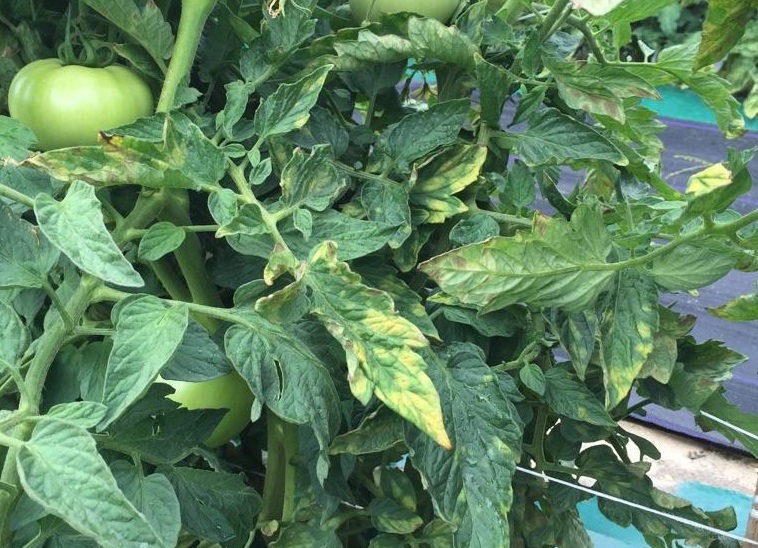
Leaf mold occasionally appears in high tunnel or greenhouse tomato production in New Jersey. However, under ideal conditions the disease will develop in field-grown crops. The fungus will cause infection under prolonged periods leaf wetness and when relative humidity remains above 85%. If relative humidity is below 85% the disease will not occur. Therefore, the proper venting of high tunnels and greenhouses on a regular basis is important. The pathogen can survive (overwinter) as a saprophyte on crop debris or as sclerotia in the soil. Conidia (spores) of the fungus can also survive up to one year in the soil.

Symptoms of leaf mold on infected tomato plant. Note the bright yellow leaves and the olive-green spores developing on the undersides of leaves.

Symptoms of leaf mold on infected tomato plant. Note bright yellow leaves and olive-green spores developing on undersides of leaves.

[Read more…]

Identifying white mold in greenhouse & high tunnel tomato production

White mold, or timber rot, is caused by the soil-borne fungal pathogen, Sclerotinia sclerotiorum.

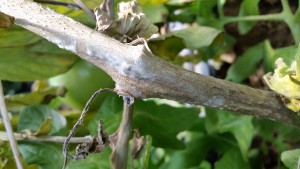
High tunnel tomato plant with main stem infected by white mold

High tunnel tomato plant with main stem infected by white mold.

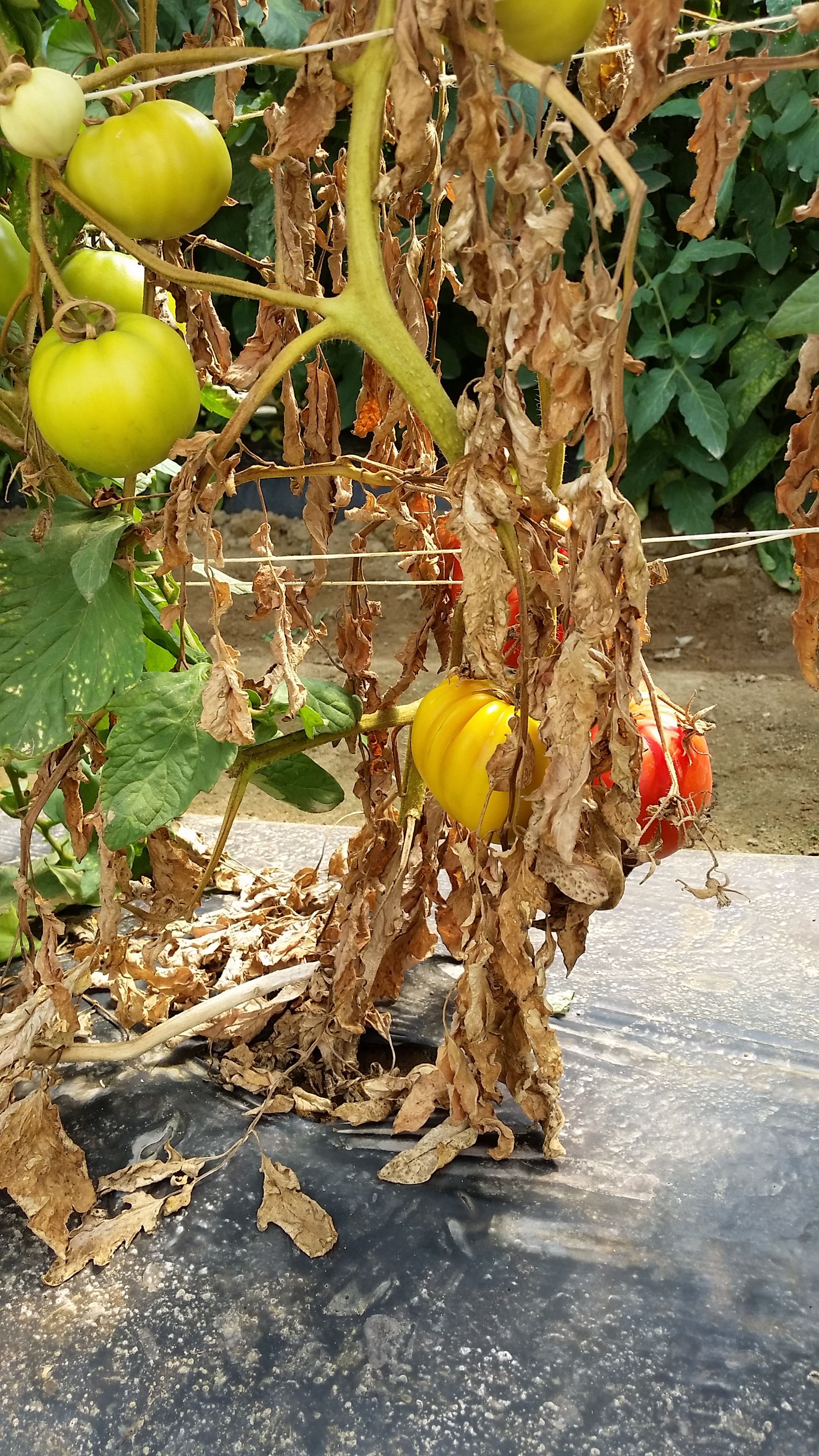
The photo on right shows a high tunnel tomato plant with main stem infected by white mold. Over time the entire plant will slowly collapse looking similar to a wilt or root rot pathogen as the water supply is cut off to the plant.

White mold is common and once introduced into a field or high tunnel it can very difficult to control. The pathogen produces black sclerotia on the surface and inside infected stems. Sclerotia, if they make their way back into the soil, can survive for years causing significant problems.

Infected stems will turn a light brown color and dry up becoming brittle. If the main stem is infected the entire plant will collapse looking like a wilt or root rot issue.

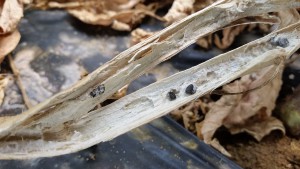
Under hot, humid conditions white fungal growth will develop on the surface of the stems and in some cases sclerotia will develop on the outside of the stem. Breaking open the stem will reveal numerous black sclerotia.

All infected plants and or plant material need to be removed from the greenhouse or high tunnel immediately and disposed of properly. Preventative protectant fungicide programs beginning at flowering will help control white mold. Cool, wet weather and poor air circulation favors disease development.

There are a number of control options for conventional and organic growers listed in Table E-11 in the 2020/2021 mid-Atlantic Commercial Vegetable Production Recommendations Guide.

Tomato stem infected by white hold. Note the fungal growth on the surface of the stem.

Tomato stem infected by white hold. Note the fungal growth on the surface of the stem.

White mold of tomato. Note the black sclerotia developing inside the brittle stems.

White mold of tomato. Note the black sclerotia developing inside the brittle stems.

Allium leaf miner update: 04/09/20

Allium Leaf Miner

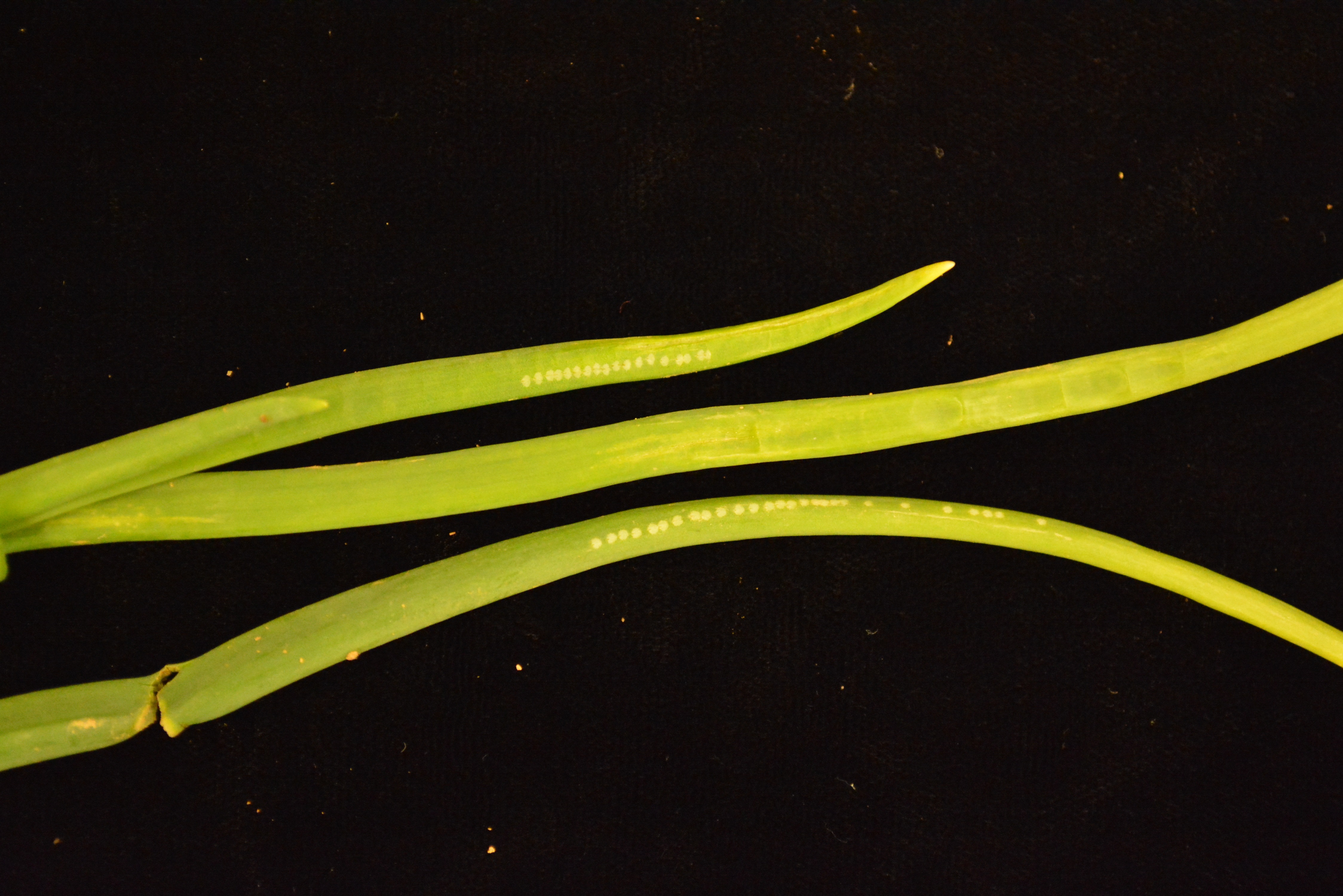
Allium leaf miner (ALM) adults were captured in higher numbers (16/week) on yellow cards in Princeton (Mercer Co.), NJ on Tuesday of this week, while lower numbers (2) were found near Milford, Hunterdon County.  Additionally, a garlic field near Asbury on the Warren/Hunterdon border was found to have 64% of plants exhibiting feeding/egglaying scars.  This indicates that the first (spring) flight of these flies is now in full swing, and damage is ongoing.  ALM flies were observed on foliage in all fields that were inspected this week.

Oviposition scars on onion

Photo: Sabrina Tirpak. Allium leafminer oviposition scars on onion

Growers should consider implementing the control method of their choice at this time.  Affected crops include chives, scallions, garlic, onions and leeks.

Floating row covers, kept on until this flight ends will help minimize access to plants.  Insecticide applications targeting adults may be helpful as well, although frequency of applications is uncertain.  Spinosyn materials (Radiant, Entrust (OMRI approved)), pyrethroids (Mustang Maxx, Warrior),  neonicotinoids (Scorpion, Venom) and the insect growth regulator Trigard are labeled for miner control.  The diamide, Exirel, is permitted in NJ under a 2ee label as well.

Adult activity and observations of feeding will be reported on in the IPM Update as they occur.  At this time, all growers should respond to the first adult generation.  We will attempt to identify the end of the first flight so that growers know when the risk of infestation has abated.


Allium leaf miner update: 03/24/20

Allium Leaf Miner

Allium leaf miner (ALM) feeding/egglaying scars were detected in chives near Princeton (Mercer Co.), NJ on Tuesday of this week.  This indicates that the first (spring) flight of these flies has now begun and damage will increase.  Additionally, extension personnel at Penn State have reported finding the first feeding scars in several southeastern PA sites within the past few days.  It is believed that all of these occurrences are very recent.

Allium leafminer oviposition scars on onion

Photo: Sabrina Tirpak. Allium leafminer oviposition scars on onion

Growers should consider initiating the control method of their choice at this time.  Affected crops include chives, scallions, garlic, onions and leeks.

Floating row covers, kept on until this flight ends will help minimize access to plants.  Insecticide applications targeting adults may be helpful as well, although frequency of applications is uncertain.  Spinosyn materials (Radiant, Entrust (OMRI approved)), pyrethroids (Mustang Maxx, Warrior),  neonicotinoids (Scorpion, Venom) and the insect growth regulator Trigard are labeled for miner control.

Adult activity and observations of feeding will be reported on in the IPM Update as they occur.  At this time, all growers should respond to the first adult generation.  We will attempt to identify the end of the first flight so that growers know when the risk of infestation has abated.