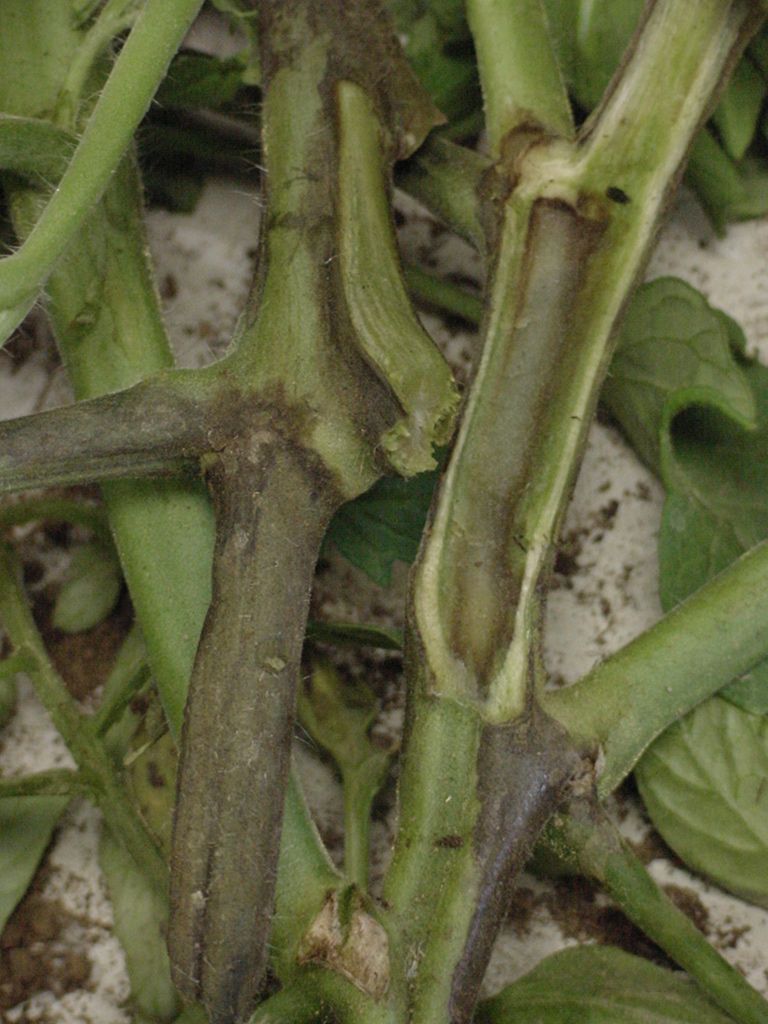
Even though much of New Jersey has had wet weather recently, which is more favorable to Pythium and Phytophthora development, Rhizoctonia root rot has been reported over the past few weeks in a number of crops. Rhizoctonia root rot, caused by Rhizoctonia solani, is an important soil-borne fungal pathogen with a very large host range. The pathogen can survive saprophytically on living or dead plant material (organic matter) or as sclerotia in the soil (for more than 3 years). Disease development is favored by warm temperatures, dry (or very well drained) soils and stressed plants. Symptoms of Rhizoctonia root rot may begin as stunted plant growth (with poor root systems) with the appearance of brown lesions at the base of the stem causing wilting with lesions eventually girdling the stem and killing the infected plant. Rhizoctonia root rot infections only extend about an inch above the soil surface (Figure 1), unlike Phytophthora blight infection which can extend much farther up the stem. [Read more…]
Diagnosing Southern blight and White mold in tomato and pepper
There have been a few reports of Southern blight (Sclerotinia rolfsii) and White mold (Sclerotinia sclerotiorum) on tomato and pepper in New Jersey. Southern blight is much more common in vegetable areas south of the state where summer temperatures remain hotter (above 90°F) for longer periods of time. Like white mold, it can survive in the soil for many years. Symptoms of Southern blight include infection at the base of the stem at the soil line. The resulting infection will girdle the plant causing wilt and death. The fungus will produce white, cottony mycelium and very small, spherical sclerotia which are often have a tannish, brown color.
White mold is more common than Southern blight in New Jersey, and like Southern blight, once introduced into a field or high tunnel it can very difficult to control. The pathogen produces large black sclerotia on the surface and inside infected stems. If sclerotia of either pathogen make their way back into the soil, both can survive for years causing significant problems.
All infected plants need to be removed immediately and disposed of properly to help reduce the chances of sclerotia returning to the soil.
For more information on chemical control please see the 2022/2023 mid-Atlantic Commercial Vegetable Production Recommendations Guide.
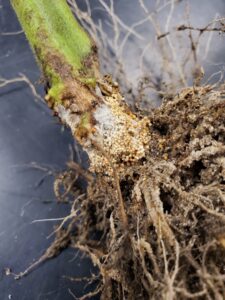
Symptoms of Southern blight on infected pepper plant. Note the numerous, small white to tan colored sclerotia on the stem.
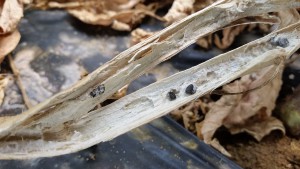
White mold of tomato. Note the large black sclerotia developing inside the brittle stems.
Diagnosing Collar Rot and Alternaria Stem Rot of Tomato
Collar rot (Alternaria linariae) or Alternaria stem rot (Alternaria alternata f. sp. lycopersici) of tomato are common in young tomato plants. Either can be particularly troublesome in seedlings that have been held in transplant flats for an extended period of time before transplanting in hot, humid greenhouses. Collar rot infections often start where a leaflet branch has been broken or pruned which allows a point of infection. Symptoms of Alternaria stem rot include brown circular to irregular lesions on stems with definitive concentric black rings (very similar to Early blight on infected leaves). Symptoms of Collar rot are similar and may or may not produce concentric black rings. Infections that start in the greenhouse may lead to losses in the field as stems become girdled causing the plant or branches to wilt and die. Most commercial tomato varieties have resistance to Alternaria stem rot. While resistance is lacking to Collar rot, growers should chose varieties with Early blight resistance. Fungicides used to control Early blight are also effective against Collar rot.
Symptoms of Collar rot in young tomato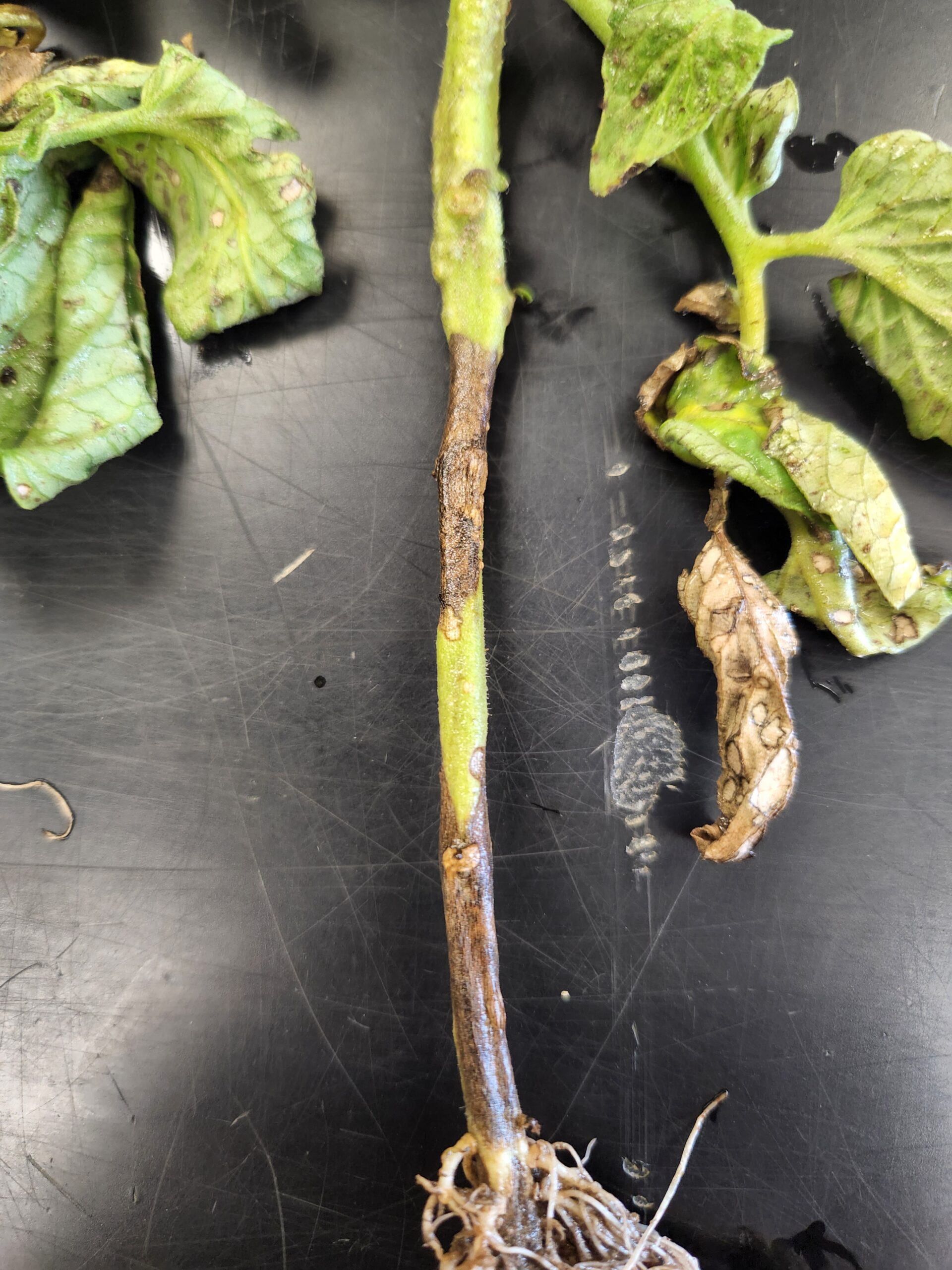 |
Diagnosing pith necrosis in tomato
Symptoms usually begin to appear on random plants throughout the field as green fruit begins to mature. The bacterium (Pseudomonas corrugata) is ubiquitous to soils and develops when weather conditions (cooler nights/very hot, humid days) and cultural practices (i.e., excess heavy N use) lead to favorable conditions for disease development. Symptoms include the development of irregular greasy (at first), brown lesions on main stems and branches. Late pruning (i.e., suckering) can provide entry points for the bacterial disease. Internally, stems will become chocolate brown and mushy. High humidity is necessary for disease development. High nitrogen and lower night temperatures are associated with Pith Necrosis development, where it has been reported around the state this past week. Control begins with cultural practices such as avoiding working in fields with wet foliage, avoiding late pruning, tying when plants are wet, and watching the amount of N applied to plantings. Infected plants can be rouged from field and most often it does not spread to nearby uninfected plants.
Identifying and controlling Botrytis in high tunnel and greenhouse tomato production
Botrytis, or gray mold, caused by the fungus, Botrytis cinerea, can cause significant losses in high tunnel and greenhouse tomato production if not controlled properly. The pathogen can rapidly spread during periods when structures are closed and when relative humidity remains high for long periods of time. This often occurs when outside weather remains cool and damp while heating is needed. Gray mold is favored by temperatures from 64° to 75°F and requires only high humidity (not leaf wetness) to become established. The pathogen has a large host range and once established in an enclosed structure it can be very difficult to control (UMASS). The fungus can survive/overwinter as mycelia or sclerotia in plant debris and in organic soil matter (NCSU).
Identifying and controlling leaf mold in high tunnel & greenhouse tomato production
Leaf mold occasionally appears in high tunnel or greenhouse tomato production in New Jersey. However, under ideal conditions the disease will develop in field-grown crops. The fungus will cause infection under prolonged periods leaf wetness and when relative humidity remains above 85%. If relative humidity is below 85% the disease will not occur. Therefore, the proper venting of high tunnels and greenhouses on a regular basis is important. The pathogen can survive (overwinter) as a saprophyte on crop debris or as sclerotia in the soil. Conidia (spores) of the fungus can also survive up to one year in the soil.
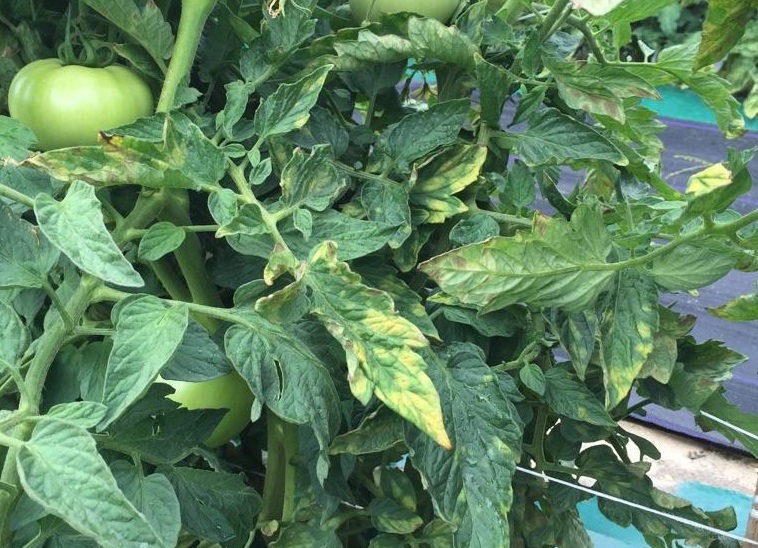
Symptoms of leaf mold on infected tomato plant. Note bright yellow leaves and olive-green spores developing on undersides of leaves.