
2021 Mid-Atlantic Field Crop Weed Management Guide

2021 Mid-Atlantic Field Crop Weed Management Guide

The 2021 updated version of the “Mid-Atlantic Field Crop Weed Management Guide” is available. This guide is produced by Penn State Extension in cooperation with weed scientists from University of Delaware, University of Maryland, Rutgers University, Virginia Tech, and West Virginia University.

The guide covers weed management  for field corn, sorghum, soybean, small grains, and forage and pastures. Information concerning the use,  restrictions, and recommendations of burndown, preemergence, and postemergence herbicides labeled on these crops can be found in the guide, including relative effectiveness data from locally conducted research. Description of the various premixes as well as guidance for  managing troublesome weeds are also part of the guide.

The guide  can be ordered on-line at https://extension.psu.edu/mid-atlantic-field-crop-weed-management-guide. Available to order are the paper copy for $10, the digital guide for $8, or both a hard copy and pdf for $18.

 

More Reasons and Some Strong Precautions When Adding Soil Around Transplants on Plastic Mulch

There are a couple of additional reasons you might consider placing soil around the transplant hole when using plastic mulches, but take note – this practice should come with a significant warning label!

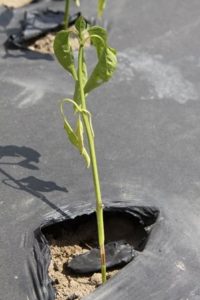
pepper transplant on plastic mulch with stem burn

This pepper seedling is wilting because the stem is severely burned where it touched the hot plastic mulch.

In addition to reducing heat venting and water pooling that Michelle described in her previous post, one of the first reasons this practice gained popularity among vegetable growers was to prevent the plastic mulch burns on the stems of transplants, especially tomatoes and peppers. On bright sunny days during the transplanting season from late April through June, the temperature of unshaded, black plastic mulch will get hot enough to cause a burn on the stem if touching the transplant. Coupled with wind whipping and rapid transpiration, stem burn can kill a new transplant outright. If the plant does survive, there can be enough damage that later in the season the stem is too weak to support the top growth and the plant topples over.

For that reason, the current Mid-Atlantic Commercial Vegetable Production Recommendations, especially for peppers, is to, “Use opaque, white plastic when planting in the summer [and even late spring] for fall harvest.”

Warning – consider these factors in selecting soil to put around transplants on plastic mulch:

Many growers have learned in the school of hard knocks that this practice can cause some problems as serious as those they were trying to prevent. By trial and error, most have learned that the best soil to put around transplant holes is clean, washed sand from a site other than the field where it is applied, or field soil that has been fumigated the same as the mulched beds.

Why?

  1. If you fumigate or apply fungicides to the beds to prevent Phytophthora, nematodes and other soil born diseases, putting untreated soil from between the beds puts innoculum right at the base of the susceptible new transplant, defeating the purpose of the fumigation, and maybe making the situation worse because there are no competing beneficial organisms to slow the development of those pathogens.
  2. Untreated soil from between beds will also contain weed seeds that won’t be controlled by pre-plant herbicides applied under the plastic mulch.
  3. To make matters worse, even if the soil between the beds was fumigated, if an herbicide was applied before transplanting, concentrating those herbicides at the base of a transplant may not be labeled for that use and likely will be toxic to the transplant.

Dr. Thierry Besancon, Rutgers Extension Weed Specialist for Specialty Crops, identified many herbicides labeled for use on bare soil between plastic beds that he would consider potentially dangerous to the transplants if soil containing these compounds would be added above the planting hole:

  • Fomesafen (Reflex): labeled PRE for row middles and under plastic on some crops. Unfortunately, it has also POST activity..
  • Pendimethalin (Prowl): labeled ONLY for row middle applications in plasticulture
  • Trifluralin (Treflan): labeled ONLY for row middle applications in plasticulture
  • Halosulfuron (Sandea): labeled for row middles only. Has both PRE and POST activity which could result in severe crop injury if the herbicide get in contact with the crop.
  • Clomazone (Command, Strategy): even if it’s labeled for under plastic and row middles PRE application in some crops, be extremely careful with this herbicide that cannot be applied over emerged plants.
  • Metribuzin: only labeled for row middles application in plasticulture – potential risk of injury if soil containing it is used around the hole because it has POST activity
  • Rimsulfuron (Matrix): labeled only for row middles with both PRE and POST activity on broadleaf species.
  • Terbacil (Sinbar): used PRE under plastic or in row middles, but has POST activity and should never be applied over the crop.
  • Ethalfluralin (Curbit): labeled ONLY for row middle applications in plasticulture

Other PRE herbicides such as bensulide (Prefar), napropamide (Devrinol) or s-metolachlor (Dual Magnum) should not cause damage but using soil that has been treated with these products when adding soil around the transplant holes is discouraged as no tests have ever been conducted to make sure this is really safe, essentially because these herbicides are not supposed to be used this way.

Dr. Besancon says, “Actually, the only herbicides I would really feel confident about are the graminicides (Poast, Select) and paraquat: graminicides are only targeting grasses and paraquat will tied up to Organic Matter particles (virtually inactive in the soil).

He also warns that this technique, if using soil from between the mulched beds, disturbs the uniform herbicide distribution in the row middles by creating gaps in the coverage… herbicide-free spaces where weeds will grow! Not disturbing the soil is essential for maintaining the efficacy of PRE herbicides.

Placing soil around the base of new transplants on plastic mulch can protect tender plants from being damaged by heat, water and the plastic itself, saving time and money by reducing the need to replace plants later. Using the right soil for the job will make sure you don’t lose those savings by creating new problems!

We R Here When You Need Us

#rcehere4u #njaeshere4u #weRhere4u

“In-Row” Control of Annual Weeds in Established Blueberries with Residual Herbicides

The program for the control of annual weeds in blueberries should consider the weed free strip under the row and the row-middles, sodded or tilled, separately. The “Weed Control Season” in blueberries starts in late fall.  The program implemented in the spring depends on what herbicides were applied the previous fall.  If herbicides were applied in late fall, applications may be able to be delayed until later in the spring.  Residual herbicides should be applied before bud break in late winter or early spring after the soil is no longer frozen if no late fall treatment was applied.

Winter annual weeds germinate in the fall or late winter, flower in the spring or early summer, then die.  Summer annuals germinate in the spring and early summer, flower, and die in late summer or fall.  Perennial weeds are weed species that live for more than two years.  Control of these weeds must be considered separately.

Emerged annual weeds under the row are controlled with a postemergence herbicide.  Annual weeds that germinate throughout the remainder of the season are controlled with residual herbicides.  Two applications of postemergence herbicide plus residual herbicides are recommended annually in the weed free strip under the row.

  1. The first application should be applied in late fall, after the blueberries are dormant, but before the soil freezes, or in late winter before the buds break in the spring.  This application targets the control of winter annuals and provides early season control of summer annual weeds.  The fall can be a less busy time to apply herbicides to the fields, usually after Thanksgiving in New Jersey.  In March, growers find themselves scrambling to apply insecticides and fungicides, and prune.  Pruned branches must be removed or chopped before weed spraying can be accomplished after pruning.
  2. The second application of residual herbicides should be applied before bloom or later spring, depending on the herbicides to be applied.  A postemergence herbicide may not be needed to control annual weeds in the spring if residual herbicides were applied in late fall. However, a postemergence herbicide may be included to control certain perennial weeds such as yellow nutsedge, Canada thistle, goldenrod species, or aster species.

Most residual herbicides primarily control annual grasses or annual broadleaf weeds (BLWs).  A combination of an annual grass herbicide and an annual BLW herbicide is usually recommended.  Rate ranges are recommended for most residual herbicides and will depend on soil type and organic matter content (see Table 3 in the 2017 Blueberry Weed Control Recommendations for New Jersey).  Use the lower rates in fields with coarse textured (sandy) soil low in organic matter, and the higher rate when soils are fine textured (silt and clay) and have higher organic matter. For efficient weed control, residual herbicides require a clean soil (no weeds, organic mulch or pruning residues) before spraying and need to be activated with a minimum of ½” of rain or irrigation in the week following application.

Casoron (dichlobenil), applied in late fall, followed by a spring application of a residual annual grass herbicide is the most effective residual weed control program recommended.  More different species of weeds are controlled than any other residual herbicide combination available.  Apply 4.0 lb active ingredient Casoron CS (2.7 gallons per acre) or 4.0 to 6.0 lb active ingredient Casoron 4G (100 to 150 lb per acre) in late fall when soil and air temperatures will remain below 50 degrees Fahrenheit until rainfall moves the herbicide into the soil.  The active ingredient in the granular formulation can be lost to volatilization in warm weather.  The Casoron CS formulation is encapsulated, which prevents loss due to volatilization.  Casoron provides annual broadleaf weed control until fall and annual grass control until early summer the next year.  Certain herbaceous perennials, including goldenrod species, aster species, and yellow nutsedge will also be controlled or suppressed by Casoron applied in late fall.  Late winter applications provide less consistent winter annual and perennial weed control.  Apply an additional residual annual grass herbicide in early or late spring to provide late summer annual grass control following the late fall application of Casoron.

If Casoron has not been applied in late fall, choose your residual annual grass herbicide for the coming season before the late fall or late winter herbicide application.  Options include Devrinol (napropamide), Surflan (oryzalin), or Solicam (norflurazon). All three residual annual grass herbicides can be used at the rate of 4.0 lb active ingredient per acre per year.  Apply half the yearly labeled rate, 2.0 lb active ingredient per acre, in the late fall, and the second half, an additional 2.0 lb active ingredient per acre, in the spring, or the full rate in early spring, in no late fall application was applied.

Your residual BLW herbicides should be chosen considering crop safety, effectiveness, and price.  For many years Princep (simazine) was recommended at 1.0 to 2.0 lb active ingredient per acre in the late fall, and Karmex (diuron) was recommended at 1.0 to 2.0 lb active ingredient per acre in the spring.  Both herbicides have been safe, reliable, and cost effective choices for many years, and continue to good options where their use provides good weed control.  Both Princep and Karmex share the same mode of action, inhibition of the light reaction of in photosynthesis.  Unfortunately, triazine resistant weeds (horseweed, common lambsquarters) with cross resistance to urea herbicides are present at some sites.

Where a triazine resistant weed has become established, switch to a BLW herbicide(s) with a different mode of action.  Use Chateau (flumioxazin) at 0.19 to 0.38 lb of active ingredient per acre or Callisto (mesotrione) at 0.094 to 0.19 lb of active ingredient per acre in late fall or late winter.  Chateau and Callisto must be applied before bud break in early spring to avoid crop injury.  Chateau can cause speckling and crinkling the crop’s foliage if spray drift occurs.  The activity of Chateau occurs at the soil surface as sensitive BLW seedlings emerge.  Do not disk, till or otherwise mechanically mix Chateau into the soil after application, or the effectiveness of the herbicide will be reduced or eliminated.  Callisto bleaches foliage white.  Horseweed, also called marestail or stickweed, and common lambsquarters are very sensitive to Callisto both pre and postemergence.  Chateau and Callisto can be used in combination, or either herbicide can be tank- mixed with Princep (simazine) and Karmex (diuron) to improve BLW control.

Sandea (halosulfuron) controls BLWs and yellow nutsedge in blueberries, and has postemergence and residual activity.  Sandea is an ALS inhibitor.  Herbicides with this mode of action rely on a single site of action in susceptible weeds, putting herbicides with this mode of action at high risk for weed resistance development.  Weed resistance to ALS inhibitor herbicides is already present in the New Jersey and the surrounding mid-Atlantic region.  Due to resistance management concerns, Sandea is recommended ONLY for emerged yellow nutsedge control later in spring, but not for residual annual weed control.

Stinger (clopyralid) is a growth regulator herbicide with postemergence and residual activity labeled in New Jersey for use in blueberries to control annual and perennial weeds in the legume and composite plant families.  Legume weeds found in blueberries include vetch and clover species.  Composite weeds targeted include horseweed, dandelion, aster species, goldenrod species, Canada thistle, and mugwort (also called wild chrysanthemum).  Stinger rates and application timing depend on the weed targeted.

When annual weeds have emerged before residual herbicides are applied, a postemergence herbicide should be included in the tank. Potential options include the following herbicides:

  • Gramoxone or other labeled generic paraquat formulations applied at 0.6 to 1.0 lb active ingredient per acre plus nonionic surfactant to be 0.25% of the spray solution will control most of broadleaf and grass seedlings that are 2 inches tall or less. As a contact herbicide, paraquat will not be translocated and regrowth may occur from the root system of established weeds (taller than 2 inches).
  • Roundup and other labeled generic glyphosate products can also be used to control emerged weeds as a spot treatment, and can be especially useful where susceptible perennial weeds are a problem. Take great care when spot treating with Roundup or other glyphosate formulations to never contact the blueberry bush, or serious crop injury could occur. The rate depends on the perennial weed targeted and the glyphosate product used.
  • Rely 280 (glufosinate) is an alternative to glyphosate that is registered for use in blueberries. It is not as fast as Gramoxone, but tends to provide more complete and faster control than glyphosate without the concern for systemic movement in the blueberry bush. Similarly, to glyphosate, do not allow spray to contact desirable foliage or green bark as this would result in serious injury. Consult the label for preemergence herbicides that can be tank mixed to broaden the spectrum of weed control.

Consult the Commercial Production Recommendations for rates and additional information.
