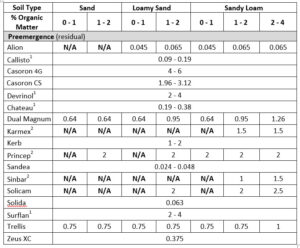
With T3 stage forecasted for the end of March this year, soil-applied preemergence herbicides should be sprayed before blueberry bud break to minimize the risk of crop injury and allow sufficient time for residual herbicide to be “activated” by rainfall.
Soil-applied preemergence herbicides should be applied prior to weed seed germination. If applied to weeds that are already out of the ground, most of these products will not control them if they are not tank-mixed with a postemergence herbicide. Glufosinate (Rely 280), paraquat (Gramoxone and generic formulations) and carfentrazone (Aim) are postemergence herbicides that may be applied with preemergence herbicides with little risk of crop injury. Keep in mind that at least ½” rainfall or irrigation is needed within 7 days after application to move (“activate”) preemergence herbicides into the soil solution. Delaying activation may reduce overall performance if some weeds continue to germinate under low soil moisture conditions or if herbicide at the surface of the soil is susceptible to sunlight breakdown.
Make sure the herbicides you plan to apply will be effective at controlling the weed species in your field by checking the herbicide label. Usually, residual herbicides will suppress weed for 5 to 8 weeks depending on irrigation as well as soil and weather conditions. After this period, another residual herbicide can be needed to control weeds through harvest and could be mixed with postemergence herbicides to control emerged weeds. To reduce the potential of selecting for herbicide-resistant weeds, it is highly recommended mixing two herbicides that belong to two different WSSA (Weed Science Society of America) groups whenever you apply preemergence herbicides.
Please, refer to the 2022-2023 New Jersey Commercial Blueberry Pest Control Recommendations for more information on herbicide rates and use restrictions. https://njaes.rutgers.edu/pubs/publication.php?pid=E265
WSSA group 0 – Unknown Site of Action
- Devrinol 50DF-XT or Devrinol 2-XT (napropamide) will provide good control of annual grasses and should therefore be tank mixed with a PSII or a PPO inhibitor for controlling broadleaf weeds. Devrinol is rapidly degraded if left exposed on the soil surface, so it should be applied less than 24 hours before a rain event to incorporate the herbicide in the soil.
WSSA group 2 – Acetolactate Synthase (ALS) Inhibitors
- Solida 25WDG or Matrix 25SG (rimsulfuron) or Sandea 75DF (halosulfuron) are ALS-inhibiting herbicides that have both preemergence and postemergence activity. They control most annual broadleaves but are weak on common groundsel, common lambsquarters and eastern black nightshade. Sandea is ONLY recommended for postemergence control of yellow nutsedge.
- However, these two herbicides will NOT control ALS resistant weeds (horseweed, ragweed) already widespread in New Jersey. Thus, these herbicides should always be tank mixed with a partner effective at controlling these weeds.
WSSA group 3 – Mitosis Inhibitors
- Kerb 50WP or Kerb 3.3SC (pronamide) is effective at controlling many annual grass species for 4 to 6 weeks after application. Surflan should not be applied to soils containing more than 5% organic matter. Kerb also helps controlling perennial quackgrass as well as annual bluegrass. If applied to warm soils, Kerb persistence and weed control can be severely reduced; therefore, keep Kerb for fall/winter application when soil temperature remains under 55°F. Do not use Kerb on blueberries that have not been established for about a year.
WSSA group 5 and 7 – Photosystem II (PS II) Inhibitors
- PS II inhibitors have a broad spectrum of control and will be effective against many broadleaves and annual grasses when applied in spring. Karmex 80DF (diuron) and Princep 4L or Princep Caliber 90WDG (simazine) have relatively low solubility and have been very safe on blueberries. Sinbar 80WDG (terbacil) has a longer residual life in the soil and also is more soluble, so it should be used infrequently on light, wet soils. These herbicides are effective on many broadleaf weed species, including common chickweed, common lambsquarters, common groundsel, henbit, nightshade, redroot pigweed, pineapple weed, shepherd’s-purse, smartweed, and some mustards. Princep and Sinbar will also control many annual grasses and help suppressing quackgrass. Do not exceed more than 1 lb/A of Sinbar to minimize the risk of crop injury.
- Trellis 4.2SC(isoxaben) is registered for bearing and non-bearing blueberry. Trellis will be most useful in new plantings for preemergence control of annual broadleaf weeds such as common lambsquarters, ragweed, black nightshade, horseweed and smartweed. It does not control grasses.
- Velpar 2L or Velossa 2.4L (hexazinone) is very soluble and should not be used on blueberries grown on sandy soils as the risk of crop injury is high with this herbicide.
WSSA group 12 and 27 – Carotenoid Biosynthesis Inhibitors
- Solicam 80DF (norflurazon) can be applied in fall or early spring primarily for annual grass control and quackgrass suppression. Solicam may also provide partial control of many broadleaf weeds as well as of yellow nutsedge. Do not use Solicam on blueberries that have not been established for about a year.
- Callisto 4SC or Motif 4L (mesotrione) will control many annual broadleaf weeds as well as annual sedges. It controls large crabgrass but no other grasses, such as goosegrass. Callisto may be used as a broadcast spray between rows to control broadleaves and crabgrass without injuring the fescue sod. However, Callisto CANNOT be applied after the onset of bloom.
WSSA group 14 – Protoporphyrinogen Oxidase (PP0) Inhibitors
- Chateau EZ (flumioxazin) and Zeus 4XC or Zeus Prime 3.5XC (sulfentrazone) have activity against many annual broadleaf weeds (pigweeds, common lambsquarters, ladysthumb, mallow, shepherd’s-purse) when applied preemergence in spring. Chateau and Zeus Prime XC also have some postemergence activity on newly emerged seedlings of annual weeds. Herbicides containing sulfentrazone will also provide suppression of yellow nutsedge. Chateau has a 7 days pre-harvest interval (PHI) and Zeus Prime XC has a 3 days PHI, allowing these herbicides to be applied later in the season to extend preemergence broadleaves control into summer. Blueberry plants must have been established at least two years prior to use of these herbicides.
WSSA group 15 – Protoporphyrinogen Oxidase (PP0) Inhibitors
- Dual Magnum 7.6ec (S-metolachlor) has a 24(c) Special Local Need label for blueberry in New Jersey. This herbicide provides preemergence control of many annual grasses and some small-seeded broadleaf annual weeds such as redroot pigweed, nightshade and common purslane. Dual Magnum also suppresses emergence of yellow nutsedge. Use Dual Magnum only on plants established for more than one year, and lower rates are suggested on 2- to 3-year-old plantings.
WSSA group 29 – Cellulose Synthesis Inhibitors
- Casoron 4G (dichlobenil) is a cellulose synthesis inhibitor recommended for fall application to control many annual and perennial broadleaves, grasses and yellow nutsedge. If left on the soil surface or if applied to warm soil (> 55°F or 70°F depending on Casoron formulation), Casoron can lose much of its activity.
- Alion 1.67SC (indaziflam) IS NOT LABELED FOR USE ON HIGHBUSH BLUEBERRY GROWN ON SANDY SOILS AND/OR ON SOILS WITH ≥20% GRAVEL CONTENT. Additionally, Alion requires significant rainfall for being activated which is not guaranteed with spring applications. Field trials at the Marucci Center have consistently shown better weed control efficacy with fall applications than spring applications.
- Casoron 4G and Alion 1.67SC should be used ONLY for fall/winter applications. Plants must be at least one year old before Casoron 4G or Alion 1.67SC should be used.