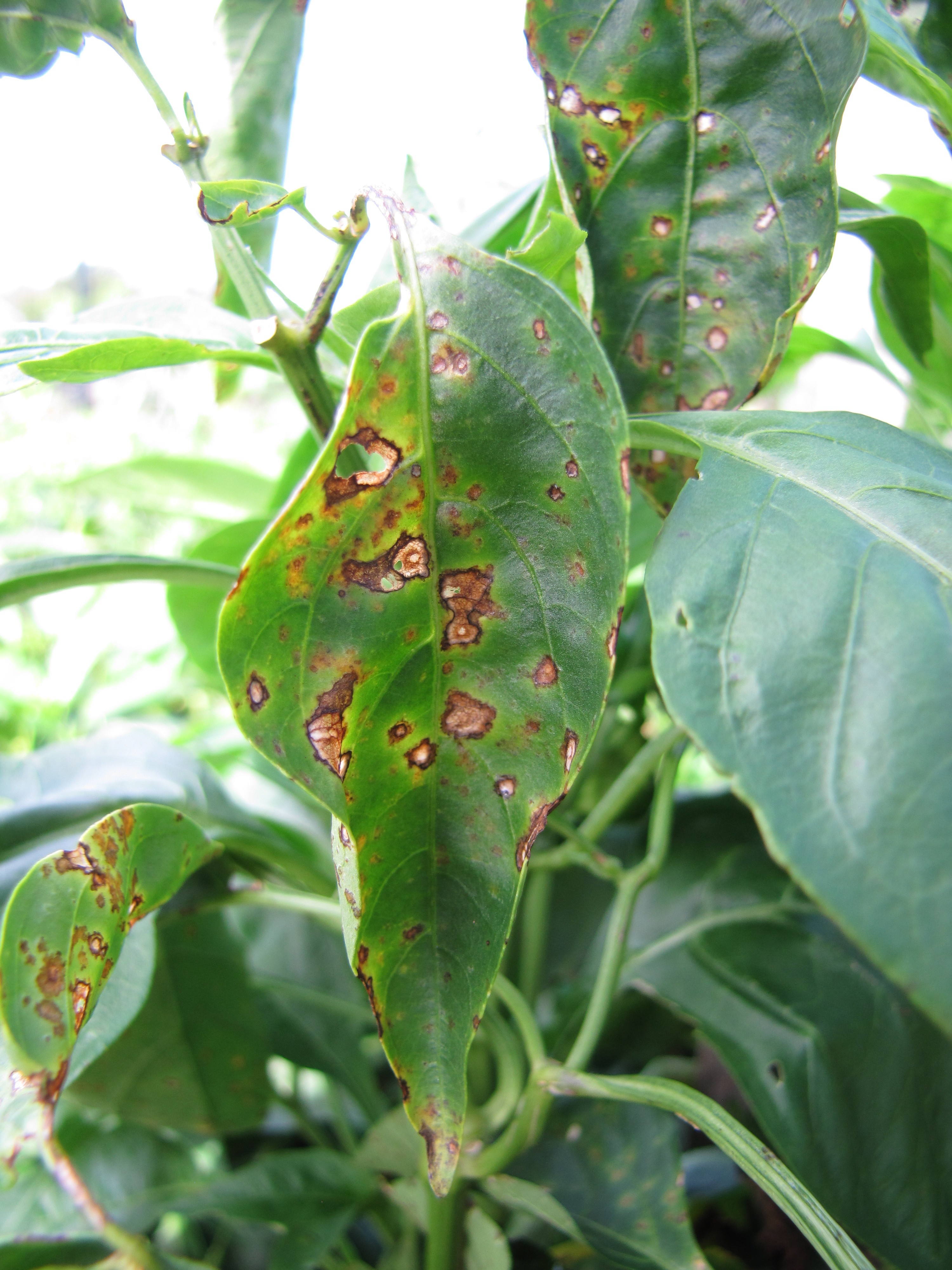
Copper resistance in bacterial leaf spot of tomato and pepper crops has been detected at a high level in New Jersey the past few summers. While not surprising, copper resistance has been known to develop for decades now. Copper applications for the control of bacterial diseases in many crops has been a mainstay for decades now and is often applied in weekly protectant fungicide programs. With help from Dr. Nrupali Patel and Dr. Don Kobayashi, bacteriologists in the Department of Plant Biology located on the New Brunswick campus, a (NJ-VGA funded) survey was initiated to determine which species of bacterial leaf spot are most prevalent in New Jersey tomato and pepper crops. Bacterial leaf spot can be caused by four species of Xanthomonas: X. euvesicatoria, X. vesicatoria, X. perforans, and X. gardneri. Currently, there are four races of BLS found in tomato (T1-T4; one for each of the 4 species stated above) and eleven races found in pepper (0-10). Differential tests in southern New Jersey using various bell pepper lines over the past 15 years has suggested that the number of races of BLS in pepper has increased over time; with all races present in the State to date. Lab testing results from samples collected from the small number of NJ vegetable farms the last three summers has shown the presence of X. euvesicatoria in pepper, as well as X. euvesicatoria and X. perforans in both tomato and pepper in the state, with ~60% of all samples testing positive for copper resistance.
Search Results for: tomato spotted wilt virus
Bacterial leaf spot, copper resistance, hot water seed treatment, and viruses
Tobacco Streak Virus (TSV) found on tomato in New Jersey
Tobacco Streak Virus (TSV) was found on fresh-market tomato this past week in southern New Jersey. TSV has a host range of close to 200 species, including cranberry, tobacco, tomato, pepper, asparagus, bean, soybean, mustard, radish, a number of ornamental hosts as well as weeds such as thistle, field bindweed, and jimson weed. Like Tomato Spotted Wilt Virus (TSWV), the Tobacco Streak Virus is also vectored by thrips. TSV can be seed-borne (reported in some hosts), spread via pollen, and mechanically transmitted. Symptoms can vary significantly depending on the host. Infected plants may have downward leaf curling, show black streaks on leaves and stems, chlorosis, stunted growth, deformed growing tips, ring spots, and flower drop. There is no genetic resistance to TSV in tomato and management should focus on keeping thrips populations as low as possible, scouting on a regular, removing infected plants, and knowing your weed population (as a potential source). The only method to correctly identify TSV is through serological tests such as ELISA.
For more information on Tomato Spotted Wilt Virus please click here.
The Curious Case of the Virus Infected Tomato Fruit
Original Article published on 6 June 2024 by Dr. Jerry Brust, University of Maryland Extension
Ben Beale, educator from St. Mary’s County found an odd thing last week. He found in a grower’s high tunnel, tomato fruit that had the symptoms of a virus infection, but there were no foliar symptoms on any of the plants. Some fruit on a cluster had symptoms while other fruit on the same cluster looked perfectly fine. Ben had the fruit tested and got a fast response from Jill Pollok at the University of Delaware Diagnostic Clinic and it was Tomato Spotted Wilt Virus. The cultivar in question Big Beef Plus has TSWV resistance. There could be one or two possibilities for TSWV symptoms showing up in a resistant cultivar and for fruit symptoms but not any foliar symptoms of the virus.
We will look at how tomatoes can get infected by the TSWV (if you already know how this works skip down to the next paragraph). Tomato spotted wilt virus (TSWV) is an obligate parasite, i.e., it must have a living host and must be moved from one plant to another by thrips or through cuttings or possibly seed. This disease can affect tomato and other Solanaceae crops as well as lettuce, beans and cucumber. TSWV may occur in the field but tends to affect greenhouse and high tunnel crops more severely. The virus is transmitted most efficiently by Western flower thrips (WFT) (Frankliniella occidentalis), and less so by Onion thrips (Thrips tabaci), Tobacco thrips (Frankliniella fusca) and several other thrips species. It is not transmitted by Eastern flower thrips (Frankliniella tritici). Only immature thrips can acquire the virus, which they can acquire within 15 minutes of feeding, but adults are just about the only stage able to transmit the virus. Adults can transmit the virus for weeks. It may take 2 – 4 weeks from when the adult thrips first feeds on a plant until initial symptoms are observed. Because of this TSWV appears to worsen in plantings over time.
Why are we seeing fruit symptoms but little if any foliar symptoms? The most likely explanation is that TSW viruliferous thrips fed on the flowers or very young fruit. The resistance to the TSWV is expressed (active if you will) in the non-reproductive parts of the plant but not expressed to any extent in the reproductive parts (flowers and fruit) of the plant. Even though the flower and fruit can act as an entry point into the plant the resistant tomato does a good job of limiting the virus into any other areas of the plant. Thus, under low to moderate feeding pressure (1-4 thrips/flower) only the fed upon fruit or possibly a few other fruits on the same cluster become infected. The other possibility is that the TSWV resistance in Big Beef Plus is intermediate and under environmental stress it may not be ‘complete enough’ to protect all of the plant.
The first question above as to why is the virus showing up at all in a resistant cultivar can be explained by the above paragraph. But there may be another possibility although not in this particular case, that we will have to watch out for in the coming years. And that is resistance- breaking virus variants. The Sw-5b gene (Sw-5) is the most widely used resistance gene for TSWV in tomato. It not only provides resistance to TSWV but also resistance to a several associated viruses including Tomato chlorotic spot virus (TCSV) and Impatiens necrotic spot virus (INSV). The presence of the Sw-5 gene in tomato plants confers resistance to TSWV by a hypersensitive defense response that causes local lesions on the leaf, preventing the spread of the virus from the infection site through the plant. In 2022, symptoms of TSWV were observed in North Carolina tomato fields on cultivars that had the gene for TSWV resistance (Sw-5). The cultivars from different farms had symptomatic foliage and fruit. Samples were collected from both farms and subjected to sequencing to identify and confirm the presence of resistance-breaking variants, which they did. I mention this because NC is very close by, many growers get their tomato transplants from NC and because the resistance-breaking occurred in the last year or so. These resistance-breaking variants may start to show up in our fields and I am guessing that when they do, we will see 20-40% viral foliar infection and possibly worse in the fruit of resistant plants. For now, we should keep using the resistant cultivars, but watch closely for any breakdown of the resistance.
Resources: 2023. First Report of Resistance-Breaking Variants of Tomato Spotted Wilt Virus (TSWV) Infecting Tomatoes with the Sw-5 Resistance Gene in North Carolina. K. Lahre, R. Shekasteband, I. Meadows, A. E. Whitfield, and D. Rotenberg. Plant Disease vol. 107.
This article appears in Volume 15, Issue 4 of the Vegetable and Fruit News.
Vegetable IPM Update 8/21/26
Greetings from the Veg IPM team! Read more for the latest pest and disease updates.
Vegetable IPM Update 8/14/26
Greetings from the Veg IPM team! Read more for the latest pest and disease updates.
Vegetable IPM Update 8/7/26
Greetings from the Veg IPM team! Read more for the latest pest and disease updates.