Search Results for: corn borer

IPM Update 7/03/19

Sweet Corn

A few European corn borer (ECB) moths were captured this past week, but numbers are very low, and no map will appear in this edition.  It is unclear at this stage if these individuals represent the onset of a second flight.  Catches over the upcoming week will clarify the situation with this pest.   No new feeding should occur until the second flight arrives.

Growers should continue to scout whorl and pre-tassel stage plantings weekly and consider treating when infested plants exceed 12% in a 50 plant sample.  As plantings proceed to the pre-tassel stage, ECB larvae may be found in emerging tassels.  It is a good idea to treat individual plantings as they move into the full tassel/first silk stage one time.  This eliminates any ECB larvae that have emerged with the tassels as they begin to move down the stalk to re-enter near developing ears.

Useful insecticides for this particular application include synthetic pyrethroids (IRAC Grp 3), spinosyns (including OMRI approved Entrust) IRAC Grp 5), and diamides such as Coragen (IRAC Grp 28) or materials such as Besiege which include the active ingredient in Coragen.  Synthetic pyrethroids alone should NOT be used for corn earworm (CEW) protection on silking corn.  Control with these materials is very inconsistent.

The highest nightly trap catches of ECB for the week ending 7/03/19 are as follows:

Denville   1
Flanders   1
Milltown   1
Monroeville   1

[Read more…]

IPM Update 6/26/19

Sweet Corn

The first European corn borer (ECB) flight is over, and no map will appear in this edition.  Feeding percentages are now declining as affected plantings get treated and pass to the silk stage.  No new feeding should occur until the second flight arrives.

Growers should continue to scout whorl and pre-tassel stage plantings weekly and consider treating when infested plants exceed 12% in a 50 plant sample.  As plantings proceed to the pre-tassel stage, ECB larvae may be found in emerging tassels.  It is a good idea to treat individual plantings as they move into the full tassel/first silk stage one time.  This eliminates any ECB larvae that have emerged with the tassels as they begin to move down the stalk to re-enter near developing ears.

Useful insecticides for this particular application include synthetic pyrethroids (IRAC Grp 3), spinosyns (including OMRI approved Entrust) IRAC Grp 5), and diamides such as Coragen (IRAC Grp 28) or materials such as Besiege which include the active ingredient in Coragen.  Synthetic pyrethroids alone should NOT be used for corn earworm (CEW) protection on silking corn.  Control with these materials is very inconsistent.

The highest nightly trap catches of ECB for the week ending 6/26/19 are as follows:

Cedarville   1
Denville   1
Hillsborough   1


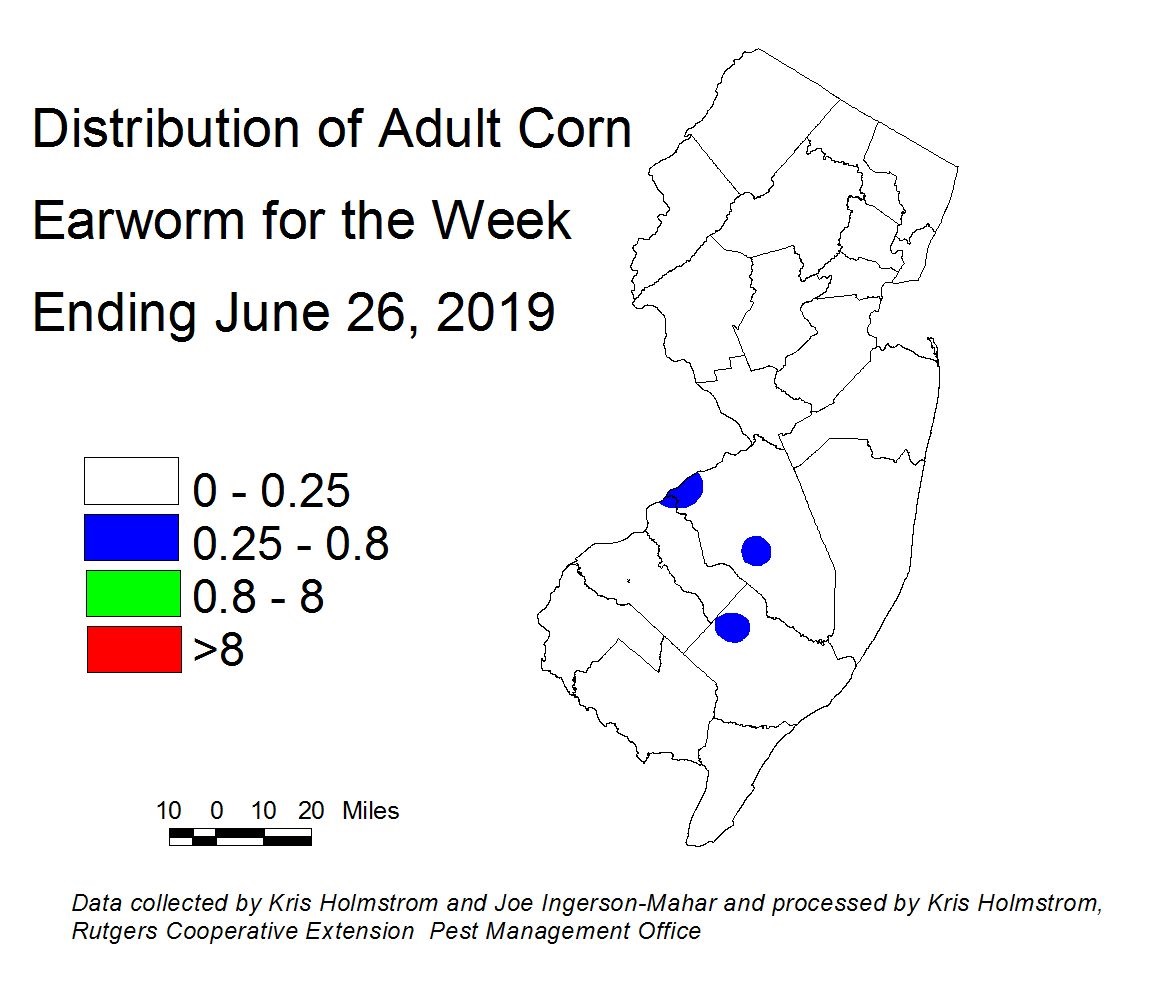
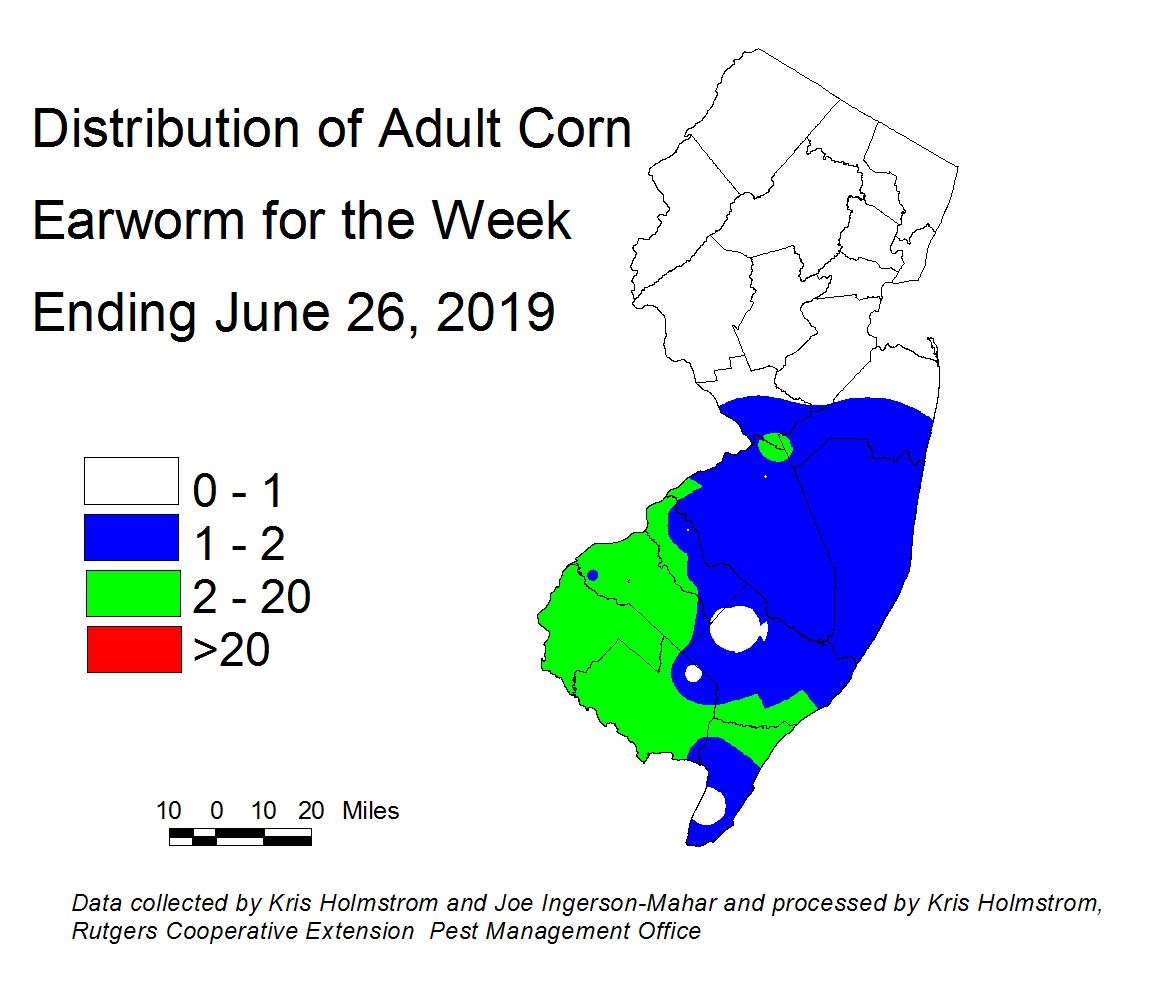
Corn earworm (CEW) moth catches in both trap types have decline dramatically over the past week (see blacklight map at left, and pheromone trap map below at right).  We are entering the time of the season when CEW activity is at its’ lowest.  Despite this, low numbers continue in southern NJ blacklights and in the much more sensitive pheromone traps.   The overwhelming majority of activity is below Mercer County, with only scattered individuals in northern areas.  Green areas on the pheromone trap map indicates a 4-5 day silk spray schedule. Blue areas represent a 5-6 day schedule, and white areas are 6-7 day.  There are far fewer CEW pheromone traps than blacklights, and the resulting map has much broader color bands as a result.  It should also be noted that the pheromone traps are much more sensitive than blacklights.  Therefore, the number of moths caught in pheromone traps required to generate a specific spray interval is much higher than the number caught in blacklight traps.   It must be stressed that there is high variability in these catches, and growers should consult with their IPM practitioner on recommended spray schedules.

[Read more…]

IPM Update 6/19/19

Sweet Corn

European corn borer (ECB) moths catches have declined to very low levels over the past week and no map will appear in this edition.  The first flight is complete.  Feeding percentages have stabilized, and no new feeding should occur until the second flight arrives.

Growers should continue to scout whorl and pre-tassel stage plantings weekly and consider treating when infested plants exceed 12% in a 50 plant sample.  As plantings proceed to the pre-tassel stage, ECB larvae may be found in emerging tassels.  It is a good idea to treat individual plantings as they move into the full tassel/first silk stage one time.  This eliminates any ECB larvae that have emerged with the tassels as they begin to move down the stalk to re-enter near developing ears.

Useful insecticides for this particular application include synthetic pyrethroids (IRAC Grp 3), spinosyns (including OMRI approved Entrust) IRAC Grp 5), and diamides such as Coragen (IRAC Grp 28) or materials such as Besiege which include the active ingredient in Coragen.  Synthetic pyrethroids alone should NOT be used for corn earworm (CEW) protection on silking corn.  Control with these materials is very inconsistent.

The highest nightly trap catches of ECB for the week ending 6/19/19 are as follows:

Crosswicks   1 Milltown   1
Milford   1 South Branch   1


Scattered corn earworm (CEW) moths continue to be captured in southern NJ blacklight traps through early this week (see blacklight map at left) although these catches have declined since last week.   Early plantings, now silking, are at risk of infestation from this pest.

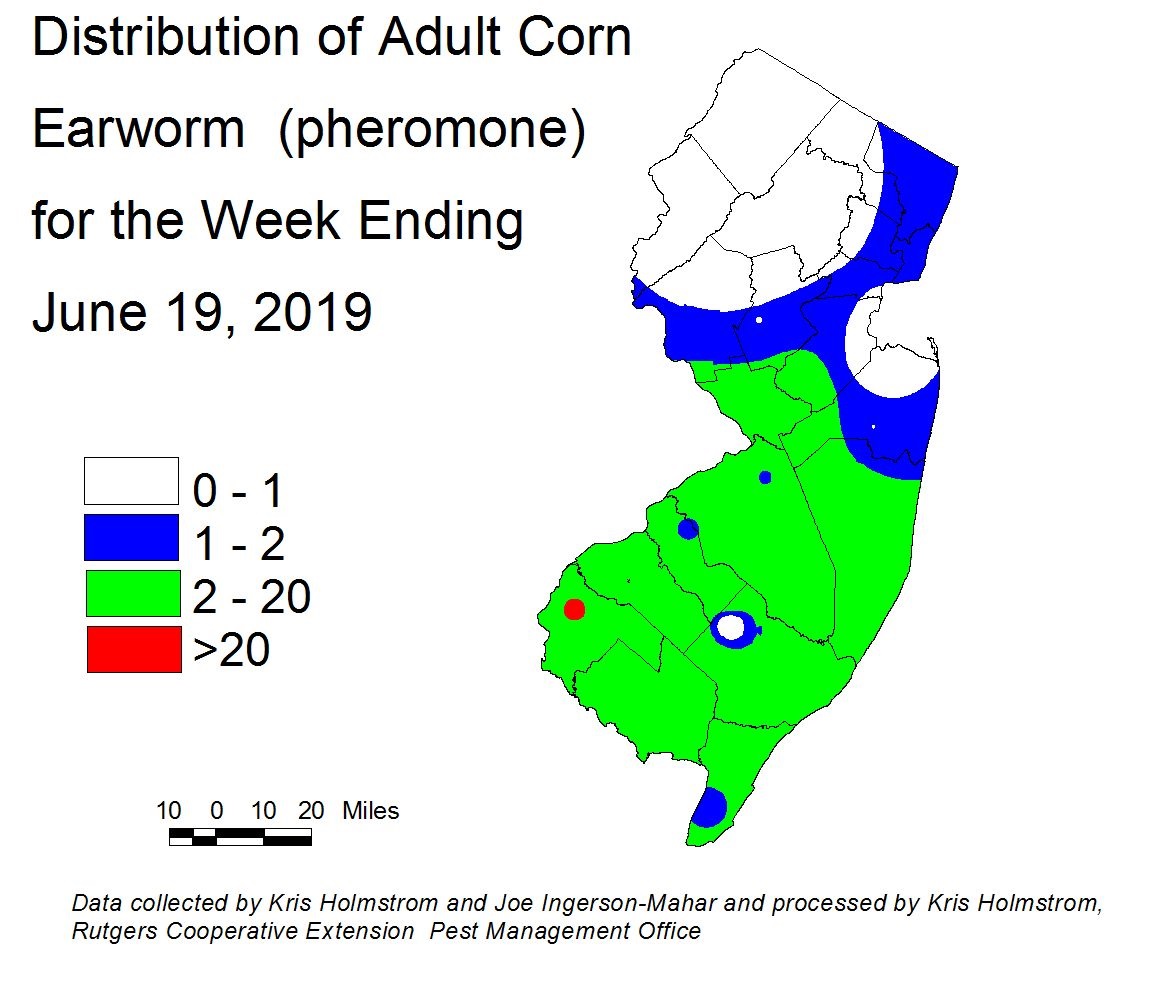
In the CEW pheromone trap network, catches have also declined but remain highly variable, with higher numbers in the south, and very low activity in northern NJ (see pheromone map  below at right). The green area on the pheromone trap map indicates a 4-5 day silk spray schedule. Blue areas represent a 5-6 day schedule, and white areas are 6-7 day.  There are far fewer CEW pheromone traps than blacklights, and the resulting map has much broader color bands as a result.  It should also be noted that the pheromone traps are much more sensitive than blacklights.  Therefore, the number of moths caught in pheromone traps required to generate a specific spray interval is much higher than the number caught in blacklight traps.   It must be stressed that there is high variability in these catches, and growers should consult with their IPM practitioner on recommended spray schedules.

[Read more…]

IPM Update 6/12/19

Sweet Corn

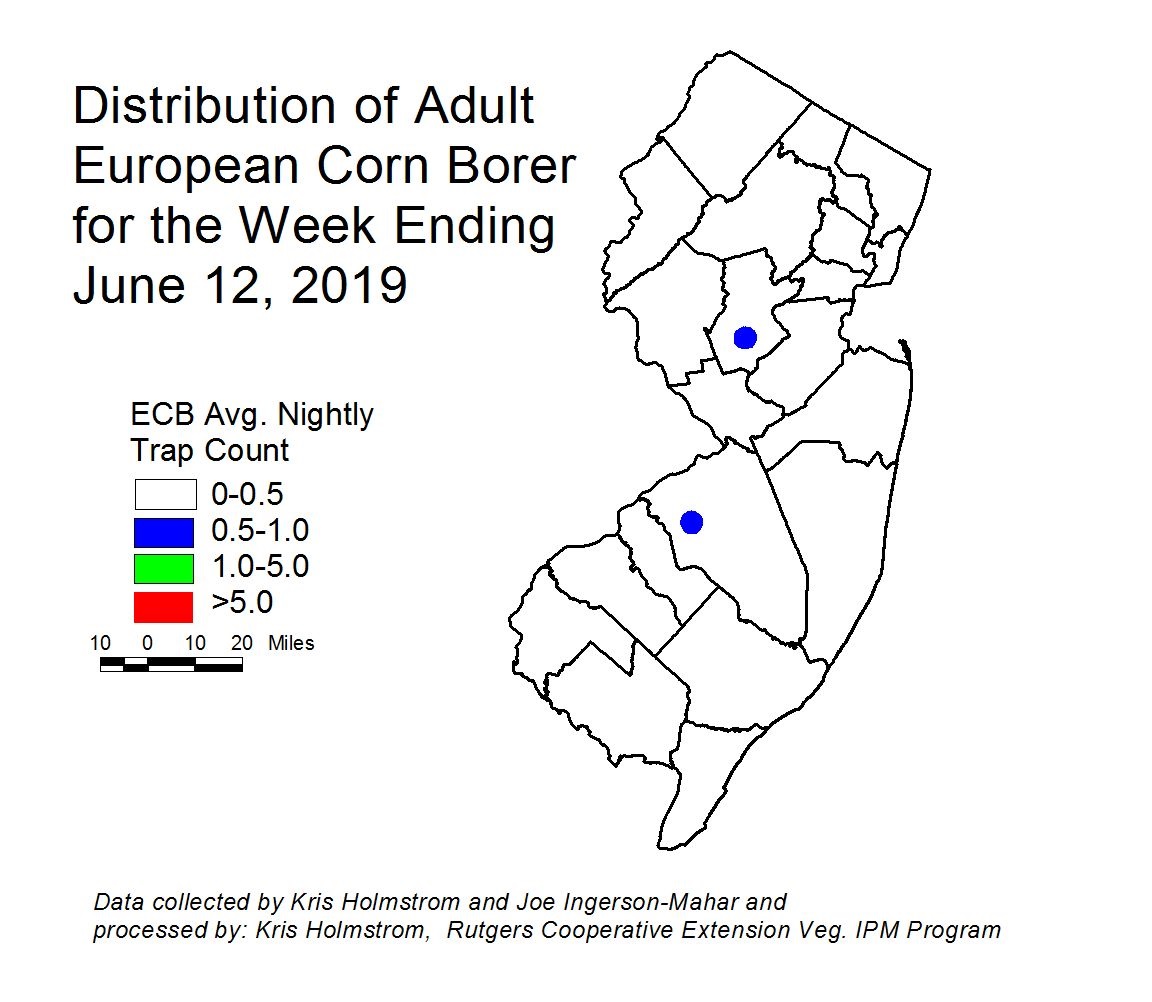
European corn borer (ECB) moths catches have declined to nearly nothing over the past week (see map at left).  Feeding percentages have increased, and should peak over the next 5-7 days.  As of the weekend, feeding percentages as high as 24% in Cape May and 60% were found in whorl corn in Somerset County, but these numbers seem to be outliers. The majority of feeding is in the 2-14% range throughout much of the state.


ECB Tassel

Sweet corn emerging tassel with ECB droppings.
Photo: Kris Holmstrom

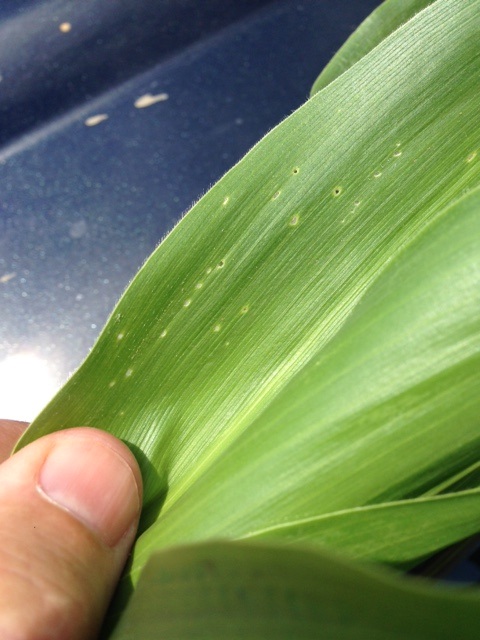
Growers should scout whorl and pre-tassel stage plantings weekly.  Look for the characteristic “shot-hole” type of feeding (photo below at right) and consider treating when infested plants exceed 12% in a 50 plant sample.  As plantings proceed to the pre-tassel stage, ECB larvae may be found in emerging tassels (see photo at left).  It is a good idea to treat individual plantings as they move into the full tassel/first silk stage one time.  This eliminates any ECB larvae that have emerged with the tassels as they begin to move down the stalk to re-enter near developing ears.

Useful insecticides for this particular application include synthetic pyrethroids (IRAC Grp 3), spinosyns (including OMRI approved Entrust) IRAC Grp 5), and diamides such as Coragen (IRAC Grp 28) or materials such as Besiege which include the active ingredient in Coragen.  Synthetic pyrethroids alone should NOT be used for corn earworm (CEW) protection on silking corn.  Control with these materials is very inconsistent.


The highest nightly trap catches of ECB for the week ending 6/12/19 are as follows:

Califon   1 Milford   1
Hillsborough   1 Pedricktown   1
Medford   1 South Branch   1

[Read more…]

IPM Update 6/05/19

Sweet Corn

 European corn borer (ECB) moths catches have declined somewhat over the past week.  Overall this flight was very low, and appears to be on the way out.  The majority of moth activity at this time is along the Delaware Bay Shore (see map at left).  Feeding percentages should increase for the next 2 weeks, as eggs that have been deposited hatch.  As of this week, feeding percentages as high as 8-10% were found in whorl corn in Burlington County.  It is likely that feeding has exceeded the 12% threshold in many southern NJ plantings.

ECB Tassel

Sweet corn emerging tassel with ECB droppings.
Photo: Kris Holmstrom

Growers should scout whorl and pre-tassel stage plantings weekly.  Look for the characteristic “shot-hole” type of feeding (photo below at right) and consider treating when infested plants exceed 12% in a 50 plant sample.  As plantings proceed to the pre-tassel stage, ECB larvae may be found in emerging tassels (see photo at left).  It is a good idea to treat individual plantings as they move into the full tassel/first silk stage one time.  This eliminates any ECB larvae that have emerged with the tassels as they begin to move down the stalk to re-enter near developing ears.

Useful insecticides for this particular application include synthetic pyrethroids (IRAC Grp 3), spinosyns (including OMRI approved Entrust) IRAC Grp 5), and diamides such as Coragen (IRAC Grp 28) or materials such as Besiege which include the active ingredient in Coragen.  Synthetic pyrethroids alone should NOT be used for corn earworm (CEW) protection on silking corn.  Control with these materials is very inconsistent.


The highest nightly trap catches of ECB for the week ending 6/05/19 are as follows:

Allentown   1 Crosswicks   1 Jones Island   1 Pennington   1
Califon   1 Folsom   1 Medford   1 South Branch   1
Centerton   1 Georgetown   1 New Egypt   1 Woodstown   1

[Read more…]

IPM Update 5/29/19

Sweet Corn

 IPM Personnel are still capturing low numbers of European corn borer (ECB) moths, although even these captures are fairly sporadic, and extremely low in the northern counties (see map at left).  Despite this, single digit feeding percentages were found on Middlesex county whorl stage corn on Wednesday of this week.  It is likely that ECB injury has occurred on early plantings in most areas, although it is probably very light.  Early plantings grown under plastic will be at risk first, followed by the first bare ground plantings.   Growers should begin scouting whorl corn for injury.


ECB Tassel

Sweet corn emerging tassel with ECB droppings.
Photo: Kris Holmstrom

Look for the characteristic “shot-hole” type of feeding (photo below at right) and consider treating when infested plants exceed 12% in a 50 plant sample.  As plantings proceed to the pre-tassel stage, ECB larvae may be found in emerging tassels (see photo at left).  It is a good idea to treat individual plantings as they move into the full tassel/first silk stage one time.  This eliminates any ECB larvae that have emerged with the tassels as they begin to move down the stalk to re-enter near developing ears.

Useful insecticides for this particular application include synthetic pyrethroids (IRAC Grp 3), spinosyns (including OMRI approved Entrust) IRAC Grp 5), and diamides such as Coragen (IRAC Grp 28) or materials such as Besiege which include the active ingredient in Coragen.  Synthetic pyrethroids alone should NOT be used for corn earworm (CEW) protection on silking corn.  Control with these materials is very inconsistent.


The highest nightly trap catches of ECB for the week ending 5/29/19 are as follows:

Downer   2 Centerton   1 Hillsborough   1
Medford   2 Elm   1 Jones Island   1
Califon   1 Folsom   1 Oldwick   1

[Read more…]