Fruit IPM for 5/24/18

Peach:

Oriental Fruit Moth: First generation timings are updated below: According to the model, treatments should be over for the first generation flight statewide. However trap counts at several sites still show captures above the treatment threshold of 6/trap. Pest pressure is quite high on some farms in northern counties. [Read more…]
South Jersey Vegetable Twilight Scheduled for 4/26

The South Jersey Vegetable Agents would like to invite you to our annual Spring integrated crop management meeting:

Vegetable Integrated Crop Management
Twilight Meeting
Thursday, April 26, 2018
6:00 p.m. – 9:00 p.m.
East Vineland Fire Hall
4931 Landis Ave. across from the Savoy Restaurant
(park behind the building and enter conference room door in rear)

6:00 pm Robots, Roselle & Resistant Basil, Finally!
– Rick VanVranken, RCE Atlantic
6:15 pm Respiratory Protection Requirements for WPS-labeled Pesticides
– Patricia Hastings, Rutgers Pesticide Safety Educ Program Coordinator
6:45 pm Soil Fertility, Liming, and Silicon Nutrition
– Joseph Heckman, Ph.D., Extension Specialist – Soil Fertility
7:15 pm Update on Herbicides & Restrictions in New Jersey Vine Crops
– Dr. Thierry Besancon, RCE Specialty Crop Weed Specialist
7:45 pm Pepper Variety Evaluations
– Dr. Wes Kline, RCE Cumberland
8:00 pm Vegetable Disease Control Options for Spring Crops
– Dr. Andy Wyenandt, RCE Vegetable Plant Pathologist
8:30 pm Vegetable Insect Pest Update
– Dr. Joe Mahar, Vegetable IPM Coordinator
9:00 pm Adjourn

Pesticide Recertification Credits have been requested for this meeting.
Hope to see you there!

Be Counted – 2017 Ag Census Includes Questions On Value-Added Sales & Agritourism

Bruce Eklund, NJ State Statistician for the U.S.D.A’s National Agricultural Statistics Service, shared this reminder to please complete the Census of Agriculture by Feb 5, and

for winery operators, direct marketers and other value-added and agritourism operations, be sure to pay attention to a few special questions:

  • Include wine and other value-added product sales under (Section 24) Practices (Item 2);
  • Other Income From Farm-Related Sources (Section 32) includes Agri-tourism (Item 4); and
  • Production Expenses (Section 30) are important as it shows this contribution from agriculture to the general economy.

With the once every five year census started, your participation is important to accurately represent the New Jersey’s specialty crop industries. USDA/NASS mailed 2017 USDA Census of Agriculture questionnaires to known farmers in December.

If you have any questions regarding the survey, or if you may have been overlooked, please call 1-888-424-78288 or 717-787-3904, or visit https://www.agcensus.usda.gov/, where you you can complete the survey online. Growers who have already completed the survey online format found that it saved time!

Remember that individual responses to the Census of Agriculture are required to be kept confidential by law, and only aggregate data are used for publication. Census results are important in showing the economic impact and significance of agriculture for your County, your Congressional District, and New Jersey. Agricultural advocates will use your combined information to inform decision makers and the public about the importance of agriculture.

More information on the Ag Census is available at:

http://www.nj.gov/agriculture/news/press/2017/approved/press171206.html

and… https://www.agcensus.usda.gov/Partners/index.php.

Please help by reminding your neighbors and thank you for taking the time to be counted.

2018 NJ State Ag Convention Educational Programs Now Online

The 2018 NJ State Ag Convention and Trade Show will be open February 6-8 at the Harrah’s Resort and Waterfront Convention Center in Atlantic City. The final version of the educational program developed by Rutgers NJAES Cooperative Extension faculty and staff in conjunction with the Vegetable Growers Association of NJ and the NJ Dept of Ag has now been posted at  njveggies.org/convention. In addition to the agenda of educational sessions and workshops, you will find links to membership/registration and meal reservation information. As in the past, Tuesday and Wednesday programs are chocked full of concurrent sessions mornings and afternoons, followed by a day of more intensive workshops on Thursday. Please pay special attention to that day’s Food Safety and Fumigation Certification workshops that require separate pre-registration. Instructions are detailed in each of those workshop agendas.

A special added feature of this year’s convention will be a produce buyers discussion panel moderated by NJDA Division of Markets Director Tom Beaver in the Trade Show area at 5pm on Tuesday afternoon.

If you will be attending as a delegate to the policy sessions of the State Board of Agriculture, a separate program and registration materials are available from the NJ Department of Agriculture’s website.

Looking forward to seeing you there!

Vegetable Disease Update – 8/22/17

  • There have been a few reports of late blight in PA this past week. Late blight has not been reported in NJ to date. If you suspect Late blight on your farm please contact your county Extension agent. To track the progress of Late blight in the US please visit USAblight.
  • Cucurbit downy mildew (CDM) on cucumber continues to be reported throughout the region. All cucumber growers should add downy mildew specific products to their regular maintenance programs. CDM has also been reported on giant pumpkin, cantaloupe, and butternut squash in PA and on watermelon in VA and MD to date. To track CDM movement in the US please visit the North Carolina State University’s CDM Forecasting Website.
  • Bacterial canker and bacterial leaf spot in tomato are being reported.
  • Bacterial leaf spot is also being reported in pepper.
  • Pepper anthracnose has been reported in the past week.
  • Cucurbit powdery mildew and anthracnose in cucurbit crops have been reported.

BMSB is Under Attack!

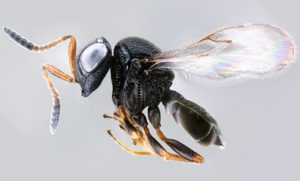
Samurai wasp (Photo by Elijah Talamas)

Many of our fruit and vegetable growers throughout the state have been battling with populations of brown marmorated stink bug. This invasive pest feeds on most fruiting vegetables, small fruits, and tree fruits and can cause significant economic losses. One of the reasons that BMSB is such a bad pest is that when it arrived in the US, it did so without its co-evolved natural enemies. Until now! The Samurai wasp (Trissolcus japonicus) arrived in the US independently and the first populations were found in NJ in 2016 by the Department of Agriculture. However, no populations had been found in agricultural crops, which made us uncertain about its impact.

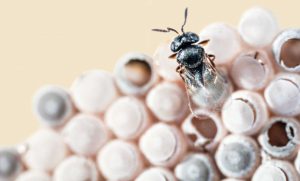
Last week, a parasitized egg mass was tentatively identified as the Samurai wasp. The Samurai wasp attacks stink bug eggs and has a special appetite for BMSB eggs. A female wasp will lay its eggs into the stink bug eggs. It is an effective parasite of BMSB and can parasitize on average 50% of each egg mass. Our finding was in a commercial peach orchard in southern New Jersey and may be the first finding in a US agricultural crop. We had placed egg masses in the orchard to measure natural enemy impacts of our border spray approach. We do not know the impact the Samurai wasp will have in NJ agriculture but this is a very promising new development in the fight against BMSB. Reduced spray methods, such as border sprays, may help to protect Samurai wasp populations in crops.

Samurai wasp emerging from BMSB egg mass


Drs. Joe Kaser and Clement Akotsen-Mensah contributed to this article.
