Landscape, Ornamentals, Nursery, and Turf Edition

Seasonal updates on ornamental, nursery, and turf pests.
Subscriptions are available via EMAIL and RSS.


Companion Website Links:

Rutgers Turf Blog - Articles on turfgrass diseases and cultural practices for the commercial turfgrass industry. Subscription available via RSS.


Rutgers Weather Forecasting - Meteorological Information important to commercial agriculture.

NJMVC Further Extends Driver License, Registration, and Inspection Expiration Dates Due to COVID-19

The New Jersey Motor Vehicle Commission Chief Administrator Sue Fulton, on Monday, May 18th, announced additional extensions to driver license, registration, and inspection expiration dates in the continuing efforts to mitigate COVID-19 and safeguard public health.

Effective immediately, the following documents, if expiring between March 13 and May 31, have been extended to July 31. Documents expiring June 30 are extended two months to August 31, and those expiring July 31 are extended to September 30.

• All Standard driver licenses (including permits) and standard non-driver IDs
• Privately owned and commercial vehicle registrations (including Farmer and Farm Use registrations)
• Vehicle inspections
• Purple Heart/Disabled Veteran placards
• Temporary tags

“Get it done online now, if you’re able,” Fulton suggests. “We do anticipate that volumes will spike once we reopen and when we reach the end of these extensions. Our job is to serve customers in the most efficient way possible and one way we can do that is by steering people to our expanded list of online services.”

On March 13, the NJMVC initially announced two-month extensions for licenses, registrations, and inspection stickers expiring in March, April, and May, timelines that have now been pushed back.

The NJMVC encourages customers to utilize online services, which have been expanded during the COVID-19 crisis. In most cases, customers can renew a license, replace a lost license, change an address, renew a registration, and complete other transactions through the NJMVC’s Online Services portal.

Customers also should check NJMVC.gov for the latest information and updates.

Increased Online CEUs for Licenses Expiring 2020 – ACT NOW!

Due to COVID-19, the New Jersey Department of Environmental Protection has made a policy decision to accommodate recertification for applicators with licenses expiring this year on October 31, 2020. Their announcement to those applicators follows below. NJ Department of Environmental Protection May 15, 2020 at 5:36:35 PM EDT Increased Online CEUs for Licenses Expiring 2020 […]

USDA Urges Farmers to Take Steps Now to Prepare for Coronavirus Assistance

Local USDA Farm Service Agencies asked to have the following information shared. These may be details that will be discussed in the informational webinar scheduled for Thurs, May 14 at 1pm.

In April, USDA announced the Coronavirus Food Assistance Program (CFAP). CFAP will provide direct support based on losses for agriculture producers where prices and market supply chains have been significantly impacted and will assist eligible producers facing additional adjustment and marketing costs resulting from lost demand and short-term oversupply for the 2020 marketing year caused by COVID-19.

CFAP will provide assistance to most farms that have experienced at least a five percent loss and will be available to farms regardless of size. We are still working on the final details of the actual payment rates and those details will be determined and included as part of the rulemaking process. Once the rule making process is complete, the application period will be open and subject to the eligibility and payment limit criteria described in the rule.

As part of applying for the program, you’ll need to contact the Farm Service Agency county office to schedule an appointment. Your local FSA staff will work with you to apply for the program, and through forms asking for this type of information:

  • Contact
  • Personal, including your Tax Identification Number
  • Farming operating structure
  • Adjusted Gross Income to ensure eligibility
  • Direct deposit to enable payment

Please do not send any personal information to USDA without first initiating contact through a phone call. We take your privacy and security of your information very seriously.

If you are an existing customer, this information is likely on file at your local Service Center.

What Can You Do Now?

While the application process has not started, you can start gathering/understanding your farm’s recent sales and inventory.

FSA has streamlined the signup process to not require an acreage report at the time of application and a USDA farm number may not be immediately needed.

How Will USDA Accept Applications?

USDA Service Centers are open for business by phone appointment only. Once the application period opens, please call your FSA county office to schedule an appointment.

Our staff is working with our agricultural producers by phone and using email, fax, mail, and online tools like Box to accept applications.

Information on CFAP can be found at farmers.gov/CFAP.

Questions?
Please contact your local FSA Office.

USDA Webinar – Applying for Coronavirus Food Assistance Program Direct Payments

1 p.m. ET, Thursday, May 14, 2020

for farmers, ranchers and other producers interested in applying for direct payments

Register in Advance

Agricultural Marketing Service header

The U.S. Department of Agriculture (USDA) Agricultural Marketing Service (AMS) and Farm Service Agency (FSA) will host a webinar on Thursday, May 14, 2020, at 1 p.m. ET, for farmers, ranchers and other producers interested in applying for direct payments through the Coronavirus Food Assistance Program (CFAP).

As part of President Trump and Secretary Perdue’s April 17 announcement of a $19 billion Coronavirus Farm Assistance Program, USDA will provide $16 billion in direct support based on losses for agricultural producers where prices and market supply chains have been impacted. Also, USDA will assist eligible producers facing additional adjustment and marketing costs resulting from lost demand and short-term oversupply for the 2020 marketing year caused by COVID-19.

USDA is hosting this webinar to share what information is needed to apply for direct payments through CFAP, once the application period begins.The webinar is an opportunity for producers to learn about the general application process and required documentation prior to the official beginning of signup. Producers who are new to participating in FSA programs are especially encouraged to join the webinar.

Producers interested in participating may register in advance.

Register in Advance

After registering, you will receive a confirmation email containing information about joining the webinar. Participants are encouraged to submit questions through the Q&A box or by emailing CFAP.webinars@usda.gov. While questions will not be answered live during the webinar, they will be posted at farmers.gov/CFAP along with a recording of the webinar and other CFAP information. More details about CFAP direct payments will be announced soon.

Labor Will Be Hot Topic For 7:00PM Wednesday Night Webinar – “Ask the Ag Agent”

This week, the webinar will be concentrated on the topic of farm labor. Since updates are coming to the industry and we have learned of some programs for migrant workers please join us for discussion. Please feel free to bring up other topics.

Ask the Ag Agent – 7:00PM Weekly – Every Wednesday – Farmer Video Conference/Call-In ForumAsk the Ag agent

“Ask the Ag Agent” weekly 1-hour sessions for farmers will be hosted again on Wednesday May 13th and continue each Wednesday until May 27th. The online conferencing/call in events will begin at 7:00PM with an open forum to discuss ag-related questions about production, marketing, regulations and any other topics farmers wish to discuss. All are welcome. Events are hosted by William Bamka, Stephen Komar, Meredith Melendez and Michelle Infante-Casella – Agricultural Agents.

To access via WebEx on a computer go to https://go.rutgers.edu/rc9n3kxt

Or, Join by phone
+1-650-429-3300 USA Toll
Access code: 799 743 872

For additional Rutgers Cooperative Extension educational programs check out https://events.rutgers.edu/njaes/

Using Growing Degree-day calculators, nursery pest and pathogen updates, important resource links

Announcements:

NJ Department of Agriculture Issues Burn Permit for Frost Protection –May 7 thru May 11

New Jersey Department of Agriculture has issued a notice concerning open burning due to colder spring overnight temperatures presently forecasted for areas of New Jersey from Thursday, May 7 through Monday, May 11, 2020, which could adversely affect fruit, vegetable, and floriculture crops in bloom or near bloom around the state. For more information: https://plant-pest-advisory.rutgers.edu/nj-department-of-agriculture-issues-burn-permit-for-frost-protection-thru-may-11/

Sourcing PPE for your workers:

If you need PPE for you and your workers, please do not wait to obtain more supplies! When our region re-opens to the masses there will be another wave of high-demand for masks and PPE. https://plant-pest-advisory.rutgers.edu/sourcing-personal-protective-equipment-ppe-for-your-farm-employees/

Recent financial Plant and Pest Advisory Posts:

US Small Business Admin Opens Economic Injury Disaster Loan (EIDL) Programs to Agriculture: https://plant-pest-advisory.rutgers.edu/us-small-business-admin-opens-economic-injury-disaster-loan-eidl-programs-to-agriculture/

SBA resumed accepting Paycheck Protection Program applications: https://plant-pest-advisory.rutgers.edu/sba-resumed-accepting-paycheck-protection-program-applications/


Utilizing Growing Degree-day calculators and resources:

(As of 5/7/20 using NEWA, Upper Deerfield = 213.5GDD50 ; Howell = 153.5 GDD50 ; Pequest = 88.0 GDD50) (GDD50 = Growing Degree-Day with min. temp. set to 50F)

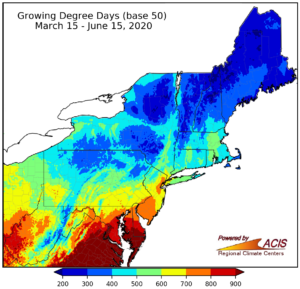
Using Growing Degree Day models to plan pest management timing is a proven method for understanding when a pest or pathogen will rear its ugly head. These models utilize temperature min. and max. throughout the day to generate “growing degree day” units that accumulate throughout the year (typically starting on Jan. 1st, with a minimum temperature set to 50F (base-50)). Correlations between degree-day accumulation and vulnerable life stage events, such as egg hatch or adult emergence, allow pest management to be conducted, or scouted for, more efficiently. These models can track or predict insect, mite, weed, and plant pathogen lifecycles as well as those of beneficial insects, allowing us to protect that arm of Integrated Pest Management (IPM).

Within these models the user can set multiple parameters, allowing hyper-localized information for most of the country. Simple models are also available. The temperature min/max, can be manipulated for specific pests, however a minimum temperature of 50F (aka base-50) is most often cited in growing degree-day pest lists. These models are general in nature, as biology occurs over some span of time or set of conditions, and should therefor be ground-truthed at each location if at all possible. Many other types of pest or disease predictive models are available within the resources listed below, and the agents can help you understand what information you need for those calculations.

Note: The nursery agents are working to develop a local, Rutgers centralized, growing degree-day calculator that will provide information on key pests as well as nursery and greenhouse BMPs thereof. Armed with this information, we will be generating charts and other visual aids that target multiple pests per application, thus increasing labor efficiency.

Degree Day Calculators (select a local weather station within the website):

NEWA (Cornell): http://newa.cornell.edu/index.php?page=growing-degree-days

–        Very easy to use

Integrated Plant Protection Center (Oregon State): http://uspest.org/

–        More complicated but has many different modeling options

–        ***Boxwood blight specific risk model: https://uspest.org/risk/boxwood_app  , also available as an iOS or Android app ***

Typically the procedure is as follows: select a close by weather station, select degree-day calculator, select the min. temperature (50F or “base-50”), select max. temperature (arbitrarily high- 110F), click graph or calculate or get report, then locate the date(s) of interest on the computed table. The accumulated growing degree-days of those dates can then be compared to the target GDD50 on the pest lists below. *Tim Waller will help you set up a local degree-day calculation, or understand how to use this information if needed (twaller@njaes.rutgers.edu)

Pest lists with GDD50 targets:

Ohio State: http://cues.cfans.umn.edu/old/Web/049DegreeDays.pdf

University of California: http://ipm.ucanr.edu/MODELS/index.html

University of Maryland: https://extension.umd.edu/node/11155

University of New Hampshire: http://ccetompkins.org/resources/using-growing-degree-days-for-insect-management

*Some discrepancies between degree-day targets; go with what you have observed locally*


Pests and diseases to be on the lookout for:

(Upper Deerfield = 213.5GDD50 ; Howell = 153.5 GDD50 ; Pequest = 88.0 GDD50)

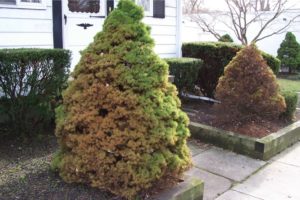
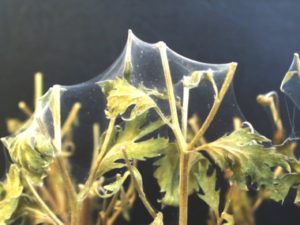
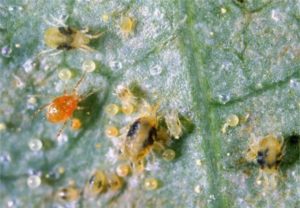
Pests: Looking towards our southern neighbor states, several pests are either currently present or will become evident in the near future including: Boxwood leafminer, Allium Leaf miner, Lilac borer, Ambrosia beetles (multiple species), Red-headed flea beetle, Hemlock woolly adelgid, Pine Bark adelgid, Roseslug sawflies, Spruce spider mites, Wooly elm aphids, Spirea aphid, Andromeda lace bug, Azalea lace bug, and Pine needle scale. The warm weather jump-started pest development only to be slowed by the current cool days and cooler nights, providing more wiggle room for protective or systemic pesticide applications. Utilize growing degree-day (GDD50) models to apply protectant applications as well as systemic soil drenches when applicable or allowable for pollinator protection.

Red-headed flea beetle larva will be hatching between 250-480 GDD50, with adults emerging between 500-1000 GDD50. A second generation of larva will then be active between 1,570 to 1860 GDD50, emerging later 1,878 to 2,318 GDD50. Brian Kunkel, entomologist at the University of Delaware, has determined that up to three, overlapping, generations can be present in container grown ornamentals. Ambrosia beetles, particularly Xylosandrus crassiusculus (granulate ambrosia beetle), and Xylosandrus germanus (black stem borer), should begin flights soon, or have already done so to some degree. These small beetles begin flight when temperatures hover around 60-70F and are attracted to alcohol produced by woody ornamentals in the spring. The cooler nighttime temperatures and daily averages have kept much of this activity low but scouting should be vigilant during this time. Another invasive pest, the Box tree moth, has been identified approaching the border of US and Canada. This pest has prompted APHIS importation amendments for Boxwood, Euonymus, and Illex. (https://content.govdelivery.com/accounts/USDAAPHIS/bulletins/27f467d)

Diseases: The current temperatures coupled with long wetness-periods, provide optimal pathogen conditions for diseases such as Botrytis, Sclerotinia sclerotiorum, Black spot on roses, multiple Needle cast diseases of conifers, root rots, and bacterial diseases. Once temperatures begin to increase again, pathogen numbers could explode. Efforts towards protectant applications are critical, especially in situations where plants are being held longer than previously anticipated due to COVID-19 related disruptions. Any steps geared towards increasing airflow, reducing wet-feet, and limiting mechanical injury during this wet and cool period will benefit disease management approaches. Please consult your agents for specific disease control recommendations.

Beach Leaf Disease, caused by an exotic nematode, is affecting beeches in the Great Lakes region  and into Pennsylvania. Little is known about the disease, other than the nematodes distort beech leaves by forming sunken lesions, which eventually turn the leaf yellow and drop off. Please contact your local agent if you suspect this disease to be anywhere in New Jersey (forest, farm, etc.). https://www.state.nj.us/dep/parksandforests/forest/docs/Pest_Alert-Beech_Leaf_Disease.pdf .USDA-ARS (more info on the nematode): https://tellus.ars.usda.gov/stories/articles/what-s-killing-beech-trees/

Please advise what pests/pathogens you are seeing in the field so we can be better informed on their management!


Online events and resources:

Ask the Agent (every Wednesday @ 7:00pm): https://go.rutgers.edu/t7wjkit1

A new online forum has been created where anyone can log-on and speak with Rutgers Cooperative Extension agents (multiple agents from multiple counties).

NJAES YouTube webpage: https://www.youtube.com/user/RutgersNJAES/

Our Rutgers Nursery Working group will be uploading many more instructional videos to the NJAES YouTube page in the near future. This webpage has numerous pest/pathogen/ID educational videos, especially from the Plant Diagnostics Lab here at Rutgers.

Tim Waller has posted an introduction video to the newly created “Commercial Nursery and Greenhouse Production” playlist https://youtu.be/RQbXmc5Uug8.

(Please email twaller@njaes.rutgers.edu or william.errickson@njaes.rutgers.edu with ideas for videos!)

 2020 Nursery Industry Survey: https://forms.gle/dUjLxaiu6qDQYYsRA

The new nursery agents have prepared a preliminary survey aimed at understanding the needs of our growers and clientele, i.e. you. Please take a moment to complete the survey, as this type of information really helps the agents secure grant funding to deal with the problems you actually have. Thank you! Please share with other growers that may not have access.

RU Sustainable Nursery Production website: https://njaes.rutgers.edu/nursery/

March meeting PDF: https://njaes.rutgers.edu/nursery/documents/2020%20SJ%20Nursery%20Meeting%20Proceedings.pdf


Thank you.

Contact information for the new nursery agents:

 Timothy J. Waller

County Agent
Specialty areas: Commercial nursery production, plant health, and phytopathology
   

Rutgers Cooperative Extension of Cumberland County
291 Morton Ave. Millville, NJ 08332
856-451-2800
twaller@njaes.rutgers.edu

Bill Errickson

County Agent
Specialty areas: Nursery and turfgrass production, agricultural innovation, and soil fertility

Rutgers Cooperative Extension of Monmouth Count
4000 Kozloski Rd., P.O. Box 5033. Freehold, NJ 07728
732-431-7260, ext. 7273
william.errickson@njaes.rutgers.edu