Vegetable Crops Edition

Seasonal updates and alerts on insects, diseases, and weeds impacting vegetable crops. New Jersey Commercial Vegetable Production Recommendations updates between annual publication issues are included.
 
Subscriptions are available via EMAIL and RSS.
 
Quick Links:

NJ Commercial Vegetable Production Recommendations

Rutgers Weather Forecasting - Meteorological Information important to commercial agriculture.

Agri-Technology and Vegetable Research Twilight Meeting

Where:  Rutgers Agricultural Research and Extension Center (RAREC), 121 Northville Rd., Bridgeton, NJ 08302

When:  Wednesday August 16, 2023, 5 PM until dark,  refreshments and ice cream will be served 

This year’s twilight meeting at RAREC will showcase new agricultural technologies for stakeholders in the state. We will showcase the newly installed agrivoltaics system established at RAREC and discuss new technologies for autonomous seeding and weeding as well as drone technologies for improving crop production and decision making. 

Agrivoltaics Research at Rutgers – Dan Ward, Director of Rutgers Agricultural Research and Extension Center (RAREC) and the New Jersey Wine Center for Wine Research and Education; and Dave Specca, Rutgers Agrivoltaics Program lead.  The demand for clean energy and the development of new technologies for solar electricity generated on producing agricultural land (Agrivoltaics) has driven Rutgers/NJAES to investigate this hybrid technology. We are investigating the effects of putting elevated photovoltaic panels above numerous cropping systems to see what effects the panels have on the crops; and what effects the crops have on the panel’s electrical productivity. Our results will be used in economic models and other recommendations to assist farmers, landowners, and solar developers in deciding whether these combined technologies are a good choice for them.

Presentation and demonstration of Naio OZ autonomous seeding and weeding platforms – Thierry Besançon, Extension Weed Science Specialist for Specialty Crops, Rutgers.  The use of small-size electrical autonomous weeders such as the Naio Oz multitask and multi crop robot may help growers to lessen their reliance on fossil fuels for weeding vegetable productions. Using an autonomous weeder can also help alleviating some of the issues with labor availability, especially for burdensome activities such as manual weeding. The GPS guided Naio Oz platform is 100% electric (8 hours autonomy) and versatile through the use a variety of tools (drill, brushes, harrows, hoes blades…) that allow it to weed within and between the crop rows, make furrows, sow, and carry loads to the field. We will present and demonstrate the use of the Naio Oz for autonomous seeding and weeding, and discuss trials currently conducted at RAREC to evaluate weed control efficacy with this system as compared to conventional herbicides. 

In-crop cereal cover crop and living mulch trials for vegetables at RAREC – Thierry Besançon, Extension Weed Science Specialist for Specialty Crops, Rutgers.  Row-middle weed control in plasticulture vegetable production is becoming increasingly difficult due to a lack of effective herbicides, a need for multiple cultivations, or hand labor. Alternative solutions that integrate multiple weed control tactics are needed to address these issues. One solution is to use cover crops to aid in weed suppression along with an effective herbicide program. A field study is being conducted at RAREC in 2023 to assess the effects of integrating spring-seeded grass cover crops with herbicide treatments for weed control in watermelon. Results from 2023 and from previous studies conducted in 2021 and 2022 show that spring seeded grass cover crops can successfully be integrated with effective herbicide programs for improved weed control between plastic beds. 

The potential applications of using drones in agricultural production in New Jersey – Peter Oudemans, Professor and Director P.E. Marucci Center for Blueberry and Cranberry Research and Extension, Rutgers.  Drones or UAVs can be used to detect anomalies in agricultural fields to directly determine the impacts of disease, pests, weeds, and soil conditions on crop production. This information can be used to determine economic crop losses, pest management strategies, and provide a wealth of other information that can be used to improve crop production and management decisions by the grower. The potential benefits and drawbacks of using drones in agricultural production will be discussed along with a flight demonstration. 

Assessing the production potential of fiber hemp in New Jersey – Raul Cabrera, Extension Specialist in Nursery Production and Management, Rutgers.  The recent re-introduction of agricultural/industrial hemp (Cannabis sativa) to New Jersey (2020 season) was initially focused on production of cannabinoid-rich (CBD, CBG) flowers. Saturation of the floral hemp market has abruptly and significantly dropped its economic viability and interest, and focus has shifted to hemp for grain and fiber production. The New Jersey Department of Agriculture funded a pilot program with Rutgers to evaluate the potential of hemp for fiber production, including the viability of agronomic production and potential industrial end uses (bioplastics, textiles, etc.). To this end, three experimental fiber hemp plots are being planted and evaluated at different locations in the state (north, central and south).

Syngenta Product Update – Erin Hitchner, Senior Research and Development Scientist, Syngenta.  An update will be given on upcoming product registration and overall pipeline development for new Syngenta active ingredients.  An overall description of the pesticide registration process and timelines will also be presented.

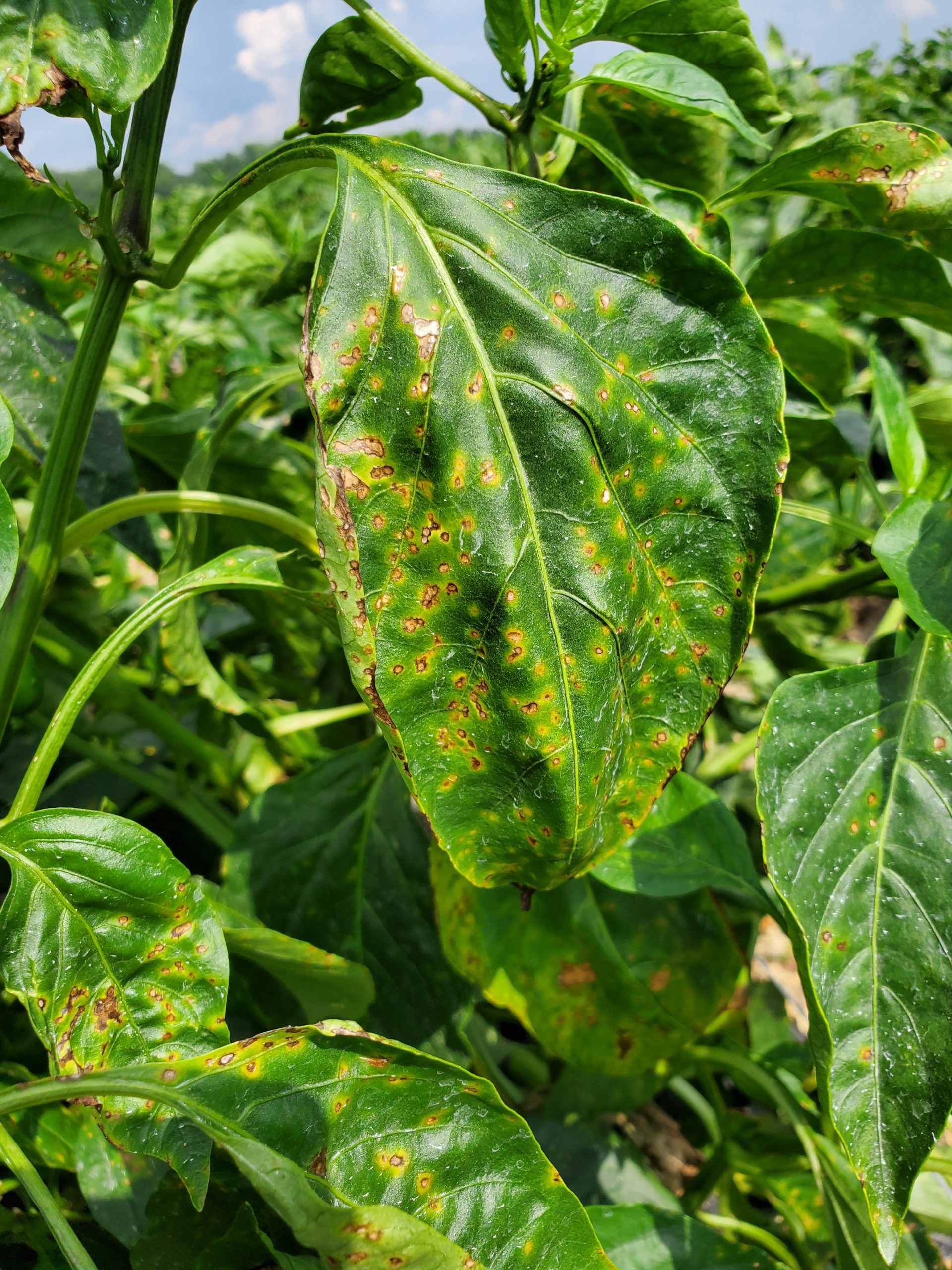
Understanding copper resistance development and controlling bacterial leaf spot of bell pepper with resistant varieties – Andy Wyenandt, Extension Specialist in Vegetable Pathology, Rutgers.  Over the past three years the pepper and tomato fields throughout New Jersey have been surveyed to determine what species of bacterial leaf spot caused by Xanthomonas spp. are present in the state and if copper resistance is present. Copper based fungicides have been used for decades for the control of bacterial diseases across many different vegetable crops, especially in tomato and pepper. Thus, it is not surprising that ~60% of the bacterial isolates collected throughout the state are resistant to copper fungicides. We will discuss how to control bacterial leaf spot and the benefits of adopting the use of X10R bell pepper varieties to help mitigate losses due to the pathogen.

Controlling Phytophthora blight in cucurbit and other vegetable crops – Andy Wyenandt, Extension Specialist in Vegetable Pathology, Rutgers.  Phytophthora blight, caused by Phytophthora capsici, is the most economically damaging vegetable disease in the state. It can cause significant losses in cucurbit, pepper, and tomato crops in any given year. We will discuss the most up-to-date information on how to control P. capsici in cucurbit and other crops using genetic resistance, cultural practice and fungicide chemistry.

Note:  Following pesticide credits have been requested:  CORE, PP2, 1A and 10

Recognizing Angular Leaf Spot in Cucurbits

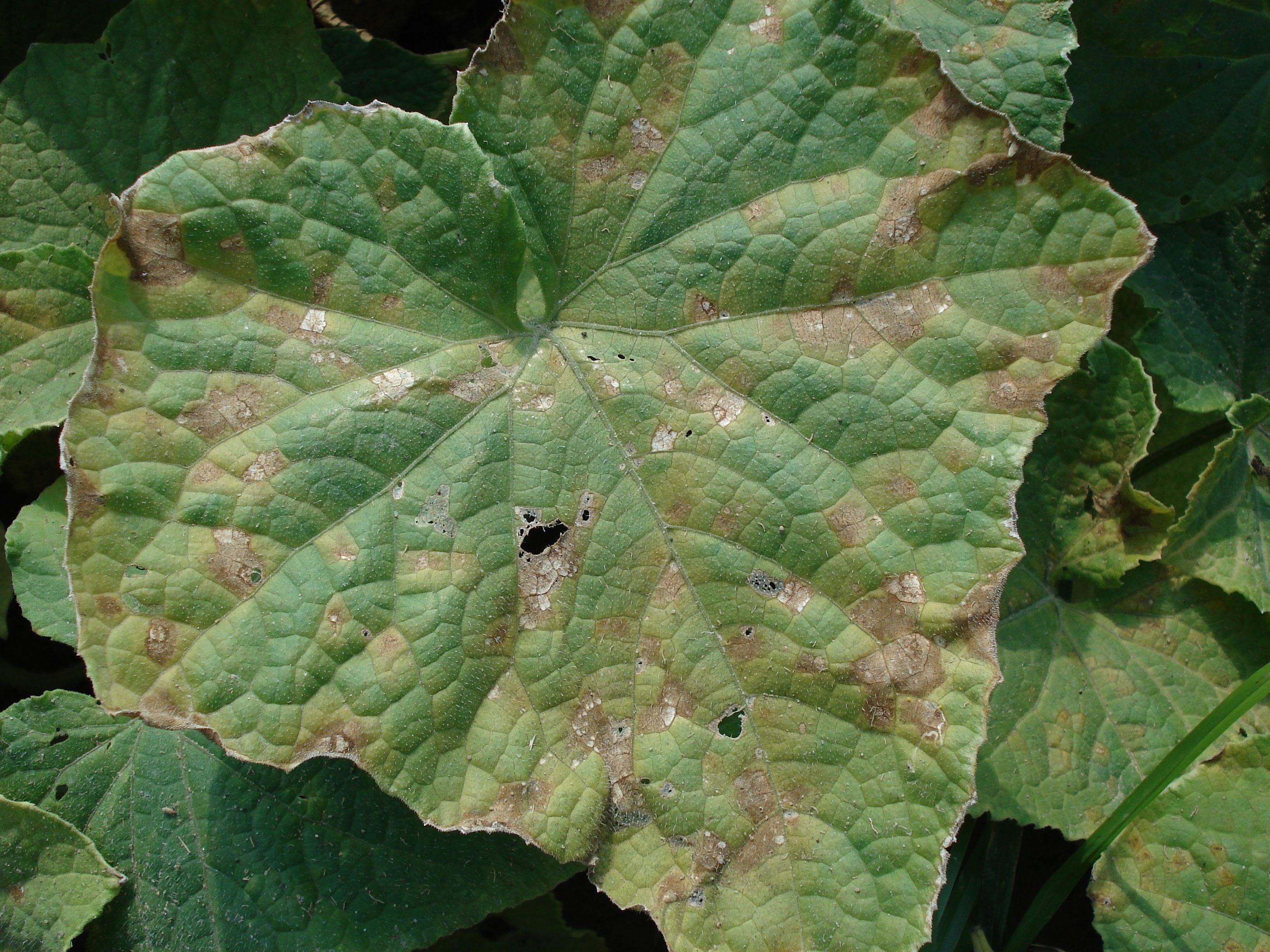
Angular leaf spot, caused by the bacterium (Pseudomonas syringae pv. lachrymans), is common in New Jersey and the region. Although it often shows up during cooler, wet weather; it can show up almost anytime during the production season with favorable weather conditions for its development.

Symptoms of angular leaf spot in cucurbit.

Symptoms of angular leaf spot in cucurbit.

Angular leaf spot of pumpkin. Note the 'shot holes' in the leaf.

Angular leaf spot of pumpkin. Note leaf ‘shot holes’.


Angular leaf spot will first appear in ‘hot spots’ as, small water-soaked lesions which will expand until they reach a larger leaf vein resulting in the angular looking symptoms on leaves. Under heavy disease pressure, the bacteria will infect fruit causing small, water-soaked circular spots. In many cases once weather conditions become dry again, infected tissue in leaves will die and fall out leaving the characteristic ‘shot hole’ symptoms. Control of angular leaf spot begins scouting your fields, particularly in areas that may get shaded and remain wet after heavy rainfalls. Application of labeled rates of fixed copper plus mancozeb to help suppress the spread of the disease until hot, dry weather returns.

Vegetable Disease Update: 07-22-23

Controlling fungal leaf blights of Carrot

Powdery mildew, Alternaria and Cercospora are three important fungal foliar pathogens that can cause early defoliation in carrots, thus reducing yields and making harvest difficult. Each pathogen produces distinct symptoms. [Read more…]

New Peach Varieties – ‘Felicia’, ‘Evelynn’ and ‘Anna Rose’

Felicia peach The Rutgers/NJAES stone fruit breeding program, led by Joe Goffreda, continues to create, and release exciting new peach varieties. We, in collaboration with growers, also continue to develop the varieties by evaluating their performance in plantings in commercial orchards and at Rutgers Agricultural Research and Extension Center. During this key time of the season, historically Redhaven season, it is important for our area to capture a substantial market share with premium fresh peaches. We are glad to feature some new and improved peach options for this season.

Felicia is a recent release from Rutgers University. It is a very attractive freestone yellow-fleshed peach variety. It has attractive red to dark red skin, little pubescence, with traces of red in the flesh. It ripens a few days before Redhaven; however, unlike Redhaven, it retains firmness for longer while maintaining the balance of sweetness and acidity (Table 1). Fruit is large and firm-fleshed, which is essential for post-harvest handling. It has low susceptibility to bacterial spot.

Though Redhaven is still the standard, yellow-fleshed, traditional peach in this season, it has a few challenges. For example, fruit can ripen faster than it changes skin color. That means it requires experience to start picking. Felicia is a good choice if one is planning a replacement for Redhaven. [Read more…]

Controlling Root Knot Nematode in New Jersey

The Root Knot Nematode does show up from time to time in vegetable production in New Jersey. Fortunately, for New Jersey, the distribution and damage done by the Root Knot Nematode is no where near the levels seen in regions further south of the state. There are two species involved, the Northern Root Rot Nematode (Meloidogyne hapla) and the Southern Root Rot Nematode (Meloidogyne incognito) and both species have been found in the state. [Read more…]