In 2004, cucurbit downy mildew re-emerged in the US with a vengeance causing significant losses in cucurbit production. In most years prior to this, concern for CDM control was minimal, since the pathogen arrived late in the growing season (in more northern regions), or the pathogen caused little damage, or never appeared. After 2004, with significant losses at stake, and with very few fungicides labeled for its proper control, CDM became a serious threat to cucurbit production. Importantly, at the time, cucumber varieties with very good levels of CDM resistance were no longer resistant, suggesting a major shift in the pathogen population. Research done over the past 19 years has led to a better understanding of the pathogen. Recent research has determined that the CDM falls into two separate clades: Clade I and Clade II. [Read more…]
Vegetable Crops Edition
Seasonal updates and alerts on insects, diseases, and weeds impacting vegetable crops. New Jersey Commercial Vegetable Production Recommendations updates between annual publication issues are included.
Subscriptions are available via EMAIL and RSS.
Quick Links:
 NJ Commercial Vegetable Production Recommendations
Rutgers Weather Forecasting - Meteorological Information important to commercial agriculture.
Vegetable IPM Update 6/05/24
Sweet Corn
European corn borer (ECB) moth captures are fairly steady at low levels in northern and central county light traps. Feeding has been detected in some whorl and pretassel stage plantings where scouting is occurring. Thus far, feeding has been mostly in single digit percentages, although one planting in Somerset County approached 20% plants infested. Feeding may be expected to rise modestly over the next two weeks. Whorl corn is the primary target for egg laying. Feeding may be present at higher numbers in the southern counties.
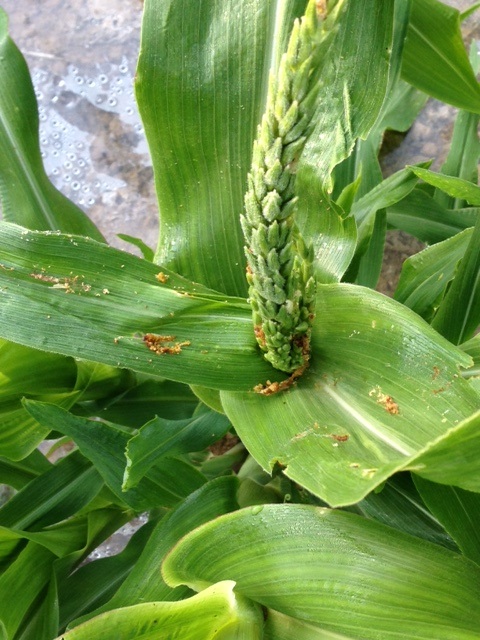 Look for the characteristic “shot-hole” type of feeding (photo below at right) and consider treating when infested plants exceed 12% in a 50 plant sample. As plantings proceed to the pre-tassel stage, ECB larvae may be found in emerging tassels (see photo at left). It is a good idea to treat individual plantings as they move into the full tassel/first silk stage one time. This eliminates any ECB larvae that have emerged with the tassels as they begin to move down the stalk to re-enter near developing ears.
Useful insecticides for this particular application include synthetic 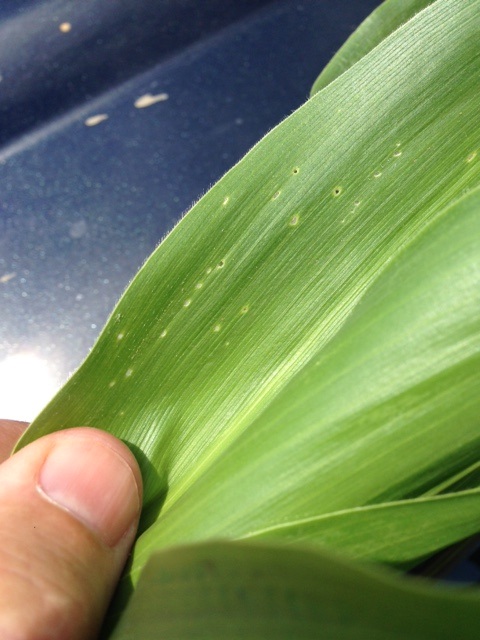 pyrethroids (IRAC Grp 3), spinosyns (including OMRI approved Entrust) IRAC Grp 5), and diamides such as Coragen or Vantacor (IRAC Grp 28) or materials such as Besiege which include the active ingredient in Coragen. It should be noted that Coragen or Vantacor, used alone, are not toxic to bees that may be visiting corn tassels during this stage. Synthetic pyrethroids alone should NOT be used for corn earworm (CEW) protection on silking corn. Control with these materials is very inconsistent.
The highest nightly trap catches of ECB for the week ending 6/05/24 are as follows:
| Asbury 1 | Lawrenceville 1 |
| Clinton 1 | Milford 1 |
| Dayton 1 | Oldwick 1 |
| Georgetown 1 | Princeton 1 |
| Hillsborough 1 | South Branch 1 |
Cucurbit powdery mildew control in 2025
Cucurbit powdery mildew (CPM), caused by Podosphaera xanthii, is one the most important diseases of cucurbit crops throughout the world. The pathogen is an obligate parasite, just like cucurbit downy mildew, meaning it needs a living host in order to survive. In northern regions that have a killing frost in the fall the pathogen will die out when the crop freezes. Not being able to overwinter, the pathogen must be re-introduced each spring or summer in the mid-Atlantic region. The pathogen accomplishes this by re-infecting cucurbit crops in the spring as they are planted up the east coast starting in Florida, then the Carolina’s, Virginia, and so forth. By late May, as soon as cucurbit crops begin to germinate in the mid-Atlantic region, the potential threat for potential powdery mildew infections begin. [Read more…]
Preparing for important fungal diseases in Asparagus during the summer.
Asparagus growers should consider scouting their fields regularly during the summer months for foliar disease development. Important pathogens that growers need to scout for on a regular basis include Purple spot, Cercospora, and Rust. [Read more…]
Controlling white mold in spring crops
White mold, or lettuce drop, caused by Sclerotinia sclerotiorum, can cause serious losses in lettuce and other susceptible crops if left uncontrolled. Disease development is favored by wet, humid conditions (especially in high tunnels and fields) with known histories of the disease.
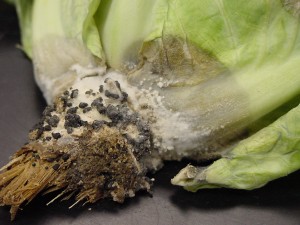
White mold on lettuce. Notice the white fungal growth and black sclerotia developing on the base of the stem. The sclerotia can survive in the soil for up to 10 years.
Bacterial leaf spot control and copper resistance in pepper and tomato
Copper resistance in bacterial leaf spot of tomato and pepper crops has been detected at a high level in New Jersey the past few summers. While not surprising, copper resistance has been known to develop for decades now. Copper applications for the control of bacterial diseases in many crops has been a mainstay for decades now and is often applied in weekly protectant fungicide programs. With help from Dr. Nrupali Patel and Dr. Don Kobayashi, bacteriologists in the Department of Plant Biology located on the New Brunswick campus, a (NJ-VGA funded) survey was initiated to determine which species of bacterial leaf spot are most prevalent in New Jersey tomato and pepper crops. Bacterial leaf spot can be caused by four species of Xanthomonas: X. euvesicatoria, X. vesicatoria, X. perforans, and X. gardneri. Currently, there are four races of BLS found in tomato (T1-T4; one for each of the 4 species stated above) and eleven races found in pepper (0-10). Differential tests in southern New Jersey using various bell pepper lines over the past 15 years has suggested that the number of races of BLS in pepper has increased over time; with all races present in the State to date. Lab testing results from samples collected from the small number of NJ vegetable farms the last three summers has shown the presence of X. euvesicatoria in pepper, as well as X. euvesicatoria and X. perforans in both tomato and pepper in the state, with ~60% of all samples testing positive for copper resistance.