Vegetable Crops Edition

Seasonal updates and alerts on insects, diseases, and weeds impacting vegetable crops. New Jersey Commercial Vegetable Production Recommendations updates between annual publication issues are included.
 
Subscriptions are available via EMAIL and RSS.
 
Quick Links:

NJ Commercial Vegetable Production Recommendations

Rutgers Weather Forecasting - Meteorological Information important to commercial agriculture.

Controlling Purple Spot on Asparagus Spears

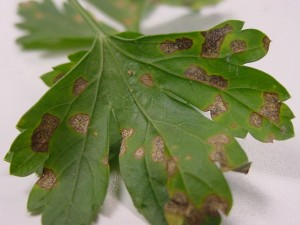
Purple spot, caused the soil-borne fungus, Stemphylium vesicarium, can cause problems in cool, wet springs. Symptoms, just like its name, include numerous, sunken oval-shaped spots on spears during the harvest season and more importantly on ferns and stalks during the summer months as long as conditions are ideal for its development.

Twelve hours of wetness is needed for infection and the disease is exacerbated by wind-blown sand injury. Heavy purple spot infection during the summer will lead to premature defoliation which will decrease carbohydrate reserves for the next production season. With the season we had last year and the wet spring we’ve had thus far this year season, pressure due to purple spot may be high. Control of purple spot can be difficult because of management issues (i.e., the mowing and chopping up and leaving of old fern material in the field) and because fungicides can’t be applied during the harvest season. Growers who had pre-mature defoliation issues last year may expect problems this spring. Remember, controlling purple spot begins with preventative fungicide applications during summer and fall by reducing infections to ferns and stalks. Weekly scouting should be done in the spring and followed up with additional scouting and timely fungicide applications once fern stalks are full size. Apply and rotate azoxystrobin (FRAC group 11) at 6.2 to 15.5 fl oz 2.08F/A with chlorothalonil at 2.0 to 4.0 pt/A.

(Photo by M. Hausbeck, Michigan State University)

Avoid Sunscald Injury in Transplants

Although the weather has been relatively wet these past few weeks, hotter than normal temperatures have already crept in, thus we need to be cautious about sunscald developing on the stems of transplants, especially those being set onto black plastic mulch. With a little planning ahead potential losses to sunscald injury can reduced significantly.

Sunscald

Sunscald injury on stems of newly transplanted pepper seedlings caused by stems laying against edges of black plastic mulch on hot, sunny days.

A transplant coming straight out of the greenhouse and directly into the field has not been exposed to much direct sunlight. Add that with black plastic mulch and you have a lot of heat aim directly at the tender tissue of the transplant. All transplants should have some time to harden-off outside the greenhouse before going into the field, a day or two, is better than none at all, the longer the better if time and space allow.

Sunscald typically appears as the slow bleaching out of the stem that will typically appear only on one side. Often this starts to appear right where the stem meets the black plastic mulch. In many cases if the stem is touching the mulch, the sunburn will start there and the transplant will begin to fall over as if the stem was broken.

When transplanting, make sure the holes in the plastic are wide enough to keep the stem from coming into contact with it. In some cases growers will fill in the transplant hole with soil to help keep the transplant upright before between-row herbicides are applied. ‘Leggy’ transplants that lay across plastic mulch and even those transplanted onto bare ground are prone to sunscald injury.

IPM Update 5/08/24

Sweet Corn

IPM personnel have deployed black light and corn earworm (CEW) pheromone trap networks in central and northern New Jersey counties.  In areas from central Burlington County southward, grower cooperators have been provided with CEW pheromone traps and will be monitoring these traps on their own properties and reporting catch data to IPM personnel.  This is an effort to maintain a statewide reporting program for the most significant economic pest of sweet corn despite a shortage of professional staff this year.  The IPM program thanks these growers in the southern counties for their assistance in maintaining this necessary service.

Black light trap derived maps for European corn borer (ECB), CEW and brown marmorated stink bug (BMSB) will not appear in the Plant and Pest Advisory, as there is no statewide blacklight trap network.  Data from existing black lights in the central and northern counties will appear in table format, with associated information on the relevance of the populations.  Provided that  data from the southern CEW pheromone traps is available on a regular basis, maps will be generated for this pest/trap type.   Limited collections from traps thus far have not contained any target pests.

[Read more…]

RU Ready to Farm Equipment Demo Day at Specialty Crop Research Farm – Cream Ridge

Register here or use the QR code:
https://go.rutgers.edu/RUReadytoFarmEquipmentDemo

RU Ready to Farm Equipment Demo May 18, 2024 flier


Webinar on the FSMA Final Rule on Pre-Harvest Agricultural Water – MAY 20, 2024 – Time: 1:00 PM – 2:00 PM ET

The U.S. Food and Drug Administration (FDA) invites the public to registerExternal Link Disclaimer for a webinar on the Standards for the Growing, Harvesting, Packing, and Holding of Produce for Human Consumption Relating to Agricultural Water (Agricultural Water Final Rule). The purpose of this webinar is to provide an overview of the final rule and answer pre-submitted and live questions.

Background

The final rule replaces certain pre-harvest agricultural water requirements for covered produce (other than sprouts) in the 2015 Produce Safety Rule with requirements for systems-based agricultural water assessments to determine and guide appropriate measures to minimize potential risks associated with pre-harvest agricultural water. Specifically, this rule:

  • Establishes requirements for agricultural water assessments that evaluate a variety of factors that are key determinants of contamination risks associated with pre-harvest agricultural water; this includes an evaluation of the water system, water use practices, crop characteristics, environmental conditions, potential impacts on water from adjacent and nearby land, and other relevant factors;


  • Includes testing pre-harvest agricultural water as part of an assessment in certain circumstances;


  • Requires farms to implement effective mitigation measures within specific timeframes based on findings from their assessments. Hazards related to certain activities associated with adjacent and nearby land uses are subject to expedited mitigation; and


  • Adds new options for mitigation measures, providing farms with additional flexibility in responding to findings from their pre-harvest agricultural water assessments.

The rule also finalizes the dates for compliance with the pre-harvest agricultural water requirements for non-sprout covered produce as follows:

  • For very small farms: 2 years, 9 months (April 5, 2007)
  • For small farms: 1 year, 9 months (April 6, 2026)
  • For all other farms: 9 months (April 7, 2025)

 Registration

The May 20 webinar is a virtual event. Registration is free and will be open through the day of the webinar. Persons interested in attending the public meeting must register at: FSMA Final Rule on Pre-Harvest Agricultural Water Webinar

If you have questions about the final rule that you wish to submit for possible discussion during the webinar, please note them during registration. All questions must be received by May 15, 2024, to be considered for discussion.

Manage your transplant watering schedule

The weather this spring has been relatively wet with a few hot days sprinkled in between. Unfortunately, these weather patterns can cause problems in transplant production, especially when it comes time for watering. Hot days may require more than one watering, and cloudy days may require no water. In either case, growers need to anticipate their transplant water needs without over or under estimating watering. Of course, other factors include the growing media and the plant itself. Lets focus on media, for example, growers using a lighter soilless media, these will dry out much quicker than a heavier media and will require more daily watering (e.g., once in AM, afternoon, and evening). Growers using a heavier media may only have to water once a day, or early in the AM and maybe once more in the PM. Either type of media works fine as long as the weather doesn’t change and it fits the growers needs. Proper transplant watering is all about adjustment. If you have stuck to the same daily watering schedule this spring its very likely you have grossly over or under watered your transplants at some point. And, in all likelihood, grossly over or under watered trying to correct the situation. Uniformity is also key when it comes to proper transplant watering. If you find yourself spot watering out of schedule because some flats dry out quicker than others then most likely your uniformity is off. This is easily done when watering is done by hand with a wand. Poor uniformity can also be the result of transplant flats being set on uneven benches or uneven floors. Much like a field, low spots tend to collect the most water. All of this can lead to uneven transplant growth as well as disease and pest pressure, such as fungus gnat problems. If you are experiencing uneven transplant growth, then most likely your watering is uneven. For transplant growth to remain even, flats need to be watered each time to maximum water holding capacity, where each cell in the flat holds the maximum amount of water. An easy way to see this is to watch for water dripping out the bottom of the flat. As important, flats should also uniformly dry out. Below is an example of tomato transplants that have been pulled from the same flat. You can see the differences in plant height as well as root system formation as a result of uneven watering in a “heavy” soilless media. Cells that have remained on the wet side show poor growth and poor root system development because of a waterlogged cell; whereas cells that have been receiving the appropriate amount of water have much better growth and a nice root ball. The weight test. When was the last time you picked up a transplant tray? Picking up a transplant flat every once in a while will give you an idea of how well your watering schedule and uniformity is. Everyone has picked up a tray that has felt like it has the weight of a rock or the tray breaks apart because of the weight, or when you pick it up and it feels as light as a feather. Doing this is a good way to determine if your soilless media is “heavy” – holds more water than you think or if you have been overwatering on days you shouldn’t be or if you have not watered enough. Consistency is key when watering. Going from an extremely wet to an extremely dry transplant tray is not what you want for the transplant production season. You want consistent soil moisture as much as possible, thus proper transplant watering is all about the proper adjustments and knowing your media.

Root growth in tomato transplants

Differences in soil moisture across a single flat of tomato transplants.

Root growth in tomato transplants

Roots of tomato transplants in a flat that has irregular soil moisture.