Vegetable Crops Edition
Seasonal updates and alerts on insects, diseases, and weeds impacting vegetable crops. New Jersey Commercial Vegetable Production Recommendations updates between annual publication issues are included.
Subscriptions are available via EMAIL and RSS.
Quick Links:
 NJ Commercial Vegetable Production Recommendations
Rutgers Weather Forecasting - Meteorological Information important to commercial agriculture.
EPA Announces Update on Atrazine (with editorial note on NJ)
EPA Announces Update on Atrazine (with editorial note on NJDEP 2018 ag use data summary)
Note Changes in Harmonized Audits for 2024
It has come to our attention that growers are using on old self audit checklist for their 2024 audit. According to USDA the old form was not acceptable after April 30, 2024! The USDA released the new Harmonized GAP Standard and Harmonized Plus+ Standard Audits in March to give growers the opportunity to update their plans. There are several changes related to section numbers and deleted numbers so if you have your audit plan setup by section number check to make sure they have not changed. Also, eight questions have been added. Following is a summary of those questions:
- G 2.4 – Approved service provider list required (the grower approves the list)
- G 7.2 – A designated recall team is required
- G 7.3 – Must perform a mock recall exercise annually
- G 11.5 – Must have labels and instructions for any water treatment chemical used
- G 11.8 – Compressed air or other gases contacting food or food contact surfaces must be maintained
- F 6.3 – Must have a procedure for storing and handling growing media (e.g., perlite, peat, rock wool, etc.)
- F 9.4 – Re-used water must be treated with a labeled product
- P 5.2 – A master cleaning schedule with standard operating procedures (SOP) must be established
There are two documents for each audit: Harmonized GAP Standard (v 3.0) or Harmonized GAP Plus+ standard (v 5.0). Each audit has a corresponding checklist “Harmonized GAP Combined Checklist (v6.1)” This is the checklist a grower should be using to their self-audit. Remember an older version will not be accepted which means the audit fails. Go to the Rutgers On-Farm Food Safety website an look under the USDA Audits tab or go to Harmonized GAP | Agricultural Marketing Service (usda.gov) to download the correct versions.
Vegetable IPM Update 7/03/24
Sweet Corn
European corn borer (ECB) moth catches are very low in blacklight traps in the northern and central counties. Feeding signs are largely absent from whorl and pre-tassel stage plantings.
The highest nightly trap catches of ECB for the week ending 7/03/24 are as follows:
| Clinton 1 | Milltown 1 |
| Dayton 1 | Old Bridge 1 |
| Hillsborough 1 | Oldwick 1 |
The low level fall armyworm (FAW) infestations we had found in some whorl stage corn in central NJ, have been treated and new infestations have not occurred. It is possible that some infestations remain in unmonitored fields. It is important to check short whorl plantings at least weekly for the remainder of the season because early detection and treatment limit irreversible damage to plants.
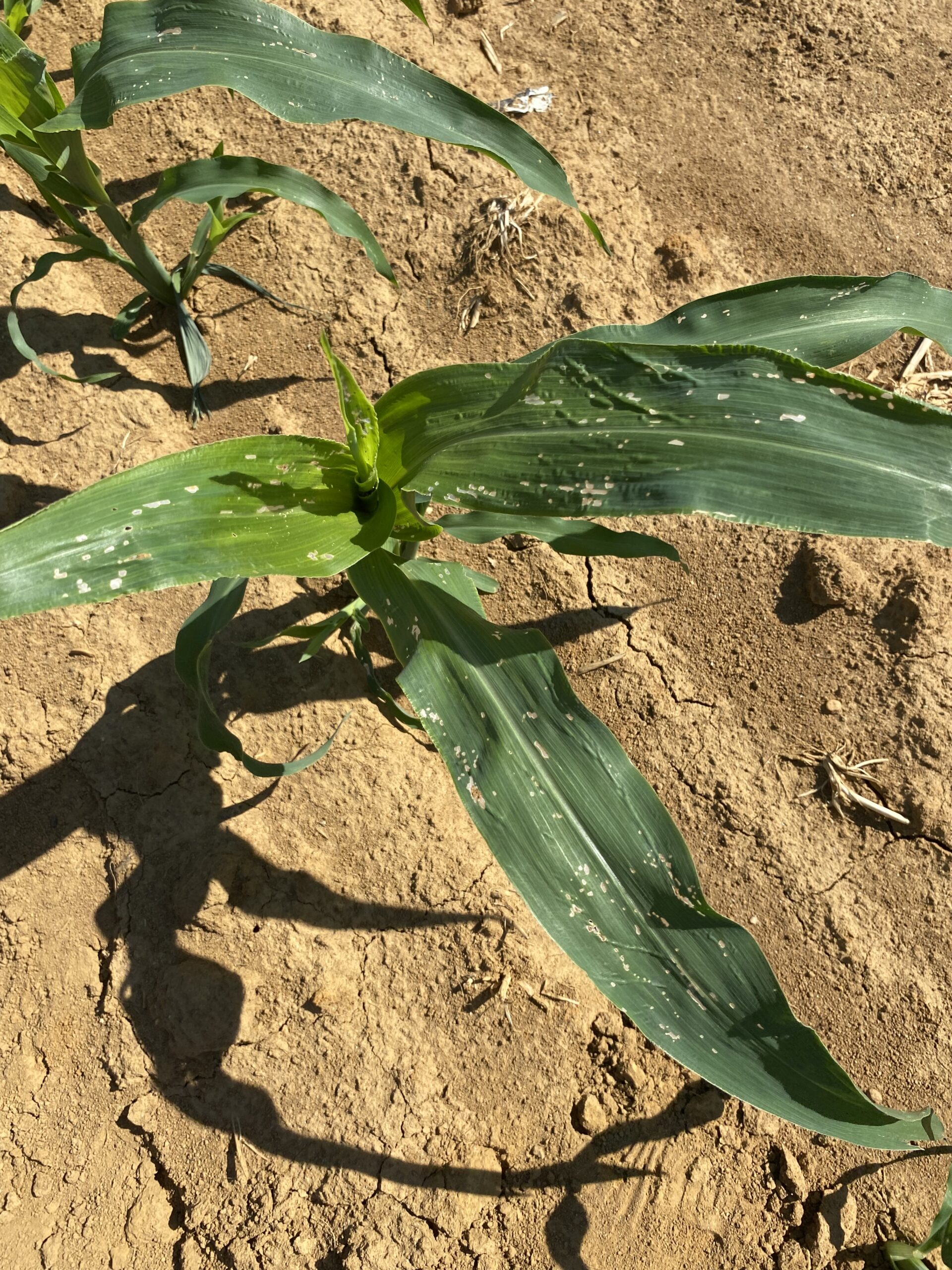 Newly hatched FAW larvae cause holes and scratches on leaves that are similar to ECB feeding, except that they tend to be more concentrated and always lead down into the whorl (see photo at left). As the larvae grow, the feeding becomes more destructive, with large ragged holes and obvious droppings deposited in the whorl (see photo at right).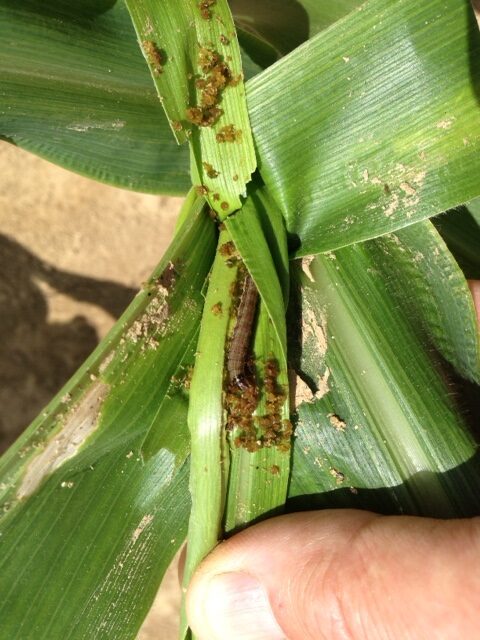
We will provide updates on new FAW appearances and severity as reports come in. FAW are resistant to synthetic pyrethroids. Effective sprays should include IRAC grp. 5 (spinosyns) or IRAC grp. 28 (diamides). The carbamate (IRAC grp. 1A) Lannate is also still effective. Sufficient water should be used in the applications to allow the solution to penetrate the layer of droppings that may have formed above the caterpillar.
Food Safety Certification for Specialty Crop (FSCSC) Cost Share Program
This is the chance for eligible fresh fruit and vegetable growers to recover some of their expenses for implementing food safety practices on the farm.
For 2024:
- Applications are due between July 1, 2024 and January 31, 2025
- Eligible expenses must be between June 26, 2024 and December 31, 2024
For 2025:
- Application is due between January 1, 2025 and January 1, 2026
- Eligible expenses must be between January 1, 2025 and December 31, 2025
Eligible specialty crop operations can apply for FSCSC by working directly with the Farm Service Agency offices at your local FSA office for details. Applications will be accepted via mail, fax, hand delivery, or electronic means.
How the Food Safety Certification for Specialty Crops Program Works
The FSCSC program provides financial assistance for specialty crop operations that incur eligible on-farm food safety program expenses related to obtaining or renewing a food safety certification in years 2024 and 2025. This program helps offset costs to comply with regulatory requirements and market-driven food safety certification requirements. FSCSC will cover a percentage of the specialty crop operation’s cost of obtaining or renewing their certification, as well as a percentage of their related expenses.
Program Eligibility
Eligibility requirements for FSCSC applicants are outlined below. We recommend you review these requirements before initiating your FSCSC application.
To be eligible for FSCSC, an applicant must:
- Have obtained or renewed:
- 2024 food safety certification issued between June 26, 2024, and December 31, 2024
- 2025 food safety certification issued during calendar year 2025.
- Be a specialty crop operation (growing fresh fruits and vegetables); and meet the definition of a small business or very small business.
- A small (farm) business means an applicant that had an average annual monetary value of specialty crops the applicant sold during the 3-year period preceding the program year of more than $250,000 but not more than $500,000.
- A very small (farm) business means an applicant that had an average annual monetary value of specialty crops the applicant sold during the 3-year period preceding the program year of no more than $250,000.
| Category of Eligible Expenses | Payment Amount of Eligible Costs |
| Developing a Food Safety Plan for First Time Certification | 75% (no maximum) |
| Maintaining or Updating a Food Safety Plan | 75% up to $675 |
| Food Safety Certification | 75% up to $2,000 |
| Certification Upload Fees | 75% up to $375 |
| Microbiological Testing of Produce | 75% up to 5 tests |
| Microbiological Testing of Soil Amendments | 75% up to 5 tests |
| Microbiological Testing of Water | 75% up to 5 tests |
| Training Expenses | 100% up to $500 |
FSCSC payments are calculated separately for each category of eligible costs based on the percentages and maximum payment amounts. The FSCSC application and associated forms are available online at farmers.gov/food-safety.
You are encouraged to contact the Farm Service Agency office about FSCSC, program eligibility, or the application process. You may also call 877-508-8364 to speak directly with a USDA employee ready to provide one-on-one assistance.
Vegetable IPM Update 6/26/24
Sweet Corn
European corn borer (ECB) moths have declined in blacklight traps in the northern and central counties, and feeding is also declining as previously infested plantings enter the silk stage and are treated. Plantings now in whorl stage are showing little feeding.
The highest nightly trap catches of ECB for the week ending 6/26/24 are as follows:
| Farmingdale 1 |
| Milltown 1 |
| Pennington 1 |
Low level fall armyworm (FAW) infestations have been detected in a few whorl stage plantings in central counties ranging from Princeton in Mercer County to Farmingdale in Monmouth County. There are likely more of these infestations in central and southern NJ counties. The appearance of very scattered clusters of infested plants points to a low number of moths arriving prior to the last weather front. These individuals will have deposited eggs on small groups of plants, resulting in the feeding pattern we now see. Many of these fields are below 2% plants infested. It is possible, however, that some fields in the southern counties have higher infestation levels, so it’s important to check these short whorl plantings at least weekly.
Newly hatched FAW larvae cause holes and scratches on leaves that are similar to ECB feeding, except that they tend to be more concentrated and always lead down into the whorl (see photo at left). As the larvae grow, the feeding becomes more destructive, with large ragged holes and obvious droppings deposited in the whorl (see photo at right).
We will provide updates on new FAW appearances and severity as reports come in. FAW are resistant to synthetic pyrethroids. Effective sprays should include IRAC grp. 5 (spinosyns) or IRAC grp. 28 (diamides). The carbamate (IRAC grp. 1A) Lannate is also still effective. Sufficient water should be used in the applications to allow the solution to penetrate the layer of droppings that may have formed above the caterpillar.

