Vegetable Crops Edition

Seasonal updates and alerts on insects, diseases, and weeds impacting vegetable crops. New Jersey Commercial Vegetable Production Recommendations updates between annual publication issues are included.
 
Subscriptions are available via EMAIL and RSS.
 
Quick Links:

NJ Commercial Vegetable Production Recommendations

Rutgers Weather Forecasting - Meteorological Information important to commercial agriculture.

Allium Leafminer, a New Invasive Pest

Allium leafminer, a leafmining fly, was found about two weeks ago in Lancaster County, Pennsylvania. Since then the leafminer, which feeds on onions and related plants, has been found in four more counties in eastern Pennsylvania; Dauphin, Delaware, Chester, and Lehigh.  This is the first time that this fly has been found in the western hemisphere.  It belongs to the family Agromyzidae, which has many leafmining species.
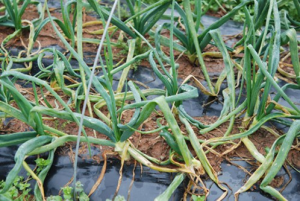
Weakened leaves caused by larvae of allium leafminer

Weakened leaves caused by larvae of allium leafminer. Photo by L. Donovall

The allium leafminer feeds on plants belonging to the onion group, including, leeks, onion, chives, shallot, green onion and garlic. The adult flies are cold tolerant and emerge in late February and March when the female, after mating, will lay eggs in the leaves of the host plant.  Upon hatching the larvae (maggots) will tunnel in the leaves eventually entering the bulb.  Reaching maturity the larvae will pupate as brown capsules between the leaves, in the bulb, or in the soil nearby.  They will go into a summer diapause with adult flies emerging in September and October to lay eggs.  The second generation larvae will mine leaves and pupate until time for adult emergence in the following February.
[Read more…]

Vegetable Disease Briefs – 5/1/16

  • Dickeya sp., an aggressive form of Black leg, has been confirmed on potato in New Jersey in 2016. Symptoms of Dickeya infection look similar to Black leg infection and can cause significant rot above ground (stems and foliage) and below ground (tubers). All potato growers should scout on a regular basis and report any suspect plants or fields.
  • There have been no new reports of cucurbit downy mildew.
  • With the cool, prolonged wet weather, basil downy mildew may become active in greenhouses or high tunnels that have been closed up to retain heat. Appropriate venting to keep relative humidity low and leaf wetness to a minimum is critically important to keep the pathogen from sporulating and spreading rapidly.

Vegetable Disease Update – 5/1/16

Cabbage

Damping-off – To help control losses due to damping-off pathogens apply Ridomil Gold (mefenoxam, FRAC code 4) at 1 to 2 pt/A, MetaStar (metalaxyl, 4) see label, or azoxystrobin at 0.40 to 0.80 fl oz 2.08SC/1000 row ft (for Rhizoctonia only), or Ridomil Gold at 1.0 to 2.0 pt/A 4SL plus azoxystrobin at 0.40 to 0.80 fl oz 2.08SC/1000 row ft. in a band up to 7 in. after seeding. To help control damping-off pathogens in Collards and Kale only: Apply Uniform (mefenoxam +  azoxystrobin, 4 + 11) at 0.34 fl oz 3.66SE/1000 ft row. For more information please see 2016 New Jersey Commercial Vegetable Production Recommendations Guide.

[Read more…]

Vegetable Growers’ Twilight 4/28 6PM East Vineland Fire Hall

Vegetable growers are invited to Rutgers spring South Jersey Integrated Crop Management Twilight meeting tonight, 4/28/2016, 6–9 PM, located at the East Vineland Fire Hall on Landis Ave. (across from Savoy Restaurant).

The program offers 2 Core and 4 Cat 1A and PP2 pesticide re-certification credits, using drones on farms,  [Read more…]

Damping-off: Identifying and Controlling Early-season Pathogens

It is extremely important to know which pathogen is causing damping-off problems and which fungicide to properly apply. The key to controlling damping-off is being proactive instead of reactive. Always refer to the fungicide label for crop use, pathogens controlled, and application rates.

Damping-off is caused by a number of important vegetable pathogens and is very common during the spring. Damping-off can kill seedlings before they break the soil line (pre-emergent damping-off) or kill seedlings soon after they emerge (post-emergent damping-off). Common pathogens that cause damping-off include Pythium, Phytophthora, Rhizoctonia and Fusarium spp.

Control of damping-off depends on a number of factors. First, is recognizing the conditions which may be leading to the problem (i.e., weather/greenhouse growing conditions) and second, identifying the pathogen causing the problem.

Conditions Favoring Damping-off

Although all four pathogens are associated with damping-off, the conditions which favor their development are very different. In general, Phytophthora and Pythium are more likely to cause damping-off in cool, wet or overwatered soils that aren’t allowed to dry out due to cloudy weather or cooler temperatures. Conversely, Rhizoctonia and Fusarium are more likely to cause damping-off under warmer, drier conditions especially if plug trays are kept on the dry side to help reduce transplant growth. [Read more…]

Vegetable Disease Briefs – 4/15/16

  • Late blight has been reported in Florida and South Carolina on tomato. To track the season-long progress of Late blight in the US please visit (http://usablight.org/)
  • There has been isolated reports of cucurbit downy mildew on watermelon and cucumber in southern Florida. To track the season-long progress of cucurbit downy mildew in the US please visit (http://cdm.ipmpipe.org/)
