Vegetable Crops Edition

Seasonal updates and alerts on insects, diseases, and weeds impacting vegetable crops. New Jersey Commercial Vegetable Production Recommendations updates between annual publication issues are included.
 
Subscriptions are available via EMAIL and RSS.
 
Quick Links:

NJ Commercial Vegetable Production Recommendations

Rutgers Weather Forecasting - Meteorological Information important to commercial agriculture.

Disinfection of Surfaces for Prevention of COVID-19 Spread – Use Caution

Cleaning supplies

The chemical concentrations for the disinfection of high touch surfaces in retail markets during the COVID-19 pandemic are higher than we normally recommend. This concentration is for the disinfection of hard non-porous surfaces and is not for use on produce. Care must be taken to ensure the safety of yourself and your workers when using this concentration. Typical concentrations of bleach for sanitizing surfaces is 150 PPM, the disinfection recommended 1/3 cup bleach to 1 gallon of water is 1000 PPM. This concentration can be caustic to skin, airways, and produce.  Take the following precautions:

1. Clean the surface with detergent removing all visible debris and with a clean water rinse.
2. Conduct mixing in a well-ventilated area and increase ventilation when possible in areas of use, wear rubber gloves to protect skin from contact with the bleach and bleach solution.
-If skin comes in contact with the bleach or bleach solution rinse with water, if irritation continues call a doctor.
-If the bleach or bleach solution comes into contact with the eyes rinse with water for 15 minutes, if irritation continues call a doctor.
5. Chlorine PPM measurement strips typically used in packing houses do not go up to 1000 PPM.
-1000 PPM test strips are available online through Granger, Amazon, and restaurant supply stores.
-Test strips must be for FREE chlorine, not total chlorine.
-Test strips have expiration dates, make sure yours are not expired.
6. Follow bleach label instructions for contact time requirement. This is the amount of time your surface needs to stay wet with the bleach solution to ensure efficacy and is usually 1 minute or more.
7. Use containers of bleach that have been opened no longer than 30 days to ensure proper concentration.
8. Mixed concentrations of bleach should be stored at cool temperatures and away from direct light, used within a few days and retested for PPM prior to each use to ensure correct concentration.
9. Do not mix bleach with any other cleanser!

Vegetable Disease Update – 4/30/20

  • Tomato and pepper transplanting has begun in southern New Jersey. With the on and off again heavy rains we have been getting all growers should consider applying at-transplanting fungicides for root rot control. Please click here to see this article from last week.
  • Root rot in pea has been reported. Infected plants will wilt and collapse, especially in wet, low areas of the field. Look for black stem lesions at the base of the plant at the soil line. In general, Pythium infections won’t extend beyond one inch above the soil line in infected plants. Under ideal conditions a white, cottony growth may be present and is a diagnostic feature. In Pythium infected plants, the outer cortex of the root can easily be pulled off. For, more information on damping-off please click here.
  • Scouting and controlling Septoria leaf spot in parsley.
  • Bacterial leaf spot has been reported on savoy cabbage in southern New Jersey.
  • Timber rot has been reported in greenhouse pepper in southern New Jersey. For more information on white mold on tomato and pepper click here.
  • Cold weather injury has been reported in numerous vegetable crops throughout the state.
  • Bacterial leaf blight in Cilantro was reported in southern New Jersey.
  • Common leaf spot was reported in strawberry. For more information click here. Weather conditions have also been ideal for fruit rot infections. For more information on controlling fruit rots in strawberry please click here.
  • White rust and anthracnose have been reported in spinach over the past few weeks. For more information click here
  • For the updated list of fungicides for use in the control of important diseases in the greenhouse please click here.
  • Transplant producers need to remember to vent their structures to reduce relative humidity buildup going into the evenings to help reduce leaf wetness during the overnight.
  • The 2020/2021 Commercial Vegetable Production Recommendations Guide is available for free online! With many county offices running reduced hours or being closed this is the easiest way to obtain the newest recommendations.
  • For a quick review on managing fungicide resistance development using tank mixes and fungicide rotations, and information on FRAC group 4, FRAC group 7, and FRAC group 3 and FRAC group 11 fungicides please click on hyperlinks.

USDA ‘Farmers to Families Food Box Program’ Info Webinar TODAY at 2pm for Farmers, Shippers, Suppliers

The U.S. Department of Agriculture (USDA) Agricultural Marketing Service (AMS) will host a webinar on Wednesday, April 29, 2020, at 2 p.m. ET, for farmers, shippers and other suppliers interested in learning more about the Farmers to Families Food Box Program. This webinar is an opportunity for these parties to learn how to supply produce, dairy and meat products to vendors supplying food boxes to non-profits and other entities feeding hungry Americans.

Register for the Webinar HERE.

Additionally, AMS, the Food and Nutrition Service (FNS) and the Office of Partnerships and Public Engagement (OPPE), published Frequently Asked Questions for non-profit organizations seeking to receive food through the Farmers to Families Food Box Program.

Frequently Asked Questions are answered here.

More information is available on the Farmers to Families Food Box Program webpage.

Additional questions may be submitted to USDAFoodBoxDistributionProgram@usda.gov.

On-Farm Direct Marketing in 2020 Webinars – Every Tuesday Night in May

Rutgers Cooperative Extension Agricultural Agents are hosting a 4-parFruit standt webinar series, every Tuesday in May from 7:00-8:00PM to assist farmers with on-farm direct marketing operations to develop strategies for the 2020 season. This 4-part, weekly program will present and discuss the following topics:

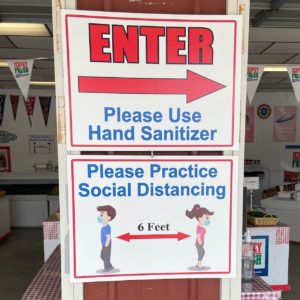
Session 1 (May 5th): Maintaining Social Distancing and Safe Food Handling Practices: Guidance for Farm Markets – Wesley Kline, Ag Agent, RCE of Cumberland Co. and Meredith Melendez, Ag Agent, RCE of Mercer Co.

Session 2 (May 12th): Sales and Distribution Strategies – William Bamka, Ag Agent, RCE of Burlington Co. and Stephen Komar, Ag Agent, RCE of Sussex Co.

Session 3 (May 19th): U-Pick Operation Guidelines under COVID-19 – Meredith Melendez, Ag Agent, RCE of Mercer Co.

Session 4 (May 26th): Farmer Panel – Strategies We Are Using – (Farmers TBD) Moderators: Michelle Infante-Casella, Ag Agent, RCE of Gloucester County and Meredith Melendez, RCE of Mercer Co.

To Participate online for All 4 Events:
Use the link:  https://go.rutgers.edu/k0d59m8h

Or join by phone:
+1-650-429-3300 USA Toll
Access code: 226 795 368 # and then # again

We suggest visiting at least 15 minutes before the session start time to confirm system requirements 

For more events hosted by Rutgers Cooperative Extension check out the NJAES Events Calendar.

Ask the Ag Agent Weekly Online/Call-In Forum and New Web Page

Ask the Ag Agent was created when COVID-19 forced a new normal in communications nationwide. Rutgers Cooperative Extension Agricultural Agents working with “Ask the Ag Agent” education and outreach are cAsk the Ag agentommitted to the agriculture industry and all interested in growing plants, raising livestock and essential resources related to agriculture. The program now features a new Ask the Ag Agent website with more information.

Farmers and others are welcome to join a weekly teleconference each Wednesday night from 7:00pm-8:00pm. Weekly events are hosted by Rutgers Cooperative Extension Agricultural Agents working with the farming industry.

This call-in/WebEx event features updates on farm management, crop conditions, farm industry observations, agricultural agency programs and other topics discussed by farmers, agricultural agents and other agricultural service providers.

Hosted by Bill Bamka, Stephen Komar, Michelle Infante-Casella and Meredith Melendez, this weekly communication provides a forum for discussion for farmers and all involved in NJ agriculture. Agricultural agency personnel, non-profit organizations and others have participated and added additional discussion with farmers.

This event and other events hosted by Rutgers Cooperative Extension can be found on the Rutgers NJAES Events website.

To join the “Ask the Ag Agent” forum each week on a computer/tablet/smartphone via the WebEx Videoconference:

Use the URL: https://go.rutgers.edu/rc9n3kxtiPhone

To join the “Ask the Ag Agent” each week on the Phone:
Call: (650)-429-3300
Access Code: 799-743-872 # followed by #

Penn State Webinar: H-2A Agricultural Workers in Times of Uncertainty

Penn State Cooperative Extension is hosting a free webinar to discuss the H-2A program in Pennsylvania. This may be helpful for NJ Farmers to listen in to find any updates or tips on how to handle this agricultural worker program. You must register to join this online event. In order to register you will need to create an account on the Penn State advertisement page.

Webinar Date: Thu., May 7, 2020
(6:30 PM – 8:00 PM ET)

Registration deadline: May 7, 2020
5:30 p.m.

COVID-19 mitigation efforts, including international travel restrictions and consulate closures, have disrupted the normal functioning of the H-2A visa program for temporary workers. These disruptions to the H-2A program raise questions about the timely arrival of guest workers and the impact on essential food and agricultural businesses. The H-2A Agricultural Workers in Times of Uncertainty Webinar will provide answers and guidance to the many questions surrounding this topic.
The dangers of COVID-19 itself similarly raises questions around how to protect the health and well-being of H-2A visa holders. As front-line workers, the protection of their livelihoods and health are integrally tied to the protection of public health.

Penn State Extension will be holding a townhall-style webinar to address these topics, and to provide answers and guidance to these questions. Join us as we hear from a panel of subject matter experts, including Brook Duer, Staff Attorney at the Penn State Center for Agricultural and Shale Law; Grant Meckley, Pennsylvania Keystone Health’s Agricultural Worker Program; Scott Sheely, Executive Director of the Lancaster County Agriculture Council; and Richard Stup, Agricultural Workforce Specialist at Cornell Cooperative Extension. Also joining us will be Alyssa Charney, Agriculture Legislative Assistant from Senator Casey’s Office.

Attendees will have the opportunity to either send in questions ahead of time, or during the webinar itself, for a Q&A session following the panelists’ overview and update on the H-2A visa program.

There is no cost for this webinar, however registration is required to receive the webinar link. To go to the registration page you can also see https://go.rutgers.edu/if9tsm4h.