Blueberry:
General Insect Control and New and Renewed Labels: Late last week we obtained the Section 24C renewal for the high rate of Gowan Malathion 8F. The specifics of the label renewal are as follows: [Read more…]
Rutgers Cooperative Extension
Seasonal updates on diseases, insects, weeds impacting tree fruit and small fruit (blueberry, cranberry, and wine grape). Fruit Pest Alerts are also available via this category feed.
Subscriptions are available via EMAIL and RSS.
Blueberry:
General Insect Control and New and Renewed Labels: Late last week we obtained the Section 24C renewal for the high rate of Gowan Malathion 8F. The specifics of the label renewal are as follows: [Read more…]
Based on our degree-day model for Sparganothis fruitworm, first eggs laid are expected at around 681 DD (see chart). As of June 13, Sparganothis has accumulated 814 DD (using March 1 as biofix) or 774 DD (using April 1 as biofix). This indicates that egg laying has just started but eggs are not expected to hatch yet. Reminder that a single insecticide application, i.e., post-bloom application with Delegate, Altacor, Diazinon, or Intrepid, aimed at Sparganothis larvae will likely have the greatest effect if it is timed for peak egg-hatch/larval-emergence, which is approximately 1,400 DD and will most likely coincide with the 1st-2nd week in July. I will keep you updated as the season progresses.
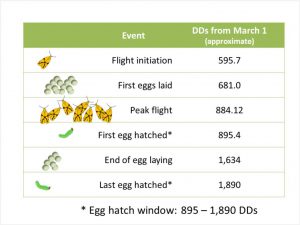
Sparganothis fruitworm degree day benchmarks
Peach:
Tufted Apple Budmoth (TABM): The second TABM flight is well underway. Adults started to emerge in northern counties on 5/16 and in southern counties on 5/1. Although this has been a minor pest, this might be changing. Trap counts in northern counties are historically high, and indicate higher than normal populations. Timings are outlined below for anyone who had high populations last year.
|
Conventional, Diamides |
Conventional, Diamides |
Intrepid, Rimon | Bt | |
| County Area | AM | EM | EM | EM |
| Southern | 3rd-6/11-12; 4th 6/15-16 | 6/12-15 | 6/12-15 | 6/12-15 |
| Northern | 1st-6/10-13; 2nd 6/18-19 | 6/14-16 | 6/13-19 | 6/16-18 |
Based on our degree-day model for Sparganothis fruitworm, flight initiation is expected at around 596 DD (see chart). As of June 3, Sparganothis has accumulated 648 DD (using March 1 as biofix) or 608 DD (using April 1 as biofix). This indicates that flight activity has just started. Growers are advised to place pheromone traps for monitoring this pest at this moment, if they haven’t done so already.
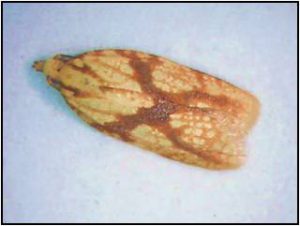
Sparganothis fruitworm adult
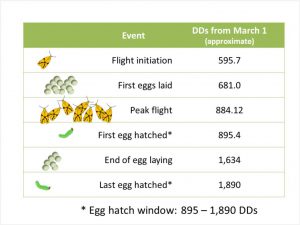
Degree-day model benchmarks for Sparganothis fruitworm
Peach:
Tufted Apple Budmoth (TABM): The first of 2 flights of tufted apple budmoth have started. Adults started to emerge in northern counties on 5/16 and in southern counties on 5/1. Although this has been a minor pest, timings are outlined below for anyone who had high populations last year.
|
Conventional, Diamides |
Conventional, Diamides |
Intrepid, Rimon | Bt | |
| County Area | AM | EM | EM | EM |
| Southern | 1st-past; 2nd-6/3-6/5 | 5/31-6/3 | 5/30-6/5 | 6/3-6/5 |
| Northern | 1st-6/9-6/11 | 6/12-6/15 | 6/11-6/26 | 6/15-6/25 |
Tufted Apple Budmoth (TABM): The first of 2 flights of tufted apple budmoth have started. Adults started to emerge in northern counties on 5/16 and in southern counties on 5/1. Although this has been a minor pest, timings are outlined below for anyone who had high populations last year. [Read more…]

