Fruit Crops Edition

Seasonal updates on diseases, insects, weeds impacting tree fruit and small fruit (blueberry, cranberry, and wine grape). Fruit Pest Alerts are also available via this category feed.
 
Subscriptions are available via EMAIL and RSS.

Suppression of cranberry seed germination with preemergence herbicides

Self-pollination or cross-pollination between undomesticated cranberries and selected cultivars occur frequently and produce fruits containing fertile seeds. Seedlings germinating from these seeds are off-type varieties that may have lower fruit yield potential and higher vegetative vigor. Contamination by off-type varieties may result in decreased long-term productivity of planted cranberry beds and loss of profitability for the New Jersey cranberry industry in an increasingly competitive environment.

In response to questions from New Jersey growers on the efficacy of preemergence herbicides at controlling off-type cranberry seedlings, we recently conducted an experiment at the Marucci Center for screening currently labeled preemergence herbicides.

Seeds were collected from three different varieties (Haines, Mullica Queen, and Stevens), stratified at 3°C for 2 months, and seeded on Petri dishes containing preemergence herbicide mixed in agar. The trial was replicated 5 times and two different runs were conducted during the winter 2018-2019. Cranberry seed germination was quantified several times a week and the experiment was terminated by 40 days after seeding cranberry seeds.
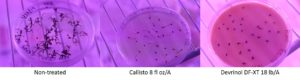
Three different petri dishes of seeds under a microscope


Results: Callisto, regardless of rate applied, did not provide any control of cranberry seed germination compared to the untreated check. Similarly, Evital 5G did not reduce seedling emergence more than 17% when used at the highest labeled rate (160 lb/A). Devrinol DF-XT had higher activity, reducing seed germination by 30% at 12 lb/A and by 50% at 18 lb/A. However, only the 12 lb/A rate is labeled for sandy beds. Casoron 4G was the most effective treatment with complete inhibition of cranberry seed germination at 50 or 100 lb/A. Similar results were noted by Dr. Jed Colqhoun in Wisconsin on cranberry grown on peat plugs for Casoron and Callisto. However, Devrinol was noted having no activity on cranberry seed germination in the WI study. This might be caused by organic matter binding of the herbicide in peat plug, which is less of a problem in agar. The study will be continued this summer by looking at germination of seed grown in a mix of sand and peat moss and treated with some of the preemergence herbicides mentioned here.
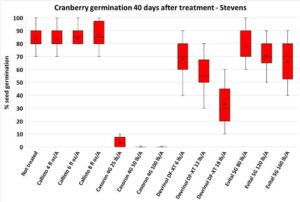
Graph of cranberry germination after treatment

These results highlight the need for rotating preemergence herbicide with different modes of action, not only for preventing the onset of herbicide resistant weed species, but also for expanding the spectrum of weeds controlled by these herbicides, including off-type cranberry seedlings.


 

Improving Your Early Season Peach Brown Rot Control Program

Have you ever felt that you did everything right at controlling brown rot during the preharvest period, but still got a significant amount of brown rot at harvest? Your preharvest fungicide applications were at tight intervals during the roughly 21-day fruit ripening period. Rains occurred but you were protected. Even when you looked back at the bloom period you saw no obvious gaps in coverage. Yet, the brown rot appeared at harvest. If this is you, read on. [Read more…]

Tree Fruit IPM Report for April 15, 2019

Peach:

Brown Rot: Blossom infections from the brown rot fungus can occur whenever pistils are exposed and a favorable climate exists. Infections can occur during any wetting period when temperatures are between 41 and 86 °F. However, optimum conditions for infection occur with wetting and temperatures in the mid 70’s. [Read more…]

Optimizing preemergence weed control in established blueberry  for 2019

Several long-residual herbicides with different modes of action (MOA) are labeled for established blueberry. In order to reduce the potential of selecting for herbicide-resistant weeds, it is highly recommended mixing two residual herbicides with different MOA whenever you apply preemergence herbicides.

Casoron (dichlobenil) is a cellulose synthesis inhibitor recommended for fall application to control many annual and perennial broadleaves, grasses and yellow nutsedge.

The photosynthesis inhibitors (PS II inhibitors) have a broad spectrum of control and will be effective against many broadleaves and annual grasses when applied in spring. Karmex (diuron) and Princep (simazine) have relatively low solubility and have been very safe on blueberries. Sinbar (terbacil) has a longer residual life in the soil and also is more soluble, so it should be used infrequently on light, wet soils. Velpar (hexazinone) is very soluble and should not be used on very sandy or wet soils.

Kerb (pronamide) and Surflan (oryzalin) are mitosis inhibitor that will be effective at controlling many annual grass species for 4 to 6 weeks after application. Fall or spring application of Kerb can also be considered for perennial quackgrass suppression.

Solicam (norflurazon) is a pigment inhibitor that may be applied in fall or spring primarily for annual grass and sedges control. Solicam may also provide partial control of many broadleaf weeds as well as of yellow nutsedge.

Chateau (flumioxazin), Zeus XC (sulfentrazone), and Zeus Prime XC (sulfentrazone plus carfentrazone) are PPO inhibitors with activity against many broadleaves when applied preemergence in fall. They also have some postemergence activity on newly emerged seedlings of annual weeds.  Chateau has a 7 day preharvest interval (PHI) and Zeus/Zeus Prime have 3 day PHI, and can therefore be applied later in the season to extend preemergence broadleaves control into late summer.

Callisto (mesotrione) is an HPPD inhibitor recommended for spring application to control many annual broadleaf weeds as well as annual sedges. It controls large crabgrass but no other grasses, such as goosegrass. Callisto may be used as a broadcast spray between rows to control broadleaves and crabgrass without injuring the fescue sod.

Matrix (rimsulfuron) and Sandea (halosulfuron) are ALS inhibitors that have both preemergence and postemergence activity. They control most annual broadleaves but are weak on common groundsel, common lambsquarters and eastern black nightshade. Sandea is recommended for postemergence  control of yellow nutsedge. However, these two herbicides will not control ALS resistant weeds (horseweed, ragweed…) already widespread in New Jersey. Thus, these herbicides should always be tank mixed with a partner effective at controlling these weeds.

Devrinol (napropamide) and Dual Magnum (s-metolachlor) are long chain fatty acid inhibitor. Devrinol will provide good control of annual grasses and should therefore be tank mixed with a PSII or a PPO inhibitor for controlling broadleaf weeds. Dual Magnum has a shorter residual activity compared to other blueberry residual herbicides but will provides good yellow nutsedge, eastern black nightshade and pigweed control.

Make sure the herbicides you plan to apply will be effective at controlling the weed species in your field by checking the herbicide label. Usually, residual herbicides will suppress weed for 6 to 8 weeks depending on irrigation as well as soil and weather conditions. After this period, another residual herbicide can be needed to control weeds through harvest and could be mixed with a postemergence herbicides to control emerged weeds. Roundup (glyphosate), Rely 280 (glufosinate,) and Gramoxone (paraquat) are postemergence herbicides that may be applied with preemergence herbicides before bud break with little risk for crop injury.


2019 North Jersey Commercial Fruit Grower Twilight Meeting II

2019 North Jersey Commercial Fruit Grower Twilight Meeting Series

Twilight Meeting II

May 8, 2019

4:30 pm – 7:30 pm

Light Dinner provided from 4:30 pm – 5:00 pm

Hosted by: Rutgers University Snyder Research and Extension Farm

140 Locust Grove Road

Pittstown, NJ 08867

Registration is free, however please RSVP by Tuesday May 7 with Kim Frey at (908)788-1339

The program will be focused around a tour of the tree and small fruit research trials and a farm pesticide safety tour at the Snyder Research Farm.  In addition, there will be discussion on pre-bloom pest control, fruit rot and internal worm management, postemergence control of weeds and a brief overview of mid-season fertility management strategies.

Speakers from Rutgers Cooperative Extension will include:

Megan Muehlbauer PhD, Agricultural and Natural Resource Agent, Hunterdon County

Norm Lalancette PhD, Specialist in Tree Fruit Plant Pathology

Anne Nielsen PhD, Specialist in Tree Fruit Entomology

Dean Polk, State Wide Fruit IPM Agent

Patricia Hastings, Pesticide Safety Education Program Coordinator

Thierry Besancon PhD, Specialist in Weed Science

Peter Nitzsche, Agricultural and Natural Resource Agent, Morris County


NJDEP PESTICIDE RECERTIFICATION CREDITS ARE ANTICIPATED


Tree Fruit IPM Report for April 5, 2019

Peach:

Brown Rot: Blossom infections from the brown rot fungus can occur whenever pistils are exposed and a favorable climate exists. Infections can occur during any wetting period when temperatures are between 41 and 86 °F. However, optimum conditions for infection occur with wetting and temperatures in the mid 70’s. [Read more…]