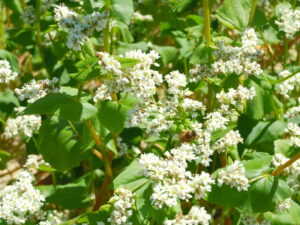
What Can Summer Cover Crops Do for Soil Health and Future Crops?

Plants floweringNow that some of our spring planted crops have finished, rather than leaving fields fallow or replanting fields that may have had some issues with plant diseases or insect pests, consider replanting with a summer cover crop. It is not too late to take advantage of summer cover crop benefits. What do summer cover crops do for soil health or future crop improvements? See below:

1. Increase Soil Organic Matter– One of the best attributes of having organic matter in the soil is improvement in soil structure. Adding organic matter improves tilth, water infiltration, water holding capacity, nutrient holding capacity and reduction of soil crusting. Also, as important is the increase in beneficial soil microbes and earthworms. Beneficial microbes can compete with pathogens and help release nutrients. Earthworms can cycle nutrients and improve pore spaces in the soil.
2. Reduce Soil Erosion – Just like with winter cover crops, summer cover crops can also reduce wind and water erosion in fields, especially those with slopes. During summer rainfall events, that can be significant if resulting from tropical storms, runoff may not just include soil loss, but also fertilizer and chemical movement. Therefore, keeping cover on a field during non-production times in any season is an excellent practice.
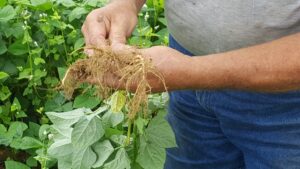
3. Nitrogen Cycling in the Soil – Nitrogen is often the most limiting nutrient for crop production, since it is so readily lost through nitrification and leaching. Storing nitrogen through plant cycling is an excellent way to improve fertility management. Whether it is a grass or non-leguminous cover crops N is still kept in the mix by the cover crop taking up residual N that wouldPerson holding plant to show root system otherwise be lost. The cover crop plant takes up the nitrogen and after the crop is incorporated it decomposes, thus releasing the N for subsequent crops to use. If legume cover crops are planted, they have the ability to “fix” nitrogen from the atmosphere and through the same decomposition process will provide N for subsequent crops. Be sure to inoculate legume seed just prior to planting with Rhizobium bacteria in order to gain the maximum N fixation benefits.
4. Reduce Weeds – When fields are left fallow after crops are harvested, weed growth can occur. If left to produce seeds, these weeds will multiply in subsequent crops. Therefore, managing the field by planting cover crops between cash crops is a great weed management option. As the cover crop grows, it will suppress the germination and growth of weeds through competition and shading. Some cover crop species can also suppress weeds biochemically, either while they are growing or while they are decomposing, which may prevent the germination or growth of other plants (allelopathy). Research has shown some cover crops like wheat, barley, oats, rye, sorghum, and sudangrass may suppress weeds. In some cases, it has also been reported that residues and leachates from crimson clover, hairy vetch, and other legumes have shown weed suppression.
5. Impacts on Plant Diseases – Cover crop residues could possibly be beneficial when it comes to plant pathogens, or can in some cases increase plant disease organisms. Some cover crop species are in the same plant families as cash crops and may be susceptible to the same disease organisms. Therefore, carrying the pathogen to the next crop. This is why paying attention to crop rotations is so important. In other cases, the cover crop residue can improve soil health in order to produce a better environment for beneficial microbes. By improving soil health, water infiltration, air pore space and other positive attributes, some soil pathogens may not survive as well, as in the case of water molds and water fungi. Some cover crops, like sorghum-sudangrass and sunnhemp, have been reported to reduce nematodes in soils. There are multiple positive factors from cover crops that can combat plant diseases.
6. Impacts on Insects – Like with plant diseases, cover crops can be susceptible to the same insect pests as cash crops. However, they may also attract beneficial insects into an area. Insect pests should be monitored in cover crops, just like in cash crops in order to not let populations get out of control and then move into nearby fields after the cover crop is killed.

For more resources on the us e of cover crops check out these resources: Cover Crops for Sustainable Crop Rotations – SARE

Fourth of July Cookout Costs

According to the American Farm Bureau a Fourth of July Cookout will cost $67.73 for a party of 10, down 3% from last year’s record high. Cookout favorites include cheeseburgers, chicken breasts, pork chops, homemade potato salad, strawberries and ice cream, among other products.  For more information: please see AFBF Fourth of July Cookouts.

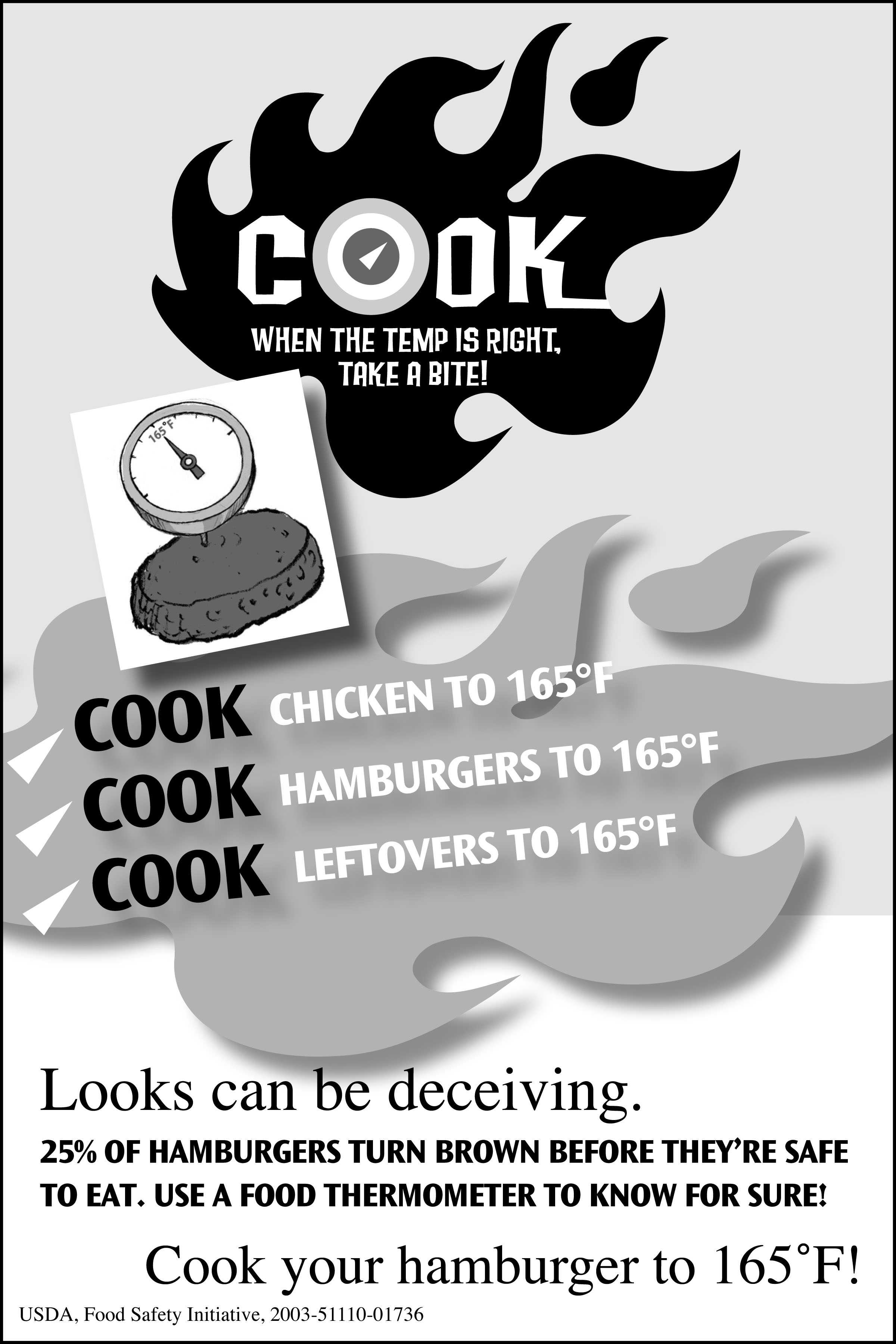
As you prepare for your cookout, please remember food safety risks whenever preparing food, particularly for outdoor consumption.  Please see these Rutgers Factsheets:   Serving Food Safely and Handling Leftovers Safely.  (Authored by Sara Elnakib, PhD, MPH, RDN, Family & Community Health Sciences Educator, Rutgers Cooperative Extension and Don Schaffner, Rutgers Extension Specialist in Food Science).

sCooking temperature poster


Manure/Methane Digester Ponzi Scheme

This comes from the “You can’t make this stuff up” category.  A man in California duped investors out of 8.75 million dollars by claiming to build anaerobic digesters for producing methane from manure on dairy farms in California and Idaho.  This was a classic “Ponzi” scheme complete with pictures and tours of existing digesters, phony invoices, and faked lease and bank contracts.   Money was invested in the bank accounts of family members and used to purchase land, a home, and pickup trucks.  Investors should have been able to “smell” this coming.  For more information please see: Dairy Manure Ponzi Scheme.

Getting a Grip on the FDA Antibiotic Rule

(Editor’s note: This article is taken from the June 1st, New Jersey Farmer Animal Science Update column.  It is co-authored by Michael L Westendorf PhD, Rutgers University; Jon E Higgins VMD  Acorn Farmvets LLC; and Dan Wunderlich, New Jersey Department of Agriculture).

You may have heard and are seeking more information about upcoming changes in the availability of Over-the-Counter (OTC) antibiotics for use in livestock.  The United States Food and Drug Administration (FDA) recently enacted the Guidance for Industry Rule – 263 (GFI-263) referred to here as the FDA Antibiotic Rule.  This rule regulates the relationship between veterinarians and livestock producers, and the usage of drugs that are medically important for humans.

The FDA Antibiotic Rule describes the use of antibiotics and provides veterinarians and livestock producers with guidelines for prescribing their sub-therapeutic use in feed or water and therapeutic usages for maintaining animal health well-being.  This Rule requires all veterinarians to prescribe such uses: provided there is a Veterinarian-Client-Patient-Relationship (VCPR) in place.

What is a VCPR? According to the American Veterinary Medical Association (AVMA) a VCPR “is the basis for interaction among veterinarians, their clients, and their patients, and is critical to the health of animals.”  This agreement means that veterinarians assume responsibility for clinical judgements related to animal health, it guarantees that the veterinarian has the knowledge to make such judgements, and that they are available for evaluation, examination, visitation, emergency coverage, and continuing care and treatment.  The veterinarian provides oversight of treatment, compliance, outcome, and the maintenance of patient records.  The client agrees to follow the veterinarian’s instructions.

What does this mean?  In the future, veterinarians will not be able to prescribe drugs for use by livestock producers unless there is a valid VCPR in place.  A VCPR is more than a phone call asking for veterinary advice, it is more than a tele-health consult on a farm that the veterinarian does not have a prior, professional relationship.  The veterinarian will be familiar with the farm, its management, its livestock, and existing animal health conditions. So, a valid VCPR is key, but this change does not mean that every time you have a sick animal that a veterinarian must visit your farm, examine, and treat that animal. But it does require the farmer will regularly seek out veterinary advice and service to maintain animal health.  When a proper VCPR is in place, a veterinarian can prescribe animal drugs for usage on livestock farms.  Over the Counter (OTC) antibiotics will not be available without a VCPR and a veterinary prescription.  Prescriptions can only be filled by veterinarians or animal health companies and other farm service companies or vendors (your local feedstore may not be approved).

It is also important to understand this overall change goes back to the instituting of the Veterinary Feed Directive (VFD) requirement, which was approved by the FDA in 2017.  The VFD is focused on maintenance of human and animal health.  The VFD ensures that drugs medically important for humans can no longer be used sub-therapeutically in animal feed or water for purposes of growth, performance, feed efficiency, etc. This class of drugs can only be used therapeutically in animal feed or water, that’s when animal health or sickness requires it.  In such cases the VFD rule requires veterinarians to authorize the use of animal drugs in feed or water only when a VCPR is in place and only when and if animal health requires it.  The VFD may allow some off-label use of drugs only when other options are not available and animal health requires it.

What does this mean?  There is concern about the development of microbial resistance to many antibiotics.  Many believe this is the result of overprescribing drugs, for both humans and animals, and concern that “superbugs” will result from sub-therapeutic levels in the feed and possibly infect humans; these bugs may not be affected by antibiotics (human or animal).  The VFD rule was enacted to strengthen and give more oversight to individual licensed veterinarians for the purpose of using antibiotics in the feed to treat actual disease conditions.

Beginning with the enactment of the FDA Antibiotic Rule (GFI-263) all antibiotics that are OTC will transition to prescription only from a licensed veterinarian and only when a VCPR is in place. Some of the drugs that will be restricted are penicillin, tylosin, tetracyclines, and sulfamethazine (calf boluses), and mastitis and dry-treat tubes (this is just a representative list, for more information go to https://www.fda.gov/animal-veterinary/antimicrobial-resistance/list-approved-new-animal-drug-applications-affected-gfi-263 or search for GFI-263 – FDA prohibited animal drug list).

Can these drugs still be used?  Of course, but they must be used as directed/recommended from your herd/flock veterinarian with a valid VCPR (when animals are sick, and health and well-being is at risk). (Veterinary-Client-Patient-Relationship) as described above.

There are drugs that are not prohibited, because they are used as animal drugs only, and not in human medicine.  These can still be used to enhance growth and feed efficiency.  Some approved drugs are listed below:

  • Ionophores (monensin (rumensin), lasalocid (Bovatec, etc.)

Other drugs that are not antimicrobials, for example:

  • Anthelmintics/Dewormers: Fenbendazole/Safeguard, Ivermectin, Prohibit/Levamisol
  • Coccidiostats: Amprolium (Corid), Decoquinate, Diclazuril

Drugs covered by the FDA Antibiotic Rule (GFI-263) are those that are used in both animal and human medicine.  They can no longer be used without veterinary oversight.  Only a veterinarian can legally authorize animal drugs for prescription, and then only after appropriate knowledge of the animals/farm  in question, with exam if needed, and when a proper relationship with the client (VCPR must be in place).

The FDA Antibiotics Rule should be seen as positive for the animal and food production industries and may have important effects on human health.  Additionally, it will allow more targeted antibiotic treatment, so animals that need treatment get it and those that don’t need antimicrobial therapy are not treated unnecessarily. American farmers are innovative, and levels of management are always improving.  This rule will allow producers to improve management and disease prevention and reduce reliance on antibiotics.

For more information please go to the FDA website https://www.fda.gov/animal-veterinary/antimicrobial-resistance/gfi-263-frequently-asked-questions-farmers-and-ranchers and search the Frequently Asked Questions; also please go to https://dairy.osu.edu/newsletter/buckeye-dairy-news/volume-25-issue-1/over-counter-antibiotics-will-require-veterinary  for an excellent overview. On livestock VCPR details, please read: https://www.aabp.org/resources/aabp_guidelines/VCPRGuideline_032020.pdf

Please contact your veterinarian for assistance or the New Jersey Department of Agriculture Division of Animal Health (http://www.nj.gov/agriculture/divisions/ah/).  See also your local Rutgers Cooperative Extension Service office for information (https://njaes.rutgers.edu/county/)

Pasture Walk in Burlington County on Thursday, 6/1

Rutgers Cooperative Extension of Burlington County invites you to a Spring Pasture Walk to be held at the Burlington County Agricultural Center on Thursday, June 1, 2023. Meet us under the red market barn and we’ll begin our walk through the sheep pastures promptly at 6:30 p.m. [Read more…]

Application for Cost-Share Grant Funding for Installation of Deer Fencing on UNPRESERVED Farmland – Out NOW

“The NJDA Deer Fencing Program makes cost-sharing funding available for the installation of deer fencing on unpreserved farms. The program is conducted in accordance with N.J.S.A 4:40-6.1.”

Please click here for the full application, eligibility, and other important information

Timing is important if considering this program. NJDA began accepting applications on 5/15/23.