USDA Increases Minimum Annual Payment for Conservation Stewardship Program

Conservation programs with USDA have received unprecedented increases in funding and farmers should investigate programs to make improvements on their farm. One program in particular, is increasing the minimum annual payments to producers for the Conservation Stewardship Program (CSP) from $1,500 to $4,000 in fiscal year 2024. The increase addresses challenges faced by small farms making participation more financially beneficial for smaller operations. The new minimum payment is available for new and renewed CSP contracts.

CSP offers technical and financial assistance to help agricultural and forest producers take their conservation efforts to the next level. The program is designed to compensate agricultural and forest producers who agree to increase their level of conservation by adopting additional conservation activities and maintaining their baseline level of conservation.

Examples of CSP enhancements that are suitable for being adopted by smaller scale and urban producers include:
  • Planting multi-species cover crops
  • Mulching with natural materials
  • Establishing pollinator habitats
  • Soil health crop rotation

Currently, an unprecedented amount of funding is available for CSP through the Inflation Reduction Act and Farm Bill. The Inflation Reduction Act provided $19.5 billion in additional funding for NRCS oversubscribed programs like CSP for five years. Inflation Reduction Act funds are available to help producers adopt climate-smart practices.

NRCS recently announced it increased the number of Climate-Smart Agricultural and Forestry Mitigation Activities eligible for Inflation Reduction Act funding for fiscal year 2024 through CSP, the Environmental Quality Incentives Program (EQIP), and the Regional Conservation Partnership Program (RCPP). To learn more, download the list of practices and a fact sheet.

NRCS accepts producer applications for its conservation programs year-round, but producers interested in this cycle of Inflation Reduction Act funding should apply as soon as possible. Producers interested in EQIP should apply by DATE or CSP should apply by DATE for consideration this year. Funding is provided through a competitive process and will include an opportunity to address the unmet demand from producers who have previously sought funding for climate-smart conservation activities.

For more information about assistance available, contact NRCS at your local USDA Service Center.
Finish the Fight Against Scrapie: Brains Needed!

For more information, please call: 609-241-2236

The United States is nearing the goal line after a 70 year battle against Scrapie, a fatal disease that affects the brain of sheep and goats. Sheep and goat producers can help the USDA achieve this goal. The current program has been very successful to drastically reduce the amount of scrapie in the US. One of the most difficult aspects of an eradication program is making sure that the last few cases of the disease are found.

The most recent two cases of scrapie found in the US were sampled at slaughter but could not be traced back to a farm origin. One of these cases was a sheep in Wisconsin in 2021 and another was a goat tested in Indiana in 2019. Because these animals did not have adequate records and identification to find where they came from, it is likely there are still farms with cases of scrapie. For a country to be declared free of scrapie, international standards require a certain level of testing among all sheep and goat populations within a country. No samples can test positive for classical scrapie. The samples we need to test are brain and a lymph node.

Each year every state is given a minimum number of samples to be collected based on the breeding sheep and goat populations. This assures sampling represents the different populations. In fiscal year 2024, NJ needs to sample 32 mature (>18 months) sheep and 22 mature goats. We continue to ask for help from our New Jersey small ruminant industry to obtain these samples. If a producer has an adult sheep or goat that dies, that must be euthanized, or is being culled please contact USDA, APHIS, Veterinary Services at 609-241-2236. There is no charge for the collection or testing of the samples. Producers may be eligible for official plastic tags as long as our supplies last.

Scrapie is in the same family of diseases as bovine spongiform encephalopathy (mad cow disease) and chronic wasting disease of deer and elk.

USDA, APHIS Veterinary Services (VS)

Acute Bovine Pulmonary Emphysema (Fog Fever)

A metabolic syndrome that sometimes affects ruminants, particularly cows on lush fall pastures is Acute Bovine Pulmonary Emphysema (ABPE), sometimes referred to as “Fog Fever”.  ABPE can occur in ruminants, especially cattle, transitioning from dry summer pastures or poor quality forage in the fall, to pastures that may be lush and fresh.  Cows may develop signs of lung disease within a few days to two weeks after the pasture change.   Death may occur within several days after the appearance of clinical signs.  It is nearly always fatal.

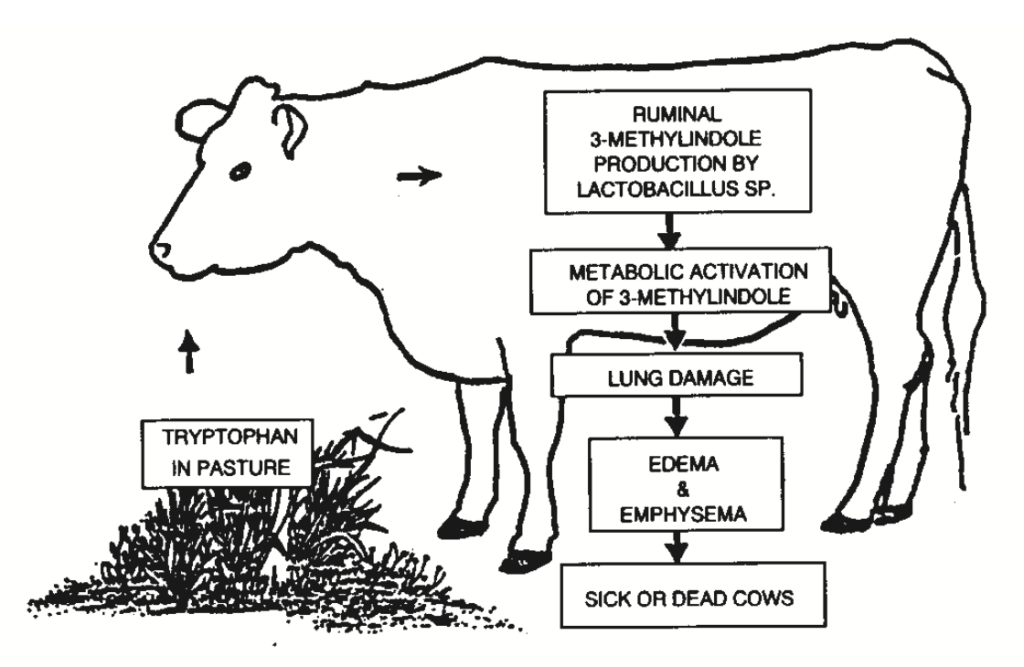
This change can result in an undesirable toxin produced by rumen fermentation.  Tryptophan is an amino acid found in protein.  It is converted to indoleacetic acid and then to 3-methylindole (3MI) in the rumen.  3MI is absorbed into the blood, transferred to the lungs and in the lungs can cause damage to lung cells.  It can occur in a variety of forage types, especially when the rumen is not properly adapted to the new forage.  There is no effective treatment, producers should focus on prevention.

Disease entering a cow through food stream


Acute Bovine Pulmonary Edema and Emphysema in Beef Cattle: Causes and Prevention.  (Beef Cattle Handbook; D.C. Honeyfield and J.R. James R. Carlson).

It occurs in lush regrowth forage, and is usually seen in the fall.  Preventative measures:

1. Feed cattle  good quality dry hay for a few days and then slowly introduce them to the lush pastures by increasing grazing time over a 10-14 day period.

2. Delay grazing of lush pastures until after a hard frost.

3. Cut lush fall pastures for hay prior to grazing.

4. Graze prior to lush fall regrowth.

5. Consider feeding an ionophore such as Rumensin® or Bovatec® before turning the cattle onto the lush pastures. These compounds change the rumen fermentation of tryptophan and may decrease the chances for ABPE or “Fog Fever”.  Consult your veterinarian for advice if you anticipate using either of these compounds to prevent ABPE.

For more information:

Beef Cattle Handbook

UC Davis Cooperative Extension

Webinar: 2024 NRCS Funding Opportunities

Monday, October 16 @ 6:30 pm – 7:30 pm EST

Join NRCS Soil Conservationist Kimberly Dalton and Natural Resource Specialist James Strehse for a webinar explaining 2024 NRCS Funding Opportunities.

REGISTER HERE

Whether you’re small or large scale, conventional or organic, there are NRCS practices that can apply to your operation. The presentation will include program information and guidance on how to apply with your local USDA service center.

Registration is through the NOFA-NJ website.

NJDEP Stakeholder Meeting for Pesticide Rules Wednesday September 27 from 1:00 pm – 3:00 pm

You are invited to participate in a virtual stakeholder meeting for amendments to the New Jersey Pesticide Control Code (N.J.A.C. 7:30). The Division of Water Monitoring, Standards and Pesticide Control is convening a stakeholder meeting to provide an opportunity to share information, and solicit input regarding amendments to the Code.  This meeting is open to […]

EPA Requests Stakeholder Input on Proposed Training Program for Healthcare Providers to Address Pesticide Injuries

[EPA Update: 25 September 2023]   Today, the U.S. Environmental Protection Agency is seeking public comment on the design of a health care provider (HCP) training program on pesticide-related illness and injury. Specifically, EPA seeks feedback from the public through a request for information (RFI) titled Request for Stakeholder Input on the Proposed Design of a […]
