Commercial Ag Updates + Farm Food Safety

Rutgers Cooperative Extension Ag Agents provide updates on what they see in the field, upcoming events, and other important news that affects your operation, such as developments in on-farm Food Safety. Subscribe if you wish to be notified about workshops, meetings, and upcoming commercial ag events.
 
Subscriptions are available via EMAIL and RSS.

Herbicide Classification Chart Available

Working with the Delaware Soybean Board and the United Soybean Board, a herbicide classification chart is available at:
http://extension.udel.edu/ag/weed-science/weed-management-guides/

This chart groups herbicides by mode of action and site group numbers that are printed on containers and labels. The chart is designed to help diversify herbicide use by rotating effective herbicides with different sites of action to delay the development of herbicide resistance. The chart provides the number of resistant weed species in the US to each site of action, which highlight those herbicides for which we already have wide-spread resistance.

No-Till Soybean Burndown Considerations

Due to the weather, a number of no-till soybean fields have not received a burndown treatment yet. As a result, many are asking about options for control. First a number of considerations:

2,4-D ester: Rate of 2,4-D may need to be adjusted. Most 2,4-D brands require a 4 week delay between application of 1 qt and planting soybeans. Rates less than 1 qt/A does not provide the same level of horseweed control. The interval between application differs with 2,4-D rates and brands. Be sure to read the label of the brand you intend to use.

Kixor products: These products have good activity on glyphosate and ALS resistant horseweed, but they have a number of restrictions due to crop safety: [Read more…]

Kudzu Bug Found in Delaware

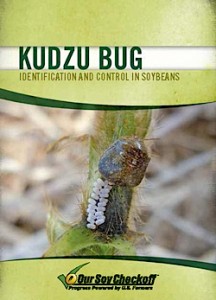
KBSBguide

Click Image to Open

We received a report from extension in Delaware that an adult Kudzu bug was found in a trap in Sussex County, Delaware near a kudzu patch.

This should serve as a reminder that kudzu bug is fast approaching New Jersey. This rather new pest is something our soybean industry needs to keep a watchful eye on. You may have first read in different farming publications about the presence of bean platasipid (Megacopta cribraria) or more commonly the kudzu bug in the southeastern US.  The kudzu bug has begun its migration north, having been found in Sussex county Delaware last year also. The recent find suggests that it can overwinter in southern Delaware. Kudzu bug is not only a pest of kudzu, but also soybean.

Corn Herbicides and Soil Insecticide Interactions

Over the past few years, a few fields have been treated with an organo-phosphate insecticide and then with an ALS-inhibiting herbicide and significant injury has occurred. A number of corn herbicides have label precautions about use of an organo-phosphate insecticide at planting due to potential crop injury. This includes the insecticides Counter (terbufos), Lorsban (chlorpyrifos), and Fortress (chlorethoxyfos). The herbicides include both soil-applied and postemergence herbicides. Some of the common products include Callisto (Halex GT); Resolve (Steadfast, Basis); Accent; Capreno, Sharpen or Kixor. Note that the list is not only Group 2 (or ALS-inhibiting herbicides). If using an organo-phosphate insecticide, a list of herbicides that have potential interactions can be found at https://extension.udel.edu/ag/files/2014/01/CornWeedguide.pdf and go to Table 19.

Unfortunately, most corn seed companies no longer designate hybrids as either IT or IR. So if you are not sure, take the cautious approach and assume the hybrid is a “standard” hybrid (no enhanced tolerance for imidazolinone herbicides); and follow the most restrictive guidelines.

What’s the Difference Between Metolachlor Formulations?

I have been asked by a few people about the differences in metolachlor (the active ingredient in Dual) products. The “old” Dual in the early 1990s was two isomers of metolachlor, R and S isomers. The Dual II included a safener to improve crop safety (improves safety to corn, not to broadleaf crops; hence Dual for broadleaf crops and Dual II for corn). [Read more…]

Be Sure to Scout No-Till Fields Before Planting

The weather has not been favorable for maximum effectiveness of many postemergence (or burndown) herbicides. Cool weather and overcast skies are not ideal conditions for herbicide performance. And given that many fall and early spring emerging weeds can be difficult to control once the crop is planted, it is important to scout your no-till fields to determine if a follow up treatment is necessary prior to planting.