Christmas Trees Edition
EMAIL | RSS
Seasonal pest alerts and news about insects, diseases, and weeds impacting Christmas Tree production including Commercial Ag Updates (meetings and marketing); and Pesticide Program updates from the Rutgers Pest Management Office News Blog.
Companion Website Links:
 Rutgers Weather Forecasting - Meteorological Information important to commercial agriculture.
EPA Announces Update on Atrazine (with editorial note on NJ)
EPA Announces Update on Atrazine (with editorial note on NJDEP 2018 ag use data summary)
IMPORTANT: EPA Issues Final Cancellation Order and Updates to Existing Stocks Provisions for Several Chlorpyrifos Products
EPA Releases Updates on Organophosphate Pesticides Dicrotophos, Dimethoate, and Tetrachlorvinphos
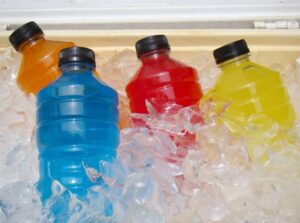
Beat the Heat: Water and Sports Drinks for Hydration
 Article By: The Rutgers Farm Health and Safety Working Group: Kate Brown, Michelle Infante-Casella, Stephen Komar and William Bamka
When it comes to hydration, the U.S. National Academies of Sciences, Engineering, and Medicine recommends an adequate daily fluid intake of about 15.5 cups (3.7 liters) of fluids a day for men and about 11.5 cups (2.7 liters) of fluids a day for women. Even with this guidance, the amount varies from person to person. Also, when temperatures are hotter and when workloads increase so should drinking water, to prevent dehydration and to help maintain the proper body temperature especially when sweating.
Regular intake of water throughout the day and during the evening, at recommended amounts may help prevent a person from becoming excessively thirsty and also prevent dehydration. The choice of drinking sports drinks that contain electrolytes may be considered when a person’s activities dramatically increase, when they excessively sweat, if they show signs of dehydration, and/or heat stress.
Most sports drinks are designed to replenish glucose, fluids, and electrolytes (sodium, potassium, magnesium, calcium) lost during strenuous exercise or heavy workloads. Sports drinks may contain carbohydrates in the form of sugar, usually glucose, high-fructose corn syrup, or sucrose. Some contain no sugar and are “sweetened” instead with low-calorie sweeteners. The amounts of sugar and electrolytes in sports drinks are intended to allow for quick hydration and absorption.
It is important to note, persons with diabetes should be mindful of not intaking amounts of sports drinks that are high in sugar that could raise blood sugar to unhealthy levels. Additionally, persons with high blood pressure should be mindful when drinking sports drinks that are high in sodium – most are. Persons who eat a healthy diet should have enough glucose and electrolytes to maintain their health, even during extra activities and with proper water intake. Some studies show drinking too many sports drinks, especially when not performing vigorous exercise, can increase the risk of overweight/obesity and other health issues such as type 2 diabetes, cardiovascular disease, gout and the risk of dental cavities.
Water is the best choice to stay hydrated and it is the responsibility of each individual person to be sure they drink enough water to maintain their proper health.
ALERT – Control window approaching for Cryptomeria and Elongate Hemlock Scale
Cryptomeria Scale, Elongate Hemlock Scale, and Bagworms in Conifers – Control Window Approaching!
| Projected GDD50 accumulation as of 5/23/2024 (for June – July) | ||||||
| CODE | Location | 23-May | 1-Jun | 15-Jun | 1-Jul | 15-Jul |
| NJ50 | Upper Deerfield (South) | 501 | 678 | 977 | 1383 | 1786 |
| D2738 | Mays Landing (South) | 500 | 667 | 943 | 1327 | 1711 |
| NJ10 | Howell (Central) | 407 | 568 | 833 | 1203 | 1577 |
| NJ36 | Parsippany (Central) | 389 | 548 | 795 | 1141 | 1491 |
| E7133 | Belvidere (North) | 432 | 592 | 836 | 1178 | 1523 |
| N59 | High Point (North) | 345 | 486 | 706 | 1020 | 1338 |
| USPEST.ORG – Model: simple average/growing degree-day, Min: 50F – Max: 95F, NMME forecast | ||||||
| Forecast: 7-month NMME based seasonal climate forecast (USPEST.ORG) – Subject to change regularly = Check Often | ||||||
Cryptomeria Scale – Click here for full Cryptomeria Scale write-up (with pictures)
(Adapted from Steve Rettke – RCE post above)
Crawlers Generation 1: 600-800 GDDs (first few weeks of June in NJ)
- Similar to many other armored scale species, the Cryptomeria scale has more than one generation of crawlers during the growing season. In New Jersey, this scale has two crawler generations per year, Crawlers are lemon yellow in color & because of the color contrast can typically be easy to observe on needles, even without a hand lens. Unfortunately, the crawler emergence periods of both generations of the Cryptomeria scale are not restricted to only a week or two. Their more prolonged crawler periods can extend for 4 weeks or even longer, although a large percentage of crawlers will occur during the first 2 weeks after emergence begins.
Crawlers Generation 2: 1750-2130 GDDs (end of July early August in NJ)
Control options: When applying control materials with short residuals (e.g., horticultural oils), the use of multiple applications will probably be required to achieve a more complete crawler suppression. If a single application is desired, then oils plus synthetic pyrethroids can provide a 3-week residual. Examine infested trees closely to determine if significant predators or parasitoids are presently active. When numerous, these beneficials can be extremely valuable to help with suppression. Therefore, the use of horticultural oil applications alone will help conserve the beneficials & still control crawlers when coverage is adequate. The use of most of the neonicotinoid insecticides (e.g., Merit) will not achieve satisfactory controls (maybe only 30-40% efficacy). However, the usage of dinotefuran (Safari) as a soil drench or bark spray has been shown to give excellent results against armored scales, with some studies showing 90% efficacy. The extremely high-water solubility of Safari allows this material to penetrate the plant cells where the scales are feeding.
Elongate Hemlock Scale – Click here for more information (with pictures)
(Adapted from Steve Rettke – RCE post above)
First crawler emergence: 360-700 GDDs (Late May – June in NJ)
- Female covers are oval, flat, tan/translucent; males are whitish. There may be six or more scales per needle. Yellow spots appear on needles under light feeding and foliage appears thin; in heavy infestations, needle drop occurs, and trees may be killed. Adult females have an exceptionally long egg-laying period (lasting throughout the summer) with two overlapping generations. Crawlers (immatures) are noticeable in late May, in conjunction with new growth. Although there are only two generations per year, crawlers can emerge over an extended period. Look for the tiny crawlers using a 10-15x hand-lens.
Control options: Pyriproxyfen (Distance) is an insect growth regulator & can provide good suppression. It is classified as a “reduced risk” material by the EPA. Dinotefuran (Safari) is a neonicotinoid that has been a product of choice to control armored scales for more than a decade. Imidacloprid (Merit) is highly effective controlling the hemlock woolly adelgid but will not provide satisfactory control of elongate hemlock scales. Acephate (Orthene) has translaminar properties within foliage & can provide some suppression.
Bagworms
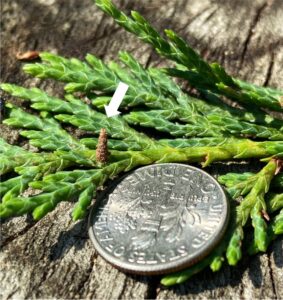
Days-old bagworm = critical management target – T. Waller – RCE
Bagworms should begin hatching NOW through – 4 weeks in NJ, beginning in the southern regions. Now is an optimal time to get this pest on your radar and prepare materials or approaches to attack first/second instar caterpillars. The control window for this pest is typically between 600-900 GDD50 when they begin to hatch and become airborne, i.e. the “ballooning” phase. It is important to check for egg-hatch prior to applications for greatest chemical efficacy, and to continue scouting as they often hatch and develop at asynchronous rates.
It is critical to target these insects EARLY!
Bagworm management – mechanical: If eggs have not hatched: hand-remove sacs/bags. Typically female/egg filled sacs are higher in the canopy so keep that in mind while scouting. This removes the problem from the field or landscape.
Treatment options for Lepidoptera (caterpillars) to have at the ready – containing: B.t. (Bacillus thuringiensis), spinosad , bifenthrin ), cyfluthrin, carbaryl, chlorantraniliprole, cyclaniliprole, cyclaniliprole + flonicamid, Lambda-cyhalothrin, cyantraniliprole, Indoxacarb. NOTE – Lethal pesticide doses are important, as sub-lethal doses can trigger early pupation, making the pest all but invincible to chemical or biological treatments. Follow label exactly.
IT IS CRITICAL TO ROTATE MATERIALS (Rotate between IRAC groups)
DISCLAIMER: The label is the law, always refer to it for allowable host crops, use-restrictions, application rates, reapplication intervals, re-entry intervals (REI), and mix compatibility information. Production and pesticide information on this site are for private/commercial pesticide applicators and landscape professionals only, and are NOT for home gardener use. Provided materials represent examples and do not cover all possible control scenarios. Please contact your local agent or chemical sales representative for more information or to discuss additional pest management options.
| BAGWORMS (600-900 GDD) (Bagworm hatch prediction as of 5/20/24) | ||||||
| Crop type | Common Name | Scientific Name | GDD Min (50F) | GDD Max (95F) | Reference | Developmental / Target Stage |
| Conifer mostly, many minor hosts | Bagworm | Thyridopteryx ephemeraeformis | 600 | 900 | RU | Larvae (early instars) – ONLY CONTROL WINDOW |
| Region | Location | Station | Date (600 GDD) | Date (900 GDD) | *Treatment window | *Bagworm Hatch – Predictions only, SCOUTING is critical! Treat as soon as larvae detected.
Remove any ‘bags’ prior to hatch if possible |
| South | Upper Deerfield | NJ50 | 29-May | 12-June | 13 days | |
| Central | Howell / Freehold | NJ10 | 4-June | 19-June | 15 days | |
| North | High Point | NJ59 | 11-June | 26-June | 15 days | |
Please download and print the Rutgers Nursery and Landscape Pest Scouting Guide or Conifer and Christmas Tree Pest Scouting Guide and refer to this post “Obtaining your local growing degree-days (GDD)” for additional information. (See pest scouting guides for complete list of references)
Please SHARE what you SEE!! If you see a pest, disease, otherwise interesting or troublesome issue please report it to the Working Group by following the QR Code on the front of the Pest Scouting Guides or by filling out this reporting form.
