Audit Ready: Sanitizing Surfaces in Post Harvest

sanitation product contact surfacesSanitizing product contact surfaces is important in reducing cross contamination risks.  “Product contact surfaces” means anything that comes in contact with the product such as equipment, belts, rollers, brushes, tables, bins, sinks, tools, and reusable totes.  Writing a standard operating procedure describing the specific steps of your cleaning process will help ensure that the surfaces are properly cleaned.

Proper cleaning and sanitizing of contact surfaces includes these steps:

  1. Surface is rinsed to remove any visible debris
  2. Appropriate detergent is applied and the surface is scrubbed
  3. The surface is rinsed with water that is potable (drinkable)
  4. Appropriate sanitizer is applied, following the directions
  5. Let the surface air dry

An appropriate sanitizer for use in post harvest surface cleaning is one that has an EPA registration number, states that it is food grade, and gives specific instructions for the products use as a surface cleaner.  Remember the label is the law.

Audit Ready: Equipment Maintenance Records

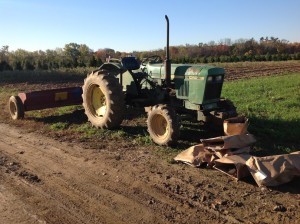
tractorThe harmonized audit requires a listing of equipment (2.7.1) that has the potential to come into contact with the crop, and for each piece of equipment a maintenance record.


Just how detailed of a record do they want?

Anytime there is a repair, cleaning, or fluid change there should be a record of this task.  The auditor will look at the equipment for signs that there could be a issue, such as an oil or fluid leak under the equipment.  If they see an issue they will then ask to see the maintenance record for that piece of equipment.  This falls under the “are in good repair and are not a source of contamination of produce” section of standard 2.7.2.  Remember, this is only for equipment that will go out into the field or production area.

Audit Ready: Handling Unwritten Policies

Writing Your PlanIn both the GAPs and Harmonized audits there are standards that focus on policies, yet the checklist does not indicate that a written policy is required.

You can choose to not write these policies in your plan but you and your employees need to be prepared to answer questions from the auditor about these policies.  Your answer to the auditor needs to be the same as your employees; they will verify this!

If the auditor does not find the policy or the employee answer satisfactory, you will receive a “CAN” (corrective action needed).

Audit Ready: 10 Tips to Help You Prepare

Birds in the rafters1. Auditors will most likely look at aerial maps of the farm prior to their visit.  They may ask about water sources, buildings etc. that they see on the online map that you might not have included in your production area maps.  Take a look at your farm on google maps to make sure you included everything required.

2. Auditors will not tell you how to fix a problem but can prompt you to solve a problem by asking questions about what they are seeing.

3. If you contract pesticide applications out to a third party you will need to have these spray records on hand during the USDA audit.  Ideally growers should have a copy of these spray records on farm, regardless of an audit. [Read more…]

Audit Ready: Tank Cleaning Procedures

Do not forget to include yourScab2-Spraying urea cleaning procedures for irrigation water tanks and pesticide application tanks in your food safety plan.  Auditors will be looking for this information during the audit process.  The cleaning and maintenance of these tanks falls under standard 2.8 Vehicles, Equipment, Tools and Utensils.  Auditors will look for the following:

1. Equipment and other items or materials used in farming operations that may come in contact with produce are identified
2. Equipment is in good repair and pose no food safety risk
3. Cleaning and sanitizing procedures do not pose a risk of product contamination
4. Tanks are cleaned at a sufficient frequency so as not to be a source of contamination

Audit Ready: Is Your Traceability Program Complete?

Traceability, which we often talk about as one step forward and one step backwards, is an important part of your food safety plan.  Expect the auditor to spend time discussing and looking at examples of your traceability program.  Here is what should be included in your traceability program:

One step forward:

1. Reconciliation of product that has been delivered to recipients.  This includes auction houses, co-op’s, repackers, retail establishments, etc.

 One step backward:
1. If the produce was grown at the farm
– Seed source or transplant source (this should also be indicated on your raw materials supplier list)
– Pesticide applications
– Fertilizer applications
– Field location
– Soil amendments

2. If the produce was purchased and not grown at the farm
– Source of the produce
– Source of raw materials and supplies used with this produce
– Items and date of receipt
– Lot numbers, quantities, and transporter

Mock trace back:
A trace back and trace forward exercise is required annually to verify that your traceability program is effective.  100% of product involved in the trace back and trace forward exercise must be reconciled within four hours to be considered effective.  If there are no records of this mock trace back exercise the auditor will require it be completed during the audit.

Click for a sample mock tract back log.