Disinfection of Surfaces for Prevention of COVID-19 Spread – Use Caution

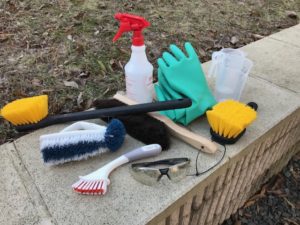
Cleaning supplies

The chemical concentrations for the disinfection of high touch surfaces in retail markets during the COVID-19 pandemic are higher than we normally recommend. This concentration is for the disinfection of hard non-porous surfaces and is not for use on produce. Care must be taken to ensure the safety of yourself and your workers when using this concentration. Typical concentrations of bleach for sanitizing surfaces is 150 PPM, the disinfection recommended 1/3 cup bleach to 1 gallon of water is 1000 PPM. This concentration can be caustic to skin, airways, and produce.  Take the following precautions:

1. Clean the surface with detergent removing all visible debris and with a clean water rinse.
2. Conduct mixing in a well-ventilated area and increase ventilation when possible in areas of use, wear rubber gloves to protect skin from contact with the bleach and bleach solution.
-If skin comes in contact with the bleach or bleach solution rinse with water, if irritation continues call a doctor.
-If the bleach or bleach solution comes into contact with the eyes rinse with water for 15 minutes, if irritation continues call a doctor.
5. Chlorine PPM measurement strips typically used in packing houses do not go up to 1000 PPM.
-1000 PPM test strips are available online through Granger, Amazon, and restaurant supply stores.
-Test strips must be for FREE chlorine, not total chlorine.
-Test strips have expiration dates, make sure yours are not expired.
6. Follow bleach label instructions for contact time requirement. This is the amount of time your surface needs to stay wet with the bleach solution to ensure efficacy and is usually 1 minute or more.
7. Use containers of bleach that have been opened no longer than 30 days to ensure proper concentration.
8. Mixed concentrations of bleach should be stored at cool temperatures and away from direct light, used within a few days and retested for PPM prior to each use to ensure correct concentration.
9. Do not mix bleach with any other cleanser!

U-Pick Operation Guidelines under COVID-19

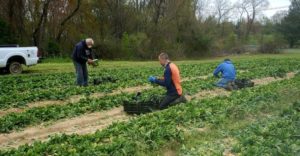
Harvesting cropsThe CDC, FDA and USDA have no reports at this time of human illnesses that suggest coronavirus can be transmitted by food or food packaging.
U-Pick operations are unique with customers going out into the field to do their own harvesting. This creates special situations for the grower and customer. How do you protect the customers, workers, and grower?

Questions to Ask Yourself
1. How many customers will you allow to pick at one time and how will you manage this?
2. Will you provide picking containers, or do you expect the customer to bring their own?
3. Will you provide harvest tools, or do you expect the customer to bring their own?
4. Where are your handwashing facilities located? Do you need to add more or change the locations?
5. How will you provide produce to those who are unable to enter your retail area or conduct U-Pick activities?
6. What areas will need frequent cleaning and sanitation (PDF)? What products will you use for this task?

Customer Notification Prior to Arriving
1. Use your social media site to inform potential customers how you are going to run your U-Pick operation with COVID-19.
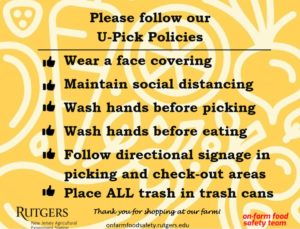
2. Inform customers that they must maintain 6 ft social distance from other customers and employees.
3. Let them know that handwashing stations and hand sanitizers will be available when they arrive.
4. Encourage your customers to come alone. Leave family at home. Only someone picking should be in the field.
5. Let them know if you will provide picking containers or they need to bring their own.
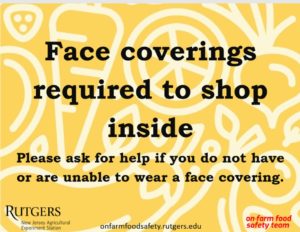
6. Face coverings are required for customers. If a customer arrives without one, or refuses to wear one, they cannot enter retail and production areas. Alternative methods of obtaining produce should be made available to them.

Upon Customer Arrival
1. Encourage everyone to wash their hands prior to going into the field.
2. Inform customers where they can pick and how many people are allowed in the field at one time.
3. Direct customers to wear face coverings and to practice social distancing.

Handwashing
1. Have handwashing stations at several locations on the farm. These should be conveniently located. If the field is not next to the check out area have handwashing stations out in the field.
2. Everyone should wash their hands often for 20 seconds with soap and water.
3. This means as soon as customers come to the farm, if they stop to eat, when they use bathroom facilities, etc. If hand sanitizers are available customers should wash hands then apply hand sanitizers. The sanitizer should be at least 62% alcohol.
4. Post handwashing signage (PDF) in the appropriate language at each handwashing station.
5. Designate the responsibility of monitoring handwashing facility supplies (water, soap, paper towels) to an individual. Provide ample supplies for restocking.

Field Picking
1. There different ways to handle picking. The number of pickers can be restricted at any one time or pick every other row. Whichever system is used there needs to be someone in the field to enforce the rules.
2. Consider what you supply to the customer when they go into the U-Pick areas.
3. Harvest tools, containers, wagons, etc. Ensure that you can properly clean and sanitize these commonly touched surfaces.

Employees
1. Train all employees on proper handwashing and food safety.
2. In New Jersey, employers must provide face coverings and gloves for their employees.
3. Handwashing is critical when dealing with customers (see above).
4. Hand sanitizers should be used between each customer by employees at checkout.
5. Touchpads should be sanitized between payment uses.
6. One person should handle money when checking out customers.

Visit the Rutgers On-Farm Food Safety and the Rutgers NJAES COVID-19 websites for the most up-to-date information.

Authors
Wesley Kline, Agricultural Agent, Rutgers Cooperative Extension of Cumberland County
Jennifer Matthews, Senior Program Coordinator, Rutgers Cooperative Extension of Cumberland County
Meredith Melendez, Agricultural Agent, Rutgers Cooperative Extension of Mercer County

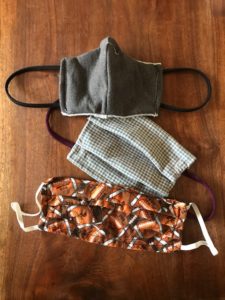
Cloth Face Coverings for Retail Employees: Executive Order No. 122

Cloth face masksThe Governor signed Executive Order No. 122 into law on Wednesday, April 8th.  This rule impacts retail sales locations that fall under the Executive Order No. 107 “essential retail business” category.  While many of the items would not be considered new, the requirement of cloth face coverings and gloves for employees is.

Face coverings for employees:
Workers are required to wear face coverings while at the retail location unless the covering would inhibit the individuals health.  Businesses are required to supply face coverings to workers.  The Executive Order does not acknowledge the fact that purchasing facemasks is currently very difficult.  The Executive Order does state that workers can supply their own face covering when preferred by the employee. Guidelines on how to make, wear, and handle face coverings can be found on the Rutgers On-Farm Food Safety COVID-19 webpage.   Printable signage is also available on the website.  Some community organizations are making cloth face coverings. These may be a resource for your workers who are not inclined to make their own if you are unable to provide them. Be sure to train your employees on proper use.  This face covering is not to be worn as a replacement for other personal protective equipment, such as those worn for pesticide applications.

Gloves for employees:
Businesses are required to provide gloves to employees who are interacting with customers and/or handling saleable goods.

Face coverings for customers:
Customers are required to wear cloth face coverings when they enter the retail area. When an individual refuses to wear a face covering for non-medical reasons the business should find an alternative method of shopping for the customer. Options could include pre or outside ordering with pick-up or delivery to the customer outside of the establishment.  Businesses may not ask for proof of a customers medical reason for not wearing a mask.

Visit the Rutgers On-Farm Food Safety COVID-19 webpage for updated resources relevant to your farm operation and COVID-19

Language specific to cloth face coverings and glove use from Executive Order No. 122 is below:

Essential retail businesses that are still permitted to operate under Executive Order No. 107 (2020) must adopt the following policies:
Require workers and customers to wear cloth face coverings while on the premises, except where doing so would inhibit that individual’s health or where the individual is under two years of age, and require workers to wear gloves when in contact with customers or goods. Businesses must provide, at their expense, such face coverings and gloves for their employees. If a customer refuses to wear a cloth face covering for non-medical reasons and if such covering cannot be provided to the individual by the business at the point of entry, then the business must decline entry to the individual, unless if the business is providing medication, medical supplies, or food, in which case the business policy should provide alternate methods of pickup and/or delivery of such goods. Nothing in the stated policy should prevent workers or customers from wearing a surgical-grade mask or other more protective face covering if the individual is already in possession of such equipment, or if the business is otherwise required to provide such worker with more protective equipment due to the nature of the work involved. Where an individual declines to wear a face covering on store premises due to a medical condition that inhibits such usage, neither the essential retail business nor its staff shall require the individual to produce medical documentation verifying the stated condition.

USDA Audits Expiration Dates Extended

Please see the press release below with regards to USDA Audit Program Certifications. Also, the Rutgers On-Farm Food Safety Website is being updated with the latest Covid-19 information as it relates to agriculture. We encourage you to check it frequently. Please reach out if you need us, we are not in the office but we are still working.

USDA Temporarily Extends Expiration Dates for Some Good Agricultural Practices, Domestic Origin Verification, Plant Systems Audit Program Certifications
The U.S. Department of Agriculture (USDA) Agricultural Marketing Service (AMS) is committed to delivering the timely services needed to support the movement of America’s food supply and will continue to take steps to meet challenges due to the COVID-19 national emergency.
To aid the movement of fresh specialty crops into marketing channels, AMS is extending the expiration date of USDA audit certifications scheduled to expire on or before May 31, 2020, by 60 days. USDA audit certifications are normally valid for 12 months. The certification extension applies to 400 current auditees certified under the USDA Good Agricultural Practices (GAP), Domestic Origin Verification and Plant Systems Audit programs.
AMS is advising affected auditees of their 60-day extension and is updating information under “Find a USDA Gap-Certified Company” on the Good Agricultural Practices (GAP) & Good Handling Practices (GHP) webpage to reflect the extended audit expiration dates.
Extending the expiration date for auditees with current certifications will allow AMS to concentrate resources on providing food safety verification audits for entities new to USDA audit programs who require certification to move product into commerce.
The extension is in alignment with the International Accreditation Forum’s Informative Document for Management of Extraordinary Events or Circumstances Affecting Accreditation Bodies and Certifying Organizations, Issue 1, which establishes guidelines for extending food safety audit certifications. The Global Food Safety Initiative (GFSI) also has communicated that, based on risk, certification bodies may be able to extend certifications under extraordinary circumstances for up to six months.
AMS recognizes that USDA specialty crops inspections and audits are critical to the nation’s food supply chain, and we are committed to ensuring the continuity of our audit operations.

NJAES COVID-19 Resource Website

Rutgers NJAES launches website dedicated to COVID-19 resources for commercial agriculture, the food industry, youth, and families.

COVID-19 Info for the Agricultural Industry

In an effort to keep the agricultural industry informed with relevant COVID-19 information The Rutgers On-Farm Food Safety website will be updated as resources become available.  Check back periodically as materials are being updated and developed.

Please reach out to us via email if you have questions, we will do our best to answer them.  We hope you and your loved ones are staying safe and healthy.

Wesley Kline wkline@njaes.rutgers.edu

Meredith Melendez melendez@njaes.rutgers.edu