Fruit rots in strawberry can cause significant losses if not recognized early and properly controlled. The use of good cultural practices such as keeping fields weed-free, promoting good drainage and air movement, long crop rotations, and preventative fungicide applications are critically important for reducing the potential development of fruit rots in strawberry.
Pathogens such as anthracnose fruit rot (Collectotrichum spp.), gray mold (Botrytis cinera), and leather rot (Phytophthora cactorum) can become systemic problems in strawberry fields and can be difficult to manage over the lifetime of the planting. Importantly, fungicide resistance development in the pathogens that cause fruit rot in strawberry are widely documented; mostly in Botrytis.
Anthracnose Fruit Rot
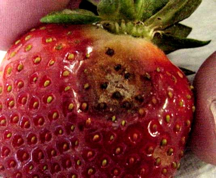
Anthracnose Fruit Rot of Strawberry
Anthracnose fruit rot can cause serious losses if not controlled. Symptoms of anthracnose include the development of circular, sunken lesions on infected fruit. Often pinkish/tan colored spore masses will develop in the center of lesions. Anthracnose in strawberry is caused by Colletotrichum spp. Spore production, germination and fruit infection are favored by warm, humid weather. The fungus can overwinter on infected plants, in plant debris or on weed hosts. Spores are dispersed by splashing water and can infect green and mature fruit. Control begins with protectant fungicides from flowering through harvest. Begin sprays no later than 10% bloom or prior to disease development and continue on a 7 to 10 day interval. Use the higher fungicide rate and shorter intervals when disease pressure is high. Do not make more than two consecutive applications of the same fungicide before switching to a fungicide in a different FRAC group. Fungicide resistance in C. acutatum and C. gloeosporioides to FRAC group 11 fungicides (azoxystrobin and pyraclostrobin) have been reported in FL in recent years.
Leather Rot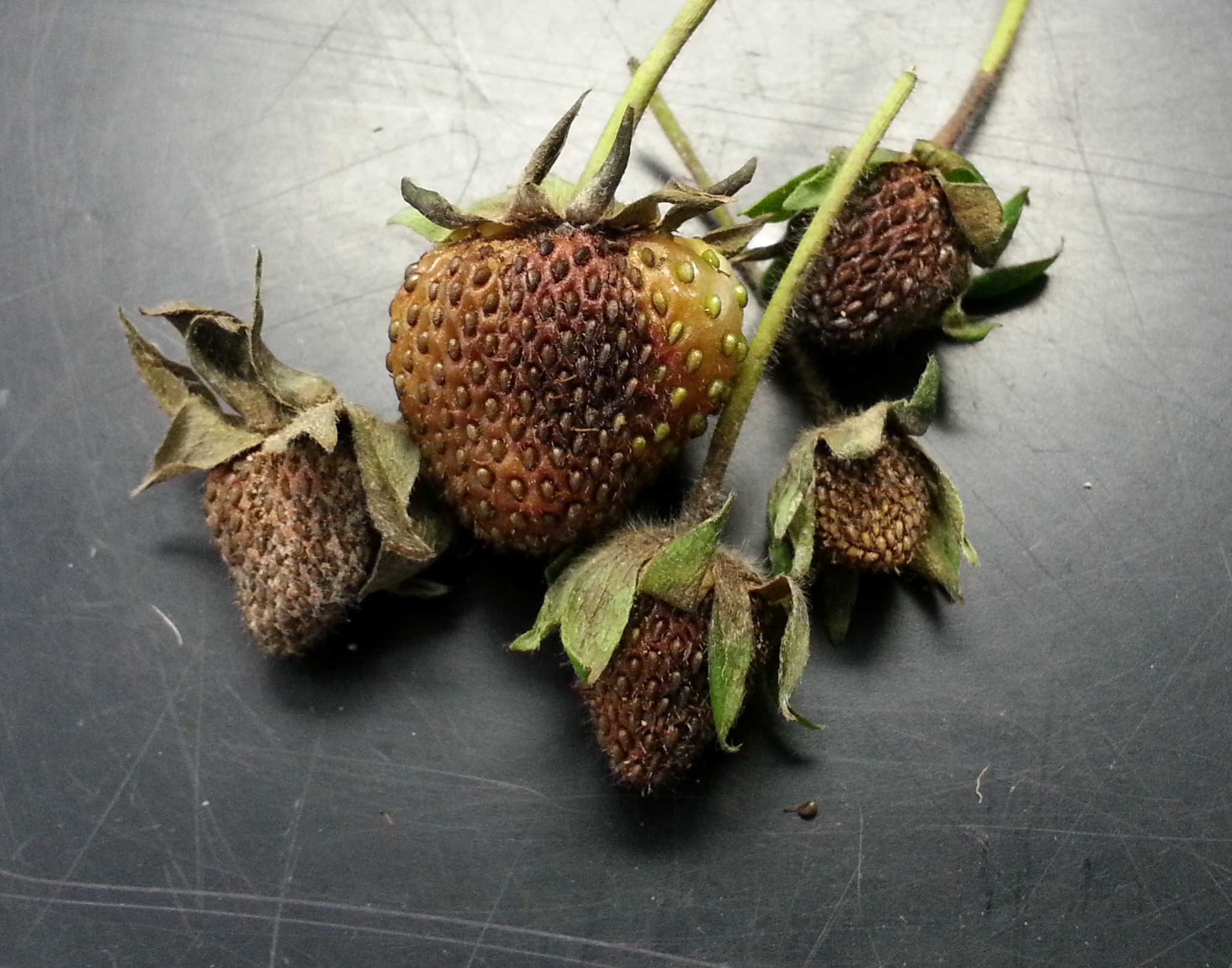 Strawberry Leather Rot Leather rot caused by Phytophthora cactorum can cause losses during warm, wet weather with extended periods of rainfall. Infection can take place during all stages of fruit development as long as favorable conditions are present. Infected fruit turn brown and have blotchy tough appearance. Infections typically occur in fruit that are in direct contact with the soil, but the pathogen can also be splashed onto fruit via rainfall and wind. Research by Dr. Mike Ellis, Using Fungicides to Control Strawberry Fruit Rots in Ohio, has shown that FRAC code 11 fungicides such as Cabrio, Abound, and Pristine are effective against leather rot. Pristine being the fungicide of choice because it also provides control of gray mold and anthracnose. Follow the link above for an excellent review of all three of these diseases and a useful efficacy table. Resistance to mefenoxam has been reported only in SC to date and resistance to QoI fungicides (FRAC group 11) in P. cactorum, from both crown and fruit infections, have been reported in FL in the past 5 years.
|
Gray Mold (Botrytis Fruit Rot)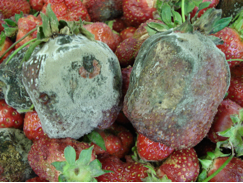 Gray Mold (Botrytis Fruit Rot) Gray mold is often a serious problem during extended cool, wet periods when fruit are sizing and reaching maturity. Symptoms of gray mold are the diagnostic grey, fuzzy growth that will cover entire fruit. Control of gray mold, like the other diseases, begins with recognizing the conditions for its development, its symptoms, and preventative fungicide applications. Start sprays when plants begin to bloom, because 90% of fruit infections occur through the flower, and repeat every 7-10 days. Increase spray intervals during persistent dry periods, but decrease intervals to 5-7 days during very wet periods. Four weekly sprays starting at 5-10% bloom are usually sufficient for season-long control. Tank-mix and rotate fungicides from different FRAC codes to reduce the chances for fungicide resistance development. Fungicide resistance in Botrytis is widely known and documented. Resistance development has been documented in MBC fungicides (FRAC code 1) to benomyl (no longer on the market) and thiophanate-methyl; the DC fungicides (FRAC group 2) with iprodione; the SDHI fungicides (FRAC group 7) with boscalid, fluxapyroxad, and penthiopyrad; the AP fungicides (FRAC group 9) with pyrimethanil and cyprodinil; the strobilurin fungicides (FRAC group 11) with azoxystrobin, trifloxystrobin, and pyraclostrobin; and the Hyd fungicides (FRAC group 17) with fenhexamid. Cross resistance to fungicides within specific FRAC groups has also been widely documented. Most importantly, resistance to multiple FRAC groups has also been widely reported in Botrytis in the US. Recent studies across the southeast have shown that some Botrytis isolates can carry resistance to 2, 3, 4, or 5 different FRAC groups. A study from 2015 examining 2,000 Botrytis isolates collected across the southeast discovered that some isolates carried resistance to 6 or 7 different FRAC groups. As described the authors, this was likely the result of “selection by association” in which resistance was selected by the fungicide applied but also indirectly because the selected isolates were also inherently resistant to fungicides in other FRAC groups. |
How to manage fruit rots and fungicide resistance development
The use of mulch to prevent/reduce soil splashing and keeping fruit from coming into direct contact with the soil surface can be beneficial in conventional production as well as organic production systems where conventional fungicides cannot be used. Long crop rotations and staying away from fields with known history of any of these pathogens is also extremely important, although this may be difficult on farms with U-pick operations where fields need to be close to the market and accessible. Adjusting plant populations to improve air movement and the drying of leaves and fruit within the canopy, and avoiding overhead irrigation are some of the cultural practices growers can do to help reduce losses to fruit rot.
Strawberry growers need to pay careful attention to the efficacy of all high-risk fungicides used during the season. Fields should be scouting regularly, particularly before and after a fungicide application. Remember, due to the specificity of high-risk fungicides, once resistance develops to any one particular fungicide chemistry the likelihood of cross-resistance development increases significantly to other fungicides within the same FRAC group. If loss of efficacy is noticed, growers should discontinue the use of that FRAC group during that growing season. Growers developing season-long fungicide programs for fruit rot control need to use as many different modes-of-action (i.e., different FRAC groups) as possible and limit the use of any single mode of action as much as possible to help mitigate resistance development. This is especially important when growers are applying fungicides with more than one mode of action. Careful attention needs to be made to both fungicide chemistries so that the same mode of action isn’t used during the next application. As a general rule, growers need to use as many different modes of action as possible and to space them out as far apart as possible during the production season.
For more information on the control of anthracnose fruit rot, gray mold, and leather rot in strawberry please see the 2024/2025 Commercial Vegetable Production Recommendations Guide for the mid-Atlantic Region.