Upcoming Schedule for ‘Ask the Expert Series Orchard Edition’ Discussions

Attention Tree Fruit Growers

The Rutgers University Tree Fruit Extension Team is looking forward to the 2021 growing season however, given the current restrictions  we will be altering the meeting format this year.  Since we are all suffering from Zoom Webex Skype fatigue, we are going to put a pause on our yearly (day long) North and South Jersey Tree Fruit meetings and instead,  hold one Hour ‘Ask the Expert Series Orchard Edition’ talk/discussions.

Beginning March 24 we will be hosting  one-hour virtual discussions,   on timely topics where YOU the growers are encouraged to ask the experts questions on all things tree fruit.

Where: Online

            Zoom meeting links will be posted to the Plant and Pest Advisory AND E-mailed to Tree Fruit Growers on Rutgers List Serves 1 week prior to each meeting.

When: 9 AM-10 AM (dates below)

Note that we plan to offer CORE and PP2 credits for some of the sessions.

If you are interested in additional session topics and/or expert please let us know!  These sessions are meant to specifically address your needs/interests.

Meeting/Discussion Dates, and Topics

Meeting Date Topic
March 24 Tree Fruit Diseases to Prepare For in 2021
April 7 Apple Thinning using Plant Growth Regulators
April 21 2021 Tree Fruit Insect Pests What’s that Buzz in the Orchard?
May 5 Orchard Soil Fertility From the Ground Up
May 19 Pesticide Safety Talk CORE pesticide credits will be offered
June 2 Timely discussions on issues that arise as the season progresses.
July 14 Timely discussions on issues that arise as the season progresses.
August 4 Timely discussions on issues that arise as the season progresses.


Help us to help you!  Please submit questions and discussion topics

 in advance of sessions to

Megan Muehlbauer muehlbauer@njaes.rutgers.edu or

Hemant Gohil gohil@njaes.rutgers.edu


Mid Atlantic Fruit and Vegetable Convention REGISTRATION IS OPEN!!!

Mid Atlantic Fruit and Vegetable Convention will be held February 8-11, 2021 ONLINE!

This year’s Mid Atlantic Fruit and Vegetable Conference is 100% online.  There will be an excellent lineup of speakers from all over the country presenting on topics ranging from soil health to digital marketing.

New Jersey Pesticide Credits will be awarded (CORE, PP2, 1A, and 10).

Please note: TO ENSURE GROWERS RECEIVE PESTICIDE CREDITS THEY MUST

  1. Register as a New Jersey State Horticultural Society Member
  2. They must attend the ENTIRE credit bearing session.
  3. They MUST look for and follow the instructions on the follow-up E-mail, which will be sent to from Hunterdon County Agricultural Extension Secretary Kim Crommelin kfrey@co.hunterdon.nj.us following the meeting.

If you have any questions or concerns regarding the meeting or pesticide credits please reach out to Kim Crommeliln kfrey@co.hunterdon.nj.us

Register at the Link Below

https://amr.swoogo.com/mafvc2021/785984


Virtual Statewide Commercial Tree Fruit Growers Twilight Meeting IV Harvest Season Update

Virtual Statewide Commercial Tree Fruit Growers Twilight Meeting IV

Harvest Season Update

Wednesday September 23, 2020

Online 6:00 PM – 7:30 PM

Statewide Tree Fruit Twilight Meeting IVClick here to register for the twilight meeting.

Password: fallfruit

NJDEP PESTICIDE RECERTIFICATION CREDITS ARE ANTICIPATED

If you wish to receive pesticide credits for this meeting, DEP regulations require you to upload a copy of a government issued photo ID and a copy of your pesticide applicator license prior to the meeting.

Click here to upload a government issued photo ID and pesticide license

Upload directions: If you click on the photo ID upload link using a smart phone/tablet you will have the option of simply taking a photo of your ID and uploading it directly into the system.  If you are using a computer you will need to scan or take a photo of your photo ID and upload the file using the directions at the upload link. If you need assistance uploading your documentation contact; Kimberley Crommelin kfrey@co.hunterdon.nj or Megan Muehlbauer muehlbauer@njaes.rutgers.edu to assist you in verifying your identity for NJDEP recertification credit purposes.

Please note: The files are uploaded into a secure Rutgers University digital folder that no one other than the session hosts (Megan Muehlbauer and Kimberley Crommelin) can view or access.


To Enter the Meeting: Click the link in the registration confirmation E-mail and select “join by browser-New” BE SURE TO KEEP VIDEO ON IF YOU WISH TO OBTAIN PESTICIDE CREDITS.


If you do not wish to receive pesticide credits, and would like to call into the meeting, dial USA Toll: +1-650-429-3300 Access code: 120 185 4274

PLEASE BE IN THE MEETING BY 6 PM AS IT WILL BEGIN PROMPTLY AT 6 PM!


Thank you very much for your willingness to cooperate!


Program

Hosted by: Megan Muehlbauer PhD. County Agent III Rutgers New Jersey Agricultural Experiment Station (NJAES) Cooperative Extension of Hunterdon County

Hemant Gohil PhD. County Agent III Rutgers (NJAES) Cooperative Extension of Gloucester County


6:00 PM – 6:20 PM Peach Tree Borer and Spotted Lanternfly Management

Anne Nielsen, PhD. Extension Specialist, Fruit Entomology, Rutgers University

Dean Polk, Fruit IPM Agent Rutgers NJAES


6:20 PM – 6:40 PM Herbicide Decisions for Fall Weed Management

Thierry Besancon, PhD. Extension Specialist, Weed Science, Rutgers NJAES


6:40 PM – 7:00 PM Peach Leaf Curl and Apple Scab Management in High Inoculum Orchards.

Norm Lalancette PhD, Extension Specialist Tree Fruit Pathology, Rutgers NJAES


7:00 PM – 7:30 PM New Jersey Pesticide Regulation and Safety Update

Patricia Hastings, Pesticide Safety Education Program Coordinator, Rutgers NJAES

Act Now! PGR Application for Harvest Management in Apple Orchards

With the looming risk of labor shortages and limitations on public visiting farms, tree fruit growers should consider their options for apple pre-harvest drop management.  The past few nights have been cool enough for color development in early varieties such as Honeycrisp and Gala, emphasizing the need to initiate harvest management strategies.

Excellent practical guidance on using plant growth regulators to control drop prepared by Professor Jim Schupp of Penn State is available here:

https://extension.psu.edu/apple-pgrs-prevention-of-preharvest-drop-in-apple-orchards

Growers of MacIntosh, Gala, and Honeycrisp should also refer to the variety-specific recommendations from Dan Donahue of Cornell Cooperative Extension available here:

Recommendations for Harvest Management Plant Growth Regulators in Eastern NY


Keep in mind that the response for stop drop control with PGRs is variable based on cultivar, and weather factors, so be sure to consult your local agricultural agent or tree fruit consultant for individual recommendations prior to application.

NJ Statewide Tree Fruit Twilight Meeting – III

NJ Statewide Tree Fruit Twilight Meeting – III

June 10 (Wed) 4:45 PM – 7:00 PM


Please join us for this informational event co-hosted by Hemant Gohil, Agricultural Extension Agent of Gloucester County and Megan Muehlbauer, Agricultural Extension Agent of Hunterdon County.


To register for this session

Goto https://rutgers.webex.com/rutgers/k2/j.php?MTID=t7146b7770ce664a4c5ace078ff541df4

and register. Once you are approved by the meeting host (Hemant Gohil), you will receive a confirmation email with instructions for joining the session.

To be eligible for Pesticide credits, please register before 12 PM (noon) June 10th.

4:45 pm – 5:00 pm: Verification of ID for registrants getting pesticide credits.

5:00 pm – 7:00 pm: Educational Talks.


Registration password:

This session does not require a registration password.


Topics covered:

An Update on the Current Use of Respirators (George Hamilton)

Herbicide drift and how to prevent it (Thierry Besancon)

Mid-Season Pest Management Practices (Dean Polk)

Updates for BSMB Management and What to Expect in 2020 (Anne Nielsen)

COVID-19 Resources for the 2020 Growing Season (Meredith Melendez)


For assistance contact program organizers Hemant Gohil at: gohil@njaes.rutgers.edu or Megan Muehlbauer muehlbauer@njaes.rutgers.edu

Help, Spotted Lanternfly Nymphs are in my Vineyard!

Management of Spotted Lanternfly Nymphs in New Jersey Vineyards

Megan Muehlbauer and Anne L. Nielsen

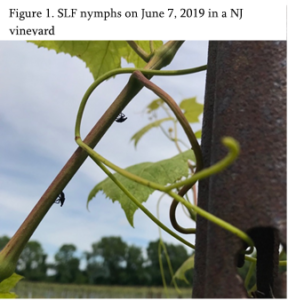
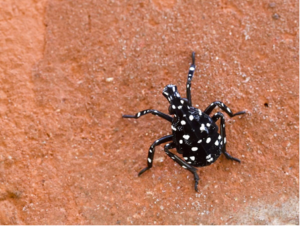
Vineyards in Salem and Hunterdon Counties in New Jersey are beginning to report spotted lanternfly (SLF) nymph sightings (Figure 1). These small black nymphs have white dots on their abdomens and will hop if disturbed. Although it is concerning to find them in large numbers in vineyards, we are not recommending that grape growers spray insecticides at the nymph stage.

Vineyard

Spotted Lanternfly Nymphs

(Photo Credit: https://www.pottsmerc.com)

Why? Thus far, there has been no definitive research showing that young SLF nymphs cause damage to grapes.  If SLF is feeding on grapes during the 1st and 2nd instar (nymph) stages, they are likely feeding on the fleshly new growth, not on the canes or cordon as the adults do.

However, these nymphs are also likely representing a very low number of the total population of SLF in and around the vineyard they are being seen at, because research has also shown that nymphs feed on multiple host plants.  To further elucidate details of SLF life cycle, and feeding habits, we are surveying to determine which life stages are found in commercial vineyards throughout the growing season.

As you make a decision on whether to spray the nymphs in your vineyard, It is important to keep these two points in mind.

1) Do not overuse pyrethroids in a vineyard as they can flare mealybug populations which vector leaf roll virus.

2) Save highly effective insecticides with good residual (Brigade, Actara, Scorpion, Carbaryl, and Mustang Maxx) for use against the adults in late summer through harvest.

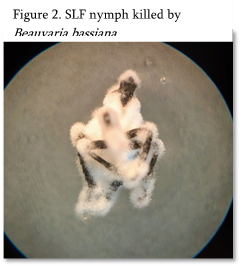
If you want a material to apply now while the nymphs are just becoming active in the vineyard, the biological pesticides, BoteGHA (1-2 qt/acre) or BotaniGard 22 WP (0.5- 2 lbs/acre), are effective against the nymphs and will minimally impact other pests. These products have Beauvaria bassiana, a beneficial fungus that attacks insects and has good efficacy against SLF nymphs and a 4 hour REI.  Keep in mind when using B. bassiana materials, they take a few days to kill SLF and the fungal growth will turn the nymphs into fuzzy white cotton balls (Fig 2). As a biological material they work best under humid conditions. Recommendations tank mix compatibility for BoteGHA can be found here

Bug under a microscope

There are two other pests in NJ vineyards, grape berry moth and Japanese beetles, that commonly require management in the early summer. While there is no action threshold for SLF nymphs in the vineyard, management can be combined with existing pest management programs. Grape berry moth timing is approaching and we recommend using an insecticide that is effective against both SLF nymphs and grape berry moth if you have SLF nymphs in your vineyard (Table 1).

Just remember that the degree-day timing for grape berry moth is based on using growth regulators or diamide chemistries and application of a broad-spectrum material would be applied 1-2 days after the predicted timing. Japanese beetles typically occur in late June/July and again, there are insecticide materials that are effective against both SLF nymphs and Japanese beetle (Table 1).

Table 1. Insecticide efficacy against SLF nymphs and key grape pests

Rating of Insecticide Efficacy*
Insecticide SLF Nymph ** Grape Berry Moth Japanese Beetle
Avaunt 30SG E G G
Brigade 10WSB E E –
Entrust 2SC F G –
Imidan 70WP E G –
Carbaryl E G G
Actara 25 WG E – G


*E – Excellent; G – Good; F – Fair; ‘-‘ not rated

**H Leach, DJ Biddinger, G Krawczyk, E Smyers, JM Urban 2019 “Evaluation of insecticides for control of the spotted lanternfly, Lycorma delicatula, (Hemiptera: Fulgoridae), a new pest of fruit in the Northeastern U.S.” Crop Protection 124:104833


The recommendations for spotted lanternfly control are centered around the adult stage which are considered the primary damaging stage.  If adults are found in your vineyard they likely warrant management. In 2019 we saw SLF move into Northern NJ vineyards in large numbers at the end of September. It is important to note that they do not discriminate between vines that have been harvested or not. The only available threshold for SLF in grapes is 10 adults/vine, however this is quickly exceeded in some vineyards. We are recommending that growers apply a border spray targeting the vines on the borders or the first few panels if rows are perpendicular around your vineyard, with a focus on areas near hedgerows as it has been shown that those are the areas that SLF if most likely to congregate in at higher densities.  Further information on adult SLF control, recommended insecticides and rates will be in a forthcoming Plant and Pest Advisory Post.