Vegetable IPM Update 5/15/25

Greetings from the Veg IPM team! No major changes have taken place between last week and this week, and with the rainy weather, scouting has been limited.

Sweet Corn

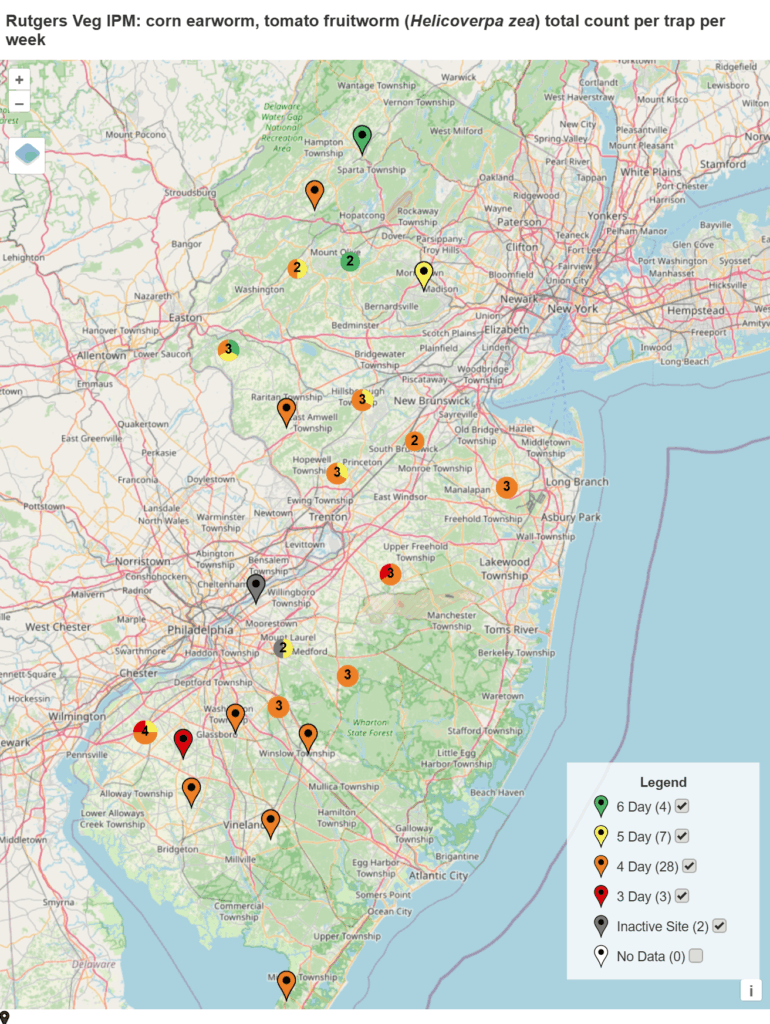
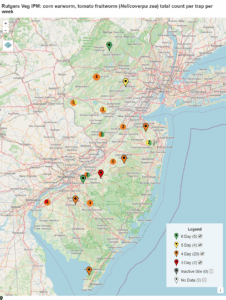
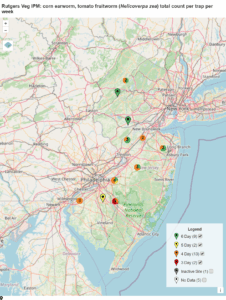
We’ve put out corn earworm pheromone traps throughout the state. While silking corn is the main target of CEW activity, we set the traps early to detect overwintering moths, which have become more common with warmer winters. As a reminder, we’re no longer using blacklight traps as of this year, and we’ll be reporting pheromone trap counts in the Plant Pest Advisory as the season progresses. So far, we haven’t spotted any corn pests through visual inspection.

Cole Crops 

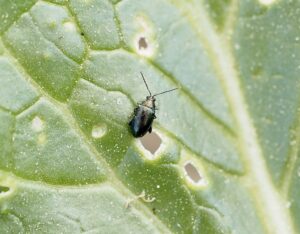
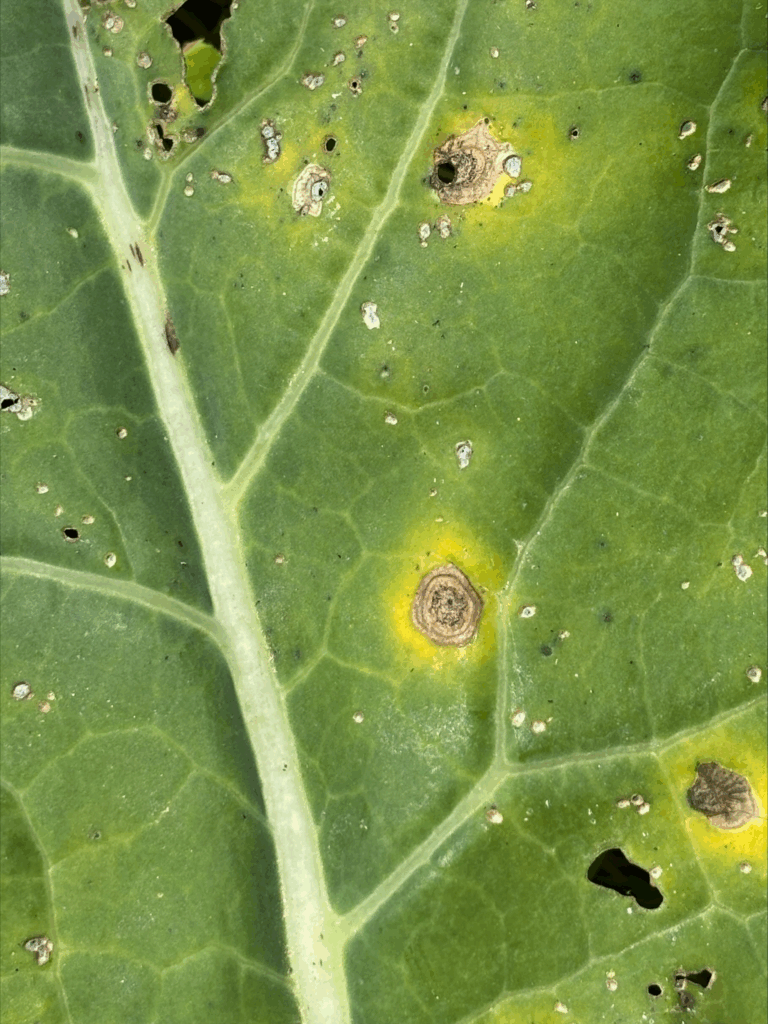
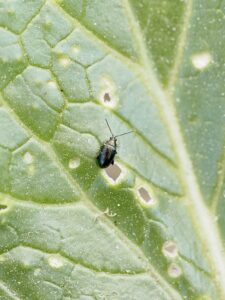
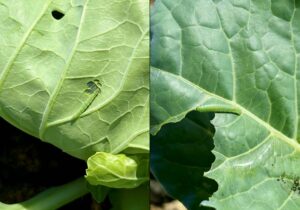
A shiny black beetle with straight antennae stands on a leaf surrounded by circular feeding holes.

Flea beetle surrounded by feeding damage. Picture by Maria Cramer.

Flea beetle are active in various cole crops. This year, they have been especially prevalent in Napa cabbage and bok choy. Young plants are especially vulnerable to attack from flea beetles. The treatment threshold for flea beetles in heading cole crops is 50% infestation.
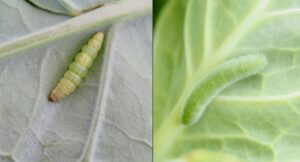
 

Two picture, the picture on the left shows a smooth caterpillar that tapers at both ends. The picture on the right shows a caterpillar that is fuzzy all over and does not taper at either end.

Left: Diamondback moth caterpillar, showing characteristic tapering at each end. Right: Imported cabbageworm caterpillar showing characteristic fuzziness. Pictures by Maria Cramer.

We’re seeing caterpillar activity (imported cabbageworm and diamondback moth) in cabbage and other cole crops. Treatment thresholds vary between crops and growth stage, but for heading cole crops between early vegetative and cupping, the treatment threshold is 30%. At this stage, sprayable Bt products (IRAC 11A) such as Dipel, Xentari, or Javelin can be effective on young caterpillars. Other materials approved for caterpillar control include Entrust/Radiant (IRAC 5), Proclaim (IRAC 6), Torac (IRAC 21A), and Exirel (IRAC 28). For Bt products and contact insecticides, coverage on the undersides the leaves is essential.


Tomatoes

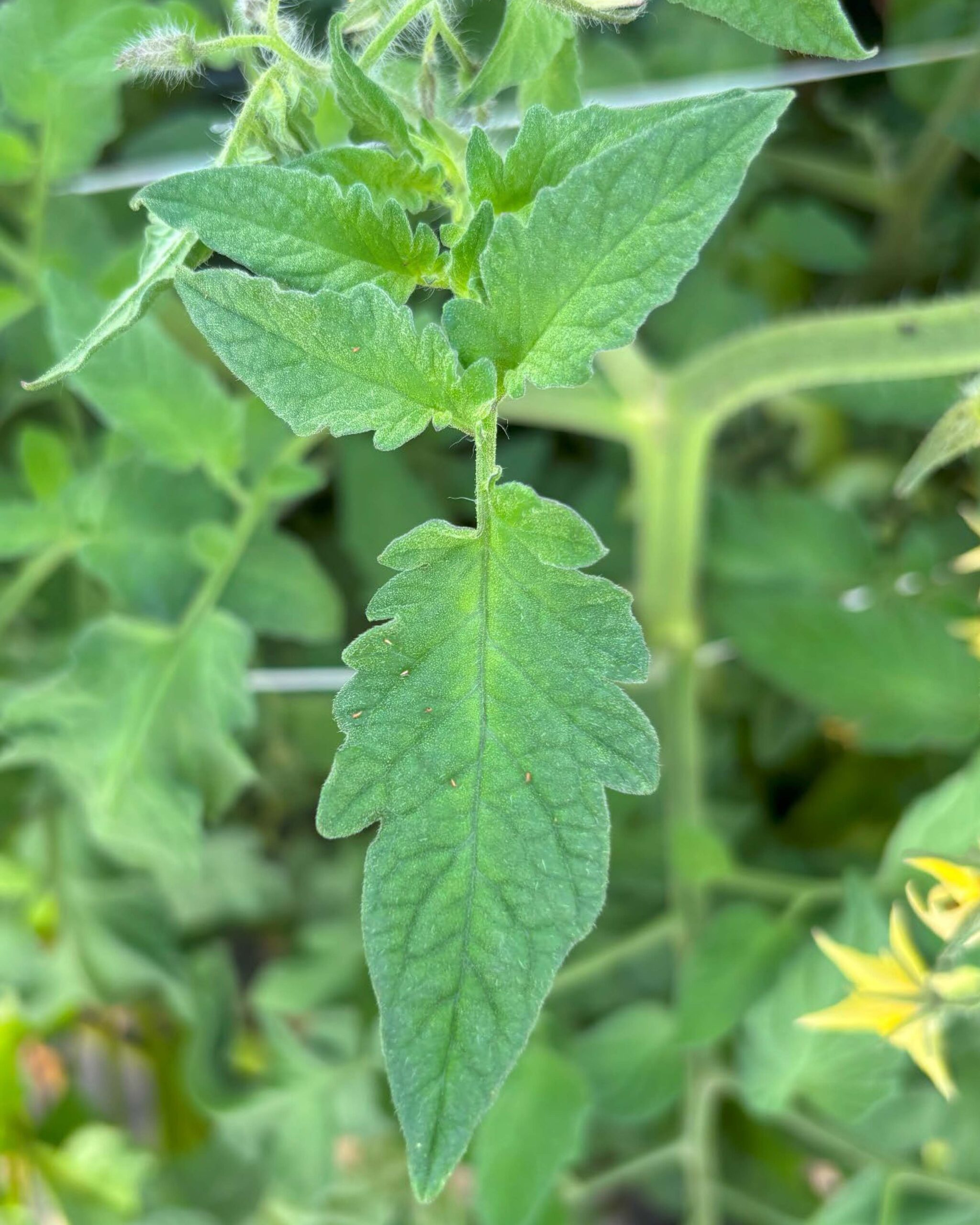
In high tunnels and the first field plantings of tomatoes, we’re seeing limited aphid, thrips, and spider mite activity. If dealing with primarily aphids, products such as Beleaf (IRAC 29) are recommended, especially if plants have reached the flowering stage. For thrips, Entrust, Radiant (IRAC 5) and Torac (IRAC 21A) can be used. For spider mites, Nealta (IRAC 25) is an effective material that is more friendly to beneficial insects, but Portal (IRAC 21A) and other materials can be used to manage populations.


Please consult the Mid-Atlantic Commercial Vegetable Production Guide for a more comprehensive list of materials that are labeled for specific crops and pests. As always, be sure to follow label rates and application instructions.
Authors: Amanda Quadrel (Northern NJ Veg IPM coordinator) and Maria Cramer (Southern NJ Veg IPM coordinator)


Vegetable IPM Update 5/08/25

Sweet Corn

We’ve put out corn earworm pheromone traps throughout the state. While silking corn is the main target of CEW activity, we set the traps early to detect overwintering moths, which have become more common with warmer winters. As a reminder, we’re no longer using blacklight traps as of this year, and we’ll be reporting pheromone trap counts in the Plant Pest Advisory as the season progresses.

Cole Crops 

A shiny black beetle with straight antennae stands on a leaf surrounded by circular feeding holes.

Flea beetle surrounded by feeding damage. Picture by Maria Cramer.

Flea beetle are active in various cole crops. This year, they have been especially prevalent in Napa cabbage and bok choy. Young plants are especially vulnerable to attack from flea beetles. The treatment threshold for flea beetles in heading cole crops is 50% infestation.


Two picture, the picture on the left shows a smooth caterpillar that tapers at both ends. The picture on the right shows a caterpillar that is fuzzy all over and does not taper at either end.

Left: Diamondback moth caterpillar, showing characteristic tapering at each end. Right: Imported cabbageworm caterpillar showing characteristic fuzziness. Pictures by Maria Cramer.

We’re seeing caterpillar activity (imported cabbageworm and diamondback moth) in cabbage and other cole crops. Treatment thresholds vary between crops and growth stage, but for heading cole crops between early vegetative and cupping, the treatment threshold is 30%. At this stage, sprayable Bt products (IRAC 11A) such as Dipel, Xentari, or Javelin can be effective on young caterpillars. Other materials approved for caterpillar control include Entrust/Radiant (IRAC 5), Proclaim (IRAC 6), Torac (IRAC 21A), and Exirel (IRAC 28). For Bt products and contact insecticides, coverage on the undersides the leaves is essential.


Tomatoes

In high tunnel tomatoes, we’re seeing limited aphid, thrips, and spider mite activity. If dealing with primarily aphids, products such as Beleaf (IRAC 29) are recommended, especially if plants have reached the flowering stage. For thrips, Entrust, Radiant (IRAC 5) and Torac (IRAC 21A) can be used. For spider mites, Nealta (IRAC 25) is an effective material that is more friendly to beneficial insects, but Portal (IRAC 21A) and other materials can be used to manage populations.


Please consult the Mid-Atlantic Commercial Vegetable Production Guide for a more comprehensive list of materials that are labeled for specific crops and pests. As always, be sure to follow label rates and application instructions.
Authors: Amanda Quadrel (Northern NJ Veg IPM coordinator) and Maria Cramer (Southern NJ Veg IPM coordinator)


Allium Leafminer Update 3/24/2025- First oviposition scars spotted

The first Allium leafminer (ALM) oviposition scars were reported in Cape May this past weekend (38.9588N, 74.9082W), suggesting that adults are active in the southern part of the state. ALM are active around 250 GDDs. If you want to know how many GDDs have accumulated in your area, the NEWA website https://newa.cornell.edu/ has a helpful GDD calculator. From the NEWA home screen, select the nearest weather station from the drop-down menu at the center of the page.  Next, scroll down to “Weather Tools” on the right side of the page and select “DD Calculator.”  Select your start date (1/01/25) and end date, as well as Degree Day Type (39 F) from the menu at the left of the page.  The site will automatically generate the accumulated GDD base 39 F to the last day of your requested sample, and then offer a forecast of accumulated GDD for the next week.

ALM can cause injury to chives, scallions, garlic, onions and leeks, but leeks and scallions seem to be the most effected. Look for neat rows of white spots descending from the upper tips of allium leaves (see photo below). Initial injury often occurs on the tallest leaves. Adults may be seen in warmer conditions at the tips of the leaves- look for small flies with grey-black bodies and yellow heads (see photo below).

If you are concerned about crop injury due to Allium leafminer, you may want to prepare for control efforts. Floating row covers, kept on until the first flight ends (around the end of May) can restrict ALM’s access to vulnerable plants. Adults can be targeted through insecticide sprays. Appropriate materials that are labeled for ALM control include spinosyns (Radiant, Entrust (OMRI approved)), pyrethroids (Mustang Maxx, Warrior), neonicotinoids (Scorpion, Venom), and the insect growth regulator Trigard. The first application should be applied 2- 3 weeks after initial detection of ALM flies (if you see oviposition scars or the fly itself) and subsequent sprays should be completed in 1–2-week intervals. Two or three sprays should provide adequate control.

Field Scouting Guide: Allium Leafminer - Growing Produce

Notice the white oviposition scars and an adult female ALM. Photo: Brian A. Nault, Cornell AgriTech. 

If you have any questions/concerns, feel free to reach out to me at amanda.quadrel@rutgers.edu or 732-742-8441.

Allium Leafminer Update 3/20/2025

Happy first day of Spring! Many parts of New Jersey are close to accumulating 250 growing degree days (GDDs) base 39˚F, which is when the first emergence of Allium leafminer (ALM) adults is predicted to occur. In some areas of New Jersey, 250 GDDs are forecasted to be surpassed as early as this weekend. In Cape May, oviposition scars have already been spotted. If you would like to know how many GDDs have accumulated in your area, the NEWA website https://newa.cornell.edu/ has a helpful GDD calculator. From the NEWA home screen, select the nearest weather station from drop down menu at the center of the page.  Next, scroll down to “Weather Tools” on the right side of the page, and select “DD Calculator”.  Select your start date (1/01/25) and end date, as well as Degree Day Type (39 F) from the menu at the left of the page.  The site will automatically generate the accumulated GDD base 39F to the last day of your requested sample, and then offer a forecast of accumulated GDD for the next week.

ALM can cause injury to chives, scallions, garlic, onions and leeks, but leeks and scallions seem to be the most effected. Look for neat rows of white spots descending from the upper tips of allium leaves (see photo below). Initial injury often occurs on the tallest leaves. Adults may be seen in warmer conditions at the tips of the leaves- look for small flies with grey-black bodies and yellow heads (see photo below).

If you are concerned about crop injury due to Allium leafminer, you may want to prepare for control efforts. Floating row covers, kept on until the first flight ends (around the end of May) can restrict ALM’s access to vulnerable plants. Adults can be targeted through insecticide sprays. Appropriate materials that are labeled for ALM control include spinosyns (Radiant, Entrust (OMRI approved)), pyrethroids (Mustang Maxx, Warrior), neonicotinoids (Scorpion, Venom), and the insect growth regulator Trigard. The first application should be applied 2- 3 weeks after initial detection of ALM flies (if you see oviposition scars or the fly itself) and subsequent sprays should be completed in 1–2-week intervals. Two or three sprays should provide adequate control.

Field Scouting Guide: Allium Leafminer - Growing Produce

Notice the white oviposition scars and an adult female ALM. Photo: Brian A. Nault, Cornell AgriTech. 

If you have any questions/concerns, feel free to reach out to me at amanda.quadrel@rutgers.edu or 732-742-8441.

Survey on Corn Earworm Management Practices and Costs in Sweet Corn

If you are a fresh-market grower of sweet corn, the regional Corn Earworm IPM team would like your input! The CEW IPM team includes entomologists and extension specialists across multiple states and institutions, such as the Northeastern and Southeastern IPM Centers and universities in NJ, NY, DE, MD, NC, VA, and GA.

This short survey aims to gather information on your current CEW control practices and their associated costs. This information will be used to evaluate how alternative CEW control practices can affect grower costs, sales, and financial performance. Most importantly, your participation will help us help you; this information will guide future recommendations for more sustainable management practices you can implement on your farms.

Note that this survey is aimed at fresh-market growers; a separate survey will be sent out for those who grow sweet corn for processing.

To take the survey online, please use this link. If you prefer, here is a PDF version of the survey to print and fill out. For more information on the regional CEW team/project, visit CEWIPM.org for the latest updates. Your participation is greatly appreciated!


Vegetable IPM Program – Corn Earworm Monitoring

Corn Earworm Monitoring – Moving Forward

It is likely that blacklight trapping will not be continued in the Rutgers Vegetable IPM Program beginning in 2025, due to the unavailability of the specific bulb that has been the standard for blacklight traps for decades.  Under these circumstances, the IPM Program will rely on pheromone trapping to determine levels of important crop pests such as the corn earworm (CEW).

The 30” Hartstack trap (see photo at right by K. Albright of Purdue Univ.), also called the Texas pheromone trap (TPT), which is used in the Rutgers IPM Program, as well as many insect monitoring programs in other states, is the best tool for determining spray intervals on silking sweet corn to limit CEW injury.  A number of New Jersey sweet corn growers already have one or more TPTs on the farm, but we encourage all growers of this crop to obtain at least one.


Deploying Traps

The TPT is mounted on ½” rebar set at a height of approximately 4’.  The trap is baited with one Hercon Luretape Corn Earworm Lure, available from Great Lakes IPM®.  An additional lure is added every two weeks, and the trap should always be deployed directly adjacent to sweet corn expressing fresh silks.  This means that the trap should be moved frequently during the season.


Building or Buying Traps

The TPT is relatively simple to manufacture, and the University of Kentucky has posted the plans and parts list for making these traps in the growers’ shops.  The UKy site for trap design is:  https://entomology.ca.uky.edu/ef010

For those who wish to purchase this trap rather than making their own, TPTs are available from Mike “O” Olsowski in Geneva, NY.  Mr. Olsowski has made a number of TPT tops for the Rutgers IPM Program and is willing to make and ship these traps to New Jersey growers.  Contact information for Mike “O” Olsowski :

Mike “O” Olsowski

3510 Sutton Rd.

Geneva, NY  14456

Phone:  315-651-5929


Recording Catches

Current silk spray intervals based on corn earworm catches in the 30″ Hartstack trap were developed by the Univ. of Delaware some time ago, and are represented on the following chart, which may be printed and posted in a convenient site on the farm so that growers can record the catch and determine a silk spray schedule.  This trap record also includes spaces for other insects for which commercial pheromones are available, including beet armyworm and fall armyworm.  Contact information for Rutgers Vegetable IPM Program staff (currently, Amanda Quadrel) is also included on the chart.