Are you required to let the public bring their animals onto your retail farm?

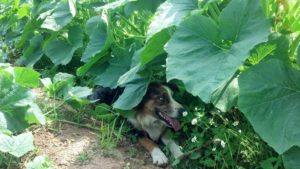
An increasing number of customers are bringing animals with them when they visit farm markets, pick your own farms, or agritainment activities. Animals can pose a food safety risk to produce, introduce disease to farm animals, frighten or upset farm animals. Outside animals can also pose a risk to employees and other market customers and farm visitors. Farmers need to consider these occurrences when keeping in compliance with regulations and buyer requirements specific to food safety and biosecurity to protect their farm animals. The Americans with Disabilities Act (ADA) governs what you are legally allowed to do in regards to customers with service animals visiting your market or on your farm. This fact sheet will cover the specifics of the ADA, animals that are not protected by the ADA regulations, and how to reduce potential risk on your farm from outside animals. States often have regulations that go beyond the federal ADA regulation, information represented in this fact sheet is specific to New Jersey. If you farm in another state please consult the state by state guide linked at the end of this article.Dog resting in the shade

What do the ADA regulations cover?
While many types of animals can provide comfort and emotional support to their owners, only service animals are protected by the ADA, specifically Title II and III. The ADA regulations define “service animal” as dogs, and less commonly miniature ponies, that are individually trained to do work or perform tasks for people with disabilities such as guiding a blind person, alerting people who are deaf, assisting a person in a wheelchair, alerting and protecting a person who is having a seizure, reminding a person with mental illness to take prescribed medications, calming a person with Post [Read more…]

Packinghouse Layout, Cleaning and Sanitation

Many packinghouses in New Jersey have not been updated in many years. If you haven’t, now is the time to be thinking about what changes will be needed to comply with a third-party audit or the Food Safety Modernization Act. Analyzing your packinghouse may also save money. Any time saved during packing will save money. If your produce moves quickly through the packing process it will maintain higher quality and be fresher.

Start by making a drawing of your packinghouse showing how the product comes from the field to the point it is loaded on the truck. Make sure to include how the produce is received, where the produce is dumped on the line or grading table, whether it goes through a washer, holding area after packing, the cold room, if applicable, and the [Read more…]

USDA Audits and Inspections Rates to Increase

The United States Department of Agriculture just announced that anyone wanting a GAP or Harmonized Audit will see the base and hourly rate increase on October 1, 2017 from $92.00 per hour to $108.00 per hour. There also will be a base fee of $432.00 for either audit. This means if you have two or three audits a year each one will be charged $432.00 then the hourly rate will be added. Growers should try and combined as many crops as possible into one audit. Also, if a grower has been getting their audit in October or November, try to schedule them before October 1 to reduce your cost for this year.
For anyone calling for a quality or grade inspection the cost will increase to $191.00 per hour.

Difference between a third party audit and the Food Safety Modernization Act (FSMA)

There is continued confusion about the difference between a third party audit and the produce safety rule under FSMA. The biggest difference is one is voluntary (third party audit) and one is government regulation (FSMA). Whether you need a third party audit depends on who is purchasing the produce. Some buyers will require an audit and specify the audit firm. This is mainly related to wholesale growers.

Whether you have a third party audit or not, FSMA applies to operations with produce sales over $25,000 (adjusted for inflation) averaged annually over three years.
Farms may be eligible for a qualified exception and modified requirements (section 112.5 and 112.6). To be eligible the farm must meet two requirements:
1. The farm must have all food sales (including animal feed) averaging less than $500,000 per year adjusted for inflation during the previous three years.
2. The farm’s direct sales to qualified end-user (restaurants, CSA, farmers markets, etc.) that is located in the same state or within 275 miles must exceed sales to all buyers combined during the previous three years.

A farm with the qualified exemption must meet modified requirements, including prominently displaying the name and the complete business address of the farm where the produce was grown either on the label of the produce or at the point of purchase.

Compliance Dates

Farm Size Compliance Dates Water Compliance Dates 1,2 Labeling Dates for Qualified Exemption 3 Compliance Date for Retention of Records to Support Qualified Exemption
>$500,000 1/26/18 1/27/20
$250 – 500K4 1/28/19 1/26/21 1/1/20 1/26/16
$25-250K5 1/27/20 1/26/22 1/1/20 1/26/16

1 Compliance dates for certain aspects of the agricultural water requirements allow an additional two years. Provisions with extended compliance dates include:
 The specific microbiological criteria that apply to agricultural water
 Corrective measures that must be taken if agricultural water does not meet requirements
 The frequency of testing agricultural water
 Records associated with data to support a microbial die-off rate, corrective measures, test results from a public water system, or data used to support alternative die-off rates, criteria, or sampling strategies
2 Guidance published 8/24/16 indicates that a farm has the option of collecting surface water samples over two to four years. For example, a farm that is not small or very small would begin sampling in 2018 and complete the water quality profile in 2020, 2021, or 2022.
3 A farm eligible for a qualified exemption must notify consumers as to the complete business address of the farm where the food is grown, harvested, packed, and held.
4 A farm is a small business if, on a rolling basis, the average annual monetary value of produce sold during the previous 3-year period is greater than $250,000 but no more than $500,000.
5 A farm is a very small business if, on a rolling basis, the average annual monetary value of produce sold during the previous 3-year period is greater than $25,000 but no more than $250,000.

Water testing requirements under the Food safety Modernization Act (FSMA)

Water testing is a major component of FSMA. The Food and Drug Administration (FDA) requires that growers begin sampling agricultural water to create a microbial water quality profile when they need to start complying with FSMA. No grower needs to start sampling until January, 2018 (growers over $500,000), small growers 2019 (growers between $250,000 and $500,000) and very small growers 2020 ($25,000 to $250,000). All growers have 2 to 4 years to complete sampling. How many samples are needed is not clear at this point. FDA is revisiting the water [Read more…]

Updated USDA Harmonized Audit Standards

The updated USDA Harmonized Audit Standards and Checklists are to be used starting on May 1, 2017.  The USDA has made changes to the Harmonized audits. Most changes are minor.   Listed below are the section numbers with major changes for each audit.

Field Operations and Harvesting Standard:
2.1.3, 2.4.3.4, 2.4.3.5, 2.4.3.6 and section 5 has been added

Post-harvest Operations:
1.5.3, 1.12.1 (moved from 1.23.2 and numbers shifted down one), 1.13.12, section 4 added

To obtain the updated Harmonized Standards that are to be used with the new Harmonized checklists starting on May 1, 2017, please go to the United Fresh’s website.   Also, there is a redline version of these Standards that show the items that were changed on the United Fresh website.
For the checklists that go with the standards go to the USDA Audit Services webpage and select the version for 5/1/17.