Archives for November 2024

Get Ready for the 2025 NJ Ag Convention – February 3-6

It is that time of year again to sign up for the annual NJ Agricultural Convention, co-sponsored by the Vegetable Growers Association of New Jersey, Rutgers Cooperative Extension, and the New Jersey Department of Agriculture. Visit the VGANJ website at https://vganj.com/convention-tickets to register.

For 2025 there are new and exciting opportunities to learn about all aspects of the agricultural industry at the educational sessions and from vendors at the trade show. If you came last year, you also saw many new improvements to the convention – more vendors, more educational sessions, a complimentary lunch (limited free tickets) on Tuesday highlighting “what’s new from industry”, a complimentary hot buffet at the Tuesday happy hour/charity auction, youth programs for FFA, and co-convention events with the NJ Department of Agriculture. These offerings and more are coming for 2025. New events like Monday afternoon workshops, a livestock session, an agricultural policy session, an environmental session, and others are confirmed for this coming year. Licensed pesticide applicators will see an increase in recertification credits on the program for 2025. 

To check out the educational programming and NJDEP recertification credits for pesticide applicators see https://go.rutgers.edu/ConvProgram2025 – this is a draft program. Also, note that some events need special sign-up so read the program carefully to see what events need pre-registration.

NJ State Board of Agriculture information for the convention is coming soon. Check out their website at Department of Agriculture | Conventions.

If you have any questions about the VGANJ registration, go to https://vganj.com/#contact. If you need more information about the educational programs please contact the Rutgers Co-Chairs for the convention – bamka@njaes.rutgers.edu Bill Bamka, Agricultural Agent in Burlington County, or minfante@njaes.rutgers.edu Michelle Infante-Casella, Agricultural Agent in Gloucester County.
Tools For Calculating Crop Production Costs

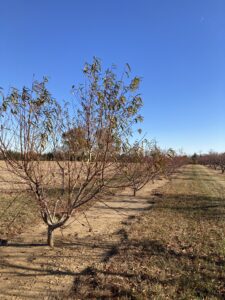
Estimating costs of production for individual crops can be challenging, but an important practice to understand where there might be areas for savings or investment in better inputs. It becomes even more difficult when there are multiple crops grown on a farm. A new online tool is now available to make it easier. [Read more…]

Ag Irrigation Water Log Template Simplifies Annual Water Use Reporting To NJ DEP


https://go.rutgers.edu/IrrigationLog


As 2024 winds down and irrigation pumps are finally being shut off after a very long, dry season, thinking about calculating how much water was used to be able to fill out that NJ DEP report form in a couple of months is likely the furthest thing on your mind. However, the RCE Ag Water Use Log Excel Template <https://go.rutgers.edu/IrrigationLog> can make that process much easier, whether you have used it all season, or just need an easier way rather than tabulating all those hours of pumping by hand. [Read more…]

Irrigation for late season perennial fruit crops during drought conditions

As New Jersey continues to experience record low precipitation levels since September, the state Department of Environmental Protection has declared a drought warning throughout the state. It is important to note that the drought warning does not call for any mandatory water use restrictions or bans. However, if the drought conditions worsen, the state may implement stricter measures to prevent further losses.

We have received many questions from growers, most who have completed harvesting for the season, on whether plants should still be receiving irrigation. Our recommendation is to continue to irrigate plants until they defoliate. For perennial fruit crops, in the fall months flower buds are forming for the next year’s crop. The leaves that remain on the tree are actively working to photosynthesize, converting light into energy the plant needs to grow.

Once leaves begin to turn yellow, brown, and drop off, you can stop supplemental watering. However, if you are in a prolonged drought, as we are currently, there are some factors to consider. For perennial crops that overwinter, severe drought can compromise their ability to store sufficient reserves, which can lead to reduced vigor and potential losses during the winter. It can be the case that during periods of drought, plants may invest more energy into developing deeper root systems; however, over a prolonged period of time, persistent stresses can hinder root development, which can negatively impact water intake and nutrient availability. Additionally, whereas hydrated soils can buffer the penetration of freezing temperatures through the soil surface, dry soils do not offer the same protection, and freezing temperatures can penetrate deeper.
There are several strategies that can be adopted to mitigate the impact of drought on fruit crops.

  • A proper irrigation schedule that includes supplemental watering during growth stages can help alleviate drought impacts and stress. When possible irrigate trees through leaf drop, and avoid irrigation on warm days (60°F and higher).
  • Mulch can be applied around plants to help conserve soil moisture and reduce evaporation.
  • Soil sensors equipped with data loggers can be deployed in the field to measure soil moisture and water stress and report measurements to a computer or mobile device.
  • Regularly monitoring your crop for signs of drought stress including wilting, leaf curling and discoloration, and reduced growth, is critical for timely intervention and applying appropriate measures.

Does your farm, ranch or ag business host visitors?

Be counted! If your farm, ranch, or agricultural business is open to visitors, please take 5 minutes to complete a short survey from our colleagues at the University of Vermont.

Click here to take the survey or copy and paste this link into your browser: http://go.uvm.edu/agt24 

The Rutgers Agrivoltaics Program wraps up its first year of crops research in New Jersey

The Rutgers Agrivoltaics Program is a multidisciplinary group of Rutgers faculty and staff committed to designing and conducting applied agrivoltaics research and outreach for stakeholders in New Jersey and throughout the region.

The Rutgers Agrivoltaics Program (RAP) was initiated over 3 years ago with the signing and passage of the Dual Use Solar Act by the New Jersey legislature. In 2023, agrivoltaics (AV) research installations were established at three Rutgers-New Jersey Agricultural Experiment Stations (NJAES). One at the Clifford E. and Melda C. Snyder Research and Extension Farm in Pittstown, NJ; one at the Animal Farm on the Rutgers New Brunswick (SEBS) Campus, and one at the Rutgers Agricultural Research and Extension Center (RAREC) near Bridgeton, NJ. Members of the Rutgers RAP Team in collaboration the New Jersey Board of Public Utilities, NJ Department of Agriculture, and NJ-DEP are now in the process of implementing the Dual-Use Solar Energy Pilot Program.


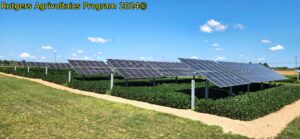
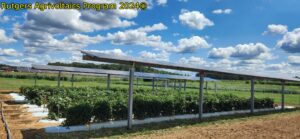
Specialty crops being grown in a double panel AV plot at the Rutgers Agricultural Research and Extension Center near Bridgeton, New Jersey.

An image of specialty crops being grown in a single AV panel plot at the Rutgers Agricultural Research and Extension Center near Bridgeton, New Jersey.


The agrivoltaics research at the Rutgers Agricultural Research and Extension Center (RAREC) near Bridgeton, New Jersey was designed to study the effects of agrivoltaics systems on the production of specialty and agronomic crops. This year eggplant, bell pepper, fresh-market tomato, and soybeans were grown under three different treatments: single-axis tracking array with one row of panels, single-axis tracking array with two rows of panels, and no panels (conventional production as a control) to determine the effects of the panels on crop yield and quality.

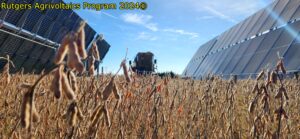
Soybeans were grown in two whole blocks at the Rutgers Agricultural Research and Extension Center near Bridgeton, NJ in 2024.

Soybeans being harvested between double AV panel arrays at the Rutgers Agricultural Research and Extension Center near Bridgton, New Jersey.


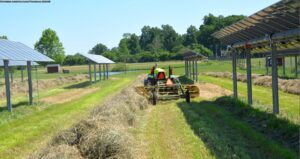
At the Clifford E. and Melda C. Snyder Research and Extension Farm in Pittstown, NJ the effects of single-axis tracking arrays with one row of panels on forage growth was studied to measure potential impacts on hay yield and quality. There were three cuts of the hay this season along with sampling for forage quality.

Hay being cut in mid-May at the Snyder Research and Extension Farm in northern New Jersey.

Cut hay being wind-rowed at the Snyder Research and Extension Farm in northern New Jersey.


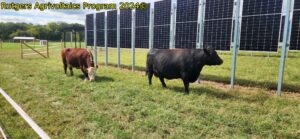
At the Rutgers SEBS Cook Campus Animal Farm in New Brunswick, New Jersey, which hosts equine and livestock facilities, research was done to study pasture forage production and animal grazing patterns in combination with vertical bifacial solar panels. In early fall, four gestational cows (led by Buttercup) were introduced to the AV array research pasture for the first time. The research pasture also includes shelter and drinking water for the animals.

Buttercup (on the right) leading the small herd into the field of vertical bifacial panels at the Cook Campus Animal Farm on the campus of Rutgers University in New Brunswick, NJ.

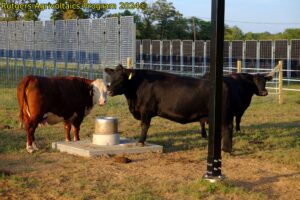
Buttercup and friends at the watering hole.

The ribbon cutting ceremony held on 30 Sep 2024 at the Cook Campus Animal Farm on the SEBS campus of Rutgers University celebrating the accomplishments Rutgers Agrivoltaics Program.


On 30 Sep., over 80 people attended the Rutgers Agrivoltaics Program ribbon cutting ceremony at the Rutgers Animal Farm in New Brunswick, NJ where State officials, University leaders, and invited guests applauded the research and outreach efforts of the Rutgers Agrivoltaics Program and discussed the potential impacts of agrivoltaics for both the agricultural and solar industries in New Jersey.

Results from all three Rutgers Agrivoltaics Program research sites will be presented at upcoming Extension meetings this winter and spring across New Jersey and the region.

UPCOMING PPRESENTATIONS

Dan Ward will be presenting at the New England Fruit and Vegetable Conference on 18 December 2024 in Manchester, New Hampshire.

Multiple RAP Team members will be presenting in the morning Agrivoltaics Session at the 2025 New Jersey Agricultural Convention and Trade Show in Atlantic City on 5 February at Harrah’s Resort.

More to be announced!

For more information on the Rutgers Agrivoltaics Program and more AV resources please visit the new RAP website by clicking here. Stakeholders interested in keeping up the what’s going on can now subscribe to the new website and have information send directly to their email account. Just go to our contact page and follow the instructions to subscribe! 

Articles and images can be used by Permission from the Rutgers RAP Team only – For Permission contact RAP at shawn.sorrels@rutgers.edu.