Archives for June 2021

Vegetable IPM Update 6/02/21

Sweet Corn

Attention sweet corn growers!  Please take a few moments to complete this survey.  Rutgers IPM personnel expect to participate in grant funded research guided by grower responses.  See the brief description below. Thank you for your help!

Corn Earworm Management in Sweet Corn Needs Assessment Survey

Dr. Kelly Hamby, Associate Professor/Extension Specialist with the Department of Entomology at University of Maryland, is leading a team of researchers, including Rutgers IPM staff, who have developed a survey to prioritize research and extension efforts for improving corn earworm management in sweet corn throughout the Northeast. We appreciate your participation in this survey and will use results to develop a grant proposal to try to get federal funding to address these needs.

Survey link: https://ume.qualtrics.com/jfe/form/SV_9vRh1xHnDp4KEaa

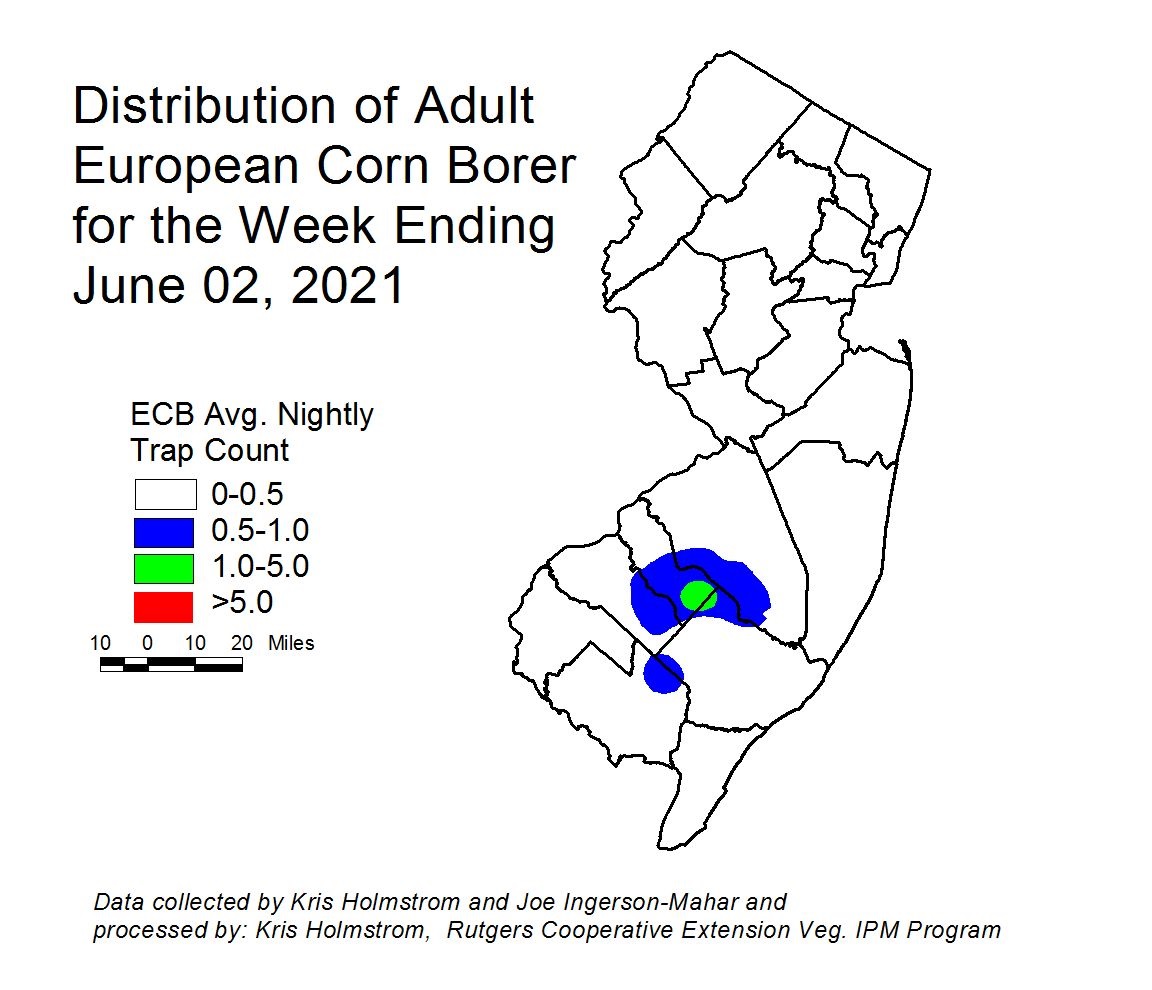
Low numbers of European corn borer (ECB) moths continue to be captured in parts of the state.  Cool temperatures over the past weekend have likely suppressed activity, and warmer weather in the upcoming week may trigger a modest rebound.  The highest adult activity is currently around the Atlantic-Camden County border (see map at right).  Whorl corn is the primary target for egg laying, and injury as high as 16% of plants infested has been found up to northern Monmouth County this week.  Feeding levels should rise over the next 3 weeks.
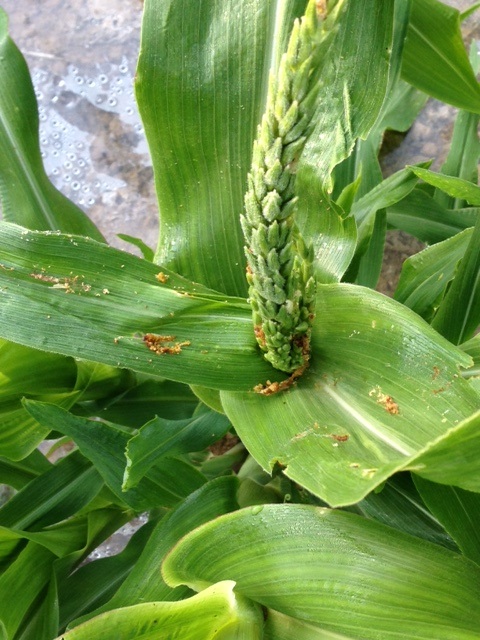
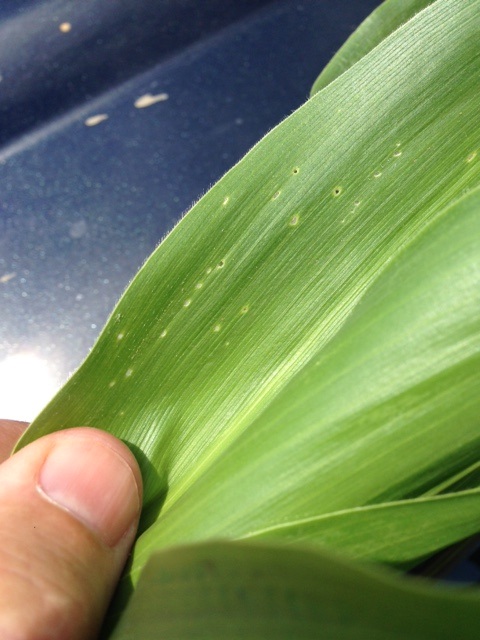
Look for the characteristic “shot-hole” type of feeding (photo below at right) and consider treating when infested plants exceed 12% in a 50 plant sample.  As plantings proceed to the pre-tassel stage, ECB larvae may be found in emerging tassels (see photo at left)It is a good idea to treat individual plantings as they move into the full tassel/first silk stage one time.  This eliminates any ECB larvae that have emerged with the tassels as they begin to move down the stalk to re-enter near developing ears.


Useful insecticides for this particular application include synthetic pyrethroids (IRAC Grp 3), spinosyns (including OMRI approved Entrust) IRAC Grp 5), and diamides such as Coragen or Vantacor (IRAC Grp 28) or materials such as Besiege which include the active ingredient in Coragen.  Synthetic pyrethroids alone should NOT be used for corn earworm (CEW) protection on silking corn.  Control with these materials is very inconsistent.
The highest nightly trap catches of ECB for the week ending 6/02/21 are as follows:

Elm   2 Denville   1 Pedricktown   1
Asbury   1 Medford   1 Sergeantsville   1
Clinton   1 Milford   1 Tabernacle   1
Dayton   1 New Egypt   1 Woodstown   1

[Read more…]

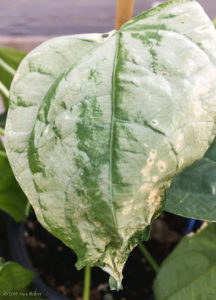
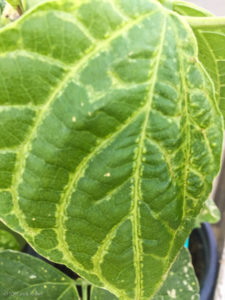
Basil downy mildew confirmed in southern New Jersey – ALERT 6/2/21

Basil downy mildew has been confirmed in a home owners garden in Atlantic County in southern New Jersey. This is the first report of BDM in the state and region this growing season and about three weeks earlier than last year. All basil growers are encouraged to scout their fields or greenhouses on a daily basis. [Read more…]

Understanding and controlling angular leaf spot in strawberries

Often considered a minor pathogen, angular leaf spot caused by the bacterium, Xanthomonas fragariae, can cause serious leaf and calyx infections ruining the marketability of fruit if left uncontrolled. [Read more…]

Recognizing cold injury

If the erratic, hot then wet weather wasn’t enough, temperatures have fluctuated the past few days with night time temperatures becoming much cooler in some parts of the state and region. With this comes the potential for cold injury on spring planted crops. Cold injury can take may different shapes on affected plants and developing fruit.

In some cases, symptoms may show up on the newest growth as a result of non-lethal injury to meristematic tissue, in pepper and tomato, new growth may be distorted with misshapen leaves. In some cases, new leaves may have a mottled, or mosaic look much like a plant infected with a mosaic virus. In these instances, plants will grow out of the problem.

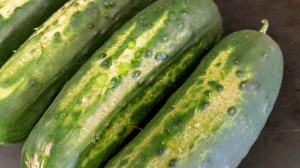
In cucumber, symptoms on maturing fruit appear as brownish-tan areas on the epidermis of fruit. The fruit will also show cracking as if it has a dry rot. The effects are physiological where areas of young developing fruit got chilled by the cold night time temperatures.

We have collected a few images below of cold injury from crops from this spring.

Cuke_cold injury

Cold injury on cucumber fruit. The initial damage was done a few weeks ago while the fruit was very young.


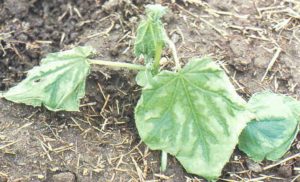
Cold injury on young cucumber plant

Cold injury on young cucumber plant (Photo: M. Casella)


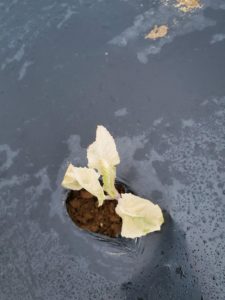
Cold injury on young cauliflower plant

Cold injury on young cauliflower plant (photo: K. Holmstrom)


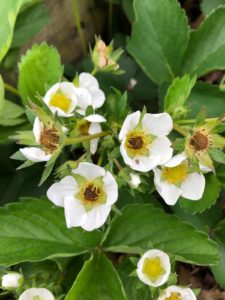
Frost damage in strawberry

Frost damage in strawberry (photo: T. Besancon)


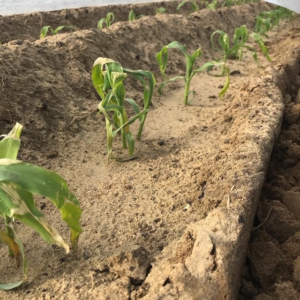
Cold injury on sweet corn

Cold injury on sweet corn under low tunnel. (photo: M. Casella)


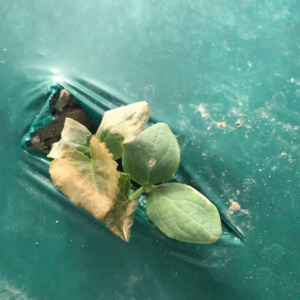
Cold injury on cucumber seedling

Cold injury on cucumber seedling (photo: M. Casella)


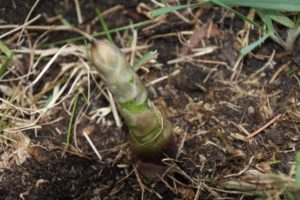
Cold injury in emerging asparagus

Cold injury in emerging asparagus spear (photo: Rick VanVranken)


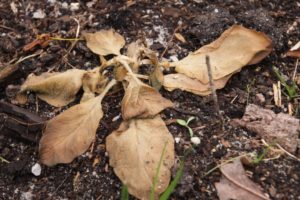
Freezing of young potato plant

Freezing of young potato plant (photo: Rick VanVranken)


Cold injury on snap bean

Cold injury on snap bean. (photo: Jack Rabin)

Freeze damage caused by ice crystal formation in veins of snap bean

Freeze damage caused by ice crystal formation in veins of snap bean (photo: Jack Rabin)

Nursery – Pest Scouting Guide for June, Boxwood blight advisory, survey requests

BOXWOOD BLIGHT

There is an immediate potential for boxwood blight June 4/5th throughout NJ.

Preventative / protective fungicide applications should be initiated and continued in high value crops

Boxwood Blight risk-model information, considerations, and links:

Boxwood Blight Risk Assessment as of 6/1/2021
Region Location CODE 1-Jun 2-Jun 3-Jun 4-Jun 5-Jun 6-Jun
Southern Upper Deerfield NJ50 Very Low  Very Low  Low  Infection Risk Infection Risk Low 
Central Howell / Freehold NJ10 Low  Very Low  Low  Infection Risk Infection Risk Low 
Northern High Point NJ59 Very Low  Very Low  Low  Infection Risk High Risk Low 
Please check your local boxwood blight risk here (click here and type in your area code – select closest station)


Wednesday 5/4/21 -PPA Post regarding boxwood blight activity (click here)

  • These advisories are general in nature and change rapidly so someone from your business should be using this risk model (CLICK HERE) daily if boxwood is important to your financial stability – In 30 seconds you can have a better idea of boxwood blight (and other pathogen) activity in your immediate area!
    • (click on the link – input area code – select closest weather station – check 7-14 prediction – click on graph / table) 


NURSERY PEST SCOUTING GUIDE – JUNE

Please download and print this pest scouting guide resource: (click on the link and then print)

To determine your local growing degree-days, please review this postObtaining your local growing degree-day information”

Projected GDD50 accumulation as of 6/1/2021
Region Location 1-Jun 1-Jul 1-Aug 1-Sep 1-Oct
Southern Upper Deerfield (NJ50) 590 1283 2125 2910 3456
Central Howell / Freehold (NJ10) 438 1078 1873 2607 3085
Northern High Point (NJ59) 353 837 1444 1999 2305
Forecast: NOAA NCEP Coupled Forecast System model version 2 (CFSv2) forecast system (3.5 months) (USPEST.ORG)


Nursery Pest Scouting – Growing Degree-day Ranges (500-1300 GDD50)
CROP TYPE Common Name Scientific Name GDD Min (50F) GDD Max (95F) Reference Developmental / Target Stage
Many Spotted Lantern Fly Lycorma delicatula 250 1000 PA Dept. Ag 1st-4th Instar (nymphs) – control target
Conifer European pine shoot moth Rhyacionia buoliana 480 710 5 Larvae Treatment
Malus, Prunus, many Peach Tree Borer Synanthedon sp. 500 600 RU Adults – emerge (1st treatment both types)
Rhododendron Rhododendron Borer Synanthedon rhododendri 509 696 RU Adults emerge
Many Redheaded flea beetle Systena frontalis 517 1028 Unv. Del Adults – feeding / laying eggs
Many Cottony camellia / taxus scale Pulvinaria floccifera 520 6 Crawlers (1st generation)
Birch Birch Leafminer Fenusa pusilla 530 700 RU Larvae (2nd generation)
Oak Oak blotch leafminers Cameraria spp. ; Tisheria spp. 533 912 5 Typical treatment window
Maple Greenstriped mapleworm Dryocampa rubicunda 533 1645 5 Control target
Conifer Arborvitae Leafminer Argyresthia thuiella 533 700 RU Adults (egg laying) – larvae treatments
Euonymus Euonymus Scale Unaspis euonymil 533 820 RU Crawlers (1st generation)
Conifer Balsam gall midge Paradiplosis tumifex 550 700 4 Galls apparent
Conifer Juniper scale Carulaspis juniperi 550 700 7 Egg hatch
Malus, Prunus, many Greater peach tree borer Synanthedon exitiosa 575 710 4 Adult emergence
Conifer Cryptomeria scale Aspidiotus cryptomeriae 600 800 3 First crawler emergence
Conifer Cooley spruce gall adelgid Adelges cooleyi 600 1000 7 Nymphs active – Douglas fir (control target)
Conifer Bagworm Thyridopteryx ephemeraeformis 600 900 RU Larvae (early instars) – ONLY CONTROL WINDOW
Conifer Cryptomeria scale Aspidiotus cryptomeriae 600 800 RU Crawlers (1st generation)
Elm Elm leaf beetle Xanthogaleruca luteola 600 1300 7 Larvae (2nd generation)
Conifer Spruce budscale Physokermes hemicryphus 700 1150 4 Crawlers (1st generation)
Many White prunicola scale Psedaulacaspis prunicola 707 1151 RU Crawlers (1st generation)
Conifer Juniper scale Carulaspis juniperi 707 1260 RU Crawlers (1st generation)
Many Calico scale Eulecanium cerasorum 714 6 Crawlers (1st generation)
Conifer Striped pine scale Toumeyella pini 750 800 4 Egg hatch
Turf Hairy cinch bug Blissus leucopterus 765 870 RU 1st generation (50% – 2nd instar)
Oak, hickory, birch, many Oak leacanium scale Parthenolecanium quercifex 789 6 Crawlers (1st generation)
Rhododendron Azalea Lacebug Stephanitis pyrioides 802 1029 RU Eggs / Nymphs 3rd Generation
Many, shadetrees Cottony maple scale Pulvinaria innumerabilis 802 1265 RU Crawlers (1st generation) – control target
Oaks Oak spider mites Oligonychus bicolor 802 1265 RU All Stages
Many Roundheaded appletree borer Saperda candida 802 1129 RU Adults
Oaks Golden oak scale Asterolecanium variolosum 802 1266 5 Egg hatch
Acer Cottony maple leaf scale Pulvinaria acericola 802 1265 5 Crawlers (1st generation)
Maples Japanese maple scale Lopholeucaspis japonica 829 6 Crawlers (1st generation)
Elm European elm scale Gossyparia spuria 831 1388 6,2 Crawlers (1st generation)
Mimosa, Honeylocust Mimosa webworm Homadaula anisocentra 880 RU Larvae (1st generation)
Turf Bluegrass billbug Sphenophorus parvulus 884 1003 RU Larvae 20%
Turf N. Masked chafer Cyclocephala borealis 898 905 RU 1st adults
Honeylocust Honeylocust mite Eotetranychus multidigituli 912 1514 2 All Stages
Honeylocust Honeylocust spider mite Platytetranychus multidigituli 912 1514 5 Typical treatment window
Shade trees European fruit lecanium Parthenolecanium corni 932 1645 6,RU Crawlers  – control target
Many Japanese beetle Popillia japonica 950 2150 7 Adult emergence and feeding
Conifer Pine tortoise scale Toumeyella parvicornis 1000 1200 4 Egg hatch ends, last of crawlers
Ash Emerald ash borer Agrilus planipennis 1000 1200 4 Peak adult activity
Many Redheaded flea beetle Systena frontalis 1028 1570 Unv. Del 2nd generation of un-hatched eggs
Yew, many conifers Fletcher Scale (Yew) Parthenolecanium fletcheri 1029 1388 RU Crawlers (1st generation) – control target
Locust Locust leafminer Odontota dorsalis 1029 1388 RU Adults
Juglandaceae Walnut Caterpillar Datana integerrima 1029 1514 2 Larvae Treatment
Many Indian wax scale Ceroplastes ceriferus 1145 6 Crawlers (1st generation)
Many Oriental Beetle Anomala orientalis 1147 6 Adult emergence
Euonymus Euonymus Scale Unaspis euonymil 1150 1388 5 2nd generation targeted treatments
Dogwood Dogwood sawfly Macremphytus tarsatus 1151 1500 RU Larvae Treatment
Tulip Tuliptree aphid Illinoia liriodendri 1151 1514 RU Nymphs / adults
Conifer Northern pine weevil Pissodes nemorensis 1200 1400 4 2nd generation adults active
Conifer Pine root collar weevil Hylobius radicis 1200 1400 4 2nd generation adults active
Conifer White pine weevil Pissodes strobi 1200 1400 4 2nd generation adults active
Boxwood Boxwood leafminer Monoarthropalpus flavus 1200 1400 5 Larvae Treatment
Conifer Pine Needle Scale Chionaspis pinifoliae 1250 1350 7 Crawlers (2nd generation)
Rhododendron Azalea whitefly Pealius azaleae 1250 1500 5 Adults/nymphs
Many Lacebugs ( on hawthorn) Corythucha cydoniae 1266 1544 RU Nymphs / adults
Many Leafhoppers Species within Cicadellidae 1266 1544 RU Nymphs / adults
Many Fall webworm Hyphantria cunea 1266 1795 2 Caterpillars present – larvae treatment
Privet Privet rust mite Aculus ligustri 1266 1515 5 Second typical treatment window
Many Two spotted spider mite Tetranychus urticae 1300 2000 RU Nymphs / adults
Conifer Cooley spruce gall adelgid Adelges cooleyi 600 1000 7 Nymphs active – Douglas fir (control target)
RU Rutgers Cooperative Extension – Landscape IPM Notes
2 http://ccetompkins.org/resources/using-growing-degree-days-for-insect-management
3 https://extension.psu.edu/ipm-basics-for-christmas-trees#section-2
4 https://www.canr.msu.edu/ipm/agriculture/christmas_trees/gdd_of_conifer_insects
5 https://www.agriculture.nh.gov/publications-forms/documents/landscape-pests.pdf
6 https://extension.umd.edu/ipm/pest-predictive-calendar-landscapenursery
7 https://www.canr.msu.edu/ipm/agriculture/christmas_trees/gdd_of_landscape_insects
Unv. Del. Coorespondance with Dr. Kunkel (University of Delaware)
Compiled 6-1-2021 – Timothy J. Waller, Ph.D. – Rutgers Cooperative Extension, Cumberland County Nursery Crops – twaller@njaes.rutgers.edu


SURVEY REQUESTS

Phytophthora sampling project – grower collaborators wanted 

Please answer a few questions if you would like to be included in a statewide Phytophthora in Conifer Nurseries sampling project 

Redheaded Flea beetle NJ specific survey: 

Please fill out this brief survey if you are experiencing damages due to Redheaded flea beetle (RHFB)

Contact – Timothy J. Waller – twaller@njaes.rutgers.edu for more information

Controlling basil downy mildew in the field

For over a decade, basil downy mildew (BDM) has caused significant losses in basil grown in organic and conventional field and greenhouse production across the United States. At the time of its introduction, there were very few fungicides labeled for its control making it nearly impossible to grow a successful crop in many areas of the country. [Read more…]