Archives for May 2021

Reminder – Virtual DOH/DOL/NJDA “Ag Stakeholder Engagement Call” 2pm, May 25

NJ Secretary of Agriculture Doug Fisher has shared this attached letter inviting the agricultural community to join a virtual “Ag Stakeholder Engagement Call” on May 25 at 2:00 p.m. Hosted by the Departments of Health, Labor and Agriculture, the Commissioners and Secretary will discuss NJ’s response to COVID-19, provide updates on mitigation efforts and guidance, provide science-based information on the COVID vaccines, and answer questions.

This is a virtual Microsoft Teams meeting

Join on your computer or mobile app:  Click here to join the meeting

Or call in (audio only):  +1 856-338-7074,,487903588# United States, Camden

Phone Conference ID: 487 903 588#

Find a local number | Reset PINLearn More | Meeting options

June 16 Webinar – Creating Healthy Resilient Food Systems in NJ Through Food Policy Councils

The COVID-19 pandemic has people around the world, and right here in NJ, talking about the Food System, and in many, concerned about what they perceive to be broken. Agriculture often considers itself the food system, but in considering the complexity of today’s farm-to-fork movement of food, agricultural production has become a small, albeit indispensable (unless you consider the movement to cell-based culture of food materials), cog on the wheel.

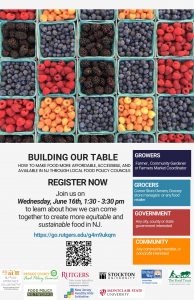
Building our Table WebinarFood Policy Councils are forming around the country and there are at least two or three here in NJ. The NJ Food Democracy Collaborative is one focusing on the shore counties and much of southern NJ. In collaboration with Rutgers NJAES Cooperative Extension and several other co-sponsors, they are hosting this webinar on June 16 to bring national experts in the roles and activities of food policy councils to discuss “Building our table: Making food more Affordable, Accessible, and Available in NJ through Local Food Policy Councils.”

They are inviting anyone involved in the food system, from production to processing, distribution, preparation and consumption (that’s everyone) to learn more about getting involved to make a sustainable food system capable of feeding our residents, visitors and beyond the Garden State. Register for the webinar at

https://go.rutgers.edu/g4m9ukqm

or by clicking on the poster.

Eastern Viticulture and Enology Forum – Town Hall

Grower and Wine Maker Town Hall: Questions from the Field and Cellar

Rutgers/NJAES New Jersey Center for Wine Research and Education (NJCWRE) has collaborated with the Eastern Viticulture and Enology Forum. Regional viticulture and enology specialists will present a Grower and Winemaker Town Hall virtual meeting series to give seasonal updates and answer pre-submitted and live questions from grape and wine industry stakeholders.   [Read more…]

Identifying and controlling leaf mold in high tunnel & greenhouse tomato production

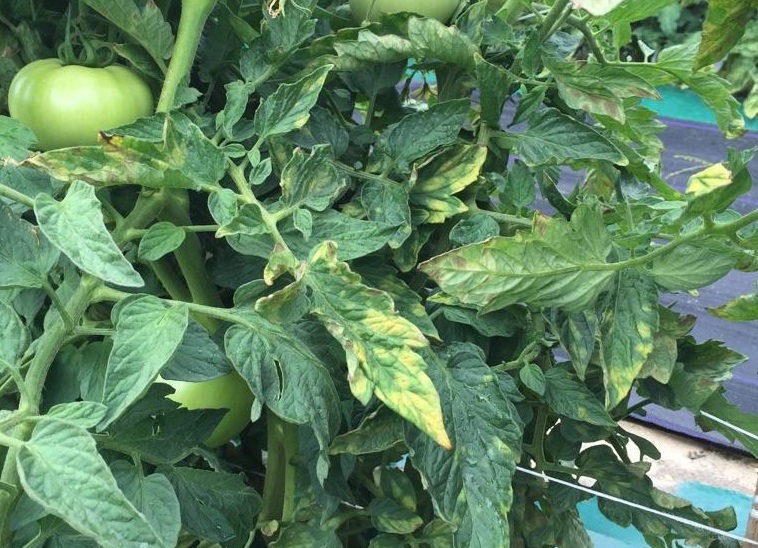
Leaf mold occasionally appears in high tunnel or greenhouse tomato production in New Jersey. However, under ideal conditions the disease will develop in field-grown crops. The fungus will cause infection under prolonged periods leaf wetness and when relative humidity remains above 85%. If relative humidity is below 85% the disease will not occur. Therefore, the proper venting of high tunnels and greenhouses on a regular basis is important. The pathogen can survive (overwinter) as a saprophyte on crop debris or as sclerotia in the soil. Conidia (spores) of the fungus can also survive up to one year in the soil.

Symptoms of leaf mold on infected tomato plant. Note the bright yellow leaves and the olive-green spores developing on the undersides of leaves.

Symptoms of leaf mold on infected tomato plant. Note bright yellow leaves and olive-green spores developing on undersides of leaves.

[Read more…]

Preparing for cucurbit downy mildew

In 2004, cucurbit downy mildew re-emerged in the US with a vengeance causing significant losses in cucurbit production. In most years prior to this, concern for CDM control was minimal, since the pathogen arrived late in the growing season (in more northern regions), or the pathogen caused little damage, or never appeared. After 2004, with significant losses at stake, and with very few fungicides labeled for its proper control, CDM became a serious threat to cucurbit production. Importantly, at the time, cucumber varieties with very good levels of CDM resistance were no longer resistant, suggesting a major shift in the pathogen population. Research done over the past 15 years has led to a better understanding of the pathogen. Recent research has determined that the CDM falls into two separate clades: Clade I and Clade II. [Read more…]

Quick reviews of fungicide chemistries, FRAC groups, and fungicide resistance management

For a quick review on fungicides, FRAC groups, and managing fungicide resistance development please click on the links below.

Using tank mixes and fungicide rotations and information on FRAC group 4, FRAC group 7, and FRAC group 3 and FRAC group 11 fungicides.