Archives for May 2021

Keep Up the Customer Communication!

Now that the dates have been set for the lifting of the face covering requirements indoors and social distancing requirements indoors and out (May 28th) farms have decisions to make. What will you require of your customers while on your property? How will you handle customers who expect more or less when it comes to COVID protections?  The CDC recommends that those not fully vaccinated should continue to socially distance themselves from others and wear a mask, but these are no longer requirements under state Executive Orders.  Here are some suggestions on how to prepare your employees and customers for their experiences on your farm this season.

1. Communicate your farm policies regarding COVID protections clearly online and on the farm.
2. If you choose to no longer require masks indoors at the farm be understanding of customers who may choose to wear a mask.  “Mask-free” environments are not enforceable, those who wish to wear masks must be allowed to do so.
3. When possible continue to provide order ahead and pick-up of items sold at your farm. This allows those who are unvaccinated or wary of those who are unmasked to still be able to shop at your farm.
4. Prepare your staff on how to handle disgruntled customers. Who is the right person at the farm to handle these situations? Have a plan on who and how you will respond to these situations.
5. Realize that you will not make everyone happy. The best you can do is decide what your masking and social distancing policies are, stick to them, and communicate the heck out of them.

Important dates:
May 28th – Indoor mask mandate lifted. Businesses may require customers to wear masks indoors, but it is no longer mandated. 6’ social distancing required indoors lifted. Businesses may still enforce 6’ of social distancing.  This does not apply to summer camp settings with children.

June 4th – Indoor gathering limits lifted.
Letter from Secretary Fisher Regarding Governor’s Executive Order #242 Lifting Major COVID-19 Restrictions

NJ Governor Murphy signed Executive Order #242 lifting major COVID-19 restrections and moving forward with the state’s most significant reopening steps to date. Indoor mask mandates and 6ft social distancing requirements will be lifted this Friday, May 28, and indoor gathering/capacity limits will be lifted on June 4. Secretary of Agriculture Douglas Fisher has provided a summary of the changes that may impact agriculture operations. The full text of his letter is attached here.

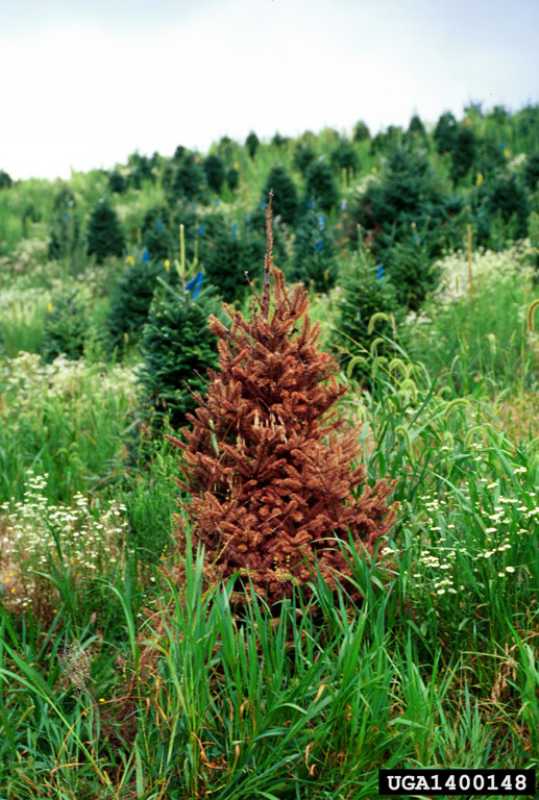
Do you have Phytophthora at your conifer nursery / Christmas tree farm? We are still looking for a few more participants in a statewide study – aimed at better RECS.

Tim Waller (Cumberland Co.) and Bill Errickson (Monmouth Co.) of Rutgers Cooperative Extension are looking for 30 conifer producers to collaborate in a statewide Phytophthora sampling project, as part of a Specialty Crop Block Grant. This study will focus on identifying the species of Phytophthora limiting conifer production in New Jersey.

  • If your operation is selected, the agents will schedule one to three visits this growing season to collect samples from roots, bark, soil, irrigation systems, and will perform soil testing (Year 1).
  • During years 2 and 3, we will be performing chemical, biological, and cultural disease management trials in addition to conifer variety trials, at Rutgers-NJAES experiment stations. The aim is to generate local data – using local isolates in order to develop a more wholistic set of recommendations when targeting this disease in our NJ nurseries.

The agents also look forward to developing stronger relationships throughout New Jersey in the post-COVID19 era

This project is open to nurseries and Christmas tree farms producing conifers in NJ 

If you are interested in this project – please respond via this brief survey (click here) 

Please print and share this PDF survey with anyone not online (click here)


Please contact Tim Waller – twaller@njaes.rutgers.edu – (856-451-2800) – for more information

Identifying and controlling botrytis in high tunnel and greenhouse tomato production

Botrytis, or gray mold, caused by the fungus, Botrytis cinerea, can cause significant losses in high tunnel and greenhouse tomato production if not controlled properly. The pathogen can rapidly spread during periods when structures are closed and when relative humidity remains high for long periods of time. This often occurs when outside weather remains cool and damp while heating is needed. Gray mold is favored by temperatures from 64° to 75°F and requires only high humidity (not leaf wetness) to become established. The pathogen has a large host range and once established in an enclosed structure it can be very difficult to control (UMASS). The fungus can survive/overwinter as mycelia or sclerotia in plant debris and in organic soil matter (NCSU).

[Read more…]

Identifying white mold in tomato production

White mold, or timber rot, is caused by the soil-borne fungal pathogen, Sclerotinia sclerotiorum.

High tunnel tomato plant

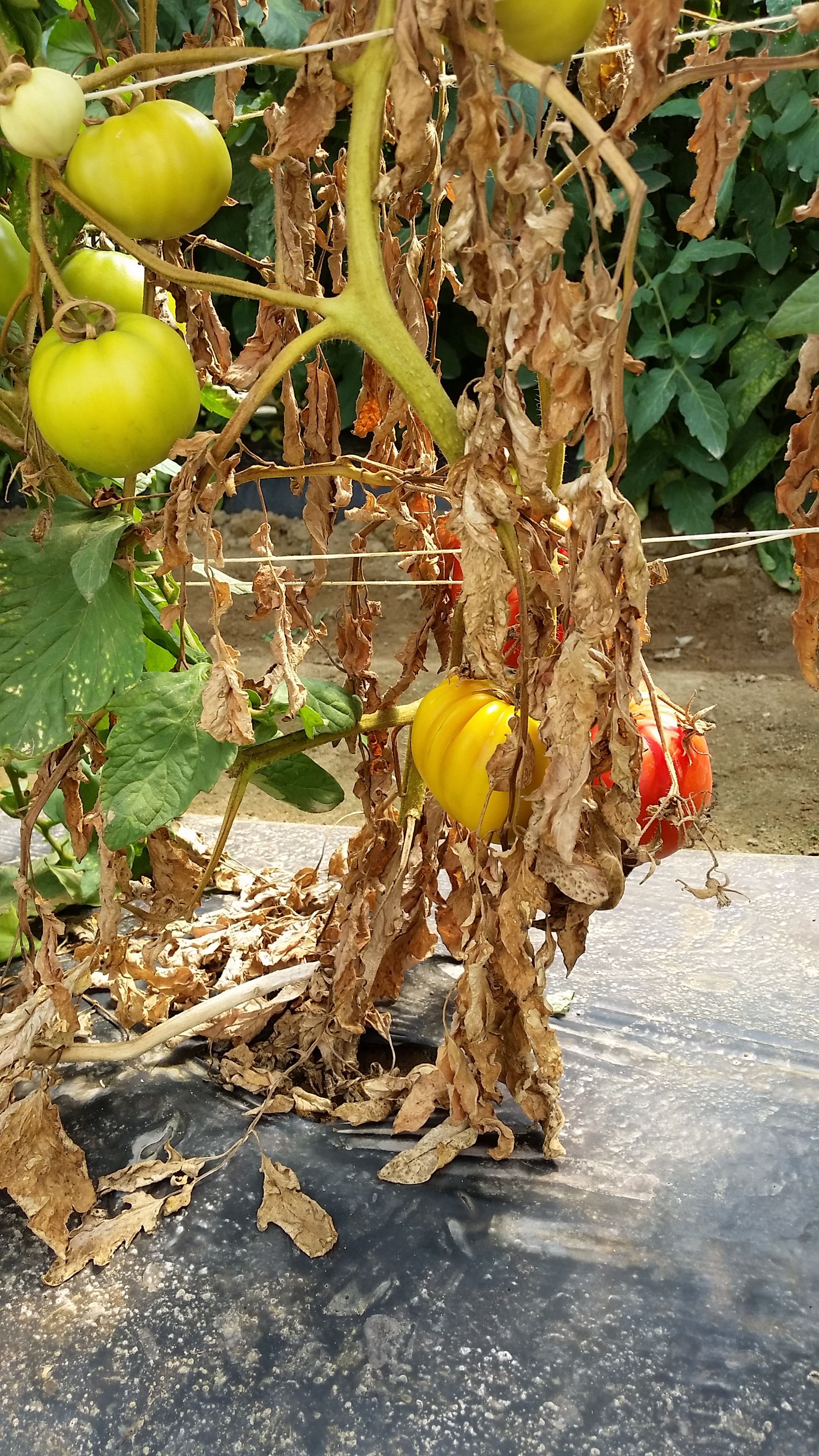
High tunnel tomato plant with main stem infected by white mold.

The photo on right shows a high tunnel tomato plant with main stem infected by white mold. Over time the entire plant will slowly collapse looking similar to a wilt or root rot pathogen as the water supply is cut off to the plant.

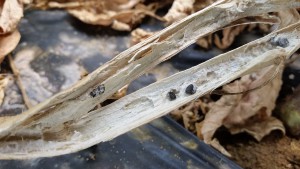
White mold is common and once introduced into a field or high tunnel it can very difficult to control. The pathogen produces black sclerotia on the surface and inside infected stems. Sclerotia, if they make their way back into the soil, can survive for years causing significant problems.

Infected stems will turn a light brown color and dry up becoming brittle. If the main stem is infected the entire plant will collapse looking like a wilt or root rot issue.

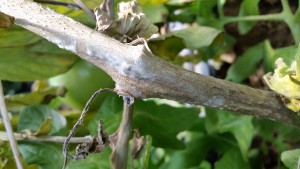
Under hot, humid conditions white fungal growth will develop on the surface of the stems and in some cases sclerotia will develop on the outside of the stem. Breaking open the stem will reveal numerous black sclerotia.

All infected plants and or plant material need to be removed immediately and disposed of properly. Preventative protectant fungicide programs beginning at flowering will help control white mold. Cool, wet weather and poor air circulation favors disease development.

There are a number of control options for conventional and organic growers listed in Table E-11 in the 2022/2023 mid-Atlantic Commercial Vegetable Production Recommendations Guide.

Tomato stem infected by white hold. Note the fungal growth on the surface of the stem.

Tomato stem infected by white hold. Note the fungal growth on the surface of the stem.

White mold of tomato. Note the black sclerotia developing inside the brittle stems.

White mold of tomato. Note the black sclerotia developing inside the brittle stems.

USDA Spanish Language Resources Now Available for Organic Stakeholders

The USDA has translated its organic regulations and resources into Spanish.  Available online are:

USDA Organic Regulations
Organic Foods Production Act
NOP Handbook
Organic Integrity in the Supply Chain
Training materials
Video resources on certified organic FAQ, preventive practices, and recordkeeping
Tip/Fact sheets on topics ranging from soil assessments, composting, manures, orchards, livestock, dairy, meat, and others