Archives for May 2020

More Reasons and Some Strong Precautions When Adding Soil Around Transplants on Plastic Mulch

There are a couple of additional reasons you might consider placing soil around the transplant hole when using plastic mulches, but take note – this practice should come with a significant warning label!
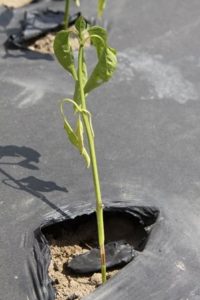
pepper transplant on plastic mulch with stem burn

This pepper seedling is wilting because the stem is severely burned where it touched the hot plastic mulch.

In addition to reducing heat venting and water pooling that Michelle described in her previous post, one of the first reasons this practice gained popularity among vegetable growers was to prevent the plastic mulch burns on the stems of transplants, especially tomatoes and peppers. On bright sunny days during the transplanting season from late April through June, the temperature of unshaded, black plastic mulch will get hot enough to cause a burn on the stem if touching the transplant. Coupled with wind whipping and rapid transpiration, stem burn can kill a new transplant outright. If the plant does survive, there can be enough damage that later in the season the stem is too weak to support the top growth and the plant topples over.

For that reason, the current Mid-Atlantic Commercial Vegetable Production Recommendations, especially for peppers, is to, “Use opaque, white plastic when planting in the summer [and even late spring] for fall harvest.”

Warning – consider these factors in selecting soil to put around transplants on plastic mulch:

Many growers have learned in the school of hard knocks that this practice can cause some problems as serious as those they were trying to prevent. By trial and error, most have learned that the best soil to put around transplant holes is clean, washed sand from a site other than the field where it is applied, or field soil that has been fumigated the same as the mulched beds.

Why?

  1. If you fumigate or apply fungicides to the beds to prevent Phytophthora, nematodes and other soil born diseases, putting untreated soil from between the beds puts innoculum right at the base of the susceptible new transplant, defeating the purpose of the fumigation, and maybe making the situation worse because there are no competing beneficial organisms to slow the development of those pathogens.
  2. Untreated soil from between beds will also contain weed seeds that won’t be controlled by pre-plant herbicides applied under the plastic mulch.
  3. To make matters worse, even if the soil between the beds was fumigated, if an herbicide was applied before transplanting, concentrating those herbicides at the base of a transplant may not be labeled for that use and likely will be toxic to the transplant.

Dr. Thierry Besancon, Rutgers Extension Weed Specialist for Specialty Crops, identified many herbicides labeled for use on bare soil between plastic beds that he would consider potentially dangerous to the transplants if soil containing these compounds would be added above the planting hole:

  • Fomesafen (Reflex): labeled PRE for row middles and under plastic on some crops. Unfortunately, it has also POST activity..
  • Pendimethalin (Prowl): labeled ONLY for row middle applications in plasticulture
  • Trifluralin (Treflan): labeled ONLY for row middle applications in plasticulture
  • Halosulfuron (Sandea): labeled for row middles only. Has both PRE and POST activity which could result in severe crop injury if the herbicide get in contact with the crop.
  • Clomazone (Command, Strategy): even if it’s labeled for under plastic and row middles PRE application in some crops, be extremely careful with this herbicide that cannot be applied over emerged plants.
  • Metribuzin: only labeled for row middles application in plasticulture – potential risk of injury if soil containing it is used around the hole because it has POST activity
  • Rimsulfuron (Matrix): labeled only for row middles with both PRE and POST activity on broadleaf species.
  • Terbacil (Sinbar): used PRE under plastic or in row middles, but has POST activity and should never be applied over the crop.
  • Ethalfluralin (Curbit): labeled ONLY for row middle applications in plasticulture

Other PRE herbicides such as bensulide (Prefar), napropamide (Devrinol) or s-metolachlor (Dual Magnum) should not cause damage but using soil that has been treated with these products when adding soil around the transplant holes is discouraged as no tests have ever been conducted to make sure this is really safe, essentially because these herbicides are not supposed to be used this way.

Dr. Besancon says, “Actually, the only herbicides I would really feel confident about are the graminicides (Poast, Select) and paraquat: graminicides are only targeting grasses and paraquat will tied up to Organic Matter particles (virtually inactive in the soil).

He also warns that this technique, if using soil from between the mulched beds, disturbs the uniform herbicide distribution in the row middles by creating gaps in the coverage… herbicide-free spaces where weeds will grow! Not disturbing the soil is essential for maintaining the efficacy of PRE herbicides.

Placing soil around the base of new transplants on plastic mulch can protect tender plants from being damaged by heat, water and the plastic itself, saving time and money by reducing the need to replace plants later. Using the right soil for the job will make sure you don’t lose those savings by creating new problems!

We R Here When You Need Us

#rcehere4u #njaeshere4u #weRhere4u

Fruit IPM for 5/14/20

Peach:

Plum Curculio (PC): PC adults are active and will damage fruit if not controlled. PC is a key pest to control during the first few weeks after petal fall. Imidan, Avaunt, Actara and Belay are very effective. However, try to delay the use of Actara and Belay for when brown marmorated stink bugs (BMSB) are more of an issue.

[Read more…]

IPM Update 5/13/20

Sweet Corn

IPM Program personnel have re-established the black light trap network in New Jersey.  With continued below normal temperatures, no corn earworm (CEW) or European corn borer (ECB) moths have been captured.  As numbers increase, look for population maps of ECB, CEW, brown marmorated stink bug (BMSB) and CEW catches from pheromone traps in this weekly publication.  The resulting full-state maps will include interpretive information.

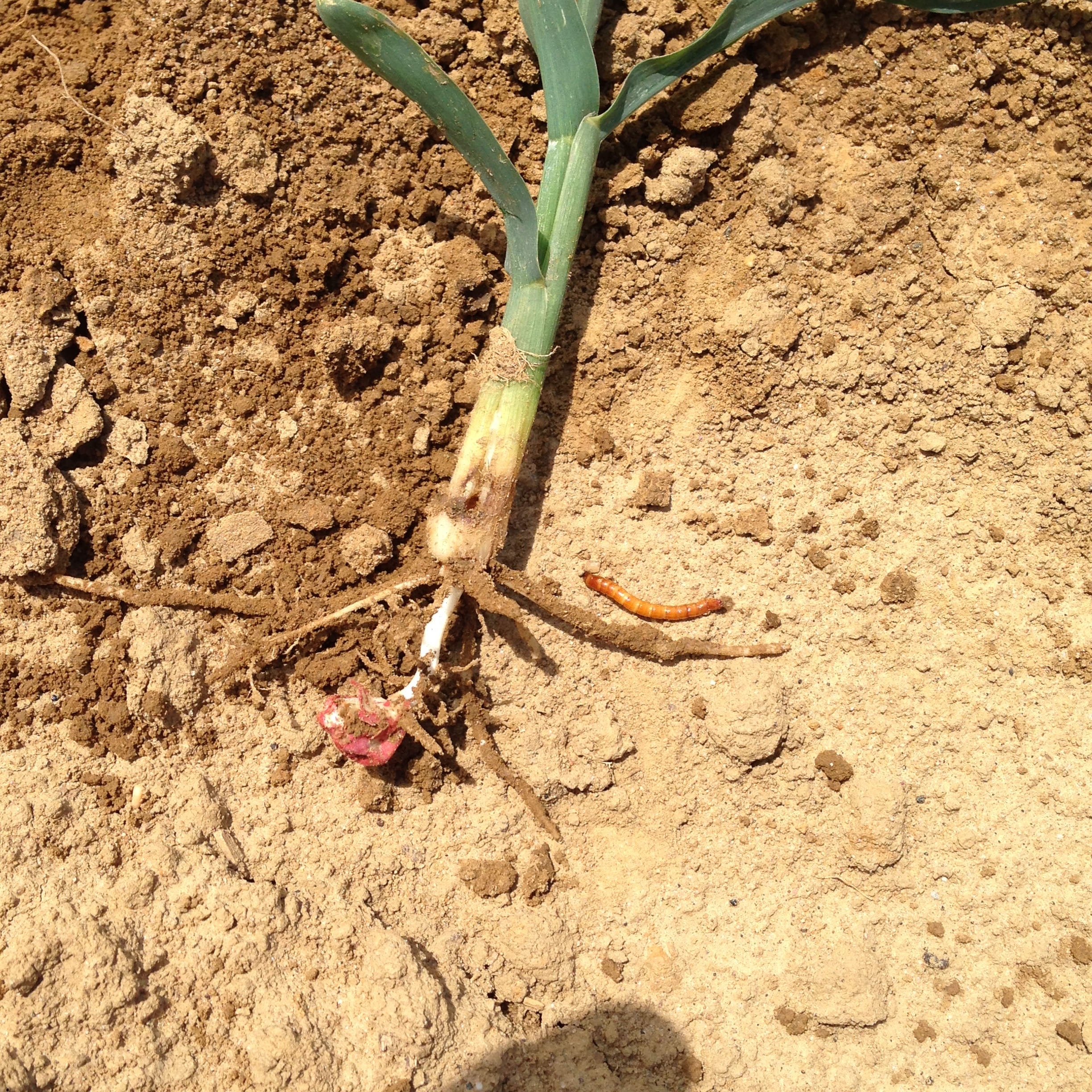
Sweet corn rootWith cold, damp conditions dramatically slowing down the growth of seedling corn, wire worms (see photo at left) have the potential to be more of a nuisance than usual.  While we don’t often see this problem in sweet corn, it does occasionally happen when wire worms are present and the corn cannot grow quickly enough to become less susceptible to injury.  Look for clusters of seedlings that exhibit wilted inner leaves.  Wire worms often are discovered by digging up these affected seedlings.  The incidence of this damage may be minor, but if growers determine that a field must be replanted, it may be necessary to include an in-furrow soil insecticide targeting this pest.

[Read more…]

USDA Urges Farmers to Take Steps Now to Prepare for Coronavirus Assistance

Local USDA Farm Service Agencies asked to have the following information shared. These may be details that will be discussed in the informational webinar scheduled for Thurs, May 14 at 1pm.

In April, USDA announced the Coronavirus Food Assistance Program (CFAP). CFAP will provide direct support based on losses for agriculture producers where prices and market supply chains have been significantly impacted and will assist eligible producers facing additional adjustment and marketing costs resulting from lost demand and short-term oversupply for the 2020 marketing year caused by COVID-19.

CFAP will provide assistance to most farms that have experienced at least a five percent loss and will be available to farms regardless of size. We are still working on the final details of the actual payment rates and those details will be determined and included as part of the rulemaking process. Once the rule making process is complete, the application period will be open and subject to the eligibility and payment limit criteria described in the rule.

As part of applying for the program, you’ll need to contact the Farm Service Agency county office to schedule an appointment. Your local FSA staff will work with you to apply for the program, and through forms asking for this type of information:

  • Contact
  • Personal, including your Tax Identification Number
  • Farming operating structure
  • Adjusted Gross Income to ensure eligibility
  • Direct deposit to enable payment

Please do not send any personal information to USDA without first initiating contact through a phone call. We take your privacy and security of your information very seriously.

If you are an existing customer, this information is likely on file at your local Service Center.

What Can You Do Now?

While the application process has not started, you can start gathering/understanding your farm’s recent sales and inventory.

FSA has streamlined the signup process to not require an acreage report at the time of application and a USDA farm number may not be immediately needed.

How Will USDA Accept Applications?

USDA Service Centers are open for business by phone appointment only. Once the application period opens, please call your FSA county office to schedule an appointment.

Our staff is working with our agricultural producers by phone and using email, fax, mail, and online tools like Box to accept applications.

Information on CFAP can be found at farmers.gov/CFAP.

Questions?
Please contact your local FSA Office.

USDA Webinar – Applying for Coronavirus Food Assistance Program Direct Payments

1 p.m. ET, Thursday, May 14, 2020

for farmers, ranchers and other producers interested in applying for direct payments

Register in Advance

Agricultural Marketing Service header

The U.S. Department of Agriculture (USDA) Agricultural Marketing Service (AMS) and Farm Service Agency (FSA) will host a webinar on Thursday, May 14, 2020, at 1 p.m. ET, for farmers, ranchers and other producers interested in applying for direct payments through the Coronavirus Food Assistance Program (CFAP).

As part of President Trump and Secretary Perdue’s April 17 announcement of a $19 billion Coronavirus Farm Assistance Program, USDA will provide $16 billion in direct support based on losses for agricultural producers where prices and market supply chains have been impacted. Also, USDA will assist eligible producers facing additional adjustment and marketing costs resulting from lost demand and short-term oversupply for the 2020 marketing year caused by COVID-19.

USDA is hosting this webinar to share what information is needed to apply for direct payments through CFAP, once the application period begins.The webinar is an opportunity for producers to learn about the general application process and required documentation prior to the official beginning of signup. Producers who are new to participating in FSA programs are especially encouraged to join the webinar.

Producers interested in participating may register in advance.

Register in Advance

After registering, you will receive a confirmation email containing information about joining the webinar. Participants are encouraged to submit questions through the Q&A box or by emailing CFAP.webinars@usda.gov. While questions will not be answered live during the webinar, they will be posted at farmers.gov/CFAP along with a recording of the webinar and other CFAP information. More details about CFAP direct payments will be announced soon.

Reasons to Add Soil Around the Transplant/Planting Hole on Plastic Mulch

Plastic mulch has been widely adopted by vegetable growers everywhere. The benefits of plastic mulch and raised beds have proven to improve crop quality and yields.

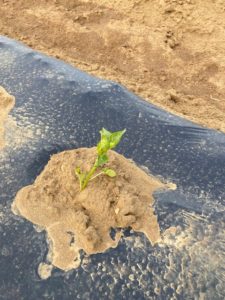
One practice some growers use, just after transplanting into plastic mulch, is to have workers place a small shovel full of soil around the Sapling growing in mulchbase of the plant and enough to seal the hole around the plant. This works best for transplants with tall stems – tomatoes, peppers, eggplants and cole crops.
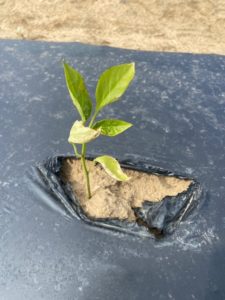
One caution before using this beneficial cultural practice, is to understand the implications of herbicides applied between rows. If a herbicide was applied in row middles that is harmful to the crop planted into the plastic mulch, the transplant could be damaged, stunted or die. Read the herbicide label before using row middle soil to fill in the planting hole. If the row middle soil is safe to apply, then this practice is recommended.

Why is the tedious, time-consuming and laborious task so important?

There are a few reasons.

1. Placing soil around the transplant and planting hole will prevent water from puddling around the plant when significant rainfalls occur. Excessive puddling around the transplant can induce root and crown disease infections.

2. The extra soil will provide support and stability for the plant until roots can anchor the plant in the ground and the plants can be stakedSapling growing in mulch and tied.

3. By adding soil to seal-over the plastic mulch hole, the seal will prevent “venting” of hot air. This is especially important when plants are young, acclimating to outdoor weather and when hot and sunny days occur shortly after transplanting.

All reasons listed above will be important this week, as the weather conditions for Thursday call for rain in New Jersey and then flowed by temperatures in the 80s. Soil temperatures will rise and more critical, air temperatures under plastic mulch will be much higher than 80 degrees. The hot air venting on young, tender transplants will cause stress and can possibly lead to transplant death.

For these reasons, it is important to fill in and seal those transplant holes.