Archives for November 2019

Hackettstown Livestock Auction Results for November 11, 2019

This auction sells: lambs, sheep, goats, calves, beef cattle, pigs, rabbits, and all types of heavy fowl. Auctions are held every Tuesday with the first sale beginning at 10:30 am and ending with the last sale at 5:30 pm. Hay, straw, grain, and firewood are also for sale.

Hackettstown Livestock Auction

Farm Fresh Eggs available for purchase by the case (30 doz.) or by the flat (2&1/2 doz.) in the main office Tuesday, Wednesday & Thursday. Also available some Monday’s and Friday’s but please call office first (908)-852-0444.

Click on link for November 11, 2019 sale results:
Hackettstown 11-19-19


Considerations for Fall Weed Control in Vineyards

Fall or early winter is the best time to consider the application of a residual herbicide that will help maintaining the ground clean in early spring and allow for delayed herbicide applications in spring. Most residual herbicides primarily control annual grasses or annual broadleaf weeds.  A combination of an annual grass herbicide and an annual broadleaf weed herbicide is usually recommended.  Rate ranges are recommended for most residual herbicides.  Use the lower rates in vineyards with coarse textured (sandy) soil low in organic matter, and the higher rate when soils are fine textured (silt and clay) and have higher organic matter.

Post-harvest application of a residual herbicide should be done in late fall after vines are dormant, but before the soil freezes, or in late winter before the weeds begin to grow in early spring.  This application targets the control of winter annuals and provides early season control of summer annual weeds.  Most growers are more easily able to apply herbicides to the vineyard in late fall, usually after Thanksgiving in New Jersey.  In March, growers find themselves scrambling to apply insecticides and fungicides, and prune.

Pruned wood must be removed or chopped before weed spraying can be accomplished. Weed residues from last season should also be removed as much as possible before considering application of a residual herbicide in fall. Too many leftover residues will prevent the residual herbicide to penetrate into the soil (the “activation” process), and the herbicide will lose efficacy at controlling the emergence of weed seedlings. If you plan hilling-up the vine, be aware that the de-hilling operations will break the residual herbicide coverage. Thus, hilling may not compatible with the use of residual herbicide in fall.

  • Casoron (dichlobenil), applied in late fall, followed by a spring application of a residual annual grass herbicide is a very effective residual weed control program.  More different species of weeds are controlled than any other residual herbicide combination available.  Apply 4.0 lb active ingredient Casoron CS (2.7 gallons per acre) or 4.0 to 6.0 lb active ingredient Casoron 4G (100 to 150 lb per acre) in late fall when soil and air temperatures will remain below 50 degrees Fahrenheit until rainfall moves the herbicide into the soil.  The active ingredient in the granular formulation can be lost to volatilization in warm weather.  The Casoron CS formulation is encapsulated, which prevents loss due to volatilization.  Casoron provides annual broadleaf weed control through harvest and annual grass control until early summer the next year.  Certain herbaceous perennials, including goldenrod species, aster species, and yellow nutsedge will also be controlled or suppressed by Casoron applied in late fall.  Late winter applications provide less consistent winter annual and perennial weed control.  Apply an additional residual annual grass herbicide in the spring to provide late summer annual grass control following the late fall application of Casoron.
  • For many years Princep (simazine) was recommended at 1.0 to 2.0 lb active ingredient per acre in the late fall/ winter, and Karmex (diuron) was recommended at 1.0 to 2.0 lb active ingredient per acre in the late spring.  Both herbicides have been safe and reliable, and cost effective choices for many years, and continue to be good options where their use provides good weed control.  Both Princep (simazine) and Karmex (diuron) share the same mode of action, inhibition of the light reaction in photosynthesis.  Unfortunately, triazine resistant weeds, with cross resistance to urea herbicides, including Karmex, are present at some sites. Where a triazine resistant weed has become established, switch to herbicide(s) a different herbicide mode of action.  Use Chateau or Tuscany (flumioxazin) at 0.19 to 0.38 lb of active ingredient per acre or Goal 2XL (oxyfluorfen) at 1.0 to 2.0 lb of active ingredient per acre in late fall or late winter. The activity of both Chateau and Goal occurs at the soil surface as sensitive BLW seedlings emerge.  Do not disk, till or otherwise mechanically mix Chateau or Goal into the soil after application, or the effectiveness of the herbicides will be reduced or eliminated.
  • Alion (indaziflam) is a relatively new (2012) herbicide labeled for use in stone and pome fruit orchards, and in vineyards.  Alion is very effective at controlling a broad range of annual grasses and broadleaf weeds. Alion does not provide control of sedges or established perennial weeds. Alion is ideally applied in late fall at 0.045 to 0.065lb of active ingredient per acre in late fall. The most compelling characteristic of Alion is its VERY long weed control period (up to 6 months). However, the use restrictions for Alion are stricter in vineyards than in orchards:
    1. Alion can only be applied in vigorous grapes that have been established for a minimum of three years after transplanting.
    2. Alion can only be used in grapes that have at least 6 inches of soil barrier between the soil surface and the major portion of the root system.
    3. Alion cannot be used on soils with 20% or more gravel content or on sand or loamy-sand soil.
    4. Do not apply Alion prior to any type of soil disturbance, including hilling/dehilling operations, and only apply the herbicide after the soil settles.
    5. Do not allow spray or spray drift to contact crop foliage, green bark, roots or fruit of the crop being treated as it may cause localized crop injury or death
    6. Maximum use rate per application now has a restriction based on soil organic matter (OM) content: if soil contains less than 1% OM, maximum rate is 3.5 oz/A (0.045 lb ai) and if over 1% maximum rate is 5 oz/A (0.065 lb ai). In any case, maximum use rate cannot exceed 5 oz/A (0.065 lb ai) per year or in a 12 month period.
    7. No irrigation can be applied within 48 hours following Allion application. This is designed to ensure crop safety by giving the herbicide enough time to bind to surface soils before rainfall or irrigation to ensure proper activation of Alion by allowing weed seeds or seedlings to come into contact with the herbicide.

The Alion label also lists some guidelines that will ensure efficient weed control:

  • Soil should be free of debris, clumps or cracks at application time to ensure best weed control performance and prevent the herbicide from reaching the grape roots (this is true for best performance of ANY of our PRE herbicides).
  • For best weed control, dry soil surface for 48 hours followed by rainfall or sprinkler irrigation within 3 weeks is ideal. If irrigation is used to activate, 0.5 inch of water is ideal (the idea is to incorporate the herbicide into the surface an inch or so, where the weeds germinate, but not go too deeply.  This is also true for all PRE herbicides.

Consult the New Jersey Commercial Blueberry Pest Control Recommendations for rates and additional information https://njaes.rutgers.edu/pubs/publication.php?pid=E283.

As with all herbicides,always  read and follow all label instructions and precautions.


Evaluating postharvest cleaners, sanitizers, and surfaces

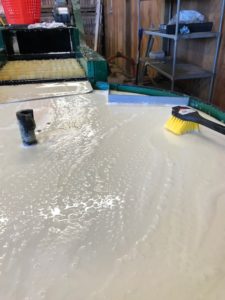
Soapy countertopGAPs, third-party audits, and the FSMA Produce Safety Rule have a heavy focus on the cleaning and sanitation of surfaces that come in contact with produce. These surfaces can be harborage points for pathogens that are problematic for those that consume them, and for decay organisms that shorten your crops shelf life and marketability.

During the summer of 2019 we gathered a number of surface materials that are commonly used in packing houses, some of the surfaces are used as temporary fixes, others are for permanent use. Each of the surfaces was evaluated for cleanability and sanitation using common detergents and sanitizers. Swab sampling was used to assess “dirtiness” before cleaning, and then cleanliness after rinsing with water, after using a detergent, and again after using a sanitizer. We paid attention to how quickly the swab sampling numbers were reduced after each step.

What was abundantly clear was that the process is critical, no matter what detergent or sanitizer you use. The most effective process is:
1. Rinse all visible debris off of the surface with water
2. Use an appropriate detergent and scrub the surface, paying attention to all corners, crevices, joints, and screw/bolt heads
3. Rinsing the surface clear of detergent and dislodged debris
4. Use a sanitizer approved for food contact surfaces, follow the directions

Another common issue found was that visibly clean doesn’t necessarily mean that the surface is clean enough to use. Just rinsing off with water can remove visible debris, and reduced the swab sampling number, but not enough to be considered clean. This was consistent across all the surfaces we evaluated in the study.  Surfaces evaluated included vinyl flooring, polyvinyl chloride (PVC), polypropylene (PP) surfaces, high density polyethylene (HDPE) tabletop, fiberglass reinforced panels (FRP), acrylic sheet (PPMA), styrene, extruded composite lumber (PET), wood surfaces, plastic household mats, and sheet metal painted with countertop paint. These surfaces were chosen for their ease of purchase locally and that many have been seen in use on farms across the state.

There are many sanitizers available on the market, including organic approved products. We evaluated chlorine, peroxyacetic acid, quaternary ammonium, and chlorine dioxide. All are labeled for use on food contact surfaces. Label instructions were followed and dip strips were used to ensure that the target PPM of each sanitizer was achieved. Using too little of a sanitizer is ineffective, and too much of a sanitizer can cause damage to the surface you are cleaning. Detergents evaluated were common dishwashing detergent, citric acid, ethoxylated coconut oil, and a foaming non-hazardous spray on detergent.

When the swab sampling numbers were evaluated we found that smooth surfaces cleaned the best and were more consistently sanitized. Surfaces with raised designs, grooves, or bumps did not have as significant reduction of swab sampling numbers as compared to the smooth surfaces. This inability to sanitize as effectively can allow for biofilms to form, providing a harborage point for disease. The surfaces that were most consistent in their ability to be cleaned and sanitized were fiberglass reinforced panels, commonly known as sanitary wall and often used in dairy milk houses, and extruded composite lumber. Surfaces painted with countertop paint did well initially, but repeated scrubbing allowed for scratches in the paint, and thinning of the surface over time. This resulted in a reduced ability to clean and sanitize effectively. Surfaces that consistently showed they were uncleanable were foil tape (sometimes used as a quick fix on surfaces), flexible plastic kitchen mats, uncoated wood surfaces, and vinyl flooring. All other evaluated surfaces had variations in the swab analysis results based on the detergent and sanitizer combinations. All detergents were effective at reducing the swab sampling numbers, with the foaming detergent having a more consistent effect over all of the surfaces tested. The sanitizers evaluated, when used according to product directions and on smooth surfaces, reduced the swab sampling numbers significantly.

Critical points to consider:

-Develop a regular cleaning schedule with a written standard operating procedure detailing the products used, how they are used, and the steps involved in cleaning and sanitizing the surfaces.
-Do a test run when you aren’t pressed for time, take apart equipment, determine if you have the right supplies, and estimate the time it will take to properly clean and sanitize the equipment.
-Remember that the beginning of the season cleaning and sanitizing procedure will likely be more detailed than a during the season cleaning.
-Provide training for the person/s, and their backup, who will be responsible for cleaning and sanitizing postharvest surfaces.
-Only use sanitizers that are approved for food contact surfaces, and follow the label directions.
-When fixing packing equipment only use surfaces that are smooth, do not absorb water, and have not been used for other activities at the farm that may pose a contamination risk.
-Avoid cracks and crevices on your postharvest surfaces, these are difficult to clean and sanitize.
-When gloves are used workers must be trained on how to use them so they do not become a contamination source.
-Remove surface moisture in the packinghouse/area whenever possible using squeegees and fans.
-Remove culls from the packing area daily so they do not become an attractant for wildlife.
-Utilize a pest control program in the packing and storage areas, focusing on rodents and other wildlife intrusions.
-Remove as much soil as possible from harvested produce in the field, rather than in the packing area.
-Use new containers or containers that can be cleaned and/or sanitized to pack and display produce.
-Storage areas and coolers should be monitored for cleanliness, and be included in the rodent control program.

Visit the Rutgers On-Farm Food Safety website for more produce safety resources.


This work funded by USDA Specialty Crop Block Grant #16-SCBGP-NJ-0046

6-Week Urban “Annie’s Project” Farm Management & Business Training Course

Especially aimed at NJ farm women and veterans, Rutgers Cooperative Extension (RCE) will present a new, urban-focused version of the popular Annie’s Project titled “Farming in New Jersey’s Cities and the Urban Fringe.” Classes will be held simultaneously in Roseland, New Brunswick and Cherry Hill on Dec. 3, 10, 17 and Jan. 7, 14, 21, between the hours 6 – 9 p.m. Registration is currently open and is $150 until Dec. 2. Dinner will be provided at 5pm each evening of the class. [Read more…]

Hackettstown Livestock Auction Results for November 5, 2019

This auction sells: lambs, sheep, goats, calves, beef cattle, pigs, rabbits, and all types of heavy fowl. Auctions are held every Tuesday with the first sale beginning at 10:30 am and ending with the last sale at 5:30 pm. Hay, straw, grain, and firewood are also for sale.

Hackettstown Livestock Auction

Farm Fresh Eggs available for purchase by the case (30 doz.) or by the flat (2&1/2 doz.) in the main office Tuesday, Wednesday & Thursday. Also available some Monday’s and Friday’s but please call office first (908)-852-0444.

Click on link for November 5, 2019 sale results:

Hackettstown 11.5.19
