Greetings from the Veg IPM team! This week’s update contains important information about Cucurbit Downy Mildew in NJ.
Sweet Corn
Corn earworm trap counts are at least 4-days for all of New Jersey this week. Sprays should be initiated at 10% green silks, and continued in intervals as determined by your local CEW pheromone trap counts. Refer to the map below to see this week’s CEW pressure. Remember, when the average maximum temperature for the next 3 days is above 80 degrees, shorten the spray interval by one day. South of 195, every location has moth counts indicating that a 3 day interval is needed (or, every other day sprays with the current temperatures). In North Jersey pressure is lower, but increasing. Rotation is important for avoiding resistance, and there are four IRAC groups that are registered in silking sweet corn: 1 (carbamates), 3 (pyrethroids), 5 (spinosyns), and 28 (diamides). Corn earworm is at least partly resistant to several pyrethroids, so a spray program should not rely solely on pyrethroids, although they are useful in tank-mixes or as pre-mixed products, such as Besiege or Elevest (Group 28 + Group 3). For detailed information about resistance and potential spray programs, the University of Delaware has an excellent resource on corn earworm management.

Spray intervals based on nightly pheromone moth captures for the southern part of New Jersey. Note that not all locations in the IPM program are currently trapping. This map is based on the following thresholds: 0 moths = 6-7 day schedule, 1 moth = 5 day spray schedule, 2-20 moths = 4 day spray schedule, 20+ moths = 3 day spray schedule.
Caterpillar pests in the whorl and tassel stage. We’re seeing above-threshold fall armyworm (FAW) infestations in many locations throughout the state. Young larvae cause “window paning” damage, in which the top surface of the leaf is eaten away, leaving behind thin, white, membranous-looking scratch marks (A). As the larvae get bigger, these feeding marks become ragged holes (B). The damage can look similar to European corn borer feeding, but FAW damage will be more severe and will lead down into the whorl. The caterpillars have a dark head capsule with a distinct, inverted Y-shaped suture (C). They can also be identified by four dark dots arranged in a square on their last segments (D). We use a treatment threshold of 12% fresh feeding damage in pre-tassel corn. Below this level, treatments for FAW are unlikely to pay off and can flare up aphids. For treatment, we recommend using products other than diamides (IRAC Group 28), as diamides are important to save for silk protection. Effective products include Lannate (Group 1A), Radiant (Group 5), Intrepid (Group 18), Intrepid Edge (5+18), and Avaunt (Group 22). Note that Avaunt can only be used through tassel push.
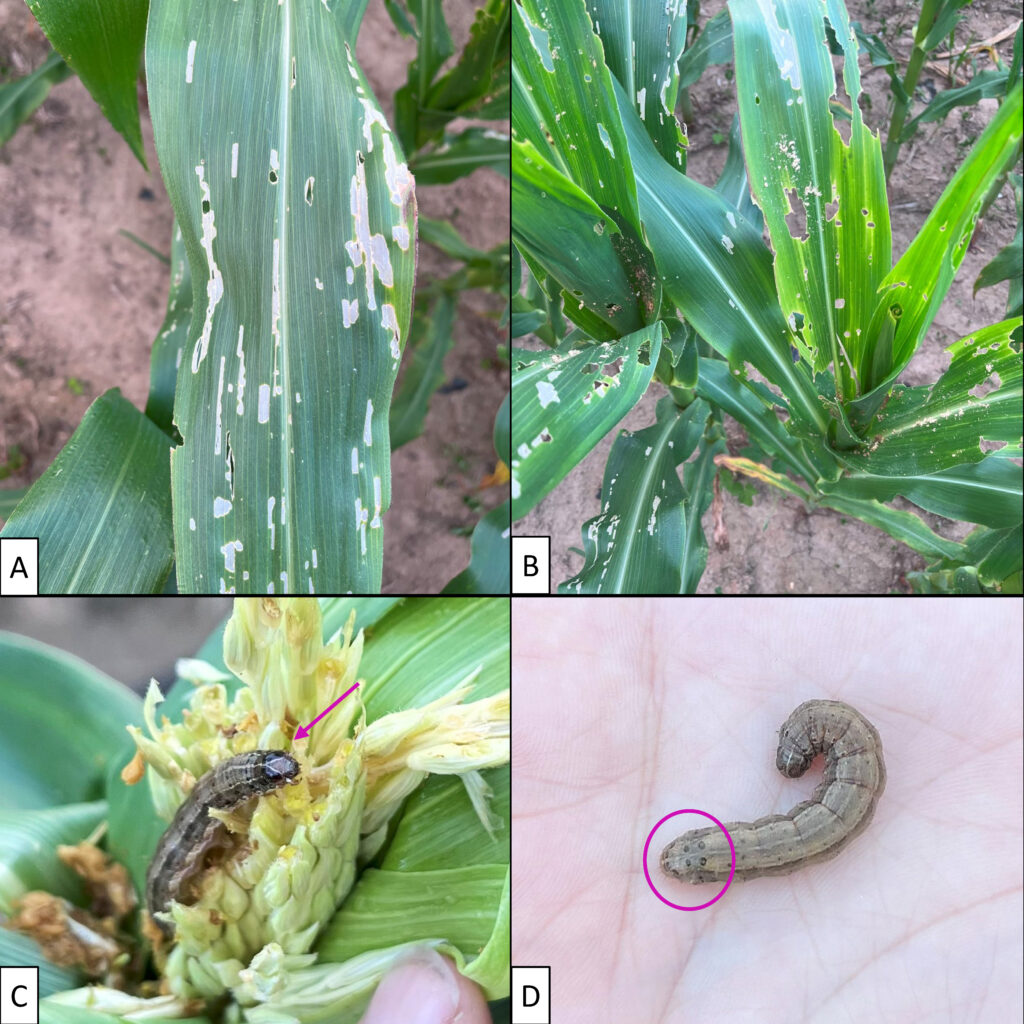
Fall armyworm identification: A) Windowpane damage, B) ragged holes, C) larva with inverted “Y” on head capsule, and D) larva with 4 dots arranged in a square. Pictures by Maria Cramer.
Aphids. We’re seeing aphid infestations in corn tassels as well as on silking ears like in the picture below. Aphids don’t hurt the edible ear of corn, but in large numbers they can cause honeydew and sooty mold that reduce marketability. If you’re seeing a lot of aphids on corn tassels, you can start your CEW spray rotation with Lannate (group 1A), which has some efficacy for aphids. Come back a week later and check ear tips for aphid populations. If they are high, as in the below picture, use a product more targeted for aphids, such as Assail 30SG or 30 SC (group 4A), Transform WG (group 4C), or Sivanto Prime (group 4D). Keep in mind that Transform WG and Sivanto Prime have 7 day PHIs.

Corn leaf aphids on the tip of an ear. Note blue-green color with dark tail pipes (also called cornicles), legs, and antennae. Picture by Maria Cramer.
Tomatoes and Peppers
Thrips and TSWV. Thrips have slowed down with lower temperatures and general declines in tomato plant health due to stress and diseases as the season has progressed. We are still seeing some spread of tomato spotted wilt virus, but it has slowed significantly compared to earlier in the season. If management of thrips no longer makes sense economically, we encourage destroying older plantings to try to reduce populations of thrips and the reservoir of the virus on farms. See our previous article for detailed information on managing thrips and TSWV in tomatoes.
Spider mites. Be on the look out for spider mites, but along with aphids and fruit worms, we have seen low populations. Wet weather is likely suppressing them.
Beet armyworm. We track beet armyworm with pheromone traps deployed in south Jersey. Beet armyworm is an occasional pest of peppers, swiss chard, and beets and can cause serious damage and crop loss if outbreaks occur unexpectedly. Our traps in Salem county continue to have elevated BAW counts this week (30+ moths per night) so scout susceptible crops for caterpillars and damage. Traps in Cumberland county continue to have low captures (<5 per night).
Cucurbits
!Cucurbit Downy Mildew (CDM) Status!: Cucurbit Downy Mildew has been detected in NJ as of 8/22/26. This past weekend we found CDM on butternut squash and cucumbers at the RAREC research center in Bridgeton, NJ. We also confirmed the disease on butternut squash and jack-o-lantern pumpkins at the Snyder Farm in Pittstown (it was not detected on cucumbers at this site). We will continue to post updates on which crops are becoming affected, but at this time, all growers should be applying downy mildew-specific fungicides to their cucurbit plantings (there are several options available in the Mid-Atlantic Production Guide). Keep in mind that products that control powdery mildew won’t necessarily control downy mildew, and vice versa. Be sure to rotate multiple products with different FRAC codes to reduce the risk of resistance development. For more detailed information about the disease and how to build an effective fungicide rotation, you can read this article by Andy Wyenandt.
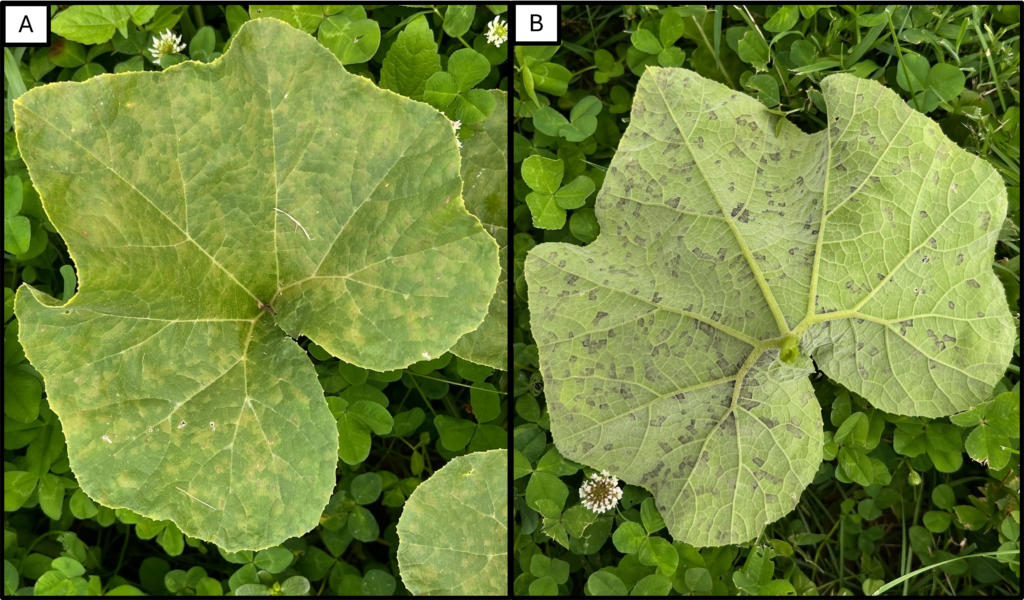
Downy Mildew symptoms on a butternut squash leaf. On the upper surface of the leaf (A), look for angular, yellow lesions that are contained within the leaf veins. On the underside of the leaf (B), dark, fuzzy-appearing spores will be present. Photos by Amanda Quadrel.
Cole Crops
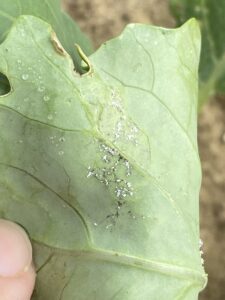
Downy mildew on a collard leaf. Photo by Maria Cramer.
Scouted cole crops continue to have varying levels of caterpillar activity. The caterpillar threshold is 20% infestation for crops still in the leafy/early cupping stage. Once heads begin to form, the threshold drops to 5%. For young caterpillars, Bt products such as Dipel or Xentari IPM friendly options. In some locations, we’ve also seen some low incidence of diseases such as Alternaria and Downy Mildew. Consult the Mid-Atlantic Guide for fungicide options.
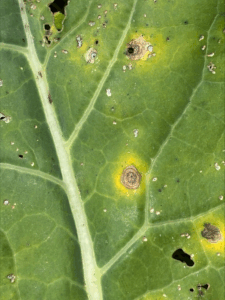
Alternaria on broccoli. Photo by Amanda Quadrel.
As a reminder, the new 2026/2027 Mid-Atlantic Commercial Vegetable Production Guide is now available for free online (click here) or as spiral-bound hard copies that can be purchased at your local county extension office. Consult this guide for a more comprehensive list of materials that are labeled for specific crops and pests.
We want to give a huge thanks to our scouting team for keeping an eye on things for us throughout the season!
North NJ: James Johnson, Shayne Miller, and Cassandra Dougherty
South NJ: Renee Carter, Peter Combs, Mar Sherman, and Kris Szymanski
Authors: Amanda Quadrel (Northern NJ Veg IPM coordinator) and Maria Cramer (Southern NJ Veg IPM coordinator)
Questions or comments? Contact us below:



