Greetings from the Veg IPM team! Things are ramping up, and we have some important updates on diseases in tomatoes and peppers.
Cole Crops

Flea beetle surrounded by feeding damage. Picture by Maria Cramer.
Flea beetles have still proven to be troublesome in various cole crops. This year, they have been especially prevalent in Napa cabbage, Tuscan kale, and bok choy. Young plants are especially vulnerable to attack from flea beetles. For all growth stages of heading cole crops, the threshold is 50% plants with flea beetles present before sprays will pay off.
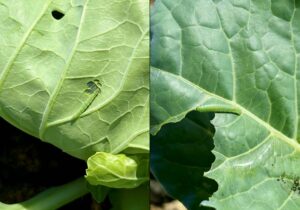
Left: Diamondback moth caterpillar, showing characteristic tapering at each end. Right: Imported cabbageworm caterpillar showing characteristic fuzziness. Pictures by Maria Cramer.
We’re also seeing caterpillar activity (imported cabbageworm and diamondback moth) in cabbage and other cole crops. Treatment thresholds vary between crops and growth stage, but for heading cole crops between early vegetative and cupping, the treatment threshold is 30%. At this stage, sprayable Bt products (IRAC 11A) such as Dipel, Xentari, or Javelin can be effective on young caterpillars and will also be gentle on natural enemies that control other cole crop pests. Other materials approved for caterpillar control include Entrust/Radiant (IRAC 5), Proclaim (IRAC 6), Torac (IRAC 21A), Exirel (IRAC 28), and the new product Incipio (IRAC 30). These additional products may work better for diamondback moth or larger larvae. For Bt products and contact insecticides, coverage on the undersides the leaves is essential.
Tomatoes and Peppers
This week, we’ve seen a few fungal and bacterial diseases pop up in both tomatoes and peppers. Botrytis, or gray mold is a fungal disease that has been prevalent in tunnel tomatoes. Refer to the photos below to identify foliar symptoms of the disease. To prevent the spread of Botrytis, good air flow and reducing humidity in your tunnels is key. Make sure that your tunnels are properly ventilated, avoid crowding your tomato plants, and lightly prune your plants to facilitate better airflow or to remove infected material (make sure to sanitize your pruning tools frequently). If disease pressure is high, fungicide applications can help; see table E-14 in the 2026/2027 Mid-Atlantic Production Guide for a list of materials approved for Botrytis control in greenhouses/tunnels. For more information on Botrytis and its management, see the Botrytis Fact Sheet from our vegetable pathologist, Andy Wyenandt.

Botrytis symptoms on tomato foliage. Notice the tan lesions with concentric rings (B). Photos by Amanda Quadrel.
Regarding bacterial diseases on tomatoes, symptoms first appear on leaves as dark brown lesions surrounded by a yellow halo. These can coalesce into larger lesions over time. On the undersides of the leaves, the lesions will often have a “greasy” or water-soaked appearance (see photos below). In the case of bacterial canker, the leaves are more likely to develop a “scorched” appearance, with the margins of the leaves turning yellow, and then eventually brown. If left untreated, the bacteria will also infect the fruit, resulting in numerous unsightly blemishes. It is often difficult to tell bacterial spot, speck, or canker apart, as symptoms can overlap. We encourage you to send a sample to the Rutgers Plant Diagnostic Laboratory to identify exactly which bacteria you are dealing with, as management for these diseases can differ slightly.

Symptoms of bacterial diseases on a tomato plant (A), lesions on the upper surface of a leaf (B), and appearance of lesions on the undersides of the leaves (C). Photos by Amanda Quadrel.
Bacterial leaf spot on peppers has similar symptoms to those seen on tomatoes, but the lesions may develop a tan center. The lesions will have a similar greasy or water-soaked appearance on the undersides of the leaf (see photos below).
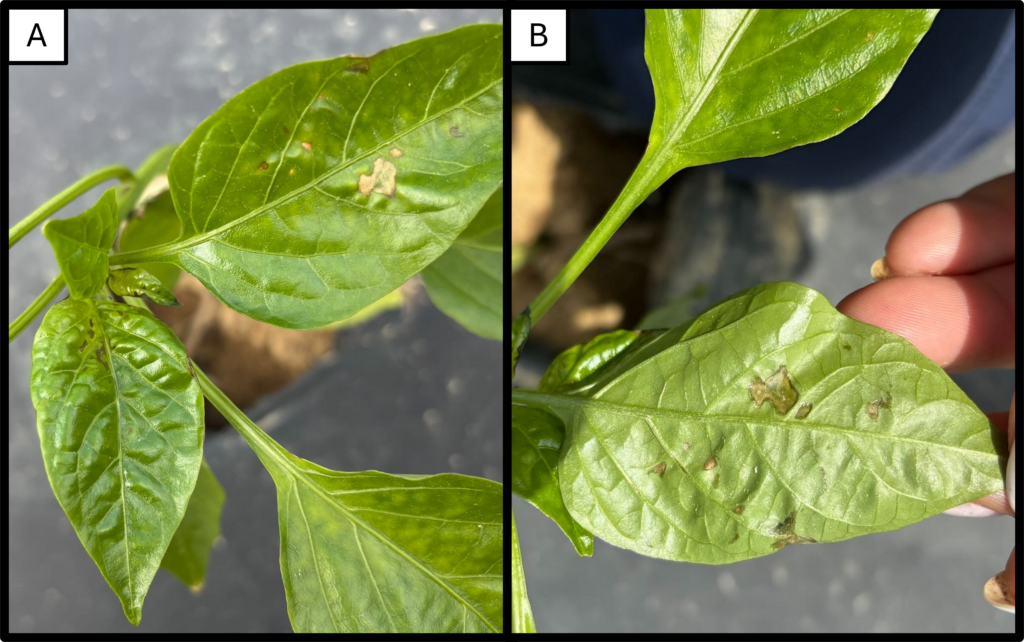
Bacterial leaf spot symptoms on the upper (A) and lower (B) surface of pepper leaves. Photos by Amanda Quadrel.
While there are seldom curative measures for bacterial diseases, there are ways to suppress symptoms and prevent the disease from spreading throughout the field. Remove and destroy symptomatic plants, avoid working with plants in wet conditions, and frequently sanitize any tools or equipment that are used when handling tomatoes and peppers. If your farm has a history of bacterial issues, or you suspect your plants may be showing early symptoms of disease, regular applications of copper-containing products can slow the spread of the disease. However, keep in mind that in some areas, the causal bacteria may be resistant to copper. More info on bacterial diseases and copper resistance can be found here.
We have identified several tomato spotted wilt virus cases in south Jersey greenhouses and tunnels (see below). It’s important to identify and remove infected plants to prevent the spread of the virus, in combination with monitoring and managing western flower thrips populations. More information on managing thrips. If you need help identifying tomato spotted wilt virus, please contact us using the form at the bottom of this post.
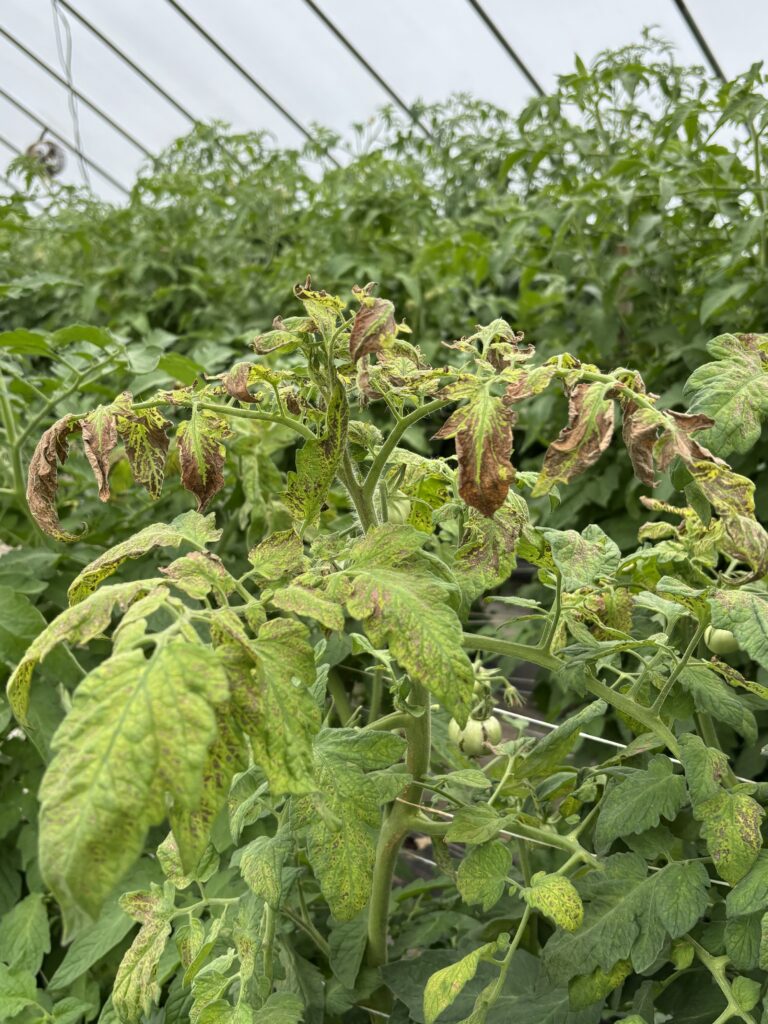
Tomato spotted wilt virus symptoms on a greenhouse tomato. Picture by Maria Cramer.
Insect/mite pest pressure is still very low in both tunnel and field tomatoes. We’ve been seeing limited thrips (A), aphid (B) and spider mite (C) activity. At this stage, we recommend avoiding broad spectrum products that can flare up secondary pests unless absolutely necessary, so be sure to base interventions on seeing threshold-level pest problems. Consider spot treatments for aphids and spider mites. Additionally, biological control agents can be used in tunnels to help suppress pest populations. If primarily dealing with aphids or thrips, products such as Beleaf (IRAC 29) are recommended, especially if plants have reached the flowering stage.

From left to right: (A) an adult thrips, (B) aphids, and (C) a two-spotted spider mite. Photos by Amanda Quadrel.
Sweet Corn
Pheromone traps have been deployed throughout the state. While silking corn is the main target of CEW activity, we set the traps early to detect overwintering moths, which have become more common with warmer winters. Official maps with statewide CEW activity will be shared starting in June. We still haven’t seen any major issues in corn. There have been some instances of flea beetle, spotted cucumber beetle, and caterpillar feeding, but these insects are incidental feeders that are not likely to reach economically damaging levels.

Spotted cucumber beetle and feeding damage on sweet corn. Photo by Maria Cramer.
As a reminder, the new 2026/2027 Mid-Atlantic Commercial Vegetable Production Guide is now available for free online (click here) or as spiral-bound hard copies that can be purchased at your local county extension office. Consult this guide for a more comprehensive list of materials that are labeled for specific crops and pests.
Last, but certainly not least, we would like to extend a warm welcome to this year’s Vegetable IPM scouts:
North NJ: Connor Colonese, Shayne Miller, and Cassandra Dougherty
South NJ: Alex White, Renee Carter, and Peter Combs
Our scouts are our eyes in the field, and their hard work allows us to provide the most up-to-date sightings throughout the season. We greatly appreciate their efforts! With that said, we will continue to provide the latest info, and we look forward to having a great vegetable season!
Authors: Amanda Quadrel (Northern NJ Veg IPM coordinator) and Maria Cramer (Southern NJ Veg IPM coordinator)
Questions or comments? Contact us below:



