Potato | Tomato Disease Forecast 8-2-16

Click to View | Download Report 8-2-16

Potato Disease Forecasting Report

We will be tracking DSVs for Late blight development and calculating P-days for initiating the first early blight fungicide application.

The first late blight fungicide application is recommended once 18 DSVs accumulate from green row. Green row typically occurs around the first week in May in southern NJ. An early season application of a protectant fungicide such as mancozeb (Dithane, Manzate, Penncozeb) or Bravo (chlorothalonil) as soon as the field is accessible is suggested. Please be vigilant and keep a lookout for suspect late blight infections on young plants. No late blight has been reported in our region to date.

Remember the threshold for P-days is 300!  Once 300 P-days is reached for your location, early blight fungicide applications should be initiated. Growers who are interested in using this model should choose the location above that is closest in proximity to their farming operation and should regularly check the Cornell NEWA website (http://newa.cornell.edu/) where this information is compiled from. Click on Pests Forecasts from the menu, select your weather station, and click on tomato diseases, set accumulation start date, and a table of daily and total DSVs will be generated.

Tomato Disease Forecasting Report

Disease severity values (DSVs) for early blight, septoria leaf spot, and tomato anthracnose development are determined daily based on leaf wetness (due to rainfall, dew) and air temperature.

On a daily basis DSV values can range from 0 to 4 where 0 = no chance for disease development to 4 = high chance for disease development.
DSVs are accumulated during the production season.

Fungicide applications are based on an individually determined DSV threshold. The first fungicide application for the control of these three diseases is not warranted until 35 DSVs have accumulated from your transplanting date. After that, growers can base fungicide applications on different DSV thresholds.

Reports generated by Ryan Tirrell

Rutgers, The State University of New Jersey
‘Yukon Gold’ potato seed from Canada test positive for Dickeya dianthicola in U.S.

‘Yukon Gold’ (2015-3079137-010) certified by the Canadian Food Inspection Agency (CFIA) has tested positive for Dickeya dianthicola in Virginia this summer. This is the second report of Dickeya dianthicola in the U.S. originating from seed potato from New Brunswick, Canada  this summer. Importantly, Dickeya-infested potato seed has also been shipped from multiple sources in Maine to 11 states located in the Northeast, mid-Atlantic, and Southeast regions  this year. All potato growers are encouraged to scout fields and report any suspect plants/tubers. The best method for keeping your potato operation Dickeya-free is to adopt your own 0% Dickeya-tolerance policy.

‘Reba’ potato seed test positive for Dickeya dianthicola in New Jersey from Canada.

‘Reba’ potato seed (lot # 2015-3100460-022, Elite 3) certified by the Canadian Food Inspection Agency (CFIA), Grand Falls office in New Brunswick has tested positive for Dickeya dianthicola in New Jersey this summer. The same lot of seed was also shipped to PA. This is the first report of potato testing positive for Dickeya dianthicola in NJ from a Canadian source. Importantly, Dickeya-infested ‘Reba’ seed has also been shipped from different sources in Maine to multiple states in the mid-Atlantic region this year. All potato growers are encouraged to scout fields and report any suspect plants/tubers. The best method for keeping your potato operation Dickeya-free is to adopt your own 0% Dickeya-tolerance policy.

Dickeya dianthicola affecting potato in New Jersey

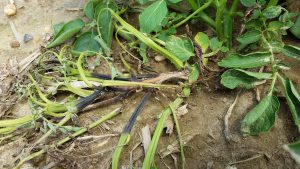
Dickeya dianthicola, an aggressive form of blackleg, has been found on potato in New Jersey for a second year in a row. The pathogen has also been found in potato crops in other states in the mid-Atlantic region this summer. The pathogen can cause significant losses if brought into the field on infested seed. Symptoms of Dickeya include the rotting/melting of the infested seed piece without the smell of traditional soft rotting bacteria. The bacterium will spread to other tubers developing on plant and into the stems leading to blackleg symptoms on the foliage. Infected plants can collapse quickly under hot conditions. Surveying and testing for Dickeya is currently being done in all states in the region. All potato growers should scout on a daily basis and any suspect plants should be submitted for testing. In New Jersey, fields of ‘Reba’, ‘Snowden’, and ‘Norwis’ have tested positive for Dickeya dianthicola from seed originating from Maine and Canada.

Symptoms of blackleg caused by Dickeya dianthicola on an infected potato plant.

Symptoms of blackleg caused by Dickeya dianthicola on an infected potato plant.


Late blight Reported on Tomato on the Eastern Shore, VA and in Maryland

Late blight was confirmed on tomato on the Eastern Shore of Virginia this afternoon and on tomato in Montgomery County, MD yesterday. All tomato and potato growers in New Jersey should scout thier fields on a daily basis and consider starting a standard weekly protectant fungicide program if one hasn’t already done so. No Late blight has been found in New Jersey to date. More more information on the control of Late blight please see the 2013 Commercial Vegetable Production Recommendations Guide. Organic growers should consider applying a OMRI-approved copper-based fungicide.

For more information and to track the progress of Late blight please USAblight.org.
