Search Results for: hornet

Vegetable IPM Update 10/02/19

Note:  This is the last regular edition of the Vegetable IPM Update for the season.  We will provide additional updates on specific pest/disease issues as they arise.

Sweet Corn

Corn earworm (CEW) moth catches remain at moderate levels.  Overall, CEW numbers represent a normal early fall population.  Moth counts will decline with cool night temperatures (especially those forecast for the upcoming weekend), but look for rebounds when nighttime temperatures exceed 60F.   Economically damaging populations of this pest are present throughout the state, and all remaining silk stage plantings are at risk of crop injury if strict spray schedules are not observed.
 

[Read more…]

Vegetable IPM Update 9/18/19

Sweet Corn

European corn borer (ECB) moth captures remain scattered and very low, and no map will appear in this addition.  There are very few plantings not yet silking.  Silk sprays for corn earworm (CEW) control will serve to manage ECB larvae as well.  Reminder:  Useful insecticides for worm control in the silk stage include  spinosyns (including OMRI approved Entrust) IRAC Grp 5), and diamides such as Coragen (IRAC Grp 28) or materials such as Besiege which include the active ingredient in Coragen.  Synthetic pyrethroids alone should NOT be used for corn earworm (CEW) protection on silking corn.  Control with these materials is very inconsistent.


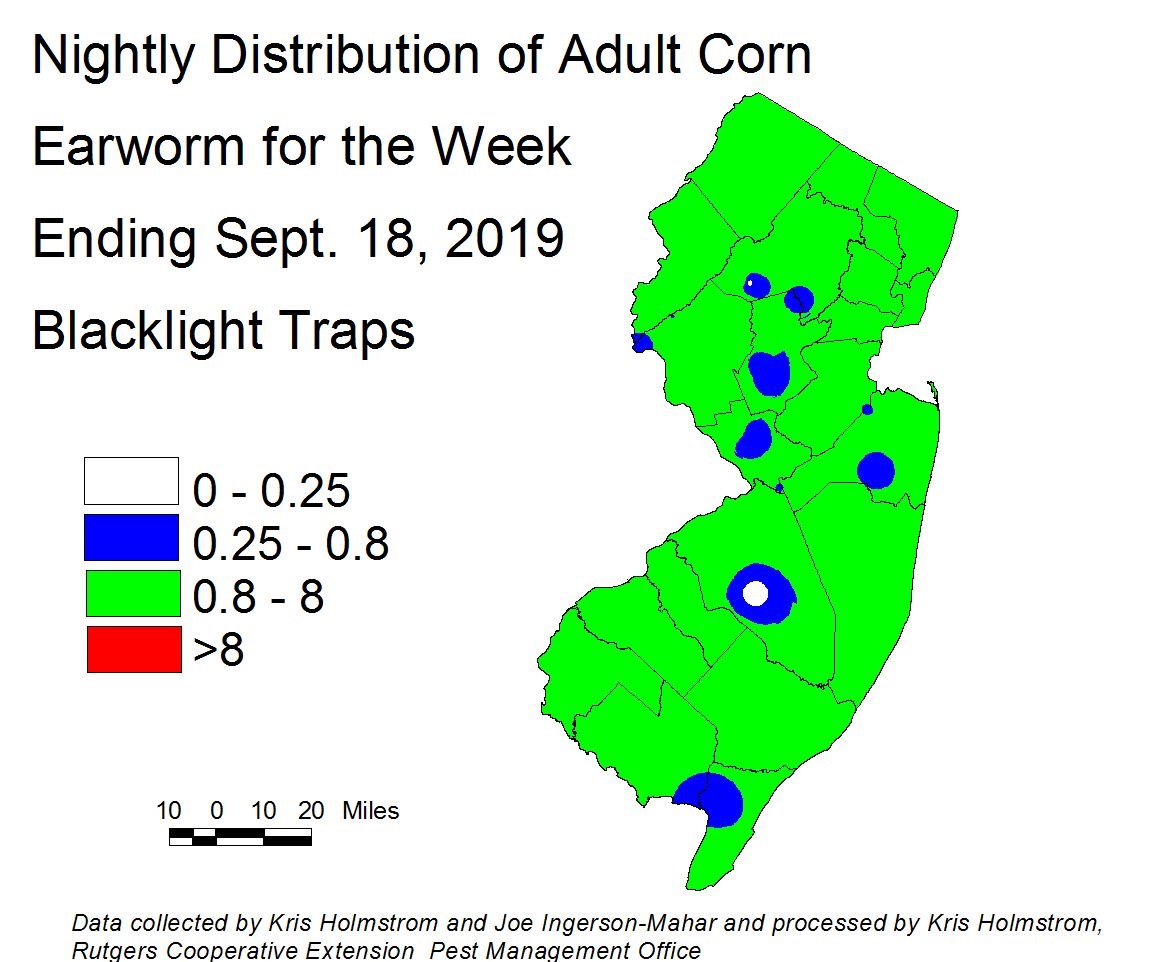
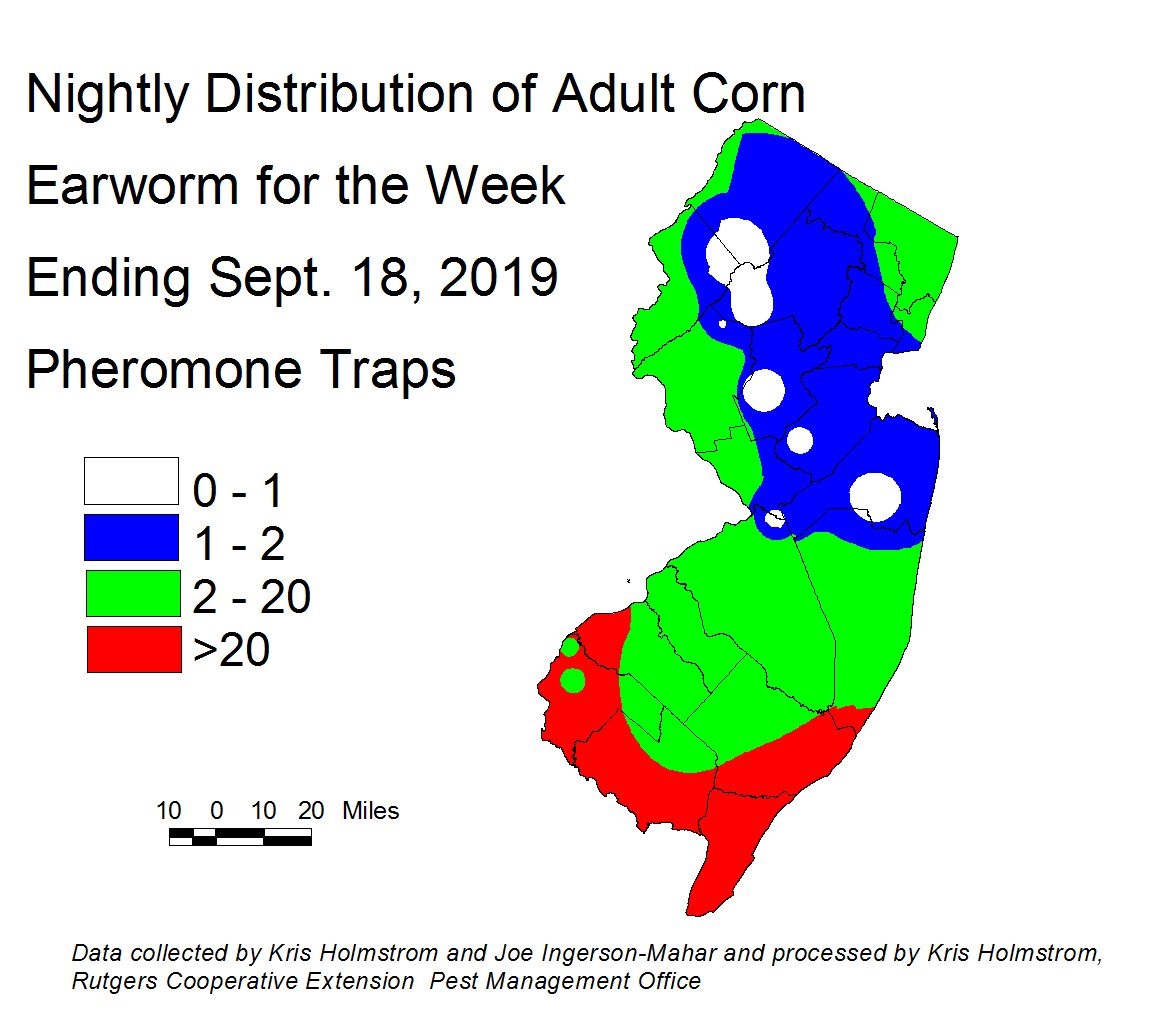
Corn earworm (CEW) moth catches have changed little in NJ this past week.  Overall, CEW numbers represent a normal late summer population.  While moth counts will decline somewhat with cool night temperatures, look for strong rebounds when nighttime temperatures exceed 60F.  The green area on the blacklight map (left) represents a 3-day silk spray schedule zone.  Blue and white areas within the overall green zone are outliers, and corn growers in or near those areas should also adhere to 3-day silk spray schedules.     Economically damaging populations of this pest are present throughout the state, and all areas are at extreme risk of crop injury if strict silk spray schedules are not observed.   Red areas on the on the pheromone trap map (below at right) indicate a 3-day silk spray schedule, while green indicates a 4-5 day silk spray schedule.  Currently, the black light network is indicating a more conservative spray regime statewide, than is the pheromone network.  Taken together, blacklight and pheromone traps are indicating 3-day silk spray schedules throughout the state.  There are far fewer CEW pheromone traps than blacklights, and the resulting map has much broader color bands as a result.  It should also be noted that the pheromone traps are much more sensitive than blacklights.  Therefore, the number of moths caught in pheromone traps required to generate a specific spray interval is much higher than the number caught in blacklight traps.   It must be stressed that there is high variability in these catches, and growers should consult with their IPM practitioner on recommended spray schedules.
 

[Read more…]

Vegetable IPM Update 9/11/19

Sweet Corn

European corn borer (ECB) moth captures remain scattered and very low, and no map will appear in this addition.  Feeding in late season pre-tassel corn in northern NJ continues, with some plantings exceeding the 12% threshold.   In combination with fall armyworm (FAW) feeding, action thresholds have been exceeded in all areas of the state.

Growers should continue to scout whorl and pre-tassel stage plantings weekly and consider treating when infested plants exceed 12% in a 50 plant sample.  As plantings proceed to the pre-tassel stage, ECB larvae may be found in emerging tassels.  It is a good idea to treat individual plantings as they move into the full tassel/first silk stage one time.  This eliminates any ECB larvae that have emerged with the tassels as they begin to move down the stalk to re-enter near developing ears.

Useful insecticides for this particular application include synthetic pyrethroids (IRAC Grp 3), spinosyns (including OMRI approved Entrust) IRAC Grp 5), and diamides such as Coragen (IRAC Grp 28) or materials such as Besiege which include the active ingredient in Coragen.  Synthetic pyrethroids alone should NOT be used for corn earworm (CEW) protection on silking corn.  Control with these materials is very inconsistent.

The highest nightly black light trap catches of ECB for the week ending 9/11/19 are as follows:

Allamuchy   1 Jones Island   1
Chester   1 Monroeville   1
Elm   1 Oldwick   1


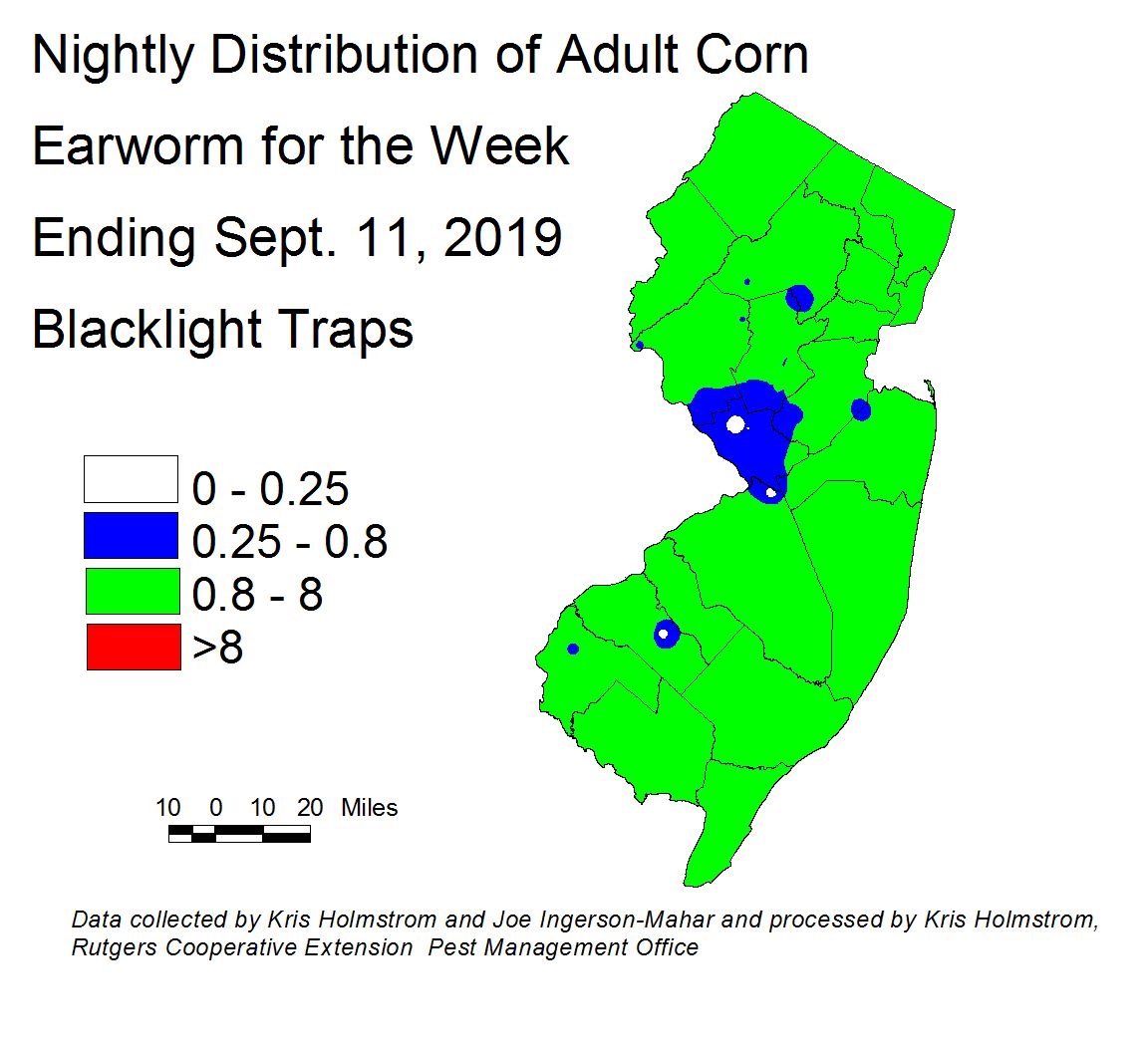
Corn earworm (CEW) moth catches have remained fairly stable in NJ this past week.  Blacklight catches are steady, while there was a slight decline in pheromone trap catches.  However, the effect on spray schedules is unchanged.  Overall, CEW numbers now represent a sizeable late summer migratory influx.  While moth counts will decline somewhat with cool night temperatures, look for strong rebounds when nighttime temperatures exceed 60F.  The green area on the blacklight map (left) represents a 3-day silk spray schedule zone.  Blue and white areas within the overall green zone are outliers, and corn growers in or near those areas should also adhere to 3-day silk spray schedules.     Economically damaging populations of this pest are present throughout the state, and all areas are at extreme risk of crop injury if strict silk spray schedules are not observed.   Red areas on the on the pheromone trap map (below at right) indicate a 3-day silk spray schedule, while green indicates a 4-5 day silk spray schedule.  Currently, the black light network is indicating a more conservative spray regime statewide, than is the pheromone network.  Taken together, blacklight and pheromone traps are indicating 3-day silk spray schedules throughout the state.  There are far fewer CEW pheromone traps than blacklights, and the resulting map has much broader color bands as a result.  It should also be noted that the pheromone traps are much more sensitive than blacklights.  Therefore, the number of moths caught in pheromone traps required to generate a specific spray interval is much higher than the number caught in blacklight traps.   It must be stressed that there is high variability in these catches, and growers should consult with their IPM practitioner on recommended spray schedules.

 

[Read more…]

Vegetable IPM Update 9/04/19

Sweet Corn

European corn borer (ECB) moth captures remain very low, and no map will appear in this addition.  Feeding in late season pre-tassel corn in northern NJ continues, with some plantings exceeding the 12% threshold.   In combination with fall armyworm (FAW) feeding, action thresholds have been exceeded in all areas of the state.

Growers should continue to scout whorl and pre-tassel stage plantings weekly and consider treating when infested plants exceed 12% in a 50 plant sample.  As plantings proceed to the pre-tassel stage, ECB larvae may be found in emerging tassels.  It is a good idea to treat individual plantings as they move into the full tassel/first silk stage one time.  This eliminates any ECB larvae that have emerged with the tassels as they begin to move down the stalk to re-enter near developing ears.

Useful insecticides for this particular application include synthetic pyrethroids (IRAC Grp 3), spinosyns (including OMRI approved Entrust) IRAC Grp 5), and diamides such as Coragen (IRAC Grp 28) or materials such as Besiege which include the active ingredient in Coragen.  Synthetic pyrethroids alone should NOT be used for corn earworm (CEW) protection on silking corn.  Control with these materials is very inconsistent.

The highest nightly black light trap catches of ECB for the week ending 9/04/19 are as follows:

Medford   2 Jobstown   1
Califon   1 Jones Island   1
Cinnaminson   1


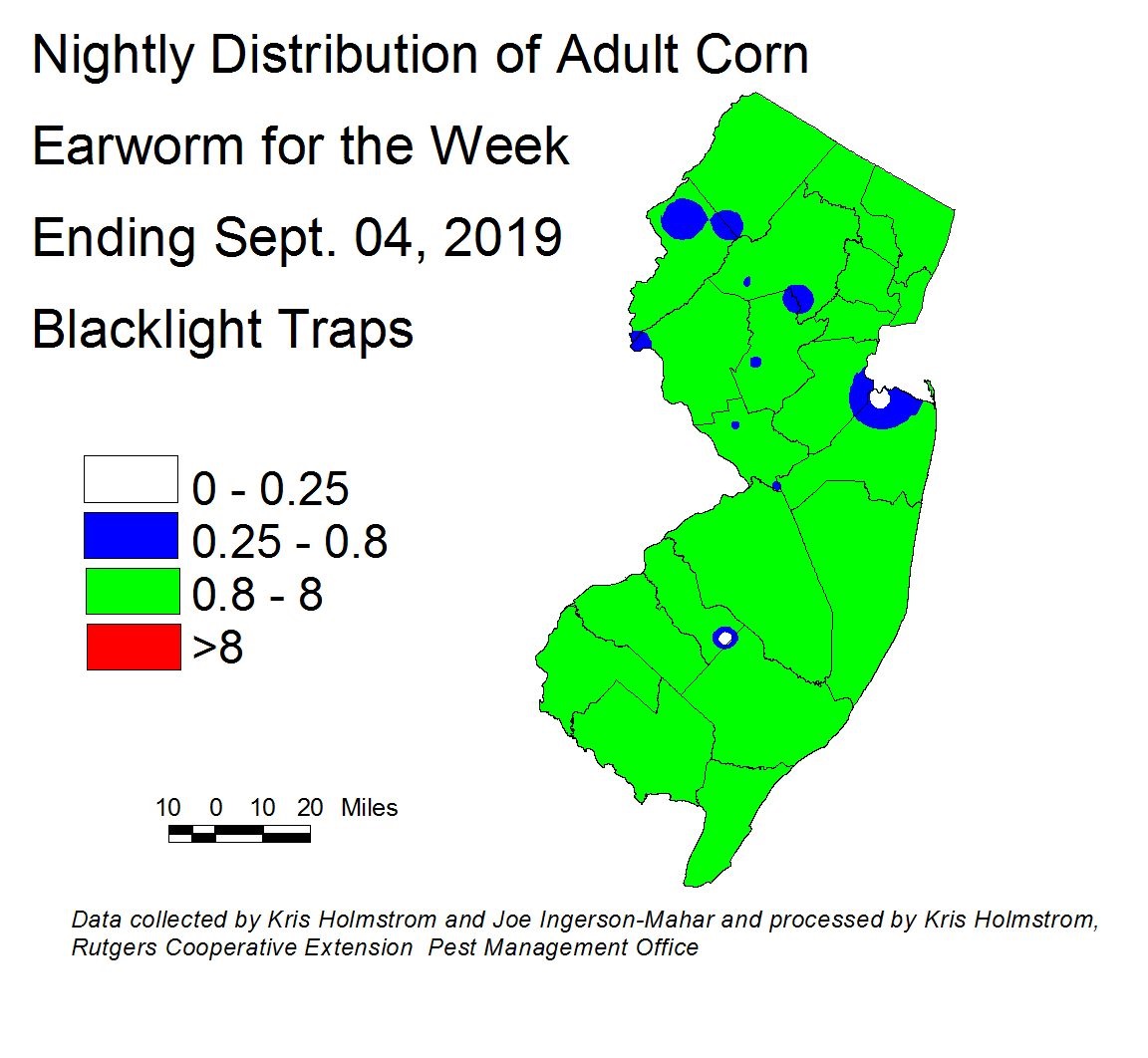
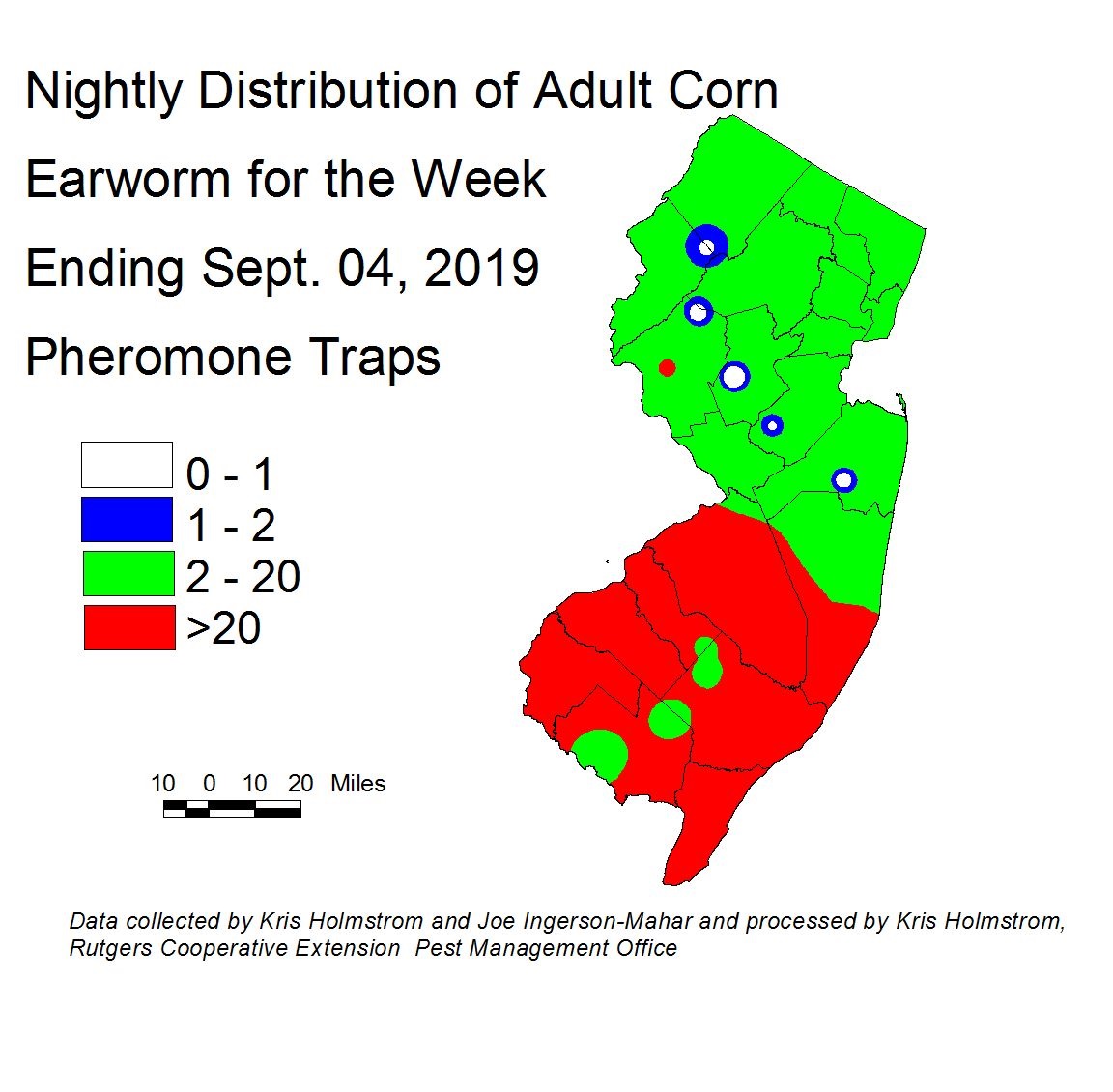
Corn earworm (CEW) moth catches increased in southern NJ this past week, while remaining stable in northern counties.  Overall, CEW numbers now represent a sizeable late summer migratory influx.  While moth counts will decline somewhat with cool night temperatures, look for strong rebounds when nighttime temperatures exceed 60F.  The green area on the blacklight map (left) represents a 3-day silk spray schedule zone.  Blue and white areas within the overall green zone are outliers, and corn growers in or near those areas should also adhere to 3-day silk spray schedules.  There continue to be some exceptionally high catches in southern NJ pheromone traps this past week (see pheromone trap map below at right).    Economically damaging populations of this pest are present throughout the state, and all areas are at extreme risk of crop injury if strict silk spray schedules are not observed.   Red areas on the on the pheromone trap map indicate a 3-day silk spray schedule, while green indicates a 4-5 day silk spray schedule.  Currently, the black light network is indicating a more conservative spray regime statewide, than is the pheromone network.  Taken together, blacklight and pheromone traps are indicating 3-day silk spray schedules throughout the state.  There are far fewer CEW pheromone traps than blacklights, and the resulting map has much broader color bands as a result.  It should also be noted that the pheromone traps are much more sensitive than blacklights.  Therefore, the number of moths caught in pheromone traps required to generate a specific spray interval is much higher than the number caught in blacklight traps.   It must be stressed that there is high variability in these catches, and growers should consult with their IPM practitioner on recommended spray schedules.


[Read more…]

DE, MD Fields with Palmer Amaranth Resistant to Both Glyphosate and ALS-Inhibiting Herbicides

Last fall we collected seed from Palmer amaranth plants in Delaware and Wicomico County, Maryland and tested them for resistant to both glyphosate or ALS-inhibiting herbicides (Group 2). A few of the samples tested positive for resistance to both glyphosate AND ALS-herbicide. We used Pursuit in the initial trials, but past experience indicates that these biotypes are resistant to many other herbicides in this family. See the table below for list of common ALS herbicides in the region. [Read more…]

Herbicide Resistant Weeds in Small Grains

Herbicide-resistant weeds are an ever increasing problem.

When most people hear herbicide-resistant weeds these days they think of glyphosate resistance. However, I think Group 2 resistance (or ALS-resistance) is just as bad, if not worse, for our area. Small grains is a crop that relies heavily on ALS herbicides for weed control, and over the years the products have been used heavily. We now have three weed species that are resistant to this mechanism of action. ALS-resistant common chickweed, annual (Italian) ryegrass, and horseweed (or marestail) are becoming more common. Before I talk about some options to control them, let’s look at how we got here. [Read more…]