- Sweet Corn
- Peppers
- Tomatoes
- Pumpkins
- Cole Crops [Read more…]
Search Results for: corn borer
Vegetable IPM Report September 26, 2012
Vegetable IPM July 13, 2012
-Kristian Holmstrom
Sweet Corn
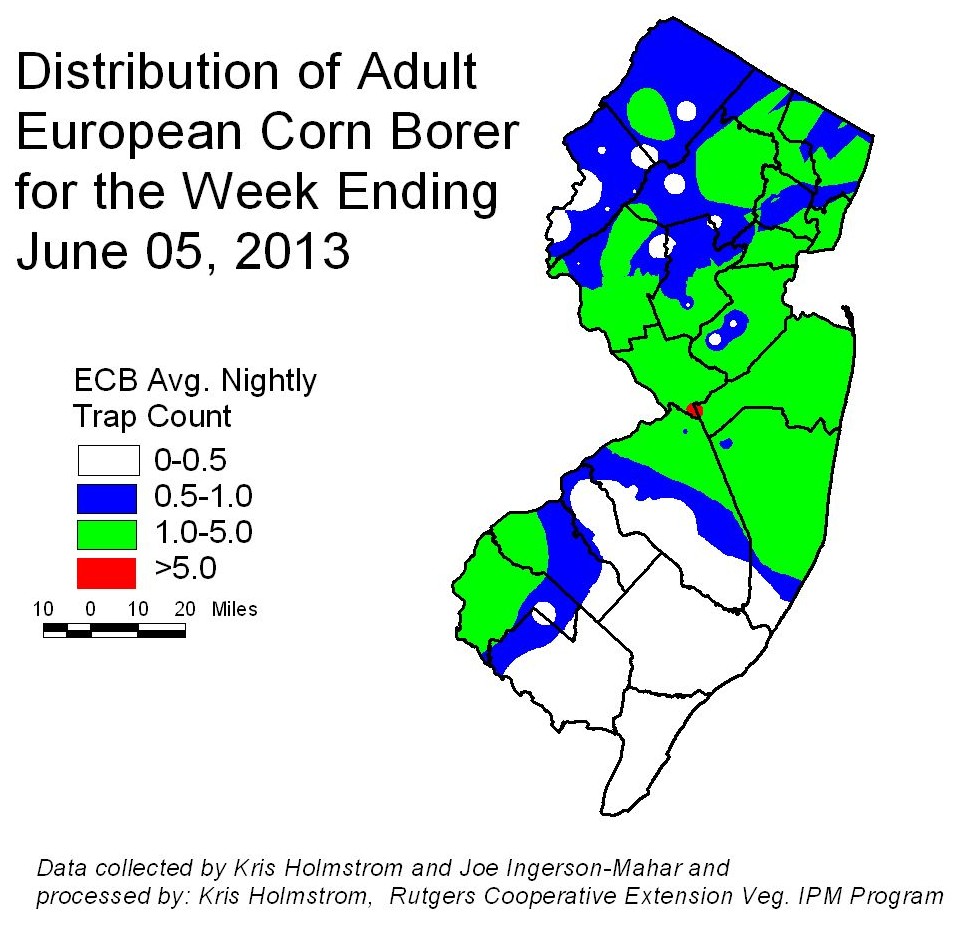
European corn borer (ECB) adult catches have begun to increase again in some parts of the state. This is an indication that the second flight is starting. The most consistent catches at this time are in Salem and Cumberland counties, although low level catches are also being recorded in Morris and Burlington counties (see ECB Map). Plants are largely free of ECB injury at this time, but the situation will change within 2 weeks, as eggs are laid and larvae begin to feed. Consider treating if 12% or more plants exhibit the characteristic “shot-hole” type feeding on leaves and/or droppings or ECB larvae in emerging tassels. Remember to make a full-tassel application to control ECB larvae as they leave the tassel and travel down the stalk to re-enter the plant near the ear shank. This last application is often critical to controlling ear infestations from ECB. Consider weekly applications through the silk stage unless local corn earworm catches dictate a tighter schedule. This will help prevent ear infestations resulting from eggs laid on or near the developing ear.
The highest nightly ECB catches for the previous week are as follows:
| Shirley | 3 | Green Creek | 2 | Eldora | 1 |
| Burlington | 2 | Shiloh | 2 | Long Valley | 1 |
| Chester | 2 | Allentown | 1 | Morristown | 1 |
| Denville | 2 | Downer | 1 | Oldwick | 1 |
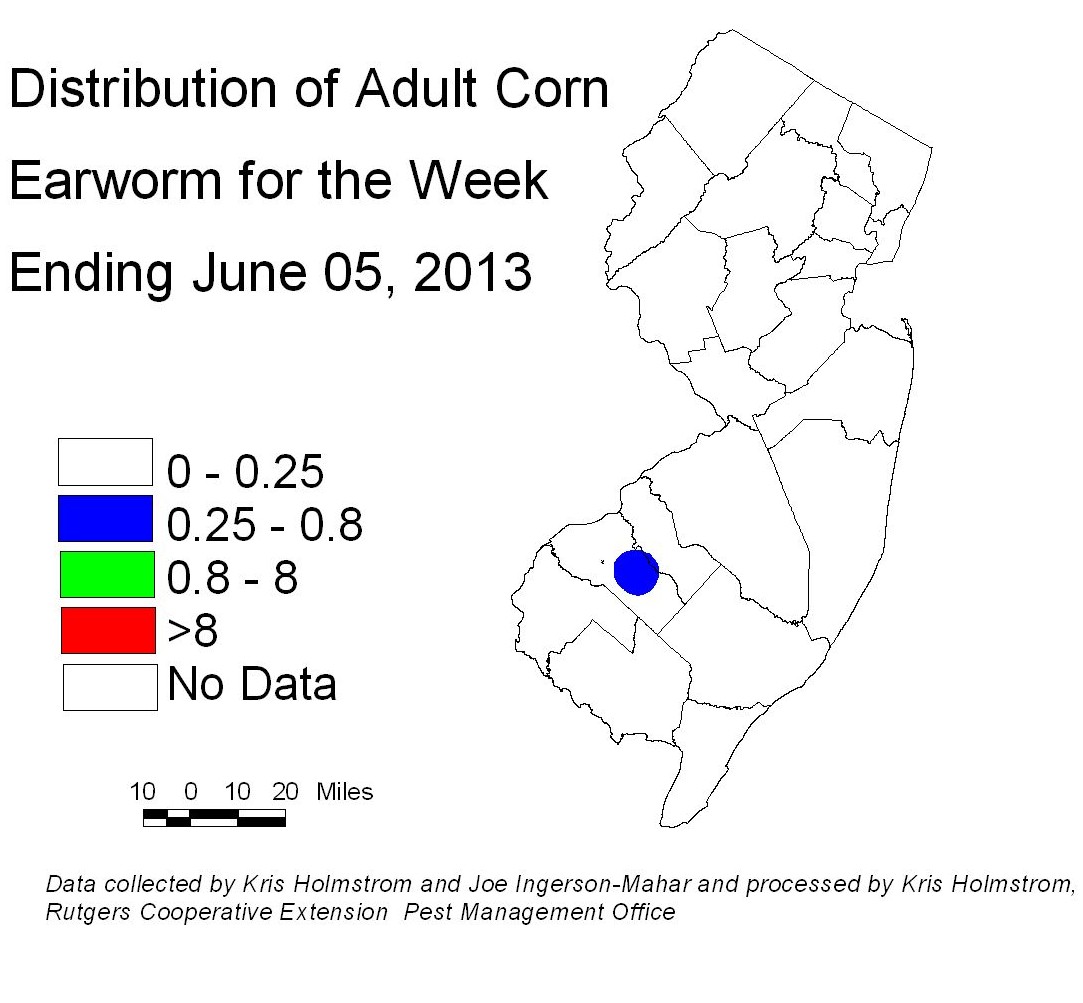
Corn earworm moth (CEW) catches are highly variable at this time. From lower Burlington County south, there are higher numbers, with particular hot-spots in Salem and Cumberland counties (see CEW Map). Pheromone catches near the Camden/Atlantic County border, as well as Salem and Cumberland counties have increased significantly over the past week as well. These moths are a threat to the sweet corn plantings now in the silk stage. As silks begin to appear, pay close attention to CEW catches in local blacklight traps, and treat silking plantings accordingly. Begin silk spray schedules as close to first silk as possible.
The highest nightly CEW catches for the previous week are as follows:
| Centerton | 5 | Downer | 2 | Hammonton | 1 |
| Woodstown | 5 | Indian Mills | 2 | Medford | 1 |
| Cedarville | 3 | Shiloh | 2 | Pedricktown | 1 |
| Jones Island | 3 | Tabernacle | 2 | Shirley | 1 |
Silking Spray Schedules*
South – 3-4 days
Central – 5-6 days
North – 6-7 days
* Note: These are general recommendations. Local trap catches may indicate some variation in the frequency of insecticide applications to silking corn.
Peppers
With the beginning of the second ECB flight, it is a good idea to scout fields at least weekly for the presence of ECB eggs. If 2 or more eggmasses are found in a 50 plant sample (2 leaves/plant), a foliar insecticide application should be considered. Generally, where blacklight trap catches average one or more ECB per night (shaded and crosshatched areas on the map, and blue and green areas on the web version, found at: http://www.pestmanagement.rutgers.edu/IPM/ Vegetable/Pest%20Maps/maparchive.htm) and fruit are greater than ½” in diameter, insecticides are warranted. See the 2012 Commercial Vegetable Production Recommendations for materials useful in controlling ECB. Beet armyworm (BAW) larval populations have been found on various crops in southern NJ. This pest is typically a threat to peppers, and as new plantings become established, growers should be on the alert for this pest. BAW larvae feed on leaves near the growing points on plants. This feeding can result in significant defoliation and ultimately fruit damage, as the larvae begin to feed there as they grow. BAW is another of our southern invaders that has shown up much earlier than expected. Like FAW, BAW can be difficult to control with older materials. See the 2012 Commercial Vegetable Production Recommendations for newer materials useful in controlling BAW.
Brown Marmorated Stinkbug (BMSB)
BMSB adult catches are still low in most blacklight traps, although numbers have been increasing gradually over the past two weeks or so. At present, the only trap averaging more than 5 BMSB/night is near Shirley in Cumberland County (see BMSB map). BMSB has shown a preference for peppers in the past. Growers should pay close attention to activity from local traps to determine when to initiate field monitoring of this pest.
The highest nightly BMSB catches for the previous week are as follows:
| Shirley | 15 | Jones Island | 4 | Indian Mills | 3 |
| Denville | 5 | Morristown | 4 | Oldwick | 3 |
| Green Creek | 5 | Flanders | 3 | Shiloh | 3 |
| Hammonton | 4 | Folsom | 3 | Oxford | 3 |
Tomatoes
With prolonged hot, dry weather, thrips have begun to increase in a number of scouted tomato fields. Flower thrips may be found by tapping upper level fresh flower clusters over an index card. This should be done at least once a week. If there is a sharp increase in the number
of flower clusters having thrips, consider an insecticide to suppress their numbers. These insects can cause a golden colored “fleck” to the surface of fruit. This injury is largely cosmetic, but can result in unmarketable fruit. Generally, if thrips are found in less than 50% of flower clusters, the threat is low. However, if multiple thrips are found in more than half of the samples, and numbers have increased, an insecticide may be warranted. See the 2012 Commercial Vegetable Production Recommendations for newer materials useful in controlling flower thrips.
Fruit IPM Report July 29, 2026
Apples
Disease Management Considerations
Various rots, but mostly bitter rot, are present in orchards throughout the state (Figure 1). Broad-spectrum fungicides, such as captan and ziram, are effective. Captan alone may not adequately suppress severe summer disease pressure. Adding single-site products such as Merivon, Luna Sensation, Pristine, Omega, and Aprovia may improve control. The addition of phosphonate products such as ProPhyt or Rampart to captan sprays can improve control of rots and other summer diseases, including sooty blotch and flyspeck. Time applications before rain events through the growing season according to the cover spray rule of applications every 2” of rain or 14 days, whichever comes first.

Figure 1. Diseases observed on developing apples a) white rot, b) bitter rot, and c) sooty blotch and fly speck.
Insect Update
Codling Moth (CM): Trap captures are increasing in some orchards, but on average, counts remain low for the second generation of codling moth. If you have applied your 2nd-generation insecticides and your trap counts are low (less than 5 moths per trap), additional treatments are not needed.
Scale: Crawlers are active and can be monitored by wrapping black electrical tape covered with double-sided sticky tape around branches with previous scale infestations. Use a hand lens to detect crawlers on the tape. Control options during crawler emergence include Esteem (2 applications/year; 45-day PHI); Centaur (1 application/year; 14-day PHI); Diazinon 50W (2 applications/year; 21-day PHI); and Venerate (0-day PHI; Make two applications 7 days apart starting a week after crawler emergence). Neonicotinoids will have some suppression.
Woolly Apple Aphid (WAA); Green Apple (Spirea) Aphids (GAA): Populations on average remain below treatment levels. A treatment threshold is set at 50% of the terminals infested with live colonies. Predation by lady beetles and other predators and parasitoids has been observed and can help to maintain pest populations below damaging thresholds. Scout in known hotspots for WAA colonies now. Minimize the use of pyrethroids to manage insect pests, as they can knock down beneficial organisms and predators. Research from Dr. Monique Rivera at Cornell University has demonstrated good control from Sefina for WAA in late summer.
Brown Marmorated Stink Bugs: Brown Marmorated Stink Bugs are being captured in orchards statewide. Both adults and nymphs are present (Figure 2). See the NJ Tree Fruit Production guide for effective materials on harvesting fruit.

Figure 2. Brown marmorated stink bug (BMSB) is a pest of ripening fruit.
Dogwood borer: On average, moth captures in pheromone traps continue to decrease. If trap captures remain high in your orchard blocks, consider a coarse trunk application of Assail before August.
Traps
Average Trap Captures in Apple – Southern Counties
| Week | STLM | TABM | CM | OFM | DWB | AMBROSIA BEETLE | BMSB |
| 5/11/2026 | 18 | 11 | 6 | 3 | 25 | 2 | – |
| 5/18/2026 | 16 | 21 | 3 | 10 | 54 | 13 | – |
| 5/25/2026 | 1.3 | 23 | 2 | 2 | 71 | 7 | – |
| 6/1/2026 | 378 | 33 | 3 | 2 | 49 | 6 | 0.4 |
| 6/8/2026 | 258 | 11 | 2 | 1 | 61 | 21 | 1.2 |
| 6/15/2026 | 355 | 4 | 0.6 | 1.5 | 57 | 13 | 0.8 |
| 6/22/2026 | 178 | 5 | 0.6 | 2 | 54 | 8 | 1.2 |
| 6/29/2026 | 504 | 0.3 | 0.1 | 0.5 | 27 | 12 | 0.8 |
| 7/6/2026 | 202 | 1.1 | 1.6 | 0.6 | 25 | 7.5 | 0.6 |
| 7/13/2026 | 226 | 0.9 | 1 | 1 | 33 | 1 | 1.6 |
| 7/20/2026 | 253 | 1.8 | 2 | 3 | 26 | 2.3 | 2.4 |
Average Trap Captures in Apple – Northern Counties
| Week | STLM | TABM | CM | DWB | AMBROSIA BEETLE | BMSB |
| 5/11/2026 | 13.7 | 1.5 | 1.8 | 12.8 | 1.1 | – |
| 5/18/2026 | 8.3 | 13.25 | 2.4 | 18.5 | 10.8 | – |
| 5/25/2026 | 2.2 | 13.75 | 1.2 | 24.5 | 5.1 | – |
| 6/1/2026 | 25.1 | 24.3 | 3.4 | 23.8 | 9.4 | 0.3 |
| 6/8/2026 | 94 | 22.3 | 0.3 | 24.6 | 18 | 1.4 |
| 6/15/2026 | 68 | 22.3 | 1 | 22.6 | 14 | 1.1 |
| 6/22/2026 | 105.9 | 35 | 0.7 | 27.2 | 8.2 | 0.5 |
| 6/29/2026 | 100 | 11.5 | 0.3 | 28.9 | 5.3 | 0.3 |
| 7/6/2026 | 50.2 | 7.3 | 0.6 | 26.4 | 5.2 | 0.2 |
| 7/13/2026 | 52.4 | 7 | 0.5 | 24.8 | 5.3 | 0.2 |
| 7/20/2026 | 69.7 | 2.5 | 0.7 | 27.4 | 4.3 | 0.1 |
Fruit IPM Report July 21, 2026
Apples
Disease Management Considerations
- Rots have been observed on fruit in southern and northern NJ counties (Figure 1).

Figure 1. Bitter rot infection on maturing apple fruit.
Broad-spectrum fungicides, such as captan and ziram, are effective. Captan alone may not adequately suppress severe summer disease pressure. Adding single-site products such as Merivon, Luna Sensation, Pristine, Omega, and Aprovia may improve control. The addition of phosphonate products such as ProPhyt or Rampart to captan sprays can improve control of rots and other summer diseases, including sooty blotch and flyspeck.
- Time applications ahead of the next rain event, where your fungicide coverage may be depleted.
- Where fire blight is present, it is appropriate to prune out infected shoots. Do not cut out infections during wet weather, as bacteria can spread through water. The recommendation is to cut back to last year’s growth, at least 12” back into healthy tissue, and to sterilize pruners between cuttings.
- Maintain coverage of captan, manzate, or ziram before rain events through the growing season according to the cover spray rule of applications every 2” of rain or 14 days, whichever comes first, to reduce the spread of foliar diseases, including Marssonina Blotch, Glomerella Leaf Spot, and Frogeye Leaf Spot. Foliar diseases can contribute to inoculum build-up in the orchard and significant defoliation of the canopy if left untreated.
Insect Update
Codling Moth (CM): Trap captures are increasing in some orchards, but on average, counts remain low for the second generation of codling moth. If you have applied your 2nd-generation insecticides and your trap counts are low (less than 5 moths per trap), additional treatments are not needed.
Scale: Second-generation San Jose scale typically emerges about mid-July. We have observed an increase in crawler activity at some locations. Monitor crawler activity by wrapping black electrical tape covered with double-sided sticky tape around branches with previous scale infestations (Figure 2).

Figure 2. Monitoring San Jose scale crawlers using electrical tape and double-sided sticky tape on a peach tree branch.
Use a hand lens to detect crawlers on the tape. Control options during crawler emergence include Esteem (2 applications/year; 45-day PHI); Centaur (1 application/year; 14-day PHI); Diazinon 50W (2 applications/year; 21-day PHI); and Venerate (0-day PHI; Make two applications 7 days apart starting a week after crawler emergence). Neonicotinoids will have some suppression.
Woolly Apple Aphid (WAA); Green Apple (Spirea) Aphids (GAA): Populations on average remain below treatment levels. A treatment threshold is set at 50% of the terminals infested with live colonies. Predation by lady beetles and other predators and parasitoids has been observed and can help to maintain pest populations below damaging thresholds. Scout in known hotspots for WAA colonies now. Minimize the use of pyrethroids to manage insect pests, as they can knock down beneficial organisms and predators. Research from Dr. Monique Rivera at Cornell University has demonstrated good control of Sefina for WAA in late summer.
Brown Marmorated Stink Bugs: Brown Marmorated Stink Bugs are being captured in orchards statewide. Both adults and nymphs are present. See the NJ Tree Fruit Production guide for effective materials on harvesting fruit.
Dogwood borer: On average, moth captures in pheromone traps continue to decrease. If trap captures continue to be high in your orchard blocks, consider a coarse trunk application of Assail before August.
Traps
Average Trap Captures in Apple – Southern Counties
| Week | STLM | TABM | CM | OFM | DWB | AMBROSIA BEETLE | BMSB |
| 5/11/2026 | 18 | 11 | 6 | 3 | 25 | 2 | – |
| 5/18/2026 | 16 | 21 | 3 | 10 | 54 | 13 | – |
| 5/25/2026 | 1.3 | 23 | 2 | 2 | 71 | 7 | – |
| 6/1/2026 | 378 | 33 | 3 | 2 | 49 | 6 | 0.4 |
| 6/8/2026 | 258 | 11 | 2 | 1 | 61 | 21 | 1.2 |
| 6/15/2026 | 355 | 4 | 0.6 | 1.5 | 57 | 13 | 0.8 |
| 6/22/2026 | 178 | 5 | 0.6 | 2 | 54 | 8 | 1.2 |
| 6/29/2026 | 504 | 0.3 | 0.1 | 0.5 | 27 | 12 | 0.8 |
| 7/6/2026 | 202 | 1.1 | 1.6 | 0.6 | 25 | 7.5 | 0.6 |
| 7/13/2026 | 226 | 0.9 | 1 | 1 | 33 | 1 | 1.6 |
Average Trap Captures in Apple – Northern Counties
| Week | STLM | TABM | CM | DWB | AMBROSIA BEETLE | BMSB |
| 5/11/2026 | 13.7 | 1.5 | 1.8 | 12.8 | 1.1 | – |
| 5/18/2026 | 8.3 | 13.25 | 2.4 | 18.5 | 10.8 | – |
| 5/25/2026 | 2.2 | 13.75 | 1.2 | 24.5 | 5.1 | – |
| 6/1/2026 | 25.1 | 24.3 | 3.4 | 23.8 | 9.4 | 0.3 |
| 6/8/2026 | 94 | 22.3 | 0.3 | 24.6 | 18 | 1.4 |
| 6/15/2026 | 68 | 22.3 | 1 | 22.6 | 14 | 1.1 |
| 6/22/2026 | 105.9 | 35 | 0.7 | 27.2 | 8.2 | 0.5 |
| 6/29/2026 | 100 | 11.5 | 0.3 | 28.9 | 5.3 | 0.3 |
| 7/6/2026 | 50.2 | 7.3 | 0.6 | 26.4 | 5.2 | 0.2 |
| 7/13/2026 | 52.4 | 7 | 0.5 | 24.8 | 5.3 | 0.2 |
Pears
Disease Management
- Foliar diseases should be managed with Mancozeb or Ziram, plus a single-site fungicide, to maintain pressure and inoculum at low levels, protecting fruit and maintaining a healthy orchard going into the next season.
- Where fire blight is present, it is appropriate to prune out infected shoots. Prune out strikes on dry, cooler days, cut back 8-12” back into healthy tissue, and sterilize pruners between cuts.
Insect Update
Pear psylla: Adult populations have decreased compared to previous weeks. If adult psylla are present, options for control include Actara, Assail, and Belay (IRAC group 4A); Sivanto Prime (IRAC group 4D); Delegate (IRAC Group 5); and products containing abamectin (IRAC group 6).
Peaches
Disease Management
-

Figure 3. Declining peach trees due to environmental stress.
Brown rot is appearing in ripening fruit throughout the state. Highly effective rot materials include DMI’s Indar, Cevya, Orius, Quash, and Tilt (FRAC group 3), and Strobilurin materials including Merivon, Luna Sensation, Pristine, and Quadris Top (FRAC group 11), which should be applied beginning 3 – 4 weeks prior to harvest.
- There have been reports of declining peach trees exhibiting yellowing foliage, gummosis, and bark splitting. Several samples have been submitted to the Rutgers Plant Diagnostic Laboratory. There has been one report of Cytospora canker and some insect borer injury observed, but overall the damage and decline have been attributed to weather extremes, including drought and significant fluctuations in temperature that have made certain varieties or trees in certain low-lying locations more vulnerable to abiotic stress, and insect and disease injury (Figure 3). The recommendation is to maintain proper irrigation and fertilization and prune out any visible cankers. Be mindful of pruning practices and avoid mechanical damage to trees to minimize injury.
Insect Update
Oriental Fruit Moth (OFM): A biofix point for OFM was set on 4/2 for southern counties and 4/15 in northern counties. See below for timings for the third generation. Consider treatment if trap captures are above threshold (>8 moths per trap).
|
|||||||||||||||||||||||||
Japanese Beetles: Japanese beetles have been observed feeding significantly on foliage and fruit. Products containing imidacloprid (Admire Pro, Leverage 360) are effective and may be warranted to protect fruit through to harvest.
Scale: Second-generation White Peach Scale crawlers should emerge sometime this week or next. Second-generation San Jose Scale crawlers emerge about 7/17 +/- 8 days. Esteem is a good scale material that has a 14-day PHI for stone fruit. Centaur is also effective, has a 14-day PHI, and can be used only once during the growing season. Venerate has shown efficacy as a pre-harvest treatment against scale and has a 0-day PHI. If using Venerate to control scale insects, make 2 applications 7 days apart, starting a week after crawler emergence.
Tarnished plant bugs and other catfacing insects: Insects are active, but new fruit feeding injury has been minimal.
Brown Marmorated Stink Bugs: Nymphs are active, and numbers continue to increase in orchards statewide. See the NJ Tree Fruit Production guide for effective materials.
Mites: Outbreaks of mites have been observed in a few orchards as a result of hot and dry weather from the previous week. If left unchecked, mites can build up to the point where leaf bronzing is visible by mid- to late July. If leaf damage is heavy enough, next year‘s crop can even be affected. Consider treatment if more than 10 mites per leaf are observed. Control options include Apollo, Savey, Envidor, Nealta, and Nexter. Try to limit miticide use to one application per material class per season.
Traps
Average Trap Captures in Peach – Southern Counties
| Week | OFM | TABM | LPTB | PTB | BMSB |
| 5/11/2026 | 5 | 10 | – | – | – |
| 5/18/2026 | 4 | 20 | – | – | – |
| 5/25/2026 | 2 | 20 | 31 | 1 | – |
| 6/1/2026 | 4 | 46 | 28 | 3 | 0 |
| 6/8/2026 | 8 | 13 | 25 | 3 | 0.75 |
| 6/15/2026 | 5 | 6 | 13 | 3 | 0.75 |
| 6/22/2026 | 6 | 4 | 23 | 7 | 1 |
| 6/29/2026 | 3 | 0.2 | 16 | 6 | 2 |
| 7/6/2026 | 5 | 0.6 | 16 | 4 | 1.3 |
| 7/13/2026 | 9 | 1.4 | 18 | 7 | 3.5 |
Average Trap Captures in Peach – Northern Counties
| Week | OFM | LPTB | PTB |
| 5/11/2026 | 4.4 | 24 | 0 |
| 5/18/2026 | 2.4 | 16.5 | 0.2 |
| 5/25/2026 | 0.7 | 8.75 | 0.1 |
| 6/1/2026 | 1.8 | 11 | 0.5 |
| 6/8/2026 | 0.6 | 8.5 | 0.05 |
| 6/15/2026 | 3.5 | 9.7 | 1.2 |
| 6/22/2026 | 3.4 | 7.4 | 1.6 |
| 6/29/2026 | 2 | 4.6 | 1.1 |
| 7/6/2026 | 1.7 | 8.5 | 1.8 |
| 7/13/2026 | 0.5 | 2.8 | 3.7 |
Blueberries
Insect Update
Scouting was conducted last week across 75 conventional and organic blueberry fields in Burlington and Atlantic Counties. Monitoring of developing fruit indicated an overall decrease in pest activity, including feeding and oviposition by leafrollers, plum curculio, and cherry and cranberry fruitworms.
Aphids: Populations have declined significantly compared with previous weeks, likely due to recent weather conditions and the hardening of new shoot growth.
Spotted-wing drosophila: Trap captures slightly decreased in both Atlantic and Burlington Counties. SWD remains the primary target for insecticide applications (Table 1). For management recommendations for SWD in blueberry and other berry crops, reference Rutgers Cooperative Extension Factsheet FS1246 and SWD Insecticides for Berries.
Blueberry maggot: Adults are also present at low numbers, particularly in fields where picking and pesticide applications have slowed down.
Table 1. Spotted-Wing Drosophila and Blueberry Maggot traps
| Spotted-Wing Drosophila | Blueberry Maggot | |||||||
| Atlantic County | Burlington County | Atlantic County | Burlington County | |||||
| Avg | High | Avg | High | Avg | High | Avg | High | |
| 6/6 | 8.99 | 35 | 2.86 | 7 | 0.03 | 1 | 0 | 0 |
| 6/12 | 9.9 | 46 | 3.7 | 25 | 0 | 0 | 0 | 0 |
| 6/20 | 10.24 | 48 | 8.22 | 35 | 0 | 0 | 0 | 0 |
| 6/27 | 6.96 | 78 | 3.6 | 18 | 0 | 0 | 0 | 0 |
| 7/3 | 29.78 | 273 | 50.9 | 81 | 0.33 | 27 | 0 | 0 |
| 7/10 | 31.2 | 130 | 86.1 | 177 | 0.15 | 12 | 0 | 0 |
| 7/18 | 28.3 | 110 | 59.3 | 125 | 0.07 | 5 | 0.16 | 1 |
Sharp-nosed leafhopper: Trap counts remain low (Table 2).
Oriental beetle: Adults are actively in flight (Table 2).
Table 2. Sharp-nosed Leafhopper and Oriental Beetle traps
| Sharp-nosed Leafhopper | Oriental Beetle | |||||||
| Atlantic County | Burlington County | Atlantic County | Burlington County | |||||
| Avg | High | Avg | High | Avg | High | Avg | High | |
| 6/6 | 1.42 | 16 | 1.25 | 7 | 5.78 | 35 | 2.57 | 14 |
| 6/12 | 0.56 | 12 | 4.8 | 46 | 62 | 340 | 47 | 170 |
| 6/20 | 0.88 | 6 | 1.44 | 12 | 411 | 2025 | 403 | 2025 |
| 6/27 | 0.77 | 9 | 0.37 | 2 | 243 | 2025 | 458 | 2025 |
| 7/3 | 1.5 | 15 | 0.55 | 2 | 466.7 | 2025 | 182.7 | 510 |
| 7/10 | 1.40 | 14 | 0.33 | 2 | 396 | 1970 | 393 | 2025 |
| 7/18 | 0.98 | 13 | 0 | 0 | 191.1 | 2025 | 235 | 1350 |
Scales: Crawler activity of both terrapin scale and Putnam scale declined over the past week (Table 3). Monitoring will continue throughout the fall to detect the emergence of the second crawler generation and determine the appropriate timing for pesticide applications. Continued monitoring will help ensure that management recommendations are based on current pest activity and that insecticide applications are made when crawlers are most susceptible. Scale infestations on fruit also decreased last week (Table 4). For scale management, target the second generation of crawlers with post-harvest applications of diazinon or pyriproxyfen (Esteem).
Table 3. Scale Traps
| Putnam Scale | Terrapin Scale | |||
| Avg | High | Avg | High | |
| 5/23 | 36.85 | 230 | 1.8 | 8 |
| 5/29 | 65.17 | 352 | 21.2 | 41 |
| 6/6 | 136.25 | 402 | 75.25 | 84 |
| 6/12 | 164 | 639 | 96 | 202 |
| 6/20 | 102 | 288 | 85 | 167 |
| 6/27 | 45 | 193 | 32 | 119 |
| 7/3 | 41.7 | 315 | 27.5 | 46 |
| 7/10 | 16.26 | 74 | 24.6 | 61 |
| 7/18 | 6.06 | 25 | 12 | 24 |
Table 4. Scale Infestation on Fruit
| Scale % infestation on fruit | ||
| Avg | High | |
| 6/12 | 0.13 | 2.1 |
| 6/20 | 0.19 | 5.7 |
| 6/27 | 0.06 | 1.5 |
| 7/3 | 0.06 | 1.8 |
| 7/10 | 0.07 | 3.1 |
| 7/18 | 0.02 | 0.9 |
Diseases
The IPM team continues to observe anthracnose and Alternaria, likely associated with mechanical damage caused by picking machine activity.
For recommendations on fungicide products, refer to:
- the 2026 Commercial Blueberry Pest Control Recommendations for New Jersey
- https://extension.rutgers.edu/sites/default/files/2026-03/bb-v42n01.pdf
| % Mummy Berry Infested Fruit | % Anthracnose Infested Fruit | % Alternaria Infested Fruit | ||||
| Avg | High | Avg | High | Avg | High | |
| 6/20 | 0.03 | 0.9 | 0.06 | 2.5 | 0.004 | 0.7 |
| 6/27 | 0.007 | 0.3 | 0.08 | 2.2 | 0.07 | 3 |
| 7/3 | 0.005 | 0.2 | 0.227 | 4.1 | 0.07 | 1.2 |
| 7/10 | 0.002 | 0.1 | 0.20 | 2.5 | 0.13 | 3 |
| 7/18 | 0.001 | 0.1 | 1.23 | 13.1 | 0.43 | 9.3 |
Grapes
Insects
Grape berry moth (GBM): Third-generation GBM is actively flying and laying eggs. The next timing to apply control for GBM is 1620-1710 DD from the biofix date of wild grape bloom (5/19 for Gloucester County). As of July 20, we are currently at 1659 DD (base 47.14°F) in Gloucester County. Consult the Grape berry moth NEWA model for the most accurate forecasting for your area. Consider treatment when 10% or more of the bunches show berry webbing and GBM larval feeding injury. To determine the percent injury, examine 10 bunches on 5 vines in 4 locations. Often, the greenish-brown larvae can be found inside the berry. See the Commercial Grape Pest Control Recommendations for New Jersey for management options.
Spotted lanternfly (SLF): Adult SLF were observed in southern county vineyards this week (Figure 4).

Figure 4. Spotted lanternfly adult in vineyards in South NJ.
See this previous Plant & Pest Advisory post on Management of Spotted Lanternfly in New Jersey Vineyards.

Figure 5. Grape root borer pupal case at the base of a grape vine where the adult moth emerged.
Japanese beetle (JB): Pressure remains high throughout the state with considerable defoliation at some vineyards. See the NJ Commercial Grape Production Guide for more information on insecticides effective for JB.
Grape root borer (GRB): Adults are active and flying in vineyards. Monitoring traps indicate the presence of GRB in the area, but only scouting around the bases of vines will indicate the presence of GRB in the vineyard (Figure 5).
Adult moths will lay eggs July-August. Larvae will enter the soil and migrate to the roots, where they feed and cause damage. Dr. Anne Nielsen and the IPM team will be monitoring vineyards throughout the state to assess GRB population pressure in NJ.
Diseases
- Botrytis has been observed in developing bunches.
- Incidence of downy mildew and powdery mildew has been low in NJ vineyards.
- See the NJ Commercial Grape Production Guide for more information on disease management options.
Fruit IPM Report Week of 7/6/2026
Apples
Disease Management Considerations
- Hot, humid weather will increase the risk of fruit rots, including white rot, bitter rot, black rot, sooty blotch, and flyspeck. Bitter rot symptoms have been observed in southern and northern NJ counties.
- There is likely to be significant shoot vigor this growing season if there is little to no crop load. Cultural control practices will help address excessive growth and minimize the impact of disease in orchards: prune to improve air circulation, thin fruit clusters to reduce humidity and inoculum buildup, and cut out cankers that serve as inoculum sources.
- Broad-spectrum fungicides, such as captan and ziram, are effective. Captan alone may not adequately suppress severe summer disease pressure. Adding single-site products such as Merivon, Luna Sensation, Pristine, Omega, and Aprovia may improve control. The addition of phosphonate products such as ProPhyt or Rampart to captan sprays can improve control of rots and other summer diseases, including sooty blotch and flyspeck.
- Where fire blight is present, it is appropriate to prune out infected shoots. Do not cut out infections during wet weather, as bacteria can spread through water. The recommendation is to cut back to last year’s growth, at least 12” back into healthy tissue, and to sterilize pruners between cuttings.
- Maintain coverage of captan, manzate, or ziram before rain events through the growing season according to the cover spray rule of applications every 2” of rain or 14 days, whichever comes first, to reduce the spread of foliar diseases, including Marssonina Blotch, Glomerella Leaf Spot, and Frogeye Leaf Spot. Foliar diseases can contribute to inoculum build-up in the orchard and significant defoliation of the canopy if left untreated.
Insect Update
Codling Moth (CM): On average, trap captures remain low for the second generation of codling moth in orchards. Consider management if >5 moths are caught per trap.
| Codling Moth Degree Day Timing – Second Generation | ||||||||
| Application and Insecticide Type | ||||||||
| County Area | Biofix | Rimon:
75-100DD + 14-17 days later
|
Intrepid
1150 + 1450 DD Diamides – Altacor, Voliam mixes: (150-200 DD) |
Madex
1250 DD + every 7-9 days during brood hatch (later if first spray is an IGR) |
Standard Insecticides - Delegate, Avaunt, OP’s, carbamates, pyrethroids
1250 DD + 1550 DD
|
|||
| DD | 1150 | 1450 | 1250 | 1250 | 1550 | |||
| Southern | April 20 | N/A | N/A | past | past | past | past | 7/13 |
| Northern | May 5 | N/A | N/A | past | 7/14 | past | past | 7/17 |
Scale: Crawlers continue to be active; however, on average, activity has decreased. Control options during crawler emergence include Neonicotinoids (suppression only), Sivanto, Esteem, and Centaur. See also the scale discussion under the peach section.
Woolly Apple Aphid (WAA); Green Apple (Spirea) Aphids (GAA): Populations on average remain below treatment levels. A treatment threshold is set at 50% of the terminals infested with live colonies. Predation by lady beetles and other predators and parasitoids has been observed and can help to maintain pest populations below damaging thresholds. Scout in known hotspots for WAA colonies now. Minimize the use of pyrethroids to manage insect pests that can knock down beneficial organisms and predators. Research from Dr. Monique Rivera at Cornell University has demonstrated good control of Sefina for WAA in late summer.
Potato leafhopper (PLH): Where adults and nymphs are present, consider treatment, particularly on young, non-bearing fruit trees. The preferred materials for leafhopper control include Actara, Admire, Assail, Belay, Endigo, and Voliam Flexi.
Dogwood borer: Moth captures in pheromone traps continue to decrease. If trap captures continue to be high in your orchard blocks, consider a coarse trunk application of Assail before August.
Traps
Average Trap Captures in Apple – Southern Counties
| Week | STLM | TABM | CM | OFM | DWB | AMBROSIA BEETLE | BMSB |
| 5/11/2026 | 18 | 11 | 6 | 3 | 25 | 2 | – |
| 5/18/2026 | 16 | 21 | 3 | 10 | 54 | 13 | – |
| 5/25/2026 | 1.3 | 23 | 2 | 2 | 71 | 7 | – |
| 6/1/2026 | 378 | 33 | 3 | 2 | 49 | 6 | 0.4 |
| 6/8/2026 | 258 | 11 | 2 | 1 | 61 | 21 | 1.2 |
| 6/15/2026 | 355 | 4 | 0.6 | 1.5 | 57 | 13 | 0.8 |
| 6/22/2026 | 178 | 5 | 0.6 | 2 | 54 | 8 | 1.2 |
| 6/29/2026 | 504 | 0.3 | 0.1 | 0.5 | 27 | 12 | 0.8 |
| 7/6/2026 | 202 | 1.1 | 1.6 | 0.6 | 25 | 7.5 | 0.6 |
Average Trap Captures in Apple – Northern Counties
| Week | STLM | TABM | CM | DWB | AMBROSIA BEETLE | BMSB |
| 5/11/2026 | 13.7 | 1.5 | 1.8 | 12.8 | 1.1 | – |
| 5/18/2026 | 8.3 | 13.25 | 2.4 | 18.5 | 10.8 | – |
| 5/25/2026 | 2.2 | 13.75 | 1.2 | 24.5 | 5.1 | – |
| 6/1/2026 | 25.1 | 24.3 | 3.4 | 23.8 | 9.4 | 0.3 |
| 6/8/2026 | 94 | 22.3 | 0.3 | 24.6 | 18 | 1.4 |
| 6/15/2026 | 68 | 22.3 | 1 | 22.6 | 14 | 1.1 |
| 6/22/2026 | 105.9 | 35 | 0.7 | 27.2 | 8.2 | 0.5 |
| 6/29/2026 | 100 | 11.5 | 0.3 | 28.9 | 5.3 | 0.3 |
| 7/6/2026 | 50.2 | 7.3 | 0.6 | 26.4 | 5.2 | 0.2 |
Pears
Disease Management
- Foliar diseases should be managed with Mancozeb or Ziram, plus a single-site fungicide, to maintain pressure and inoculum at low levels, protecting fruit and maintaining a healthy orchard going into the next season.
Insect Update
- Pear psylla adult and egg stages are present in orchards where populations persist.
- Options for control include Actara, Assail, and Belay (IRAC group 4A); Sivanto Prime (IRAC group 4D); Delegate (IRAC Group 5); and products containing abamectin (IRAC group 6). Other options include Movento (IRAC Group 23). The addition of 0.25-1 gal of summer oil may improve control. Avoid applying oil at high temperatures, and do not mix with captan. Be sure to read and follow the label instructions for adding penetrants to products.
Peaches
Disease Management
- Brown rot is appearing in ripening fruit throughout the state. Highly effective rot materials such as DMI’s (FRAC group 3) and Strobilurins (FRAC group 11) should be applied beginning 3-4 weeks prior to harvest. See the NJ Commercial Tree Fruit Production Guide for more information.
- Bacterial spot infections occur anytime from petal fall until after harvest. To properly control fruit infection, sprays should be applied from petal fall until 15 days before harvest. Mycoshield, FireLine, and fixed-coppers have provided satisfactory disease control. Generally, we recommend gradually lowering the rate as the season progresses. The rate applied will depend on the formulation. Dr. Lalancette published a chart listing common copper formulations and rates for peach and nectarine applications.
Insect Update
Oriental Fruit Moth (OFM): A biofix point for OFM was set on 4/2 for southern counties and 4/15 in northern counties. See below for timings for the third generation. Consider treatment if trap captures are above threshold (>8 moths per trap).
| OFM 3rd Generation Timing | ||||
| Insecticide Type | ||||
| County/Region | Degree Days by 7/13 base 45 | Conventional
2100-2200 2450-2500 |
Intrepid/Rimon
2000-2100 2350-2450 |
Diamides/Virus
2025-2150 2375-2450 |
| Gloucester – Southern | 2179 | 1st –7/11-7/13
2nd – 7/22-7/24 |
1st –past
2nd – 7/18-7/22 |
1st –7/8-7/12
2nd – 7/19-7/22 |
| Middlesex – Northern | 1984 | 1st – 7/16-7/19
2nd – too far off |
1st – 7/14-7/16
2nd – too far off |
1st – 7/15-7/17
2nd – too far off |
Japanese Beetles: Japanese beetles have been observed feeding in orchards. Products containing imidacloprid (Admire Pro, Leverage 360) are effective and have a short preharvest interval.
Scale: Where crawlers are present and active, treatment options include Centaur, Sivanto, and neonicotinoids (for suppression only). Movento and Esteem should have been applied a week before or at the start of crawler emergence.
Tarnished plant bugs and other catfacing insects: Insects are active, but new fruit feeding injury has been minimal.
Brown Marmorated Stink Bugs: Brown Marmorated Stink Bugs are present at low to moderate levels, and numbers are increasing from previous weeks in orchards statewide. Eggs are hatching, and nymphs are present. See the NJ Tree Fruit Production guide for effective materials.
Lesser and Greater Peach Tree Borers: Male moth captures in pheromone traps decreased in number from previous weeks. Mating disruption is recommended to maintain low populations in your orchards.
Traps
Average Trap Captures in Peach – Southern Counties
| Week | OFM | TABM | LPTB | PTB | BMSB |
| 5/11/2026 | 5 | 10 | – | – | – |
| 5/18/2026 | 4 | 20 | – | – | – |
| 5/25/2026 | 2 | 20 | 31 | 1 | – |
| 6/1/2026 | 4 | 46 | 28 | 3 | 0 |
| 6/8/2026 | 8 | 13 | 25 | 3 | 0.75 |
| 6/15/2026 | 5 | 6 | 13 | 3 | 0.75 |
| 6/22/2026 | 6 | 4 | 23 | 7 | 1 |
| 6/29/2026 | 3 | 0.2 | 16 | 6 | 2 |
| 7/6/2026 | 5 | 0.6 | 16 | 4 | 1.3 |
Average Trap Captures in Peach – Northern Counties
| Week | OFM | LPTB | PTB |
| 5/11/2026 | 4.4 | 24 | 0 |
| 5/18/2026 | 2.4 | 16.5 | 0.2 |
| 5/25/2026 | 0.7 | 8.75 | 0.1 |
| 6/1/2026 | 1.8 | 11 | 0.5 |
| 6/8/2026 | 0.6 | 8.5 | 0.05 |
| 6/15/2026 | 3.5 | 9.7 | 1.2 |
| 6/22/2026 | 3.4 | 7.4 | 1.6 |
| 6/29/2026 | 2 | 4.6 | 1.1 |
| 7/6/2026 | 1.7 | 8.5 | 1.8 |
Blueberries
Insect Update
- Scouting was conducted last week across 105 conventional and organic blueberry fields in Burlington and Atlantic Counties.
- Monitoring of developing fruit indicated an overall decline in pest activity, including feeding and/or oviposition by leafrollers, plum curculio, and cherry and cranberry fruitworms.
- Aphid populations have declined substantially compared with previous weeks, likely due to recent weather conditions and the hardening of new shoot growth, which has reduced the availability of suitable feeding sites.
- Spotted-wing drosophila trap counts decreased in Atlantic County but increased in Burlington County. In fields where harvesting is still ongoing, spotted-wing drosophila remains the primary target for insecticide applications (Table 1).
- Blueberry maggot activity has been increasing in the last two weeks (Table 1), likely due to reduced insecticide applications in fields where traps are located and where harvest has been completed for the monitored varieties.
Table 1. Spotted-Wing Drosophila and Blueberry Maggot traps
| Spotted-Wing Drosophila | Blueberry Maggot | |||||||
| Atlantic County | Burlington County | Atlantic County | Burlington County | |||||
| Avg | High | Avg | High | Avg | High | Avg | High | |
| 6/6 | 8.99 | 35 | 2.86 | 7 | 0.03 | 1 | 0 | 0 |
| 6/12 | 9.9 | 46 | 3.7 | 25 | 0 | 0 | 0 | 0 |
| 6/20 | 10.24 | 48 | 8.22 | 35 | 0 | 0 | 0 | 0 |
| 6/27 | 6.96 | 78 | 3.6 | 18 | 0 | 0 | 0 | 0 |
| 7/3 | 29.78 | 273 | 50.9 | 81 | 0.33 | 27 | 0 | 0 |
| 7/10 | 31.2 | 130 | 86.1 | 177 | 0.15 | 12 | 0 | 0 |
- Sharp-nosed leafhopper trap counts remain low (Table 2).
- Oriental beetle adults are actively in flight (Table 2).
Table 2. Sharp-nosed Leafhopper and Oriental Beetle Traps
| Sharp-nosed Leafhopper | Oriental Beetle | |||||||
| Atlantic County | Burlington County | Atlantic County | Burlington County | |||||
| Avg | High | Avg | High | Avg | High | Avg | High | |
| 6/6 | 1.42 | 16 | 1.25 | 7 | 5.78 | 35 | 2.57 | 14 |
| 6/12 | 0.56 | 12 | 4.8 | 46 | 62 | 340 | 47 | 170 |
| 6/20 | 0.88 | 6 | 1.44 | 12 | 411 | 2025 | 403 | 2025 |
| 6/27 | 0.77 | 9 | 0.37 | 2 | 243 | 2025 | 458 | 2025 |
| 7/3 | 1.5 | 15 | 0.55 | 2 | 466.7 | 2025 | 182.7 | 510 |
| 7/10 | 1.40 | 14 | 0.33 | 2 | 396 | 1970 | 393 | 2025 |
- Scale crawler activity on average has decreased slightly from previous weeks (Table 3). Scale infestations on fruit, on average, remain low (Table 4).
Table 3. Scale Traps
| Putnam Scale | Terrapin Scale | |||
| Avg | High | Avg | High | |
| 5/23 | 36.85 | 230 | 1.8 | 8 |
| 5/29 | 65.17 | 352 | 21.2 | 41 |
| 6/6 | 136.25 | 402 | 75.25 | 84 |
| 6/12 | 164 | 639 | 96 | 202 |
| 6/20 | 102 | 288 | 85 | 167 |
| 6/27 | 45 | 193 | 32 | 119 |
| 7/3 | 41.7 | 315 | 27.5 | 46 |
| 7/10 | 16.26 | 74 | 24.6 | 61 |
Table 4. Scale Infestation on Fruit
| Scale % infestation on fruit | ||
| Avg | High | |
| 6/12 | 0.13 | 2.1 |
| 6/20 | 0.19 | 5.7 |
| 6/27 | 0.06 | 1.5 |
| 7/3 | 0.06 | 1.8 |
| 7/10 | 0.07 | 3.1 |
Diseases
The IPM team continues to observe anthracnose in fields where fruit has not yet been harvested.
The IPM team is also likely observing an increase in Alternaria fruit rot due to the increased use of mechanical harvesters. For fungicide recommendations, please refer to the Rutgers Blueberry Commercial Production Guide or https://extension.rutgers.edu/sites/default/files/2026-03/bb-v42n01.pdf
| % Mummy Berry Infested Fruit | % Anthracnose Infested Fruit | % Alternaria Infested Fruit | ||||
| Avg | High | Avg | High | Avg | High | |
| 6/20 | 0.03 | 0.9 | 0.06 | 2.5 | 0.004 | 0.7 |
| 6/27 | 0.007 | 0.3 | 0.08 | 2.2 | 0.07 | 3 |
| 7/3 | 0.005 | 0.2 | 0.227 | 4.1 | 0.07 | 1.2 |
| 7/10 | 0.002 | 0.1 | 0.20 | 2.5 | 0.13 | 3 |
For blueberry production and management recommendations, please reference the recently revised 2026 Commercial Blueberry Pest Control Recommendations for New Jersey.
Grapes
Insects
- Grape berry moth (GBM) second-generation larvae are protected within berries and complete their development.
- Scout vineyards for GBM damage and determine if the number of damaged clusters from the previous generation exceeds the treatment threshold of 10%. If above threshold, consider treatment for the next generation.
- The next timing for GBM control measures should be applied starting at 1620 DD from the biofix date of wild grape bloom. As of July 14, we are currently at 1444 DD (base 47.14°F) in Gloucester County with a biofix date of 5/19. Consult the Grape berry moth NEWA model for the most accurate forecasting for your area. See the Commercial Grape Pest Control Recommendations for New Jersey for management options.
Fruit IPM Report for Week of 6/29/2026
Apples
Disease Management Considerations
- Bitter rot symptoms observed in southern and northern counties.
- Hot, humid weather will increase the risk of fruit rots, including white rot, bitter rot, black rot, sooty blotch, and flyspeck.
- Cultural control practices will help to minimize impact from disease in orchards: prune for improved air circulation, thin fruit clusters to reduce humidity and inoculum buildup, and cut out cankers that serve as inoculum sources.
- Broad-spectrum fungicides, such as captan and ziram, are effective. Captan alone may not adequately suppress severe summer disease pressure.
- Adding single-site products such as Merivon, Luna Sensation, Pristine, Omega, and Aprovia may improve control. The addition of phosphonate products such as ProPhyt or Rampart to captan sprays can improve control of rots and other summer diseases, including sooty blotch and flyspeck. It may help suppress scab infections when present.
- Where fire blight is present, it is appropriate to prune out infected shoots. Do not cut out infections during wet weather, as bacteria can spread through water. The recommendation is to cut back to last year’s growth, at least 12” back into healthy tissue, and to sterilize pruners between cuttings.
- Maintain coverage of captan, manzate, or ziram before rain events through the growing season according to the cover spray rule of applications every 2” of rain or 14 days, whichever comes first, to reduce the spread of foliar diseases, including Marssonina Blotch, Glomerella Leaf Spot, and Frogeye Leaf Spot. Foliar diseases can contribute to inoculum build-up in the orchard and significant defoliation of the canopy if left untreated.
- Rainy seasons require tighter fungicide intervals to maintain coverage. Consider refreshing fungicide protection before major rain events.
Insect Update
Codling Moth (CM): On average, trap counts remain low in orchards across the state, with some numbers increasing at a few sites. Second-generation timings are updated below. Consider management if >5 moths are caught per trap or if fruit injury is observed (Figure 1).

Figure 1. Codling moth injury and larva in developing fruit.
| Codling Moth Degree Day Timing – Second Generation | ||||||||
| Application and Insecticide Type | ||||||||
| County Area | Biofix | Rimon:
75-100DD + 14-17 days later
|
Intrepid
1150 + 1450 DD Diamides – Altacor, Voliam mixes: (150-200 DD) |
Madex
1250 DD + every 7-9 days during brood hatch (later if first spray is an IGR) |
Standard Insecticides – Delegate, Avaunt, OP’s, carbamates, pyrethroids
1250 DD + 1550 DD
|
|||
| DD | 1150 | 1450 | 1250 | 1250 | 1550 | |||
| Southern | April 20 | N/A | N/A | past | 7/10 | past | past | 7/13 |
| Northern | May 5 | N/A | N/A | past | 7/13 | 7/6 | 7/6 | 7/17 |
Scale: Crawler emergence continues, and injury has been observed on fruit in some orchards (Figure 2).

Figure 2. San Jose scale crawlers on apple.
Control options during crawler emergence include Neonicotinoids (suppression only), Sivanto, Esteem, and Centaur. See also the scale discussion under the peach section.
Woolly Apple Aphid (WAA); Green Apple (Spirea) Aphids (GAA): Populations continue to build in some orchards statewide, but on average remain below treatment levels. A treatment threshold is set at 50% of the terminals infested with live colonies. Predation by lady beetles and other predators and parasitoids has been observed and can help to maintain pest populations below damaging thresholds. Scout in known hotspots for WAA colonies now. Minimize use of pyrethroids to manage insect pests, including Brigade and Mustang Max, which can flare pest populations and knock down beneficial organisms and predators. Movento will control WAA and GAA and can suppress scale when crawlers are active. Research from Dr. Monique Rivera at Cornell University has demonstrated good control from Sefina for WAA and can be considered instead of late Movento applications.

Figure 3. Potato leafhopper injury in new apple shoots.
Potato leafhopper (PLH): Adults and nymphs are present and increasing in apple orchards throughout the state. Feeding damage from PLH results in “hopperburn” symptoms, which include browning & necrosis along leaf margins, along with leaf curling and stunting (Figure 3).
Consider treatment, particularly on young, non-bearing fruit trees. The preferred materials for leafhopper control include Actara, Admire, Assail, Belay, Endigo, and Voliam Flexi.
Ambrosia Beetle: Trap captures have been low in orchards across the state. Monitor for signs of stress or infested trees with “toothpicks” from boring activity and consider trunk sprays if needed.
Dogwood borer: Adult male moths caught in pheromone traps decreased significantly from previous weeks, indicating peak flight activity is coming to an end.
Traps
Average Trap Captures in Apple – Southern Counties
| Week | STLM | TABM | CM | OFM | DWB | AMBROSIA BEETLE | BMSB |
| 5/11/2026 | 18 | 11 | 6 | 3 | 25 | 2 | – |
| 5/18/2026 | 16 | 21 | 3 | 10 | 54 | 13 | – |
| 5/25/2026 | 1.3 | 23 | 2 | 2 | 71 | 7 | – |
| 6/1/2026 | 378 | 33 | 3 | 2 | 49 | 6 | 0.4 |
| 6/8/2026 | 258 | 11 | 2 | 1 | 61 | 21 | 1.2 |
| 6/15/2026 | 355 | 4 | 0.6 | 1.5 | 57 | 13 | 0.8 |
| 6/22/2026 | 178 | 5 | 0.6 | 2 | 54 | 8 | 1.2 |
| 6/29/2026 | 504 | 0.3 | 0.1 | 0.5 | 27 | 12 | 0.8 |
Average Trap Captures in Apple – Northern Counties
| Week | STLM | TABM | CM | DWB | AMBROSIA BEETLE | BMSB |
| 5/11/2026 | 13.7 | 1.5 | 1.8 | 12.8 | 1.1 | – |
| 5/18/2026 | 8.3 | 13.25 | 2.4 | 18.5 | 10.8 | – |
| 5/25/2026 | 2.2 | 13.75 | 1.2 | 24.5 | 5.1 | – |
| 6/1/2026 | 25.1 | 24.3 | 3.4 | 23.8 | 9.4 | 0.3 |
| 6/8/2026 | 94 | 22.3 | 0.3 | 24.6 | 18 | 1.4 |
| 6/15/2026 | 68 | 22.3 | 1 | 22.6 | 14 | 1.1 |
| 6/22/2026 | 105.9 | 35 | 0.7 | 27.2 | 8.2 | 0.5 |
| 6/29/2026 | 100 | 11.5 | 0.3 | 28.9 | 5.3 | 0.3 |
Pears
Disease Management
- Foliar diseases should be managed with Mancozeb or Ziram, plus a single-site fungicide, to maintain pressure and inoculum at low levels, protecting fruit and maintaining a healthy orchard going into the next season.
- Where fire blight is present, it is appropriate to prune out infected shoots. Prune out strikes on dry, cooler days, cut back 8-12” back into healthy tissue, and sterilize pruners between cuts.
Insect Update
- Pear psylla adult and egg stages are present in orchards where populations persist.
- Options for control include Actara, Assail, and Belay (IRAC group 4A); Sivanto Prime (IRAC group 4D); Delegate (IRAC Group 5); and products containing abamectin (IRAC group 6). Other options include Movento (IRAC Group 23). The addition of 0.25-1 gal of summer oil may improve control. Avoid applying oil at high temperatures, and do not mix with captan. Be sure to read and follow the label instructions for adding penetrants to products.
Peaches
Disease Management
- Brown rot can be found on developing fruit in southern NJ orchards (Figure 4).

Figure 4. Brown rot on mature fruit.
Growers should rely on a captan-based program for mid-season covers, followed by better materials during the last 3 weeks’ pre-harvest, where fruit is present and being harvested. See the New Jersey Commercial Tree Fruit Production Guide for more information.
Insect Update
Oriental Fruit Moth (OFM): We are past the window to target the second generation.
Japanese Beetles: Japanese beetles have been observed feeding in orchards. Products containing imidacloprid (Admire Pro, Leverage 360) are effective and have a short preharvest interval.
Scale: Crawler emergence is active in orchards across the state. If crawlers are present, treatment options include Movento, Esteem, Centaur, Sivanto, and neonicotinoids (for suppression only). Movento and Esteem should be applied a week before or at the start of crawler emergence.
Thrips: Thrips injury has been found in orchards throughout the state (Figure 5).

Figure 5. Russeting on peach from early thrips feeding injury.
Delegate or Entrust at the highest labeled rate are the usual recommended materials for thrips present in stone fruit. Time applications starting at petal fall to reduce injury. Lannate also has activity on thrips. These materials all have short PHI’s and may be applied close to harvest where thrips are observed.
Tarnished plant bugs and other catfacing insects: Insects are active, but new fruit feeding injury has been minimal.
Brown Marmorated Stink Bugs: Brown Marmorated Stink bugs are present at low to moderate levels and numbers are increasing from previous weeks in orchards statewide. Eggs are hatching and nymphs are present (Figure 6). See the NJ Tree Fruit Production guide for effective materials.
Lesser and Greater Peach Tree Borers: Male moth captures in pheromone traps decreased in number from previous weeks. Mating disruption is recommended to maintain low populations in your orchards.
Traps
Average Trap Captures in Peach – Southern Counties
| Week | OFM | TABM | LPTB | PTB | BMSB |
| 5/11/2026 | 5 | 10 | – | – | – |
| 5/18/2026 | 4 | 20 | – | – | – |
| 5/25/2026 | 2 | 20 | 31 | 1 | – |
| 6/1/2026 | 4 | 46 | 28 | 3 | 0 |
| 6/8/2026 | 8 | 13 | 25 | 3 | 0.75 |
| 6/15/2026 | 5 | 6 | 13 | 3 | 0.75 |
| 6/22/2026 | 6 | 4 | 23 | 7 | 1 |
| 6/29/2026 | 3 | 0.2 | 16 | 6 | 2 |
Average Trap Captures in Peach – Northern Counties
| Week | OFM | LPTB | PTB |
| 5/11/2026 | 4.4 | 24 | 0 |
| 5/18/2026 | 2.4 | 16.5 | 0.2 |
| 5/25/2026 | 0.7 | 8.75 | 0.1 |
| 6/1/2026 | 1.8 | 11 | 0.5 |
| 6/8/2026 | 0.6 | 8.5 | 0.05 |
| 6/15/2026 | 3.5 | 9.7 | 1.2 |
| 6/22/2026 | 3.4 | 7.4 | 1.6 |
| 6/29/2026 | 2 | 4.6 | 1.1 |
Blueberries
Insect Update
Scouting was conducted last week across 119 conventional and organic blueberry fields in Burlington and Atlantic Counties.
This week, the IPM monitoring team observed signs of cherry fruitworm infestation in developing fruit, although infestation levels remain low.
Aphids: Aphid populations remain low at an average of 1–5 aphids per shoot.
Spotted-wing drosophila & Blueberry maggot: Trap captures increased in both Atlantic and Burlington Counties for spotted-wing drosophila. An increase in blueberry maggot trap captures were observed in Atlantic County (Table 1).
Table 1. Spotted-Wing Drosophila and Blueberry Maggot Traps
| Spotted-Wing Drosophila | Blueberry Maggot | |||||||
| Atlantic County | Burlington County | Atlantic County | Burlington County | |||||
| Avg | High | Avg | High | Avg | High | Avg | High | |
| 6/6 | 8.99 | 35 | 2.86 | 7 | 0.03 | 1 | 0 | 0 |
| 6/12 | 9.9 | 46 | 3.7 | 25 | 0 | 0 | 0 | 0 |
| 6/20 | 10.24 | 48 | 8.22 | 35 | 0 | 0 | 0 | 0 |
| 6/27 | 6.96 | 78 | 3.6 | 18 | 0 | 0 | 0 | 0 |
| 7/3 | 29.78 | 273 | 50.9 | 81 | 0.33 | 27 | 0 | 0 |
SWD remains the primary target for insect management. When selecting insecticides, special consideration should be given to products with shorter pre-harvest intervals (PHIs) that provide effective control of these pests while also helping suppress scale crawlers, aphids, and other pest populations above threshold levels. For more information, see the Blueberry Bulletin or Commercial Blueberry Pest Control Recommendations for New Jersey for recommendations.
Diseases
The IPM team continues to observe higher levels of anthracnose than in the previous week. The recent wet weather is conducive for anthracnose development on berries. Fungicide applications are still merited in fields where anthracnose has been reported. Phosphite materials are effective and have a 0-day PHI.
Additionally, mummy berry and Alternaria have been observed during scouting. The increased incidence of Alternaria is most likely associated with fruit injury caused by mechanical harvesting.
For fungicide recommendations, refer to the Rutgers Blueberry Commercial Production Guide or https://extension.rutgers.edu/sites/default/files/2026-03/bb-v42n01.pdf
| % Mummy Berry Infested Fruit | % Anthracnose Infested Fruit | % Alternaria Infested Fruit | ||||
| Avg | High | Avg | High | Avg | High | |
| 6/20 | 0.03 | 0.9 | 0.06 | 2.5 | 0.004 | 0.7 |
| 6/27 | 0.007 | 0.3 | 0.08 | 2.2 | 0.07 | 3 |
| 7/3 | 0.005 | 0.2 | 0.227 | 4.1 | 0.07 | 1.2 |
Grapes
Insects
Grape Berry Moth (GBM): Second generation adult GBM continue to be captured in pheromone traps and larval activity in bunches has been observed. The degree day timing to treat the second generation has passed. Second generation grape berry moth is not an automatic pest problem in New Jersey vineyards. The need for control is determined by examining bunches for larval activity, beginning in early‐July. An insecticide application is warranted when 5% of the bunches display larval feeding signs.
Japanese beetle: Japanese beetles are present in vineyards feeding on foliage. While established vines can tolerate some foliar injury, young or stressed vines are more susceptible to damage. If damage is severe, Assail, Baythroid, Belay, Danitol, or Sevin should provide the necessary control.
Spotted lanternfly: Population levels have been variable across the state, with average counts of nymphs remaining low compared to previous years. Fourth instars have been recently observed.
Diseases
Reports of disease incidence of downy mildew, powdery mildew, black rot, Botrytis bunch rot, and ripe rot have been minimal. Recommended materials can be found in the New Jersey Commercial Grape Production Guide.
- « Previous Page
- 1
- …
- 45
- 46
- 47
- 48
- 49
- …
- 58
- Next Page »