Search Results for: allium leaf

Veg IPM Update: Allium leaf miner 04/30/18

Allium Leaf Miner

Allium leaf miner (ALM) adults (flies) were trapped on sticky cards, and moderate levels of feeding signs were discovered late last week at sites in Lawrenceville and Pennington (Mercer County).  Additionally, volunteer garlic in the Chesterfield area of Burlington County was infested.  As yet, no adult activity or feeding has been found at the more northern sites in Milford, Pittstown and Asbury (Hunterdon County).  Affected crops include chives, scallions, garlic and leeks.  Although we are 2-3 weeks behind last spring’s development, the ALM flight now seems to be well underway in parts of the state.  With warm weather forecast for the remainder of this week, growers in the northernmost counties should expect infestations to occur there as well.

Floating row covers, kept on until the first flight ends will help minimize access to plants.  Insecticide applications targeting adults may be helpful as well, although frequency of applications is uncertain.  Spinosyn materials (Radiant, Entrust (OMRI approved)), pyrethroids (Mustang Maxx, Warrior), and pyrethrin materials (Pyganic (OMRI approved)), neonicotinoids (Scorpion, Venom) and the insect growth regulator Trigard are labeled for miner control.

Adult activity and observations of feeding will be reported on in the IPM Update as they occur.  At this time, all growers should respond to the onset of the first adult generation.  We will attempt to identify the end of the first flight so that growers know when the risk of infestation has abated.


Veg IPM Update: Allium leaf miner 04/12/18

Allium Leaf Miner

Allium leaf miner (ALM) adults (flies) and a very limited number of leaves with feeding signs were discovered Thursday at sites in Lawrenceville and Pennington (Mercer County).  As yet, no adult activity or feeding has been found at the more northern sites in Milford, Pittstown and Asbury (Hunterdon County).  Affected crops include chives, scallions, garlic and leeks.  Indications are that we are 2-3 weeks behind last year’s development, but warmer weather through the coming weekend will surely result in more apparent infestations.

Floating row covers, kept on until the first flight ends will help minimize access to plants.  Insecticide applications targeting adults may be helpful as well, although frequency of applications is uncertain.  Spinosyn materials (Radiant, Entrust (OMRI approved)), pyrethroids (Mustang Maxx, Warrior), and pyrethrin materials (Pyganic (OMRI approved)), neonicotinoids (Scorpion, Venom) and the insect growth regulator Trigard are labeled for miner control.

Adult activity and observations of feeding will be reported on in the IPM Update as they occur.  At this time, all growers should respond to the onset of the first adult generation.  We will attempt to identify the end of the first flight so that growers know when the risk of infestation has abated.


Veg IPM Update: Allium leaf miner 04/06/18

Allium Leaf Miner


Allium leaf miner (ALM) traps (sticky cards) were deployed on March 20, in overwintered allium crops at sites in Lawrenceville and Pennington (Mercer County), and Milford, Pittstown and Asbury (Hunterdon County).  These traps have been checked weekly since that time and have returned no positive ALM catches.  Host crops at these sites (chive, scallion and garlic)  were free of injury as of April 5.  In 2017, traps placed at these locations were already catching ALM adults by the end of March, and feeding injury was easily discovered on chives.  Indications are that we are 2-3 weeks behind last year’s development.

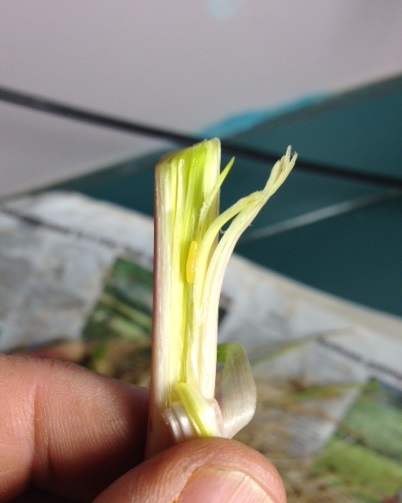
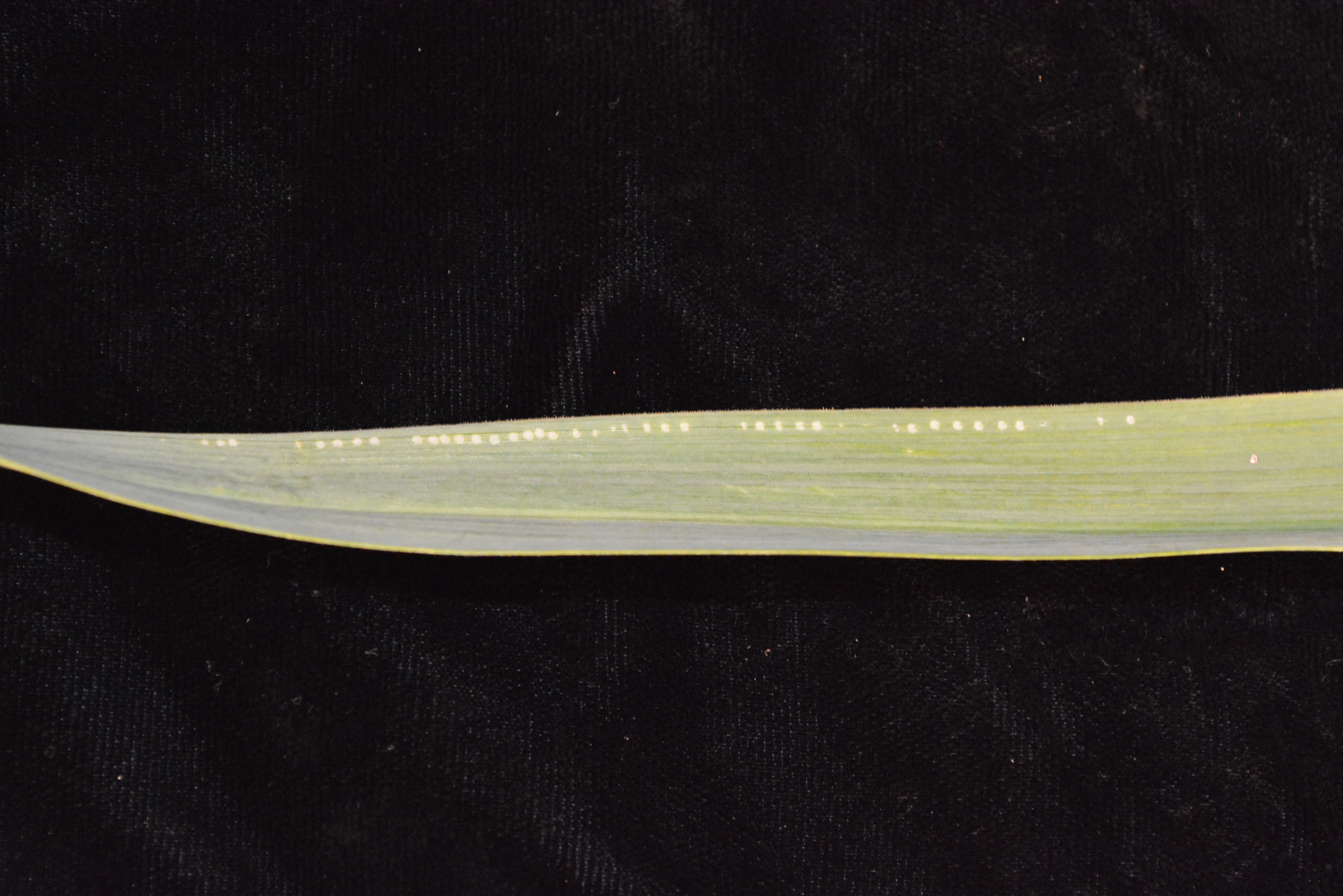
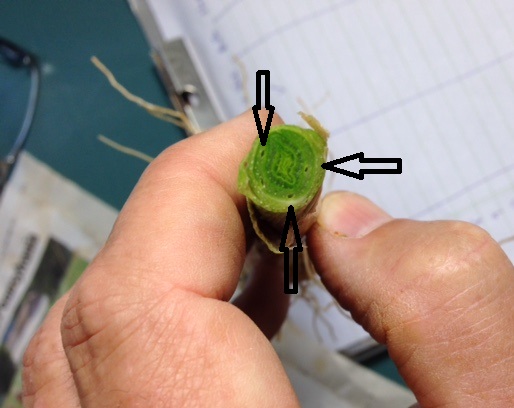
We do have confirmed injury and sighting of adult ALM on scallions in high tunnel production in the Pennington area, but insect development in this warmer protected environment is not indicative of what is occurring outdoors.  As weather warms, expect adults to emerge and become active.  They will feed on available allium crops, which will include overwintered chives and garlic as well as newly transplanted onions and scallions and leeks.  Look for characteristic dots (see photo at center) on the upper portion of upright leaves.  Expect that any plant with these feeding/egg laying scars is infested.  Larvae will tunnel downward (see photo at right); ultimately pupating in the neck of the plant (see late instar larva at left).

Floating row covers, kept on until the first flight ends will help minimize access to plants.  Insecticide applications targeting adults may be helpful as well, although frequency of applications is uncertain.  Spinosyn materials (Radiant, Entrust (OMRI approved)), pyrethroids (Mustang Maxx, Warrior), and pyrethrin materials (Pyganic (OMRI approved)), neonicotinoids (Scorpion, Venom) and the insect growth regulator Trigard are labeled for miner control.

Adult activity and observations of feeding will be reported on in the IPM Update as they occur.  We will attempt to identify the beginning and end of the first flight so that growers know when they should initiate control tactics and when the risk of infestation has abated.


Veg IPM Update: Allium leaf miner 10/25/17

Allium Leaf Miner


A sample of unsprayed/unprotected volunteer garlic near Asbury on the Hunterdon/Warren County border today showed 68% of plants infested with allium leaf miner (ALM).  These maggots were all later stage, and found in the necks, about 1″ above the bulb (see photo at upper left).  We should expect that all untreated/unprotected allium crops are similarly affected at this time.  Interestingly, 100% of infested plants had visible feeding/egg laying scars (see photo at center above), while 100% of uninfested plants showed no visible signs.  None of the plants had mines visible on the surface, but cross sections of the neck revealed clean tunnels the maggots had created on their way down (see photo at right, above).

Our colleagues at Cornell, operating in the Hudson Valley had notified us that they had had no success catching ALM adults on sticky cards, and we have had the same difficulty in NJ this Fall.  This is unlike our experience in the Spring, when we were able to catch numerous individuals at nearly every trap site.  Additionally, the generation of adults emerging in the Spring here in NJ heavily infested chives; the earliest possible host.  This Fall, chives appear to be largely uninfested, while onions, scallions, and leeks are showing the most feeding/egg laying scars.

Be aware that if no program of protection was enacted roughly 3 weeks ago, Fall allium crops may be heavily infested at this time.


Allium Leafminer Alert III in New Jersey

As of Friday, April 21, we confirmed that ALM is in south Jersey and it is likely that it can be found throughout the state.  Infested field chives were found in East Vineland as well as in backyard chives in Atlantic County and onion sets in the Middlesex/Monmouth County area.  Feeding scars have been found in wild garlic which is abundant in New Jersey.  So far, adult flies have only been trapped in chives.  Given how chives are harvested, it is difficult to assess how damaging the fly will be to the chive crop.  More of a problem will be protecting longer term crops like leeks and onions. [Read more…]

Allium Leafminer Alert II in New Jersey

A survey of fields from Princeton/Pennington in Mercer County northward through Milford and Asbury (Hunterdon County) and east to Chester in central Morris Co. revealed heavy allium leafminer feeding and active adults in chives only.  There was only one garlic plant at the Pennington site that had feeding signs.  Yellow sticky cards from chive plots in the Princeton area had numerous adults, but cards from a garlic field in Pennington did not have leafminers despite being within 200 yards of an infested chive plot.

At this point, allium leafminer adults appear to be favoring chives for feeding and egg laying.  As one of the earliest and most succulent allium leaf types, chives may be a good indicator of the onset of adult activity, and could be useful as we decide when to begin protecting our other allium crops, including overwintered leeks, garlic and onion plants now being transplanted.  Because egg laying is now happening, the prudent course of action would be to protect these crops, either with row covers or with recommended insecticides.  These include Trigard, Scorpion, Radiant and Entrust (OMRI-approved).  For a complete list see the RCE Vegetable Crops Online Resource Center Critical Updates to the Mid-Atlantic Commercial Vegetable Recommendations.

If you wish to inspect crops in your area, start with chives.  Observe the tallest leaves first, and look for lines of characteristic white spots.  These are wounds made by the female as she pierces the leaves to lay eggs and  extract plant sap on which to feed (see photo below).

Allium leaf miner oviposition scars on garlic.

As a review, allium leafminer has spread from Pennsylvania into New Jersey, New York, and Maryland.  At present, the main area of infestation in New Jersey appears to be in the northern counties.  Only one suspected fly has been caught (Fall, 2016) in southern New Jersey in East Vineland.   Traps set in this southern area will be checked this week.  The Vegetable IPM Program will continue to track the spread and population levels of ALM in New Jersey.
