Search Results for: allium leaf

Allium Leafminer Update 4/7/2026

Greetings from the Veg IPM team!

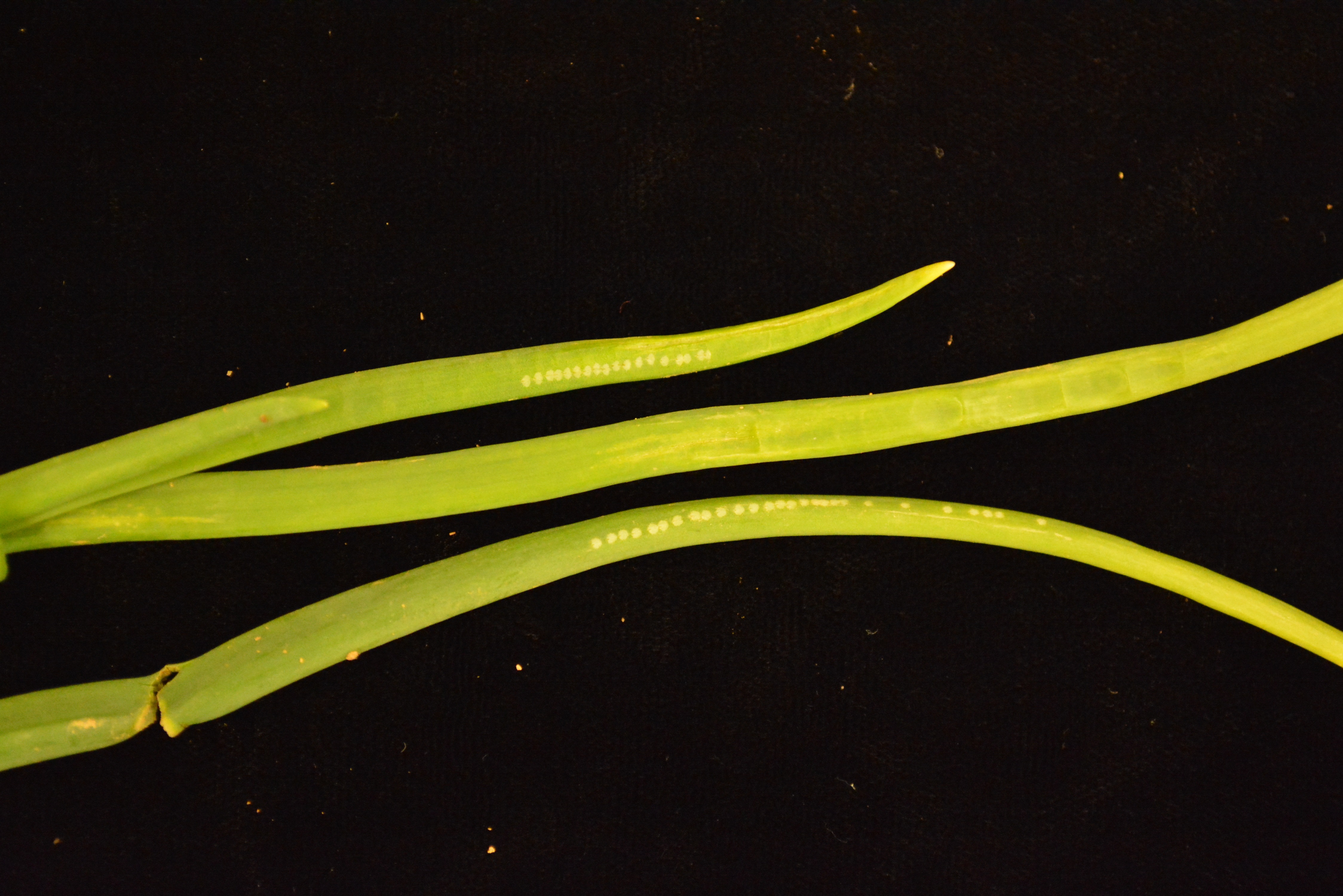
We detected the first Allium Leafminer oviposition scars on garlic in Burlington County, NJ today (see photos below). Adults are likely active throughout the state at this time. Be on the lookout for oviposition scars on both crop alliums and wild alliums such as wild onion/garlic and ramps. You can also use yellow sticky cards to monitor for adult presence in the field.

Allium Leafminer oviposition scars. Notice the neat line of white dots near the tips of the leaves. Photos by Maria Cramer.

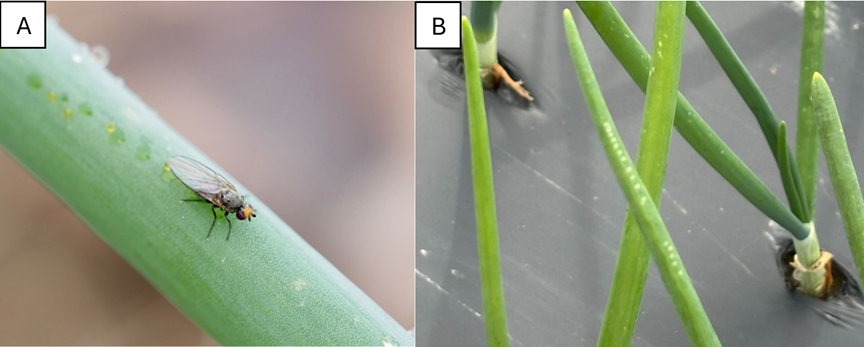
Allium Leafminer (Phytomyza gymnostoma) is a small grey-bodied fly with a yellow head (A). In warm, still weather, you may see adult flies settling on foliage. The females lay eggs in neat rows, leaving behind a line of white dots on the leaves (B). As the larvae hatch and begin to feed, they will tunnel downwards, causing damage to leaves and bulbs. ALM have two generations per year; the first in early spring, and the second occurring in the fall. Crops such as chives, scallions, garlic, onions and leeks are attacked by ALM, but leeks and scallions seem to be the most affected. 
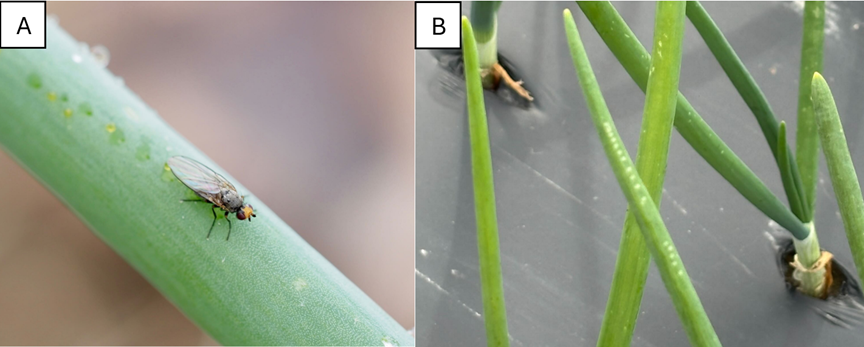
An allium leafminer adult (A) and oviposition scars (B). Photos by Maria Cramer a7l;/nd Amanda Quadrel

If you are concerned about crop injury due to ALM, floating row covers, kept on until the first flight ends (around the end of May) can restrict ALM’s access to vulnerable plants. Reflective mulches may also provide some additional crop protection. Adults and larvae can be targeted through well-timed insecticide sprays. Materials labeled for ALM control include spinosyns (IRAC 5- Radiant or Entrust (OMRI approved)), pyrethroids (IRAC 3A- Mustang Maxx, Proaxis, and Warrior II), neonicotinoids (IRAC 4A- Scorpion, Venom), the insect growth regulator Trigard (IRAC 17), and diamide products (IRAC 28- Exirel, Minecto Pro). The newly registered product Vertento (IRAC 30) may also be used for ALM control. However, growers who have trouble managing onion thrips may want to save group 28 and 30 products for thrips sprays, as both groups have season use limits. The first spray application of a material should be completed 2- 3 weeks after initial detection of ALM (either oviposition scars or the fly itself). Subsequent sprays should be completed in 1–2-week intervals. Two or three sprays should provide adequate control. As always, be sure to follow label rates and application instructions for any pesticide that you plan to use.

For more pictures and detailed information on the biology and management of ALM, Cornell has an excellent fact sheet that can be found here: https://cals.cornell.edu/integrated-pest-management/outreach-education/fact-sheets/allium-leafminer. In the meantime, feel free to reach out to us if you have any questions.

~Amanda Quadrel and Maria Cramer, Senior Program Coordinators- Vegetable IPM

Questions or concerns? Get in touch with us by filling out the form below:

← Back

Thank you for your response. ✨

Allium Leafminer Update 3/20/2026

Greetings from the Veg IPM team, and happy first day of Spring! As we are slowly transitioning into warmer weather, now is a great time to be thinking about Allium Leafminer (ALM), a pest of many bulbous crops such as onions, scallions, chives, and garlic.

Allium Leafminer (Phytomyza gymnostoma) is a small grey-bodied fly with a yellow head (A). In warm, still weather, you may see adult flies settling on foliage. The females lay eggs in neat rows, leaving behind a line of white dots on the leaves (B). As the larvae hatch and begin to feed, they will tunnel downwards, causing damage to leaves and bulbs. ALM have two generations per year; the first in early spring, and the second occurring in the fall. Crops such as chives, scallions, garlic, onions and leeks are attacked by ALM, but leeks, and scallions seem to be the most affected. 

An Allium leafminer adult (A) and the characteristic oviposition scars left behind after females lay eggs (B)

An Allium Leafminer adult (A) and the characteristic oviposition scars left behind after females lay eggs (B). Photos by Maria Cramer and Amanda Quadrel


Be on the lookout for oviposition scars on both crop alliums and wild alliums such as wild onion/garlic and ramps. You can also use yellow sticky cards to monitor for adult presence in the field. However, another way to the predict the first generation’s activity is by using growing degree days (GDDs). The first emergence of ALM adults occurs around 250 GDDs (Base temperature: 39˚F). Below is a table that shows the number of GDDs that have accumulated from January 1st to March 19th (the date this post was written), as well as the number of GDDs predicted to accumulate by March 24th.

Location  GDDS for 3/19 GDDs for 3/24 (forecast)
Northern NJ (Chester) 102 129
Central NJ (Cream Ridge) 162 202
Southern NJ (Upper Deerfield) 187 231


While ALM risk is currently low for northern and central NJ, areas in southern NJ could reach 250 GDDs by the end of next week, thus being at a higher risk for ALM activity. To find out how many GDDs have accumulated in your specific area, the NEWA website: https://newa.cornell.edu/ has a helpful GDD calculator. From the NEWA home screen, select your nearest weather station from the drop down menu or map at the center of the page. Next, scroll down to the “Weather Tools” section on the lower right side of the page, and select “DD Calculator”. Select your start date (1/01/26) and end date (typically the day you check), as well as Degree Day Type (Base 39 F) from the menu at the left of the page.  The site will automatically generate a table of the number of accumulated GDDs for the specified date range and a forecast of predicted GDD accumulations over the next five days.

If you are concerned about crop injury due to ALM, you may want to prepare for control efforts. Floating row covers, kept on until the first flight ends (around the end of May) can restrict ALM’s access to vulnerable plants. Reflective mulches may also provide some additional crop protection. Adults and larvae can be targeted through well-timed insecticide sprays. Materials labeled for ALM control include spinosyns (IRAC 5- Radiant or Entrust (OMRI approved)), pyrethroids (IRAC 3A- Mustang Maxx, Proaxis, and Warrior II), neonicotinoids (IRAC 4A- Scorpion, Venom), the insect growth regulator Trigard (IRAC 17), and diamide products (IRAC 28- Exirel, Minecto Pro). The newly registered product Vertento (IRAC 30) may also be used for ALM control. However, growers who have trouble managing onion thrips may want to save this active ingredient for thrips sprays, as there is a limit of two applications per season. The first spray application of a material should be completed 2- 3 weeks after initial detection of ALM (either oviposition scars or the fly itself). Subsequent sprays should be completed in 1–2-week intervals. Two or three sprays should provide adequate control. As always, be sure to follow label rates and application instructions for any pesticide that you plan to use.

For more pictures and detailed information on the biology and management of ALM, Cornell has an excellent fact sheet that can be found here: https://cals.cornell.edu/integrated-pest-management/outreach-education/fact-sheets/allium-leafminer. In the meantime, we will keep our eyes open for any ALM activity in our respective areas and provide updates in the next coming weeks. We are looking forward to warmer weather and a productive season! 

~Amanda Quadrel and Maria Cramer, Senior Program Coordinators- Vegetable IPM

Questions or concerns? Get in touch with us by filling out the form below:

← Back

Thank you for your response. ✨

Allium Leafminer Update 3/24/2025- First oviposition scars spotted

The first Allium leafminer (ALM) oviposition scars were reported in Cape May this past weekend (38.9588N, 74.9082W), suggesting that adults are active in the southern part of the state. ALM are active around 250 GDDs. If you want to know how many GDDs have accumulated in your area, the NEWA website https://newa.cornell.edu/ has a helpful GDD calculator. From the NEWA home screen, select the nearest weather station from the drop-down menu at the center of the page.  Next, scroll down to “Weather Tools” on the right side of the page and select “DD Calculator.”  Select your start date (1/01/25) and end date, as well as Degree Day Type (39 F) from the menu at the left of the page.  The site will automatically generate the accumulated GDD base 39 F to the last day of your requested sample, and then offer a forecast of accumulated GDD for the next week.

ALM can cause injury to chives, scallions, garlic, onions and leeks, but leeks and scallions seem to be the most effected. Look for neat rows of white spots descending from the upper tips of allium leaves (see photo below). Initial injury often occurs on the tallest leaves. Adults may be seen in warmer conditions at the tips of the leaves- look for small flies with grey-black bodies and yellow heads (see photo below).

If you are concerned about crop injury due to Allium leafminer, you may want to prepare for control efforts. Floating row covers, kept on until the first flight ends (around the end of May) can restrict ALM’s access to vulnerable plants. Adults can be targeted through insecticide sprays. Appropriate materials that are labeled for ALM control include spinosyns (Radiant, Entrust (OMRI approved)), pyrethroids (Mustang Maxx, Warrior), neonicotinoids (Scorpion, Venom), and the insect growth regulator Trigard. The first application should be applied 2- 3 weeks after initial detection of ALM flies (if you see oviposition scars or the fly itself) and subsequent sprays should be completed in 1–2-week intervals. Two or three sprays should provide adequate control.

Field Scouting Guide: Allium Leafminer - Growing Produce

Notice the white oviposition scars and an adult female ALM. Photo: Brian A. Nault, Cornell AgriTech. 

If you have any questions/concerns, feel free to reach out to me at amanda.quadrel@rutgers.edu or 732-742-8441.

Allium Leafminer Update 3/20/2025

Happy first day of Spring! Many parts of New Jersey are close to accumulating 250 growing degree days (GDDs) base 39˚F, which is when the first emergence of Allium leafminer (ALM) adults is predicted to occur. In some areas of New Jersey, 250 GDDs are forecasted to be surpassed as early as this weekend. In Cape May, oviposition scars have already been spotted. If you would like to know how many GDDs have accumulated in your area, the NEWA website https://newa.cornell.edu/ has a helpful GDD calculator. From the NEWA home screen, select the nearest weather station from drop down menu at the center of the page.  Next, scroll down to “Weather Tools” on the right side of the page, and select “DD Calculator”.  Select your start date (1/01/25) and end date, as well as Degree Day Type (39 F) from the menu at the left of the page.  The site will automatically generate the accumulated GDD base 39F to the last day of your requested sample, and then offer a forecast of accumulated GDD for the next week.

ALM can cause injury to chives, scallions, garlic, onions and leeks, but leeks and scallions seem to be the most effected. Look for neat rows of white spots descending from the upper tips of allium leaves (see photo below). Initial injury often occurs on the tallest leaves. Adults may be seen in warmer conditions at the tips of the leaves- look for small flies with grey-black bodies and yellow heads (see photo below).

If you are concerned about crop injury due to Allium leafminer, you may want to prepare for control efforts. Floating row covers, kept on until the first flight ends (around the end of May) can restrict ALM’s access to vulnerable plants. Adults can be targeted through insecticide sprays. Appropriate materials that are labeled for ALM control include spinosyns (Radiant, Entrust (OMRI approved)), pyrethroids (Mustang Maxx, Warrior), neonicotinoids (Scorpion, Venom), and the insect growth regulator Trigard. The first application should be applied 2- 3 weeks after initial detection of ALM flies (if you see oviposition scars or the fly itself) and subsequent sprays should be completed in 1–2-week intervals. Two or three sprays should provide adequate control.

Field Scouting Guide: Allium Leafminer - Growing Produce

Notice the white oviposition scars and an adult female ALM. Photo: Brian A. Nault, Cornell AgriTech. 

If you have any questions/concerns, feel free to reach out to me at amanda.quadrel@rutgers.edu or 732-742-8441.

Allium leaf miner update: 04/29/24

Allium Leaf Miner (ALM)

As of last week, allium leaf miner (ALM) adults were still being captured on sticky cards placed in chive plantings in Mercer and Hunterdon counties, and in a garlic planting in Morris County.  Numbers had declined somewhat from catches the week of 4/15.  There is a possibility that damaging levels of ALM adults remain.  Once we cease to capture adults, another update will follow.

Deceased tree branch

Photo: Sabrina Tirpak. Allium leaf miner oviposition scars on onion

Growers should consider initiating the control method of their choice at this time, if any allium crops are in the field.  Affected crops include chives, scallions, garlic, onions and leeks.  Look for neat rows of white spots descending from the upper tips of allium leaves (see photo at left).  Initial injury often occurs on the tallest leaves.  Under warmer, less breezy conditions, adults may be seen near the tips of leaves (see photo of adult at lower right).  Perennial chive beds are often the first, and most heavily infested alliums of the spring season, so this makes chives an ideal crop to confirm ALM adult activity.

Floating row covers, kept on until this flight ends will help minimize access to plants.  Insecticide applications targeting adults may be helpful as well, although frequency of applications is uncertain.  Spinosyn materials (Radiant, Entrust (OMRI approved)), pyrethroids (Mustang Maxx, Spider on leafWarrior), neonicotinoids (Scorpion, Venom), the diamide Exirel (section 2ee recommendation) and the insect growth regulator Trigard are labeled for miner control.


Allium leaf miner update: 03/25/24

Allium Leaf Miner (ALM)

Many weather stations on the NEWA network except for typical colder sites in northern New Jersey have surpassed 250 growing degree days (GDD) base 39˚F.  39˚F is close to the lower developmental temperature (38.3˚ F) which our colleagues at Penn State recommend for predicting the first emergence of ALM adults.    In recent years, initial feeding/egg laying scars have been detected within a few days of local weather stations recording the 250 GDD threshold.  Growers who feel they may be impacted by this pest should check the accumulated GDD from local weather stations.   Growers in southern counties may reasonably assume there will be ALM activity in their area soon, if not already happening.  To determine GDD from local weather stations, the NEWA website https://newa.cornell.edu/ is very helpful.  From the NEWA home screen, select the nearest weather station from drop down menu at the center of the page.  Next, scroll down to “Weather Tools” on the right side of the page, and select “DD Calculator”.  Select your start date (1/01/24) and end date as well as Degree Day Type (39 F) from the menu at the left of the page.  The site will automatically generate the accumulated GDD base 39F to the last day of your requested sample, and then offer a forecast of accumulated GDD for the next week.   If you should select 1˚C, then the DD accumulation should be 350.

Deceased tree branch

Photo: Sabrina Tirpak. Allium leaf miner oviposition scars on onion

Growers should consider initiating the control method of their choice at this time, if any allium crops are in the field.  Affected crops include chives, scallions, garlic, onions and leeks.  Look for neat rows of white spots descending from the upper tips of allium leaves (see photo at left).  Initial injury often occurs on the tallest leaves.  Under warmer, less breezy conditions, adults may be seen near the tips of leaves (see photo of adult at lower right).  Perennial chive beds are often the first, and most heavily infested alliums of the spring season, so this makes chives an ideal crop to confirm ALM adult activity.

Floating row covers, kept on until this flight ends will help minimize access to plants.  Insecticide applications targeting adults may be helpful as well, although frequency of applications is uncertain.  Spinosyn materials (Radiant, Entrust (OMRI approved)), pyrethroids (Mustang Maxx, Spider on leafWarrior), neonicotinoids (Scorpion, Venom), the diamide Exirel (section 2ee recommendation) and the insect growth regulator Trigard are labeled for miner control.

Adult activity and observations of feeding will be reported on in the IPM Update as they occur.