Search Results for: allium leaf

Veg IPM Update: Week Ending 10/04/17

Note:  Today’s edition is the last regular IPM Update of the season.  We will continue to monitor late season crop pests and will publish updates as necessary.

Sweet Corn
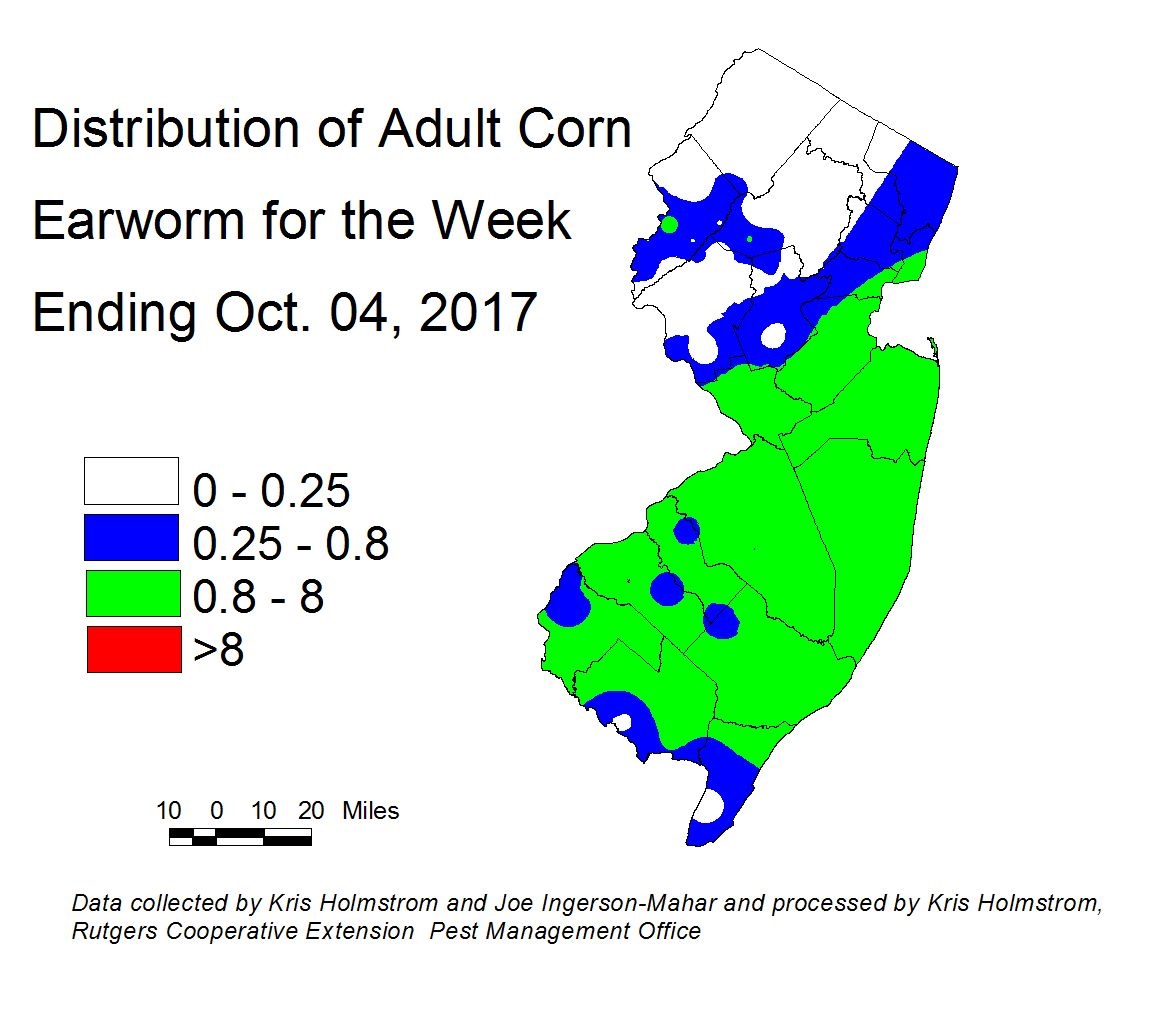
Corn earworm (CEW) moth catches declined dramatically over this past week with evening temperatures dropping into the high 40s in many locations (see CEW blacklight map at left).   In this map, areas in green roughly correspond to a 3-day schedule, while blue areas are in the 4-5 day range.  Blue points within larger green areas should be considered “outliers”, and the broader color scheme in any particular region is more representative of the population. The current situation may change with somewhat warmer night temperatures forecast toward the end of the week.  Should night temperatures begin to approach 60F or more, growers should consider treating remaining silks on a 3-4 rather than a 4-5 day schedule.   Be aware that synthetic pyrethroids have become less effective at managing ear infestations from this pest over the past several years.  For this reason, it is advisable to include products in the IRAC group 28 (Coragen, Besiege) or IRAC group 5 (Radiant, Entrust (OMRI approved)).

The highest nightly CEW blacklight trap catches are as follows:

Georgetown   5 Farmingdale   2 Chester   1
New Egypt   5 Allamuchy   1 Centerton   1
Crosswicks   3 Beckett   1 Eldora   1
Matawan   3 Belvidere   1 Eldora   1

[Read more…]

Veg IPM Update: Week Ending 9/27/17

Sweet Corn
European corn borer (ECB) catches have again fallen to levels too low to register a map image.  This pest is not much of a threat at this point, with most remaining plantings in silk.  ECB feeding in less mature NJ sweet corn plantings is nearly non-existent now.  Sprays for fall armyworm and corn earworm will manage any ECB larvae at this time.  [Read more…]

Veg IPM Update: Week Ending 5/17/17

Sweet Corn

The arrival of warmer temperatures should improve corn growth considerably.  This same weather could bring on the first consistent European corn borer (ECB) catches, although this has not yet happened.  No ECB were captured in blacklight traps this week.  As the population develops, look for maps to be published in the weekly IPM Update.  There were several corn earworm (CEW) captured in blacklights located in New Egypt, Folsom and Woodstown this past week, however these individuals are of little concern in the absence of silking sweet corn.

Cole Crops

IPM personnel continue to observe infestations of crucifer flea beetle.  These beetles can build to high populations quickly, especially where wild mustard and related cruciferous weeds are common.  Extreme feeding on small transplants can cause irreversible damage if not controlled promptly. [Read more…]

Veg IPM Update: Week Ending 5/10/17

Sweet Corn

Cold temperatures are slowing corn growth considerably.  The same weather is also delaying the onset of pests like the European corn borer (ECB).  No ECB were captured in blacklight traps this week.  As the population develops, look for maps to be published in the weekly IPM Update.

Cole Crops

Although cold weather and heavy rains have suppressed them, IPM personnel continue to observe infestations of crucifer flea beetle.  These beetles can build to high populations quickly, especially where wild mustard and related cruciferous weeds are common.  Extreme feeding on small transplants can cause irreversible damage if not controlled promptly. [Read more…]

Veg IPM Update: Week Ending 5/03/17

Sweet Corn

The Vegetable IPM blacklight trap network is nearly complete.  With limited numbers of traps having been checked, only one European corn borer (Allentown, Mercer County) and one corn earworm (Old Bridge, Middlesex County) have been recorded.  As sweet corn is currently in the seedling stage, neither of these catches represent a threat.  As catches become more consistent, maps of the adult populations of these two pests will be published in the weekly IPM Update.

Cole Crops

With warm, sunny days, IPM personnel have discovered a number of heavy infestations of crucifer flea beetle.  These beetles can build to high populations quickly, especially where wild mustard and related cruciferous weeds are common.  Extreme feeding on small transplants can cause irreversible damage if not controlled promptly. [Read more…]

Veg IPM Update: Week Ending 7/06/16

Sweet Corn  16ecb0706a

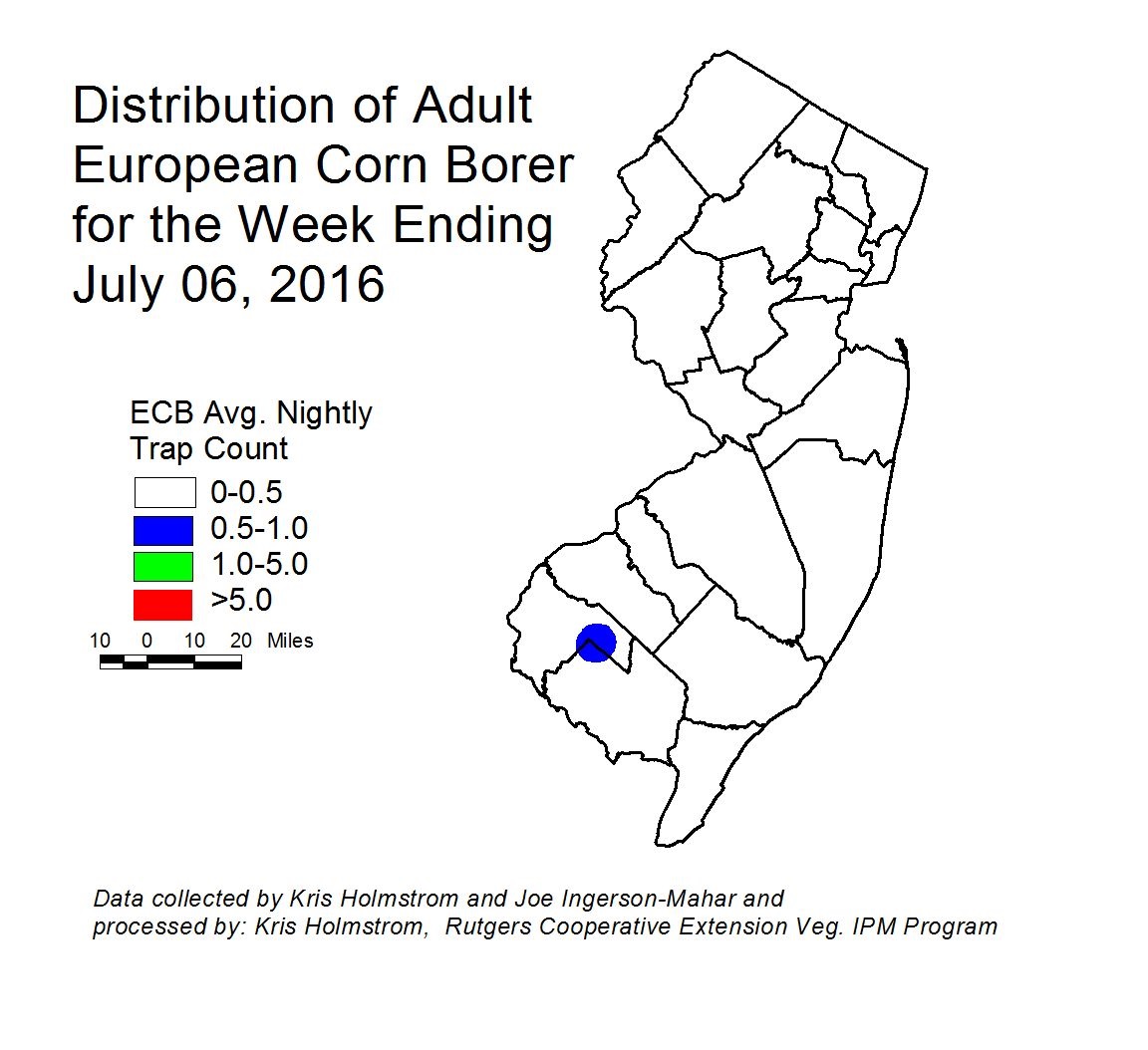
European corn borer (ECB) moth catches remain very low now.  Only scattered individuals are now being captured, and growers are managing residual infestations.  At the present, the highest adult activity is in Salem county, although it is quite low even there (see ECB map).  Larval feeding ranges from single digits to above 20% in areas where IPM personnel are operating.  Be sure to begin monitoring plantings for ECB feeding while they are still in the whorl stage.  Consider treating when the number of infested plants in a 50 plant sample exceeds 12%.  [Read more…]