This week we have detected two cases of resistance-breaking tomato spotted wilt virus (RB-TSWV) in South Jersey. Read further for more information.
While we have been seeing TSWV in susceptible tomato cultivars in South Jersey since early May, this week we detected the first cases of TSWV in varieties with the Sw-5b resistance gene. We detected the virus in one processing tomato variety (HM 58841) and one fresh-market variety (Red Snapper). Plants were selected for testing based on visual symptoms, and we used ELISA tests to confirm the presence of the virus.
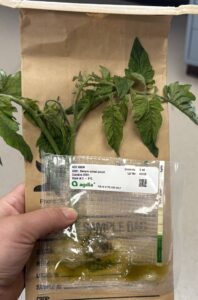
ELISA test for TSWV and the plant being tested. Two lines indicate a positive TSWV test. Picture by Maria Cramer.
TSWV is vectored primarily by Western flower thrips (WFT) (Frankliniella occidentalis), an invasive thrips species from the American Southwest. Both TSWV and WFT have very large host ranges. WFT feeds on many crops including solanaceous, cucurbit, and leafy green hosts, as well as many other plants including ornamentals and weedy hosts. TSWV has a host range of 1,000+ plant species and can be symptomatic (tomatoes and peppers) or asymptomatic/hard to identify (ornamentals and many weed species). The huge number of hosts for both the virus and the vector contribute to management being difficult.
RB-TSWV was first identified in New Jersey in 2022. Results determined that the strain found in New Jersey was similar to the RB-TSWV found in fresh-market tomato from Mexico and processing tomato in California suggesting a high potential for its widespread movement. We also had isolated reports of TSWV in resistant varieties in 2025.
If you think you have TSWV in your resistant varieties, we would like to know. Be on the look out for stunted/yellowed plants that look significantly smaller than adjacent plants (See below). Leaves near growing points will often have purple or brown mottling. Infected plants with ripening fruit may also have brown lesions and deformation of the fruit. Please use the form at the end of this post to report suspected cases to Maria Cramer.
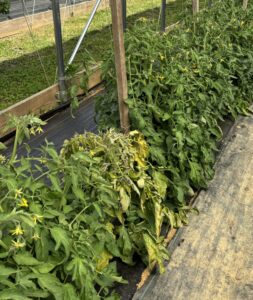
TSWV plant showing stunting and yellowing compared to healthy plants. Picture by Maria Cramer.
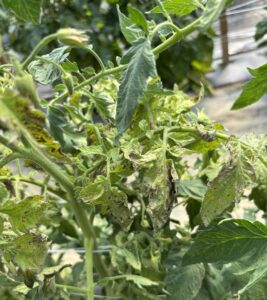
Leaves of plants infected with TSWV will be more curled than wilted. Leaves often have purple or brown mottling. Pictures by Maria Cramer.
For information on managing WFT and TSWV, see the weekly vegetable IPM update. If planting late plantings after finding TSWV, locate plantings as far as possible from infested field.
By: Maria Cramer and Andy Wyenandt
References: Macedo MA, Melgarejo T, Cespedes M, Rojas M, Lazicki P, Turini T, et al. (2024) An allout
assault on a dominant resistance gene: Local emergence, establishment, and spread of strains
of tomato spotted wilt orthotospovirus (TSWV) that overcome Sw-5b-mediated resistance in fresh
market and processing tomatoes in California. PLoS ONE 19(7):e0305402.
Tomato spotted wilt virus on pepper and tomato. Inga Meadows and Andy Cooper, NCSU 2024.
Gautam et al., 2022. First report of a resistance-breaking strain of tomato spotted wilt orthotospovirus
infecting Capsicum annuum with Tsw resistance gene in Texas. Plant Dis.107:1958.



