2018 NJ State Ag Convention Educational Programs Now Online

The 2018 NJ State Ag Convention and Trade Show will be open February 6-8 at the Harrah’s Resort and Waterfront Convention Center in Atlantic City. The final version of the educational program developed by Rutgers NJAES Cooperative Extension faculty and staff in conjunction with the Vegetable Growers Association of NJ and the NJ Dept of Ag has now been posted at  njveggies.org/convention. In addition to the agenda of educational sessions and workshops, you will find links to membership/registration and meal reservation information. As in the past, Tuesday and Wednesday programs are chocked full of concurrent sessions mornings and afternoons, followed by a day of more intensive workshops on Thursday. Please pay special attention to that day’s Food Safety and Fumigation Certification workshops that require separate pre-registration. Instructions are detailed in each of those workshop agendas.

A special added feature of this year’s convention will be a produce buyers discussion panel moderated by NJDA Division of Markets Director Tom Beaver in the Trade Show area at 5pm on Tuesday afternoon.

If you will be attending as a delegate to the policy sessions of the State Board of Agriculture, a separate program and registration materials are available from the NJ Department of Agriculture’s website.

Looking forward to seeing you there!

Vegetable Disease Update – 8/22/17

  • There have been a few reports of late blight in PA this past week. Late blight has not been reported in NJ to date. If you suspect Late blight on your farm please contact your county Extension agent. To track the progress of Late blight in the US please visit USAblight.
  • Cucurbit downy mildew (CDM) on cucumber continues to be reported throughout the region. All cucumber growers should add downy mildew specific products to their regular maintenance programs. CDM has also been reported on giant pumpkin, cantaloupe, and butternut squash in PA and on watermelon in VA and MD to date. To track CDM movement in the US please visit the North Carolina State University’s CDM Forecasting Website.
  • Bacterial canker and bacterial leaf spot in tomato are being reported.
  • Bacterial leaf spot is also being reported in pepper.
  • Pepper anthracnose has been reported in the past week.
  • Cucurbit powdery mildew and anthracnose in cucurbit crops have been reported.

BMSB is Under Attack!

Samurai wasp (Photo by Elijah Talamas)

Many of our fruit and vegetable growers throughout the state have been battling with populations of brown marmorated stink bug. This invasive pest feeds on most fruiting vegetables, small fruits, and tree fruits and can cause significant economic losses. One of the reasons that BMSB is such a bad pest is that when it arrived in the US, it did so without its co-evolved natural enemies. Until now! The Samurai wasp (Trissolcus japonicus) arrived in the US independently and the first populations were found in NJ in 2016 by the Department of Agriculture. However, no populations had been found in agricultural crops, which made us uncertain about its impact.

Last week, a parasitized egg mass was tentatively identified as the Samurai wasp. The Samurai wasp attacks stink bug eggs and has a special appetite for BMSB eggs. A female wasp will lay its eggs into the stink bug eggs. It is an effective parasite of BMSB and can parasitize on average 50% of each egg mass. Our finding was in a commercial peach orchard in southern New Jersey and may be the first finding in a US agricultural crop. We had placed egg masses in the orchard to measure natural enemy impacts of our border spray approach. We do not know the impact the Samurai wasp will have in NJ agriculture but this is a very promising new development in the fight against BMSB. Reduced spray methods, such as border sprays, may help to protect Samurai wasp populations in crops.

Samurai wasp emerging from BMSB egg mass


Drs. Joe Kaser and Clement Akotsen-Mensah contributed to this article.


Spotted Lanterfly

Have you seen this Insect?

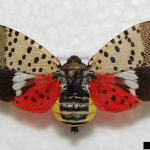
Some people may think it is a moth but it’s really a plant hopper known as the spotted lanternfly, Lycorma deliculata (White) and is a member of the order Hemiptera, family Fulgoridae.

Spotted Lanternfly adult. Adults are about 1″ long

Its normal distribution is in eastern Asia, China, India, and Vietnam and has been found in Japan and South Korea. The adults are large (~1” long) and quite colorful with a black head, grayish black spotted forewings and reddish black spotted hind wings.

Young juveniles are black with white spots and as they get older they become red and black with white spots.

Spotted lanterfly nymph. Nymphs are black with red markings and white dots. Do not confuse them with BMSB nymphs which do not have spots and have white banding on the antennae.

Egg masses are brownish grey and generally laid on bark in early fall and appear like a smudge of mud. Egg masses are 1-1.5” long and ½ – ¾ “ wide and survive the winter.

 This insect was accidentally introduced into Pennsylvania and was confirmed in the state September of 2014. At first it was also found in Berks County, however, today it has been collected from Lehigh, Northampton, Bucks, Montgomery, and Chester County. Cities in these counties where Spotted Lanternfly has been found are currently under quarantine meaning that live Spotted Lanternfly and any material or object that can spread the insect cannot be moved from the quarantine area. Inspection of shipments for egg masses and subsequent removal may be an effective management tool if it becomes established in New Jersey. The Pennsylvania Department of Agriculture has a video series on egg mass scraping.

The spotted lanternfly is known to feed on more than 70 plant species including cultivated grapes, fruit trees, and hardwood trees. One tree of particular importance is Ailatus altissima (P. Mill) or the “Tree of Heaven”.

Tree of Heaven

Tree of Heaven typically grows in sunny areas along highways or disturbed habitat in clumps such as along farm edges. The Spotted Lanternfly must feed on Tree of Heaven to survive. Spotted Lanternfly has a sucking mouthpart and produces significant amounts of excess sugar from the plant sap, known as “honey dew”, during feeding. Honeydew can block sunlight absorption and reduce plant growth. We are concerned about this insect becoming established in New Jersey grape vineyards. In grapes, the honeydew produced during feeding is difficult to wash off and can reduce grape quality and perhaps growth. A 2015 and 2016 of 9 vineyards within southern New Jersey by the fruit entomology lab did not observe any spotted lanternfly adults or nymphs. However, in Pennsylvania, adults and nymphs were found in commercial vineyards in 2016 in Chardonnay, Concord, and Niagara plantings, although populations were low. Vineyard rows neighboring forested edges are at highest risk.

Egg mass


Additional information regarding this insect can be found at:

The Pennsylvania Department of Agriculture

Penn State Extension


If you think you seen or collected a spotted lanternfly please report it the New Jersey Department of Agriculture and the Department of Entomology at the Rutgers University School of Environmental and Biological Sciences by emailing slanternfly@njaes.rutgers.edu. This post was written by Anne L Nielsen and George C. Hamilton from the Department of Entomology.

Ultra-Niche Crop Workshop on High Tunnel Winter Lettuce Production to be Held

Loose leaf lettuce growing in a high tunnel.

Rutgers Cooperative Extension is continuing its Ultra-Niche Crop series in 2017 with the upcoming workshop “High Tunnel Winter Lettuce”.  This workshop, the third class in the Ultra-Niche educational series for farmers seeking new crop opportunities, will take place on Tuesday, January 31, 2017 from 5:30 to 8 p.m.  The workshop will be held simultaneously in Cape May Court House, Bridgewater and Bordentown, New Jersey.

[Read more…]

Sparganothis Fruitworm Degree-Day Update: as of June 27, 2016

As of June 27, Sparganothis has accumulated 968 DD. Based on the DD model, Sparganothis has reached peak flight, and should have started egg laying. Reminder that a single insecticide application, i.e., post-bloom application with Delegate, Altacor, Diazinon, or Intrepid, aimed at Sparganothis larvae will likely have the greatest effect if it is timed for peak egg-hatch/larval-emergence, which is approximately 1,400 DD. I will keep you updated on these predictions as the season progresses.