Basil downy mildew has been confirmed in field grown basil in southern New Jersey. This is the first confirmed report of BDM in the state this growing season. To date, there have been very few reports of BDM in the mid-Atlantic and Northeast regions this growing season. The extremely, hot dry weather these past three to four weeks have not been ideal for its development. However, all basil growers are encouraged to scout their fields or greenhouses on a daily basis and should consider initiating a preventative fungicide program. [Read more…]
Organic Farm Advisory
The Plant & Pest Advisory serves NJ growers by reporting on important pests and recommending responses that are grounded in reproducible trials.
 Articles in this section contain information helpful to the NJ commercial organic grower.
Sharing organic practice trial results between land-grant universities is a cost effective way to create a common knowledge base built on the strengths of individual programs. In the sidebar, find institutions with programs in organic agriculture which augment knowledge developed at the Rutgers New Jersey Ag Experiment Station.
Rutgers Cooperative Extension Field Guides: These concise guides help with decision making from pre-planting to harvest. For each crop listed, learn what pests to proactively look for as the season progresses, how to look for them, and when to take action.
July 28, 2022 Kris Holmstrom and Joe Ingerson-Mahar
Special IPM Update – Fall Armyworm Alert
Sweet Corn – Fall Armyworm
As of Wednesday (7/27) evening, significant fall armyworm (FAW) infestations were found in whorl stage sweet corn in Cape May County. These infestations were nearing 50% of plants infested, and are an indication that all sweet corn growers in southern NJ should be checking fields regularly for signs of FAW feeding. This pest often hits earliest and hardest in coastal areas, and new infestations have been detected up the coast to Monmouth County. Northern infestations have been much lower, and very recent.
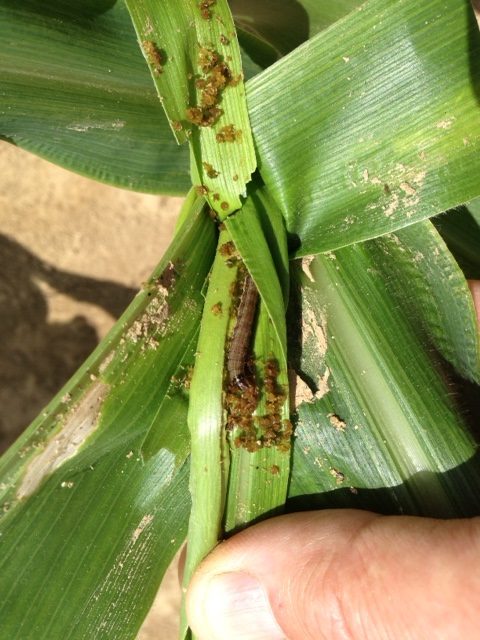 Look for extensive foliar feeding in sweet corn ranging from seedling to pre-tassel stage. FAW create large volumes of droppings that often cover larvae while feeding in the whorl. Untreated infestations can result in severely stunted plants. Consider treating when FAW feeding alone, or in combination with European corn borer exceeds 12%. Insecticides in the IRAC 28 class (diamides) and IRAC 5 class (spinosyns) work well against FAW.
July 27, 2022 Kris Holmstrom and Joe Ingerson-Mahar
Vegetable IPM Update 07/27/22
Sweet Corn
European corn borer (ECB) moth catches continue to be extremely low around the state, although there has been some increase in adults in southern traps. ECB population maps will resume if second flight catches rise to high enough numbers.
The highest nightly trap catches of ECB for the week ending 07/27/22 are as follows:
| Allentown 1 | Jones Island 1 | Oldwick 1 |
| Eldora 1 | Medford 1 | Tabernacle 1 |
| Elm 1 | Milltown 1 | |
| Georgetown 1 | New Egypt 1 |
July 25, 2022 Michelle Infante-Casella
Pesticide Applicators Seminar – Credits Available
Over the past two years in-person trainings for pesticide applicators to obtain recertification credits have been a challenge. To educate licensed pesticide applicators and help them to receive credits, a 3-hour seminar will be held on Tuesday, October 18, 2022 from 9:00AM to 12:00PM at the Rutgers Cooperative Extension office in Gloucester County, 254 County House Rd, Clarksboro, NJ 08020. The meeting will be in the Sullivan Room auditorium. Attendees can enter through the ramp on the far right side of the main building.
Presenter: Michelle Infante-Casella, Agricultural Agent
Schedule:
9:00 AM……………..Pesticide Storage Facilities and Pesticide Disposal
10:00 AM……………Pesticide Record Keeping, Notification, and Posting
10:30 AM……………Insect Identification and Life Cycles for Proper Control Strategies in Landscapes, Turf, and Farm Fields
11:00 AM…………….Weed Identification: Annuals and Perennials: Know Your Weeds in Landscapes, Turf and Farm Fields
11:30 AM…………….Common Plant Diseases of Major Crop/Plant Groups
12:00 PM …………….Pesticide Credits and Adjourn
The following credits have been assigned by NJ DEP:
3 – CORE Credits
3 – PP2 Credits
3 – 3A Credits
3 – 3B Credits
3 – 1A Credits
Call 856-224-8040 ext. 1 or email jmedany@co.gloucester.nj.us to pre-register or for more information.
There is a $50.00 fee per participant. Only checks or cash will be accepted. Please make checks payable to “Rutgers the State Univ. of NJ”
Pre-registration is appreciated, and walk-in participants are welcome and can pay at the door. To find more information see: https://go.rutgers.edu/Oct18PesticideSeminar
July 24, 2022 Joe Ingerson-Mahar
Temporary Seasonal help needed for the Rutgers Vegetable IPM Program
There are still positions available for seasonal, temporary worker(s) for the Rutgers Vegetable IPM program. The work entails checking insect traps and doing some field scouting with farms in southern New Jersey (Burlington, Camden, Gloucester, Atlantic, Cumberland, and Salem counties). There will be on-the-job
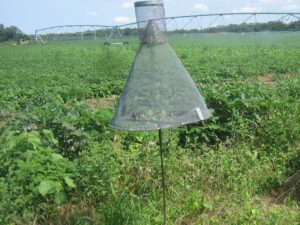
Corn earworm pheromone trap
training. Hourly wages are up to $20/hour, depending upon experience and/or areas of study. Applicants must have vehicles and will be reimbursed for mileage. For more details and to fill out an application, please go to https://jobs.rutgers.edu/postings/158384
July 20, 2022 Kris Holmstrom and Joe Ingerson-Mahar
Vegetable IPM Update 07/20/22
Sweet Corn
European corn borer (ECB) moth catches continue to be extremely low around the state. We are in between adult generations at this time. ECB population maps will resume if second flight catches rise to high enough numbers.
The highest nightly trap catches of ECB for the week ending 07/20/22 are as follows:
| Allentown 1 | Old Bridge 1 |
| Dayton 1 | Sergeantsville 1 |
| Hillsborough 1 | South Branch 1 |
